SmarterEd

Aussie Maths & Science Teachers: Save your time with SmarterEd

  • Login
  • Get Help
  • About

Complex Numbers, EXT2 N2 2025 HSC 6 MC

The complex numbers \(z\) and \(w\) lie on the unit circle. The modulus of  \(z+w\)  is \(\dfrac{3}{2}\).

What is the modulus of  \(z-w\) ?

  1. \(\dfrac{1}{8}\)
  2. \(\dfrac{\sqrt{7}}{2}\)
  3. \(\dfrac{3}{2}\)
  4. \(\dfrac{7}{4}\)
Show Answers Only

\(B\)

Show Worked Solution

\(|z|=|w|=1, \quad \abs{z+w}=\dfrac{3}{2} \ \text{(given)}\)

\(\text{Find}\ \ \abs{z-w}:\)

\(\abs{z+\omega}^2=(z+\omega)(\bar{z}+\bar{\omega})=z \bar{z}+z \bar{\omega}+\omega \bar{z}+\omega \bar{\omega}\)

\(\abs{z-\omega}^2=(z-\omega)(\bar{z}-\bar{\omega})=\bar{z} z-z \bar{\omega}-\omega \bar{z}+\omega \bar{\omega}\)

\(\abs{z+\omega}^2+|z-\omega|^2\) \(=2 z \bar{z}+2 \omega \bar{\omega}=2\abs{z}^2+2\abs{\omega}^2=4\)
\(\dfrac{9}{4}+\abs{z-\omega}^2\) \(=4\)
\(\abs{z-w}^2\) \(=\dfrac{7}{4}\)
\(\abs{z-\omega}\) \(=\dfrac{\sqrt{7}}{2}\)

 
\(\Rightarrow B\)

Mean mark 56%.

Filed Under: Geometric Representations, Geometrical Implications of Complex Numbers Tagged With: Band 5, smc-1052-60-Other problems, smc-7428-50-Modulus Identities

Complex Numbers, EXT2 N2 2024 HSC 7 MC

It is given that \(\abs{z-1+i}=2\).

What is the maximum possible value of \(\abs{z}\)?

  1. \(\sqrt{2}\)
  2. \(\sqrt{10}\)
  3. \(2+\sqrt{2}\)
  4. \(2-\sqrt{2}\)
Show Answers Only

\(C\)

Show Worked Solution

\(\abs{z-1+i}=2 \ \Rightarrow \ \text{circle centre} \ \ (1,-i), \ \ \text {radius}=2\)
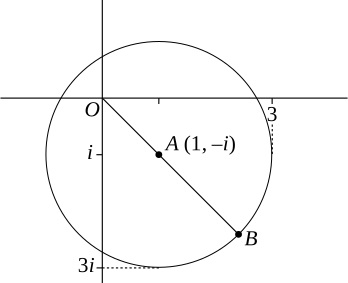


\(OA=\sqrt{1^2+1^2}=\sqrt{2}\)

\(AB=2 \ \ \text{(radius)}\)

\(\therefore \abs{z}_{\text{max}}=2+\sqrt{2}\)

\(\Rightarrow C\)

Filed Under: Geometrical Implications of Complex Numbers, Lines, Curves and Regions Tagged With: Band 3, smc-1052-60-Other problems, smc-7431-50-Circles, smc-7431-70-Max/Min Modulus

Complex Numbers, EXT2 N2 2023 14a

Let \(z\) be the complex number  \(z=e^{\small{\dfrac{i \pi}{6}}} \)  and \(w\) be the complex number  \(w=e^{\small{\dfrac{3 i \pi}{4}}} \).

  1. By first writing \(z\) and \(w\) in Cartesian form, or otherwise, show that
  2.    \(|z+w|^2=\dfrac{4-\sqrt{6}+\sqrt{2}}{2}\).   (3 marks)

    --- 6 WORK AREA LINES (style=lined) ---

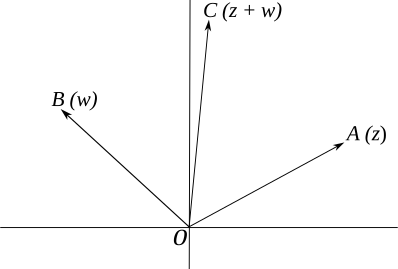
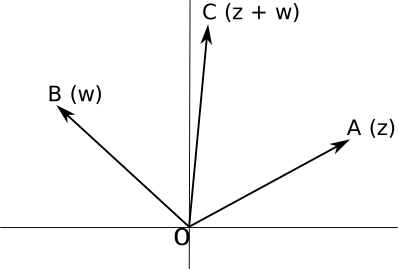
  3. The complex numbers \(z, w\) and \(z+w\) are represented in the complex plane by the vectors \(\overrightarrow{O A},\overrightarrow{O B}\) and \(\overrightarrow{O C}\) respectively, where \(O\) is the origin.
  4. Show that  \(\angle A O C=\dfrac{7 \pi}{24}\).   (2 marks)

    --- 8 WORK AREA LINES (style=lined) ---

  5. Deduce that  \(\cos \dfrac{7 \pi}{24}=\dfrac{\sqrt{8-2 \sqrt{6}+2 \sqrt{2}}}{4}\).   (1 mark)

    --- 5 WORK AREA LINES (style=lined) ---

Show Answers Only

i.    \(\text{See Worked Solutions}\)

ii.   \(\text{See Worked Solutions}\)

iii.  \(\text{See Worked Solutions}\)

Show Worked Solution

i.    \(z=e^{\small\dfrac{i \pi}{6}} = \cos\,\dfrac{\pi}{6} + i \,\sin\,\dfrac{\pi}{6} = \dfrac{\sqrt3}{2} + \dfrac{1}{2}i \)

\(w=e^{\small\dfrac{3i \pi}{4}} = \cos\,\dfrac{3\pi}{4} + i \,\sin\,\dfrac{3\pi}{4} = -\dfrac{1}{\sqrt2} + \dfrac{i}{\sqrt2} \)

\(|z+w|^2\) \(=\Bigg{|} \dfrac{\sqrt3}{2}+\dfrac{1}{2}i-\dfrac{1}{\sqrt2}+\dfrac{i}{\sqrt2} \Bigg{|}\)  
  \(=\Bigg{|} \Bigg{(}\dfrac{\sqrt3}{2}-\dfrac{1}{\sqrt2} \Bigg{)} +\Bigg{(}\dfrac{1}{2}+\dfrac{1}{\sqrt2}\Bigg{)}\,i \Bigg{|}\)  
  \(=\Bigg{|} \dfrac{\sqrt6-2}{2\sqrt2}+\dfrac{\sqrt2+2}{2\sqrt2}\,i \Bigg{|}\)  
  \(= \dfrac{(\sqrt6-2)^2+(\sqrt2+2)^2}{(2\sqrt2)^2}\)  
  \(= \dfrac{6-4\sqrt6+4+2+4\sqrt2+4}{8}\)  
  \(=\dfrac{16-4\sqrt6+4\sqrt2}{8} \)  
  \(=\dfrac{4-\sqrt6+\sqrt2}{2} \)  
 
ii.   

\(\angle AOB= \arg(w)-\arg(z)=\dfrac{3\pi}{4}-\dfrac{\pi}{6}=\dfrac{7\pi}{12} \)

\( |z|=|w|=1\ \Rightarrow AOBC\ \text{is a rhombus.} \)

\(\overrightarrow{OC}\ \text{is a diagonal of rhombus}\ AOBC \)

\(\Rightarrow \overrightarrow{OC}\ \text{bisects}\ \angle AOB \)

\(\therefore \angle AOC= \dfrac{1}{2} \times \dfrac{7\pi}{12}=\dfrac{7\pi}{24} \)
  

iii.   \(\text{In}\ \triangle AOC: \)

\( \overrightarrow{AC}=\overrightarrow{OC}-\overrightarrow{OA} = \overrightarrow{OB} \)

\(\Rightarrow \overrightarrow{OB}\ \text{is represented by}\ w. \)
 

\(\text{Using the cos rule in}\ \triangle AOC: \)

\(\cos\,\dfrac{7\pi}{24}\) \(=\dfrac{|z|^2+|z+w|^2-|w|^2}{2|z||z+w|}\)  
  \(=\dfrac{ 1+\frac{4-\sqrt6+\sqrt2}{2}-1}{2 \times 1  \sqrt{\frac{4-\sqrt6+\sqrt2}{2}}} \)  
  \(=\dfrac{\sqrt{\frac{4-\sqrt6+\sqrt2}{2}} \times 2} {2 \times 2} \)  
  \(=\dfrac{\sqrt{4( \frac{4-\sqrt6+\sqrt2}{2})}} {4} \)  
  \(=\dfrac{8-2\sqrt6+2\sqrt2}{4} \)  
♦♦ Mean mark (iii) 26%.

Filed Under: Geometrical Implications of Complex Numbers Tagged With: Band 3, Band 4, Band 5, smc-1052-60-Other problems, smc-1052-70-Vectors

Complex Numbers, EXT2 N2 EQ-Bank 23

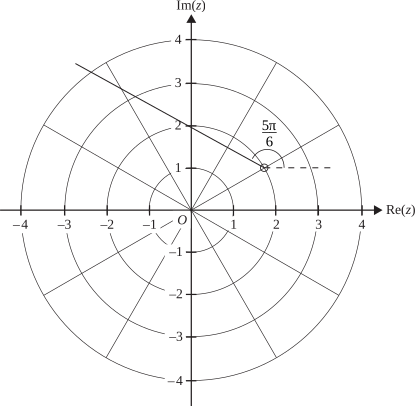
Consider the point on the complex plane  `z_1 = sqrt3 + 1`.

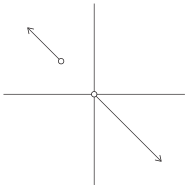
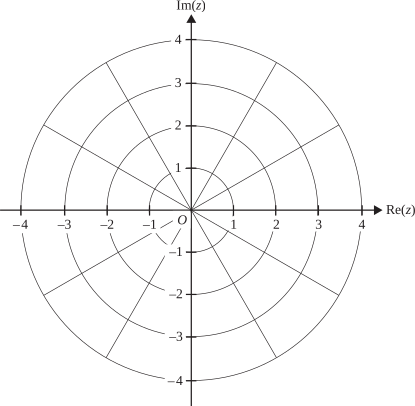
Sketch the ray given by  `text(Arg)(z-z_1) = (5pi)/6`  on the Argand diagram below.   (2 marks)


--- 0 WORK AREA LINES (style=lined) ---
Show Answers Only


  1.  
Show Worked Solution

Filed Under: Geometrical Implications of Complex Numbers, Lines, Curves and Regions Tagged With: Band 4, smc-1052-60-Other problems, smc-7431-30-Rays

Complex Numbers, EXT2 N2 2021 SPEC2 5

The graph of the circle given by  `|z-2-sqrt3i| = 1`, where  `z ∈ C`, is shown below.
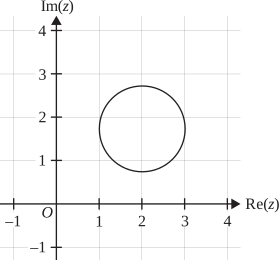
 

For points on this circle, find the maximum value of  `|z|`.   (2 marks)

--- 6 WORK AREA LINES (style=lined) ---
Show Answers Only

`sqrt7+1`

Show Worked Solution

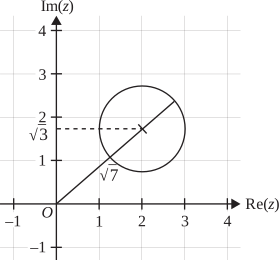
`text(Centre of circle at)\ (2, sqrt3)`

`text(Radius = 1)`

`text(By Pythagoras, line from origin to the centre of the circle)`

`d = sqrt(2^2 + sqrt(3)^2) = sqrt7`

`:. |z|_text(max) = sqrt7 + 1`

Filed Under: Geometrical Implications of Complex Numbers, Lines, Curves and Regions Tagged With: Band 4, smc-1052-60-Other problems, smc-7431-50-Circles, smc-7431-70-Max/Min Modulus

Complex Numbers, EXT2 N2 2021 HSC 10 MC

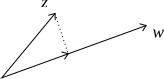
Consider the two non-zero complex numbers `z` and `w` as vectors.

Which of the following expressions is the projection of `z` onto `w` ? 
  1.  `{text{Re} (zw)}/{|w|} w`
  2.  `|z/w| w`
  3.  `text{Re} (z/w) w`
  4. `{text{Re}(z)}/{|w|} w`
Show Answers Only

`C`

Show Worked Solution

`text{Let} \ \ z = a + i b \ \ =>\ underset~z = ((a),(b))`

♦♦♦ Mean mark 30%.

`text{Let} \ \ w = c + i d \ \ =>\ underset~w = ((c),(d))`

`underset~z * underset~w = ac + bd`

`|underset~w|^2 = c^2 + d^2`

`text{proj}_(underset~w) underset~z = (underset~z*underset~w)/|underset~w|^2 *underset~w= (ac+bd)/(c^2+d^2)*underset~w`

`z/w` `=(a+ib)/(c+id) xx (c-id)/(c-id)`  
  `=(ac+bd + i(bc-ad))/(c^2+d^2)`  

 
`text{Re}(z/w) =(ac+bd)/(c^2+d^2)`

`:.\ text{proj}_(underset~w) underset~z = text{Re} (z/w) w`
 

`=> C`

Filed Under: Basic Concepts and Arithmetic, Geometrical Implications of Complex Numbers, Powers and Roots Tagged With: Band 6, smc-1052-60-Other problems, smc-1195-40-Unit Vectors and Projections, smc-1195-50-Complex numbers, smc-7430-70-Vectors

Complex Numbers, EXT2 N2 2020 SPEC2 2

Two complex numbers, `u` and `v`, are defined as  `u = −2-i`  and  `v = −4-3i`.

  1. Express the relation  `|z-u| = |z-v|`  in the cartesian form  `y = mx + c`, where  `m, c ∈ R`.   (3 marks)

    --- 5 WORK AREA LINES (style=lined) ---
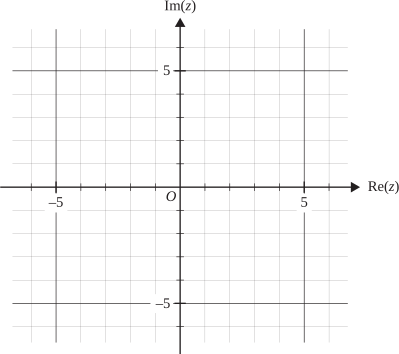
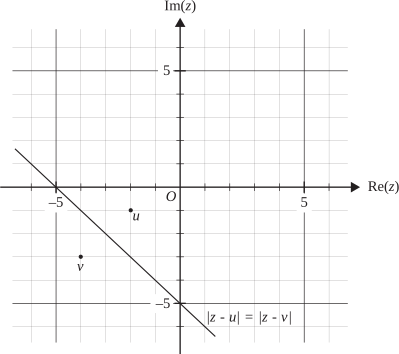
  2. Plot the points that represent `u` and `v` and the relation `|z-u| = |z-v|` on the Argand diagram below.   (2 marks)


  3. State a geometrical interpretation of the graph of  `|z-u| = |z-v|`  in relation to the points that represent `u` and `v`.   (1 mark)

    --- 2 WORK AREA LINES (style=lined) ---

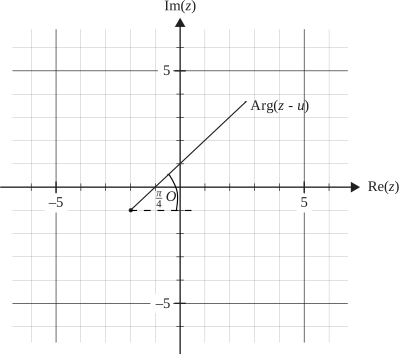
  4.  Sketch the ray given by  `text(Arg)(z-u) = pi/4`  on the Argand diagram in part b.   (1 mark)

    --- 10 WORK AREA LINES (style=lined) ---

  5. In Cartesian form, write down the function that describes the ray  `text(Arg)(z-u) = pi/4`.   (1 mark)

    --- 2 WORK AREA LINES (style=lined) ---

Show Answers Only

a.    `y = −x-5`

b.    
       

c.   `|z-u| = |z-v|\ text(is the graph of the perpendicular bisector of the)`

`text(line joining)\ u and v.`

d.    
       

e.    `f: (−2, ∞) ->, f(x) = x + 1`

Show Worked Solution

a.   `text(Let)\ \ z = x + iy`

`z-u = x + 2 + iy + i`

`z-v = x + 4 + iy + 3i`

`|z-u| = |z-v|`

`(x + 2)^2 + (y + 1)^2` `= (x + 4)^2 + (y + 3)^2`
`x^2 + 4x + 4 + y^2 + 2y + 1` `= x^2 + 8x + 16 + y^2 + 6y + 9`
`-4y` `= 4x + 20`
`y` `= −x-5`


b.   


c.   `|z-u| = |z-v|\ text(is the graph of the perpendicular bisector of the)`

`text(line joining)\ u and v.`


d.   


e.    `text(Arg)(z-u) = pi/4 =>\ text(gradient) = 1, ytext(-intercept at)\ (0, 1)`

`:. f: (−2, ∞) -> RR, \ f(x) = x + 1`

Filed Under: Geometrical Implications of Complex Numbers, Lines, Curves and Regions Tagged With: Band 4, Band 5, smc-1052-60-Other problems, smc-7431-20-Perp Bisector, smc-7431-30-Rays

Complex Numbers, EXT2 N2 2018 HSC 7 MC

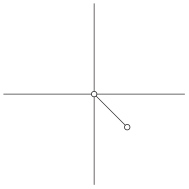
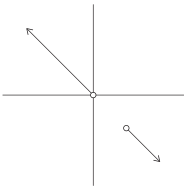
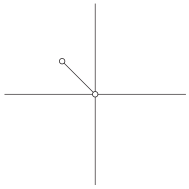
Which diagram best represents the solutions to the equation  `text(arg)(z) = text(arg)(z + 1-i)`?

A. B.
C. D.
Show Answers Only

`D`

Show Worked Solution
`text(arg)(z)` `= text(arg)(z + 1-i)`
  `=text(arg)(z-(−1 + i))`

 
`=>\ text(arg)(z-(−1 + i))\ \ text(is the argument of)\ z\ text(from)\ (-1+i).`

 
`text(Plot)\ (-1 + i)\ text(on the argand diagram and then test different)`

`text(positions of)\ z\ text(along the solutions for each option.)`

`=>D`

Filed Under: Geometrical Implications of Complex Numbers, Geometry and Complex Numbers (vectors), Lines, Curves and Regions Tagged With: Band 4, smc-1052-60-Other problems, smc-7431-30-Rays

Complex Numbers, EXT2 N2 2007 HSC 2c

The point  `P`  on the Argand diagram represents the complex number `z`, where  `z`  satisfies

    `1/z + 1/bar z = 1.`

Give a geometrical description of the locus of `P` as `z` varies.   (3 marks)

--- 6 WORK AREA LINES (style=lined) ---

Show Answers Only

`text(Locus is a circle, centre)\ (1, 0), text(radius 1,)`

`text(excluding the point)\ (0, 0).`

Show Worked Solution
`1/z + 1/bar z` `=1/(x + iy) +1/(x-iy)`
  `=(x-iy + x+iy)/(x^2+y^2)`
  `=(2x)/(x^2+y^2)`


`(2x)/(x^2+y^2)` `=1`
`x^2 + y^2` `=2x`
`x^2-2x + 1 + y^2` `=1`
`(x-1)^2 + y^2` `=1`


`:.\ text(Locus is a circle, centre)\ (1, 0), text(radius 1,)`

`text(excluding the point)\ (0, 0).`

Filed Under: Curves and Regions, Geometrical Implications of Complex Numbers, Lines, Curves and Regions Tagged With: Band 4, smc-1052-60-Other problems, smc-7431-50-Circles

Complex Numbers, EXT2 N2 2015 HSC 9 MC

The complex number `z` satisfies  `| z-1 | = 1.`

What is the greatest distance that `z` can be from the point `i` on the Argand diagram?

  1. `1`
  2. `sqrt 5`
  3. `2 sqrt 2`
  4. `sqrt 2 + 1`
Show Answers Only

`D`

Show Worked Solution

HSC 2015 9MC

`| z-1 | = 1\ \ text{is a circle, centre (1,0), radius 1.}`

`text(Consider the graph:)`

`text(Distance from)\ \(0, i)\ \ text(to the centre)=sqrt2`

`:.\ text(Greatest distance)=sqrt2 + text(radius)=sqrt2+1`

`=>  D`

Filed Under: Geometrical Implications of Complex Numbers, Geometry and Complex Numbers (vectors), Lines, Curves and Regions Tagged With: Band 4, smc-1052-60-Other problems, smc-7431-50-Circles, smc-7431-70-Max/Min Modulus

Complex Numbers, EXT2 N2 2011 HSC 4a

Let `a` and `b` be real numbers with  `a != b`. Let  `z = x + iy`  be a complex number such that

    `|\ z-a\ |^2-|\ z-b\ |^2 = 1.` 

  1. Prove that  `x = (a + b)/2 + 1/(2 (b-a)).`   (2 marks)

    --- 6 WORK AREA LINES (style=lined) ---

  2. Hence, describe the locus of all complex numbers  `z`  such that  
  3.     `|\ z-a\ |^2-|\ z-b\ |^2 = 1.`   (1 mark)

    --- 2 WORK AREA LINES (style=lined) ---
Show Answers Only

a.    `text(Proof)\ \ text{(See Worked Solutions)`

b.    `x = (a + b)/2 + 1/(2(b-a))`

Show Worked Solution
a.     `|\ z-a\ |^2-|\ z-b\ |^2` `= 1`
  `|\ (x-a)+iy\ |^2-|\ (x-b)+iy\ |^2` `=1`
  `(x-a)^2 + y^2-((x-b)^2 + y^2)` `=1`
  `(x-a)^2-(x-b)^2` `=1`
  `(x-a-(x-b)) (x-a + x-b)` `=1`
  `(b-a) (2x-a-b)` `=1`
`2x-a-b` `= 1/(b-a)`
`2x` `= a + b + 1/(b-a)`
`:. x` `= (a + b)/2 + 1/(2(b-a))`


♦ Mean mark part (ii) 44%.

b.    `text(The locus is the vertical line:)`

`x = (a + b)/2 + 1/(2(b-a)).`

Filed Under: Geometrical Implications of Complex Numbers, Geometry and Complex Numbers (vectors), Lines, Curves and Regions Tagged With: Band 4, Band 5, smc-1052-60-Other problems, smc-7431-10-Lines

Copyright © 2014–2026 SmarterEd.com.au · Log in