SmarterEd

Aussie Maths & Science Teachers: Save your time with SmarterEd

  • Login
  • Get Help
  • About

Calculus, EXT2 C1 2022 HSC 14b

Let  `J_(n)=int_(0)^(1)x^(n)e^(-x)\ dx`, where "n" is a non-negative integer.

  1. Show that  `J_(0)=1-(1)/(e)`.  (1  mark)

    --- 2 WORK AREA LINES (style=lined) ---

  2. Show that  `J_(n) <= (1)/(n+1)`.  (2 marks)

    --- 3 WORK AREA LINES (style=lined) ---

  3. Show that  `J_(n)=nJ_(n-1)-(1)/(e)`.  (2 marks)

    --- 4 WORK AREA LINES (style=lined) ---

  4. Using parts (i) and (iii), show by mathematical induction, or otherwise, that for all `n >= 1`,
  5.        `J_(n)=n!-(n!)/(e)sum_(r=0)^(n)(1)/(r!)`    (2 marks)

    --- 6 WORK AREA LINES (style=lined) ---

  6. Using parts (ii) and (iv) prove that  `e=lim_(n rarr oo)sum_(r=0)^(n)(1)/(r!)`.  (1  mark)

    --- 5 WORK AREA LINES (style=lined) ---
Show Answers Only
  1. `text{Proof (See Worked Solutions)}`
  2. `text{Proof (See Worked Solutions)}`
  3. `text{Proof (See Worked Solutions)}`
  4. `text{Proof (See Worked Solutions)}`
  5. `text{Proof (See Worked Solutions)}`
Show Worked Solution
i.    `J_0` `=int_0^1 e^(-x)\ dx`
    `=[-e^(-x)]_0^1`
    `=-e^(-1)+1`
    `=1-1/e`


Mean mark (i) 93%.

ii.  `text{Show}\ \ J_n<=1/(n+1)`

`text{Note:}\ e^(-x)<1\ \ text{for}\ \ x in [0,1]`

`J_n` `=int_0^1 x^n e^(-x)\ dx`  
  `leq int_0^1 x^n \ dx`  
  `leq 1/(n+1)[x^(n+1)]_0^1`  
  `leq 1/(n+1)(1^(n+1)-0)`  
  `leq 1/(n+1)\ \ text{… as required}`  


♦♦ Mean mark (ii) 28%.
 

iii.  `text{Show}\ \ J_n=nJ_(n-1)-1/e`

`u` `=x^n` `v′` `=e^(-x)`
`u′` `=nx^(n-1)` `v` `=-e^(-x)`
`J_n` `=[-x^n * e^(-x)]_0^1-int_0^1 nx^(n-1)*-e^(-x)\ dx`  
  `=(-1^n * e^(-1)+0^n e^0)+nint_0^1 x^(n-1)*e^(-x)\ dx`  
  `=nJ_(n-1)-1/e`  

 
iv.
   `text{Prove}\ \ J_(n)=n!-(n!)/(e)sum_(r=0)^(n)(1)/(r!)\ \ text{for}\ \ n >= 0`

`text{If}\ \ n=0:`

`text{LHS} = 1-1/e\ \ text{(see part (i))}`

`text{RHS} = 0!-0!/e (1/(0!)) = 1-1/e(1)=\ text{LHS}`

`:.\ text{True for}\ \ n=0.`
 

`text{Assume true for}\ \ n=k:`

`J_(k)=k!-(k!)/(e)sum_(r=0)^(k)(1)/(r!)`


♦ Mean mark (iv) 50%.

`text{Prove true for}\ \ n=k+1:`

`text{i.e.}\ \ J_(k+1)=(k+1)!-((k+1!))/(e)sum_(r=0)^(k+1)(1)/(r!)`

`J_(k+1)` `=(k+1)J_k-1/e\ \ text{(using part (iii))}`  
  `=(k+1)(k!-(k!)/(e)sum_(r=0)^(k)(1)/(r!))-1/e`  
  `=(k+1)!-((k+1)!)/(e)sum_(r=0)^(k)(1)/(r!)-1/e xx ((k+1)!)/((k+1)!)`  
  `=(k+1)!-((k+1)!)/e(\ sum_(\ r=0)^(k)(1)/(r!)+1/((k+1)!))`  
  `=(k+1)!-((k+1)!)/e(\ sum_(\ r=0)^(k+1)(1)/(r!))`  

 
`=>\ text{True for}\ \ n=k+1`

`:.\ text{S}text{ince true for}\ n=1,\ text{by PMI, true for integers}\ n>=1`
 

v.   `0<=J_n<= 1/(n+1)\ \ \ text{(part (ii))}`

`lim_(n->oo) 1/(n+1)=0\ \ => \ lim_(n->oo) J_n=0`

  
`text{Using part (iv):}`

`J_n/(n!)` `=1-1/e sum_(r=0)^(n)(1)/(r!)`  
`1/e sum_(r=0)^(n)(1)/(r!)` `=1-J_n/(n!)`  
`sum_(r=0)^(n)(1)/(r!)` `=e-(eJ_n)/(n!)`  
`lim_(n->oo)(\ sum_(\ r=0)^(n)(1)/(r!))`  `=lim_(n->oo)(e-(eJ_n)/(n!))`  
  `=e-0`  
  `=e`  

♦♦ Mean mark (v) 34%.

Filed Under: Induction, P2 Induction (Ext2), Recurrence Relations Tagged With: Band 2, Band 3, Band 5, smc-1044-60-Recursive, smc-1044-68-Sigma Notation, smc-1054-30-Logs/Exp, smc-5115-60-Recursive, smc-5115-68-Sigma notation

Calculus, EXT2 C1 2021 HSC 13c

  1. The integral  `I_n`  is defined by  `I_n = int_1^e (ln x)^n\ dx`  for integers  `n >= 0`.
    Show that  `I_n = e - nI_(n - 1)`  for   `n >= 1`.  (2 marks)

    --- 6 WORK AREA LINES (style=lined) ---

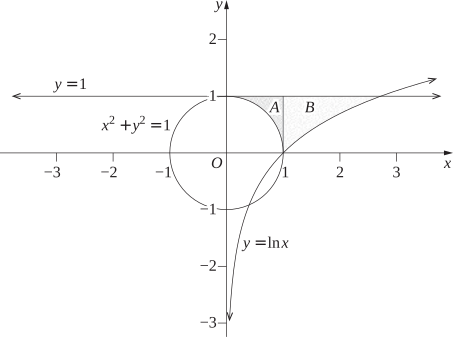
  2. The diagram shows two regions.

Region `A` is bounded by  `y = 1`  and  `x^2 + y^2 = 1`  between  `x = 0`  and  `x = 1`.

Region `B` is bounded by  `y = 1`  and  `y = ln x`  between  `x = 1`  and  `x = e`.


The volume of the solid created when the region between the curve  `y = f(x)`  and the  `x`-axis, between  `x = a`  and  `x = b`, is rotated about the `x`-axis is given by  `V = pi int_a^b [f(x)]^2\ dx`.

The volume of the solid of revolution formed when region `A` is rotated about the `x`-axis is `V_A`.

The volume of the solid of revolution formed when region `B` is rotated about the `x`-axis is `V_B`.

Using part (i), or otherwise, show that the ratio  `V_A : V_B` is `1:3`.  (4 marks)

--- 8 WORK AREA LINES (style=lined) ---

Show Answers Only
  1. `text(See Worked Solutions)`
  2. `text(See Worked Solutions)`
Show Worked Solution

i.   `I_n = int_1^e (ln x)^n\ dx\ \ text(for)\ \ n >= 0`

`text(Show)\ \ I_n = e – nI_(n – 1)\ \ text(for)\ \ n >= 1`

`text(Integrating by parts:)`

`u` `= (ln x)^n` `u′` `= n/x (ln x)^(n – 1)`
`v` `= x` `v′` `= 1`
`I_n` `= [x(ln x)^n]_1^e – n int(ln x)^(n – 1)\ dx`
  `=[e(lne)^n-1(ln1)^n]- n I_(n – 1)`
  `= e – n I_(n – 1)`


ii.    `V_A` `=\ text(cylinder volume – hemisphere volume)`
    `= pi int_0^1 1\ dx – 1/2 xx 4/3 xx pir^3`
    `= pi [x]_0^1 – (2pi)/3`
    `= pi(1 – 0) – (2pi)/3`
    `= pi/3`


`V_B` `= pi int_1^e 1\ dx – pi int_1^e (ln x)^2\ dx`
  `= pi [x]_1^e – pi I_2`
  `= pi(e – 1) – pi(e – 2I_1)`
  `= pi(e – 1) – pi[e – 2(e – I_0)]`
  `= pi(e – 1) – pi(2I_0 – e)`
  `= pi(e – 1) – pi[2(e – 1) – e]`
  `= pi(e – 1) – pi(e – 2)`
  `= pie – pi – pie + 2pi`
  `= pi`
`:. V_A : V_B` `= pi/3 : pi`
  `= 1 : 3`

Filed Under: Recurrence Relations Tagged With: Band 3, Band 4, smc-1054-30-Logs/Exp, smc-1054-60-Recurrence and SOR

Calculus, EXT2 C1 2009 HSC 5b

For each integer  `n >= 0`, let

`I_n = int_0^1 x^(2n + 1) e^(x^2)\ dx.`

  1. Show that for  `n >= 1,`
     
    `I_n = e/2 - nI_(n-1).`  (2 marks)

    --- 6 WORK AREA LINES (style=lined) ---

  2. Hence, or otherwise, calculate  `I_2.`  (2 marks)

    --- 6 WORK AREA LINES (style=lined) ---

Show Answers Only
  1. `text(Proof)\ \ text{(See Worked Solutions)}`
  2. `(e – 2)/2`
Show Worked Solution

i.   `text(Integrating by parts:)`

`u` `=x^(2n),` `u′` `=2nx^(2n-1)`
`v′` `=xe^(x^2),` `v` `=1/2 e^(x^2)`
`:.I_n` `= int_0^1 x^(2n + 1) e^(x^2)\ dx`
  `= int_0^1 x^(2n) x e^(x^2)\ dx`
  `= [(x^(2n) e^(x^2))/2]_0^1 – int_0^1 (2n x^(2n) e^(x^2))/2 \ dx`
  `= e/2 – n int_0^1 x^(2n) e^(x^2)\ dx`
  `= e/2 – nI_(n-1)`


ii.   `I_2 = e/2 – 2I_1`

`I_1 = e/2 – I_0`

`I_0` `= int_0^1 xe^(x^2)\ dx`
  `= [(e^(x^2))/2]_0^1`
  `= (e-1)/2`
`I_1` `= e/2 – (e – 1)/2=1/2`
`:.I_2` `= e/2 – 2 xx 1/2`
  `= (e – 2)/2`

Filed Under: Integration By Parts, Recurrence Relations, Recurrence Relations Tagged With: Band 4, Band 5, smc-1054-30-Logs/Exp

Calculus, EXT2 C1 2012 HSC 12c

For every integer  `n ≥ 0`  let  `I_n = int_1^(e^2)(log_e x)^n\ dx`.

Show that for  `n ≥ 1,`
 
     `I_n = e^2 2^n − nI_(n − 1)`.  (3 marks)

--- 6 WORK AREA LINES (style=lined) ---

Show Answers Only

`text{Proof (See Worked Solutions)}`

Show Worked Solution

`I_n = int_1^(e^2)(log_e x)^n\ dx`

`u` `= (log_e x)^n,` `v′` `= 1`
`u′` `= n (log_e x)^(n − 1) xx 1/x` `v` `= x`
`I_n` `=int_1^(e^2) 1*(ln x)^n\ dx`
  `= [x (log_e x)^n]_1^(e^2) − int_1^(e^2)n/x(log_e x)^(n − 1) xx x\ dx`
  `= [e^2(log_e e^2)^n − 1*ln\ 1] − n int_1^(e^2)(log_e x)^(n − 1)\ dx`
  `= [e^2(2 log_ee)^n-0 ]− nI_(n − 1)`
 
`= e^2 2^n − nI_(n − 1)`

Filed Under: Integration By Parts, Recurrence Relations, Recurrence Relations Tagged With: Band 3, smc-1054-30-Logs/Exp

Copyright © 2014–2025 SmarterEd.com.au · Log in