It is given that \(A=\displaystyle \int_2^4 \frac{e^x}{x-1}\, dx\).
Show that \(\displaystyle \int_{m-4}^{m-2} \frac{e^{-x}}{x-m+1}\, d x=k A\), where \(k\) and \(m\) are constants. (3 marks)
--- 10 WORK AREA LINES (style=lined) ---
Aussie Maths & Science Teachers: Save your time with SmarterEd
It is given that \(A=\displaystyle \int_2^4 \frac{e^x}{x-1}\, dx\).
Show that \(\displaystyle \int_{m-4}^{m-2} \frac{e^{-x}}{x-m+1}\, d x=k A\), where \(k\) and \(m\) are constants. (3 marks)
--- 10 WORK AREA LINES (style=lined) ---
\(A=\displaystyle \int_2^4 \frac{e^x}{x-1}\,d x\)
\(\text{Let} \ \ u=m-x\)
\(\dfrac{d u}{d x}=-1 \ \ \Rightarrow \ \ du=-d x\)
\(\text{When} \ \ x=4, \ u=m-4\)
\(\text{When} \ \ x=2, \ u=m-2\)
| \(A\) | \(=-\displaystyle\int_{m-2}^{m-4} \frac{e^{m-u}}{m-u-1}\, du\) |
| \(=-e^m \displaystyle \int_{m-2}^{m-4} \frac{e^{-u}}{m-u-1}\, du\) | |
| \(=-e^m \times \left[\displaystyle \int_{m-4}^{m-2} \frac{e^{-u}}{u-m+1}\, du\right]\) |
\(\Rightarrow \displaystyle \int_{m-4}^{m-2} \frac{e^{-x}}{x-m+1}\, d x=kA \ \ (\text{where}\ \ k=-e^{-m})\)
\(A=\displaystyle \int_2^4 \frac{e^x}{x-1}\,d x\)
\(\text{Let} \ \ u=m-x\)
\(\dfrac{d u}{d x}=-1 \ \ \Rightarrow \ \ du=-d x\)
\(\text{When} \ \ x=4, \ u=m-4\)
\(\text{When} \ \ x=2, \ u=m-2\)
| \(A\) | \(=-\displaystyle\int_{m-2}^{m-4} \frac{e^{m-u}}{m-u-1}\, du\) |
| \(=-e^m \displaystyle \int_{m-2}^{m-4} \frac{e^{-u}}{m-u-1}\, du\) | |
| \(=-e^m \times \left[\displaystyle \int_{m-4}^{m-2} \frac{e^{-u}}{u-m+1}\, du\right]\) |
\(\Rightarrow \displaystyle \int_{m-4}^{m-2} \frac{e^{-x}}{x-m+1}\, d x=kA \ \ (\text{where}\ \ k=-e^{-m})\)
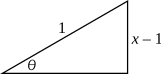
Using a suitable substitution, find \(\displaystyle\int \dfrac{2 x^2}{\sqrt{2 x-x^2}}\, d x\). (3 marks) --- 12 WORK AREA LINES (style=lined) --- \(I=3 \sin ^{-1}(x-1)-4 \sqrt{2x-x^2}-(x-1) \sqrt{2x-x^2}+c\) \(\text {Let} \ \ x-1=\sin \theta \ \Rightarrow \ x=1+\sin \theta\) \(\dfrac{dx}{d \theta}=\cos \theta \ \Rightarrow \ dx=\cos \theta \, d \theta\) \(\Rightarrow \cos \theta=\sqrt{1^2-(x-1)^2}=\sqrt{2x-x^2}\) \(\therefore I=3 \sin ^{-1}(x-1)-4 \sqrt{2x-x^2}-(x-1) \sqrt{2x-x^2}+c\)
\(\displaystyle \int \dfrac{2x^2}{\sqrt{2x-x^2}}\, dx\)
\(=\displaystyle \int \frac{2 x^2}{\sqrt{1-(1-2 x+x^2)}}\, dx\)
\(=\displaystyle \int \frac{2 x^2}{\sqrt{1-(x-1)^2}} \, dx\)
\(I\)
\(=\displaystyle \int \frac{2(1+\sin \theta)^2}{\sqrt{1-\sin ^2 \theta}} \cdot \cos \theta \, d \theta\)
\(=2 \displaystyle \int \frac{1+2 \sin \theta+\sin ^2 \theta}{\cos \theta} \cdot \cos \theta \, d \theta\)
\(=2 \displaystyle \int 1+2 \sin \theta+\frac{1}{2}(1-\cos (2 \theta)) \, d \theta\)
\(=\displaystyle \int 2+4 \sin \theta+1-\cos (2 \theta) \, d \theta\)
\(=\displaystyle \int 3+4 \sin \theta-\cos (2 \theta) \, d \theta\)
\(=3 \theta-4 \cos \theta-\dfrac{1}{2} \sin (2 \theta)+c\)
\(=3 \theta-4 \cos \theta-\sin \theta \cos \theta+c\)
Given that `f^{\prime}(x)=\frac{\cos (2 x)}{\sin ^3(2 x)}` and `f((pi)/(8))=(3)/(4)`, find `f(x)`. (4 marks)
--- 9 WORK AREA LINES (style=lined) ---
`f(x)=\frac{-1}{4 \sin ^2(2 x)}+\frac{5}{4}=-\frac{1}{4} \text{cosec}^2(2 x)+\frac{5}{4}`
`text{Let}\ \ u=sin(2x)\ \ =>\ \ {du}/{dx}=2cos(2x)`
| `\int \frac{\cos (2 x)}{\sin ^3(2 x)} d x` | `=\frac{1}{2} \int \frac{d u}{u^3}` | |
| `= -\frac{1}{4} u^{-2}+c` | ||
| `=-\frac{1}{4} \ xx \frac{1}{\sin ^2(2 x)}+c` |
`text{When}\ \ x = pi/8:`
| `-\frac{1}{4} \cdot \frac{1}{(\frac{1}{sqrt{2}})^2}+c` | `=\frac{3}{4}` | |
| `-\frac{1}{4} \cdot 2+c` | `=\frac{3}{4}` | |
| `\Rightarrow c` | `=\frac{3}{4}+\frac{2}{4}=5/4` |
`:. \ f(x)=\frac{-1}{4 \sin ^2(2 x)}+\frac{5}{4}=-\frac{1}{4} \text{cosec}^2(2 x)+\frac{5}{4}`
Find \({\displaystyle \int \frac{1-x}{\sqrt{5-4 x-x^2}}\ dx}\). (3 marks) --- 8 WORK AREA LINES (style=lined) --- \(I=\sqrt{5-4x-x^2} + 3 \sin^{-1} \big{(} \dfrac{x+2}{3} \big{)} + c \) \( \dfrac{du}{dx}=-4-2x\ \ \Rightarrow\ \ du=-4-2x\ dx \)
\(I\)
\(={\displaystyle \int \frac{1-x}{\sqrt{5-4 x-x^2}}\ dx}\)
\(= \dfrac{1}{2} {\displaystyle \int \frac{2-2x}{\sqrt{5-4 x-x^2}}\ dx}\)
\(=\dfrac{1}{2} {\displaystyle \int \frac{-4-2x}{\sqrt{5-4 x-x^2}}\ dx} + \dfrac{1}{2} {\displaystyle \int \frac{6}{\sqrt{5-4 x-x^2}}\ dx}\)
\(\text{Let}\ \ u=5-4x-x^2 \)
\(I\)
\(= \dfrac{1}{2} {\displaystyle \int u^{-\frac{1}{2}}\ du} + {\displaystyle 3 \int \frac{1}{\sqrt{9-(x+2)^2}}\ dx}\)
\(= u^{\frac{1}{2}} + 3 \sin^{-1} \big{(} \dfrac{x+2}{3} \big{)} + c \)
\(= \sqrt{5-4x-x^2}+ 3 \sin^{-1} \big{(} \dfrac{x+2}{3} \big{)} + c \)
Use an appropriate substitution to evaluate `int_(sqrt10)^(sqrt13) x^3 sqrt{x^2 - 9}\ dx`. (3 marks)
--- 9 WORK AREA LINES (style=lined) ---
`136/5`
`int_(sqrt10)^(sqrt13) x^3 sqrt{x^2 – 9} dx`
`text{Let} \ \ u = x^2 – 9 \ => \ x^2 = u + 9`
`(du)/dx = 2x \ => \ du = 2x\ dx`
`text{If} \ \ x = sqrt13 \ , \ u =4`
`text{If} \ \ x = sqrt10 \ , \ u = 1`
| `int_(sqrt10)^(sqrt13) x^3 sqrt{x^2 – 9}\ dx` | `= int_(1)^(4) (u + 9) sqrtu * 1/2\ du` |
| `= 1/2 int_(1)^(4) u^{3/2} + 9 u^{1/2}\ du` | |
| `= 1/2 [ 2/5 u^{5/2} + 9 * 2/3 u^{3/2}]_(1)^(4)` | |
| `= 1/2 [(2/5 * 4^{5/2} + 6 * 4^{3/2}) – (2/5 + 6)]` | |
| `= 1/2 (64/5 + 48 – 32/5)` | |
| `= 136/5` |
With a suitable substitution `int_(pi/4)^(pi/3) (sec^2(x))/(sec^2(x) - 3 tan(x) + 1)\ dx` can be expressed as
`B`
`text(Let)\ \ u = tan(x)`
`(du)/(dx) = sec^2 (x) \ => \ du = sec^2(x)\ dx`
| `text(When)\ ` | `x = pi/3,\ u = sqrt3` |
| `x = pi/4,\ u = 1` |
| `int_(pi/4)^(pi/3) (sec^2(x))/(sec^2(x) – 3 tan(x) + 1)\ dx` |
`= int_1^(sqrt3)\ 1/(u^2 + 1 – 3u + 1)\ du` |
| `= int_1^(sqrt3) 1/(u^2 – 3u + 2)\ du` | |
| `= int_1^(sqrt3) 1/((u – 2)(u – 1))\ du` | |
| `= int_1^(sqrt3) 1/(u – 2) – 1/(u – 1)\ du` |
`=>B`
Evaluate `int_(-1)^0 (1 + x)/sqrt(1 - x)\ dx`. (3 marks)
--- 8 WORK AREA LINES (style=lined) ---
`(8 sqrt 2)/3 – 10/3`
| `text(Let)\ \ u` | `= 1 – x \ => \ x = 1 – u` |
| `(du)/(dx)` | `= -1 \ => \ dx = -du` |
| `text(When)\ \ x` | `= 0,\ u = 1` |
| `x` | `= -1,\ u = 2` |
| `int_(-1)^0 (1 + x)/sqrt(1 – x)\ dx` | `= -int_2^1 (2 – u)/sqrt u\ du` |
| `= int_1^2 2u^(-1/2) – u^(1/2)\ du` | |
| `= [4u^(1/2) – 2/3u^(3/2)]_1^2` | |
| `= 4 sqrt 2 – (4 sqrt 2)/3 – (4 – 2/3)` | |
| `= (8 sqrt 2)/3 – 10/3` |
Which of the following is equal to `int_0^(2a) f(x)\ dx`?
`B`
`int_0^(2a) f(x)\ dx – int_0^a f(x)\ dx + int_a^(2a) f(x)\ dx`
`text(Let)\ \ x = 2a – u\ \ => \ u = 2a – x`
`frac{du}{dx} = -1 \ \ => \ du = -dx`
| `text{When}` | `x = a,` | `\ u = a` |
| `x= 2a,` | `\ u = 0` |
`int_0^(2a) f(x)\ dx= int_0^a f(x)\ dx – int_a^0 f(2a – u)\ du`
`text(Use substitution for)\ \ int_a^0 f(2a – u)\ du`
`text(Let)\ \ 2a – u = 2a-x \ \ => \ x=u`
`dx/(du) = 1 \ => \ du=dx`
| `text{When}` | `u = a,` | `\ x = a` |
| `u= 0,` | `\ x = 0` |
| `:. int_0^(2a) f(x)\ dx` | `= int_0^a f(x)\ dx – int_a^0 f(2a – x)\ dx` |
| `= int_0^a f(x)\ dx + int_0^a f(2a -x)\ dx` | |
| `= int_0^a f(x) + f(2a – x)\ dx` |
`=> \ B`
Evaluate `int_(e^3) ^(e^4) (1)/(x log_e (x))\ dx`. (3 marks)
--- 6 WORK AREA LINES (style=lined) ---
`log_e ((4)/(3))`
`text(Let)\ \ u = log_e x`
`(du)/(dx) = (1)/(x) \ => \ du = (1)/(x) dx`
`text(When) \ \ x = e^4 \ => \ u = 4`
`text(When) \ \ x = e^3 \ => \ u = 3`
| `int_(e^3) ^(e^4) (1)/(x log_e (x))` | `= int_3 ^4 (1)/(u)\ du` |
| `= [ log_e u]_3 ^4` | |
| `= log_e 4 – log_e 3` | |
| `= log_e ((4)/(3))` |
Find `int(cos theta)/(sin^5 theta) d theta` (2 marks)
--- 5 WORK AREA LINES (style=lined) ---
`(-1)/(4sin^4 theta ) + C`
| `text(Let) \ u` | `= sin theta ` |
| `(du)/(d theta)` | `=cos theta => d u = cos theta \ d theta` |
| `int(cos theta)/(sin^5 theta) d theta` | `= int u^-5 d u` |
| `=(-1)/(4) u ^-4 + C` | |
| `=(-1)/(4sin^4 theta ) + C` |
--- 6 WORK AREA LINES (style=lined) ---
Using part (i), or otherwise, show that
`int_0^a f(x)\ dx = a/2\ f(a).` (2 marks)
--- 8 WORK AREA LINES (style=lined) ---
i. `text(Show)\ \ int_0^a f(x)\ dx = int_0^a f(a – x)\ dx.`
`text(Let)\ \ x = a – u,\ \ dx = -du`
`text(When)\ \ x = 0,\ \ u = a`
`text(When)\ \ x = a,\ \ u = 0`
| `:. int_0^a f(x)\ dx` | `=int_a^0 f(a – u) (-du)` |
| `=int_0^a f(a – u)\ du` | |
| `=int_0^a f(a – x)\ dx\ \ text{.. as required}` |
ii. `f(x) = f(a) – f(a – x)`
| `int_0^a f(x)\ dx` | `=int_0^a [f(a) – f(a – x)]\ dx` |
| `=int_0^a f(a)\ dx – int_0^a f(a – x)\ dx` | |
| `=int_0^a f(a)\ dx – int_0^a f(x)\ dx` | |
| `2 int_0^a f(x)\ dx` | `=int_0^a f(a)\ dx` |
| `=[f(a) xx x]_0^a` | |
| `int_0^a f(a)\ dx` | `=(f(a))/2 (a – 0)` |
| `=a/2\ f(a)` |
Evaluate `int_0^(3/4) x/sqrt (1 - x)\ dx.` (4 marks)
`5/12`
`text(Let)\ \ u = 1 – x,\ \ du = -dx,\ \ x = 1 – u`
`text(When)\ \ x = 0,\ \ u = 1`
`text(When)\ \ x = 3/4,\ \ u = 1/4`
| `int_0^(3/4) (x\ dx)/sqrt (1 – x)` | `=int_1^(1/4) ((1 – u)(-du))/sqrt u` |
| `=int_(1/4)^1 (u^(-1/2) – u^(1/2)) du` | |
| `=[2 u^(1/2) – 2/3 u^(3/2)]_(1/4)^1` | |
| `=[(2 – 2/3) – (1 – 1/12)]` | |
| `=5/12` |
Which integral is necessarily equal to `int_(−a)^a f(x)\ dx`?
`D`
`int_(−a)^a f(x)\ dx= int_0^a f(x)\ dx + int_(−a)^0 f(x)\ dx`
`text(Consider)\ \ int_0^a f(x)\ dx`
`text(Let)\ u = a − x\ \ => x = a − u\ \ text(and)\ \ dx = −du`
| `int_0^a f(x)\ dx` | `= int_0^a f(a − u) − du` |
| `=int_a^0 f(a-u)\ du` | |
| `= int_0^a f(a − x)\ dx` |
`text(Consider)\ \ int_(−a)^0 f(x)\ dx`
`text(Let)\ u = x + a\ \ => x = u − a\ \ text(and)\ \ dx = du`
| `int_(−a)^0 f(x)\ dx` | `= int_0^a f(u − a)\ du` |
| `= int_0^a f(x − a)\ dx` | |
| `:.int_(−a)^a f(x)\ dx` | `= int_0^a f(x − a)+ f(a − x)\ dx` |
`=> D`
Evaluate `int_1^sqrt 3 1/(x^2 sqrt (1 + x^2))\ dx.` (4 marks)
--- 8 WORK AREA LINES (style=lined) ---
`sqrt 2 – (2 sqrt 3)/3`
`text(Let)\ \ x = tan theta,\ \ \ \ dx = sec^2 theta\ d theta`
`text(When)\ \ x = 1,\ \ theta = pi/4`
`text(When)\ \ x = sqrt 3,\ \ theta = pi/3`
| `int_1^sqrt 3 1/(x^2 sqrt (1 + x^2))\ dx` | `= int_(pi/4)^(pi/3) (sec^2 theta)/(tan^2 theta sqrt (1 + tan^2 theta))\ d theta` |
| `= int_(pi/4)^(pi/3) (sec^2 theta)/(tan^2 theta sec theta)\ d theta` | |
| `= int_(pi/4)^(pi/3) (sec theta)/(tan^2 theta)\ d theta` | |
| `= int_(pi/4)^(pi/3) (cos^2 theta)/(cos theta sin^2 theta)\ d theta` | |
| `= int_(pi/4)^(pi/3) (cos theta\ d theta)/(sin^2 theta)` | |
| `= [-1/(sin theta)]_(pi/4)^(pi/3)` | |
| `= (-2/sqrt 3 + sqrt 2)` | |
| `= sqrt 2 – (2 sqrt 3)/3` |
Find `int (ln x)/x\ dx.` (2 marks)
`((ln x)^2)/2 + c`
`text(Let)\ \ u=lnx,\ \ \ du=1/x\ dx`
| `int (ln x)/x \ dx` | `=int u\ du` |
| `=1/2 u^2 +c` | |
| `=1/2 (ln x)^2 +c` |
Find `int (dx)/(1 + sqrtx)`. (3 marks)
--- 8 WORK AREA LINES (style=lined) ---
`2sqrtx − 2log_e\ (1 + sqrtx) + c_1\ \ text(or)`
`2+2sqrtx − 2log_e\ (1 + sqrtx) + c_2`
`text(Solution 1)`
| `text(Let)\ \ u = sqrtx,\ \ du = 1/(2sqrtx)\ dx,\ \ dx = 2u\ du` | |
| `int (dx)/(1 + sqrtx)` | `=int (2u\ du)/(1 + u)` |
| `=int((2+2u-2)/(1+u))\ du` | |
| `=int (2 − 2/(1 + u))\ du` | |
| `=2u − 2log_e(1 + u) + c_1` | |
| `=2sqrtx − 2log_e\ (1 + sqrtx) + c_1` | |
`text(Alternative Solution)`
| `text(Let)\ \ u = 1+sqrtx,\ \ du = 1/(2sqrtx)\ dx,\ \ dx = 2(u-1)\ du` | |
| `int (dx)/(1 + sqrtx)` | `=2int (u-1)/u\ du` |
| `=2 int(1 − 1/u)du` | |
| `=2u − 2log_e\ |\ u\ | + c_2` | |
| `=2+2sqrtx − 2log_e\ (1 + sqrtx) + c_2` | |
`text(NB. These solutions are equivalent by making)\ \ c_1=c_2+2`
Find `int x/(sqrt(1 + 3x^2))\ dx`. (2 marks)
`1/3 sqrt(1 + 3x^2) + c`
`text(Let)\ u = 1 + 3x^2, \ du = 6x\ dx`
| `:.int x/(sqrt(1 + 3x^2))\ dx` | `=1/6 int u^(-1/2)\ du` |
| `=1/6 xx 2 xx sqrtu + c` | |
| `=1/3 sqrt(1 + 3x^2) + c` |
Evaluate `int_0^3 x sqrt (x + 1)\ dx.` (3 marks)
--- 7 WORK AREA LINES (style=lined) ---
`116/15`
`text(Let)\ \ u = 1 + x,\ \ \ du = dx`
| `text(When)\ \ x = 0,` | `\ \ \ u = 1` |
| `x = 3,` | `\ \ \ u = 4` |
| `int_0^3 x sqrt (1 + x)\ dx` | `= int_1^4 (u – 1) sqrt u\ du` |
| `= int_1^4 (u^(3/2) – u^(1/2))\ du` | |
| `= [2/5 u^(5/2) – 2/3 u^(3/2)]_1^4` | |
| `= (2/5 xx 32 – 2/3 xx 8) – (2/5 – 2/3)` | |
| `= 116/15` |