SmarterEd

Aussie Maths & Science Teachers: Save your time with SmarterEd

  • Login
  • Get Help
  • About

Calculus, EXT1 C1 2025 HSC 12a

The radius, \(r\) cm, and angle, \(\theta\) radians, of a sector vary in such a way that its area, \(A=\frac{1}{2} \theta r^2\), remains a constant 10 cm\(^2\).
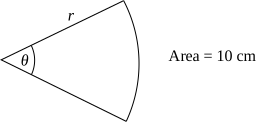
 

The angle \(\theta\) is increasing at a constant rate of 2 radians per second.

Find the rate at which the radius is changing when the radius is 4 cm.   (3 marks)

--- 6 WORK AREA LINES (style=lined) ---

Show Answers Only

\(\text{Radius is decreasing at} \ \dfrac{16}{5} \ \text{cm per second.}\)

Show Worked Solution

\(\dfrac{d \theta}{d t}=2\)

\(\dfrac{dv}{d t}=\dfrac{dv}{d \theta} \times \dfrac{d \theta}{d t}\)

\(A\) \(=\dfrac{\theta}{2 \pi} \times \pi r^2\)  
\(10\) \(=\dfrac{\theta}{2} \times r^2\)  
\(\theta\) \(=20\, r^{-2}\)  

 
\(\dfrac{d \theta}{dv}=-40 r^{-3} \)

\(\dfrac{dv}{d \theta}=-\dfrac{r^3}{40}\)
 

\(\text{ Find \(\dfrac{dv}{dt}\)  when  \(r=4\):}\)

\(\dfrac{dv}{dt}=-\dfrac{4^3}{40} \times 2=-\dfrac{16}{5}\)

\(\therefore \ \text{Radius is decreasing at} \ \dfrac{16}{5} \ \text{cm per second.}\)

Filed Under: Related Rates of Change, Related Rates of Change Tagged With: Band 4, smc-1079-30-Area, smc-7351-30-Area

Calculus, EXT1 C1 EQ-Bank 5 MC

The diagram shows an equilateral triangle with side length \(x\) cm and area \(A\) cm\(^2\).
 

The area of the triangle is increasing at a rate of 6 cm\(^2\) per second.

Find the rate at which the side length \(x\) is expanding when the triangle has a side length of 4 cm.

  1. \(\dfrac{2}{\sqrt{3}} \text{ cm s}^{-1}\)
  2. \(\sqrt{3} \ \text{cm s}^{-1}\)
  3. \(6 \ \text{cm s}^{-1}\)
  4. \(12 \sqrt{3} \ \text{cm s}^{-1}\)
Show Answers Only

\(\Rightarrow B\)

Show Worked Solution

\(\cos 30^{\circ}=\dfrac{h}{x} \ \Rightarrow \ h=x \times \cos 30^{\circ}=\dfrac{\sqrt{3}}{2} x\)

\(A=\dfrac{1}{2} b h=\dfrac{1}{2} x \times \dfrac{\sqrt{3}}{2} x=\dfrac{\sqrt{3}}{4} x^2\)

\(\dfrac{d A}{dx}=\dfrac{\sqrt{3}}{2} x\)

\(\dfrac{dx}{dt}=\dfrac{dx}{dA} \cdot \dfrac{d A}{d t}=\dfrac{2}{\sqrt{3} x} \cdot 6=\dfrac{12}{\sqrt{3} x}\)

\(\text{When} \ x=4:\)

\(\dfrac{dx}{dt}=\dfrac{12}{4 \sqrt{3}}=\dfrac{3}{\sqrt{3}}=\sqrt{3} \ \text{cm s}^{-1}\)

\(\Rightarrow B\)

Filed Under: Related Rates of Change, Related Rates of Change Tagged With: Band 4, smc-1079-30-Area, smc-7351-30-Area

Calculus, EXT1 C1 2017 HSC 8 MC

A stone drops into a pond, creating a circular ripple. The radius of the ripple increases from 0 cm, at a constant rate of `5\ text(cm s)^(-1)`.

At what rate is the area enclosed within the ripple increasing when the radius is 15 cm?

  1. `25pi\ text(cm)^2\ text(s)^(-1)`
  2. `30pi\ text(cm)^2\ text(s)^(-1)`
  3. `150pi\ text(cm)^2\ text(s)^(-1)`
  4. `225pi\ text(cm)^2\ text(s)^(-1)`
Show Answers Only

`C`

Show Worked Solution

`(dr)/(dt) = 5\ text(cm)^2\ text(s)^(-1)`

`A` `=pi r^2`
`(dA)/(dr)` `= 2pir`

 
`(dA)/(dt)= (dA)/(dr) xx (dr)/(dt)= 2pi r xx 5= 10 \pi r`
 

`text(When)\ \ r = 15:`

`(dA)/(dr)= 10pi xx 15= 150pi\ text(cm)^2\ text(s)^(-1)`

 `=>C`

Filed Under: Rates of Change EXT1, Related Rates of Change, Related Rates of Change Tagged With: Band 3, smc-1079-30-Area, smc-7351-30-Area

Calculus, EXT1 C1 2013 HSC 13a

A spherical raindrop of radius `r` metres loses water through evaporation at a rate that depends on its surface area.  The rate of change of the volume `V` of the raindrop is given by

`(dV)/(dt) = -10^(-4) A`, 

where `t` is time in seconds and `A` is the surface area of the raindrop. The surface area and the volume of the raindrop are given by  `A = 4pir^2`  and  `V = 4/3 pi r^3`  respectively.

  1. Show that `(dr)/(dt)` is constant.   (1 mark)

    --- 5 WORK AREA LINES (style=lined) ---

  2. How long does it take for a raindrop of volume `10^(–6)\ \text{m}^3`  to completely evaporate?   (2 marks)

    --- 6 WORK AREA LINES (style=lined) ---

Show Answers Only

a.    `text(Proof)\ \ text{(See Worked Solutions)}`

b.    `62\ text(seconds)`

Show Worked Solution

a.    `text(Show)\ \ (dr)/(dt)\ \ text(is a constant)`

`(dV)/(dt) = (dV)/(dr) * (dr)/(dt)\ \ \ …\ text{(1)}`

`V= 4/3 pi r^3\ \ =>\ \ (dV)/(dr)= 4 pi r^2`

`(dV)/(dt)= -10^(-4) A\ \ text{(given)}`
 

`text{Substituting into (1)}:`

`-10^(-4) A` `= 4 pi r^2 xx (dr)/(dt)`
`-10^(-4) A` `= A xx (dr)/(dt)`
`:.\ (dr)/(dt)` `= -10^(-4)\ \ text(… as required)`


b.     `V` `= 10^(-6)\ text(m³)`
  `4/3 pi r^3` `= 10^(-6)`
  `r^3` `= (3 xx 10^(-6))/(4pi)`
  `r` `= root(3)((3 xx 10^(-6))/(4pi))`

 
`text(S)text(ince the radius decreases at a constant rate:)`

♦♦ Mean mark (b) 31%

  `t=(root(3)((3 xx 10^(-6))/(4pi)))/(10^(-4)) =62.035 …=62\ text(seconds)\ text{(nearest whole)}`

`:.\ text(It takes 62 seconds for the raindrop to evaporate.)`

Filed Under: Rates of Change EXT1, Related Rates of Change, Related Rates of Change Tagged With: Band 4, Band 5, smc-1079-30-Area, smc-7351-30-Area

Copyright © 2014–2026 SmarterEd.com.au · Log in