Consider the region bounded by the curve \(y=\dfrac{5}{9}x^2\), the \(y\)-axis and the line \(y=h\). A drinking glass of height 10 cm is formed by rotating the region about the \(y\)-axis. The drinking glass is filled with water at a constant rate of 15 cm\(^3\) s\(^{-1}\). Find the rate at which the height \(h\) of water is rising with respect to time when the drinking glass is filled to half its capacity. (4 marks) --- 14 WORK AREA LINES (style=lined) ---
Calculus, EXT1 C1 2025 HSC 12a
The radius, \(r\) cm, and angle, \(\theta\) radians, of a sector vary in such a way that its area, \(A=\frac{1}{2} \theta r^2\), remains a constant 10 cm\(^2\).
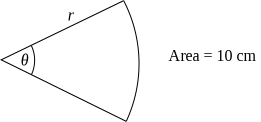
The angle \(\theta\) is increasing at a constant rate of 2 radians per second.
Find the rate at which the radius is changing when the radius is 4 cm. (3 marks)
--- 6 WORK AREA LINES (style=lined) ---
Calculus, EXT1 C1 EQ-Bank 5 MC
The diagram shows an equilateral triangle with side length \(x\) cm and area \(A\) cm\(^2\).

The area of the triangle is increasing at a rate of 6 cm\(^2\) per second.
Find the rate at which the side length \(x\) is expanding when the triangle has a side length of 4 cm.
- \(\dfrac{2}{\sqrt{3}} \text{ cm s}^{-1}\)
- \(\sqrt{3} \ \text{cm s}^{-1}\)
- \(6 \ \text{cm s}^{-1}\)
- \(12 \sqrt{3} \ \text{cm s}^{-1}\)
Show Worked Solution

\(\cos 30^{\circ}=\dfrac{h}{x} \ \Rightarrow \ h=x \times \cos 30^{\circ}=\dfrac{\sqrt{3}}{2} x\)
\(A=\dfrac{1}{2} b h=\dfrac{1}{2} x \times \dfrac{\sqrt{3}}{2} x=\dfrac{\sqrt{3}}{4} x^2\)
\(\dfrac{d A}{dx}=\dfrac{\sqrt{3}}{2} x\)
\(\dfrac{dx}{dt}=\dfrac{dx}{dA} \cdot \dfrac{d A}{d t}=\dfrac{2}{\sqrt{3} x} \cdot 6=\dfrac{12}{\sqrt{3} x}\)
\(\text{When} \ x=4:\)
\(\dfrac{dx}{dt}=\dfrac{12}{4 \sqrt{3}}=\dfrac{3}{\sqrt{3}}=\sqrt{3} \ \text{cm s}^{-1}\)
\(\Rightarrow B\)
Calculus, EXT1 C1 2024 HSC 11f
The volume of a sphere of radius \(r\) cm, is given by \(V=\dfrac{4}{3} \pi r^3\), and the volume of the sphere is increasing at a rate of \(10 \text{ cm}^3 \text{ s}^{-1}\). Show that the rate of increase of the radius is given by \(\dfrac{d r}{d t}=\dfrac{5}{2 \pi r^2} \text{ cm s}^{-1}\). (2 marks) --- 5 WORK AREA LINES (style=lined) ---
Calculus, EXT1 C1 EQ-Bank 16
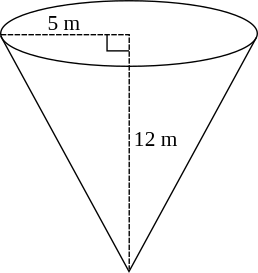
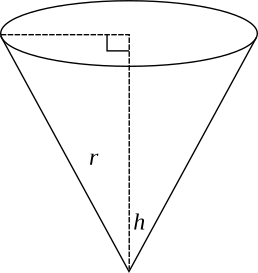
A wheat silo in the shape of a right cone is pictured below. The silo has a height of 12 metres and a base radius of 5 metres. Wheat is poured into the top of the silo at a rate of 3 cubic metres per minute. At any given time, the wheat filling the silo will have a vertical height of \(h\) metres from the bottom tip and a radius \(r\). --- 3 WORK AREA LINES (style=lined) --- --- 6 WORK AREA LINES (style=lined) --- --- 3 WORK AREA LINES (style=lined) ---
Calculus, EXT1 C3 2023 HSC 13a
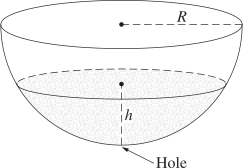
A hemispherical water tank has radius \(R\) cm. The tank has a hole at the bottom which allows water to drain out. Initially the tank is empty. Water is poured into the tank at a constant rate of \(2 k R\) cm³ s\(^{-1}\), where \(k\) is a positive constant. After \(t\) seconds, the height of the water in the tank is \(h\) cm, as shown in the diagram, and the volume of water in the tank is \(V\) cm³. It is known that \(V= \pi \Big{(} R h^2-\dfrac{h^3}{3}\Big{)}. \) (Do NOT prove this.) While water flows into the tank and also drains out of the bottom, the rate of change of the volume of water in the tank is given by \(\dfrac{d V}{d t}=k(2 R-h)\). --- 5 WORK AREA LINES (style=lined) --- --- 6 WORK AREA LINES (style=lined) --- --- 9 WORK AREA LINES (style=lined) ---
Calculus, EXT1 C1 2021 HSC 11e
A spherical bubble is moving up through a liquid. As it rises, the bubble gets bigger and its radius increases at the rate of 0.2 mm/s.
At what rate is the volume of the bubble increasing when its radius reaches 0.6 mm? Express your answer in mm³/s rounded to one decimal place. (2 marks)
--- 5 WORK AREA LINES (style=lined) ---
Calculus, EXT1 C1 2020 HSC 10 MC
The quantities `P`, `Q` and `R` are connected by the related rates.
`(dR)/(dt) = -k^2`
`(dP)/(dt) = -l^2 xx (dR)/(dt)`
`(dP)/(dt) = m^2 xx (dQ)/(dt)`
where `k`, `l` and `m` are non-zero constants.
Which of the following statements is true?
- `P` is increasing and `Q` is increasing
- `P` is increasing and `Q` is decreasing
- `P` is decreasing and `Q` is increasing
- `P` is decreasing and `Q` is decreasing
Calculus, EXT1 C1 2019 HSC 12a
Distance `A` is inversely proportional to distance `B`, such that `A = 9/B` where `A` and `B` are measured in metres. The two distances vary with respect to time. Distance `B` is increasing at a rate of `0.2\ text(ms)^(-1)`.
What is the value of `(dA)/(dt)` when `A = 12` ? (3 marks)
--- 6 WORK AREA LINES (style=lined) ---
Calculus, EXT1 C1 2018 HSC 12b
A ferris wheel has a radius of 20 metres and is rotating at a rate of 1.5 radians per minute. The top of a carriage is `h` metres above the horizontal diameter of the ferris wheel. The angle of elevation of the top of the carriage from the centre of the ferris wheel is `theta`.
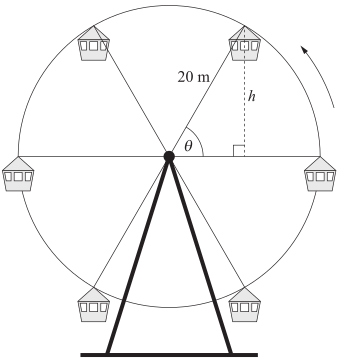
- Show that `(dh)/(d theta) = 20 cos theta`. (1 mark)
--- 2 WORK AREA LINES (style=lined) ---
- At what speed is the top of the carriage rising when it is 15 metres higher than the horizontal diameter of the ferris wheel? Give your answer correct to one decimal place. (2 marks)
--- 6 WORK AREA LINES (style=lined) ---
Calculus, EXT1 C1 2017 HSC 8 MC
A stone drops into a pond, creating a circular ripple. The radius of the ripple increases from 0 cm, at a constant rate of `5\ text(cm s)^(-1)`.
At what rate is the area enclosed within the ripple increasing when the radius is 15 cm?
- `25pi\ text(cm)^2\ text(s)^(-1)`
- `30pi\ text(cm)^2\ text(s)^(-1)`
- `150pi\ text(cm)^2\ text(s)^(-1)`
- `225pi\ text(cm)^2\ text(s)^(-1)`
Calculus, EXT1 C1 2016 HSC 12a
The diagram shows a conical soap dispenser of radius 5 cm and height 20 cm.
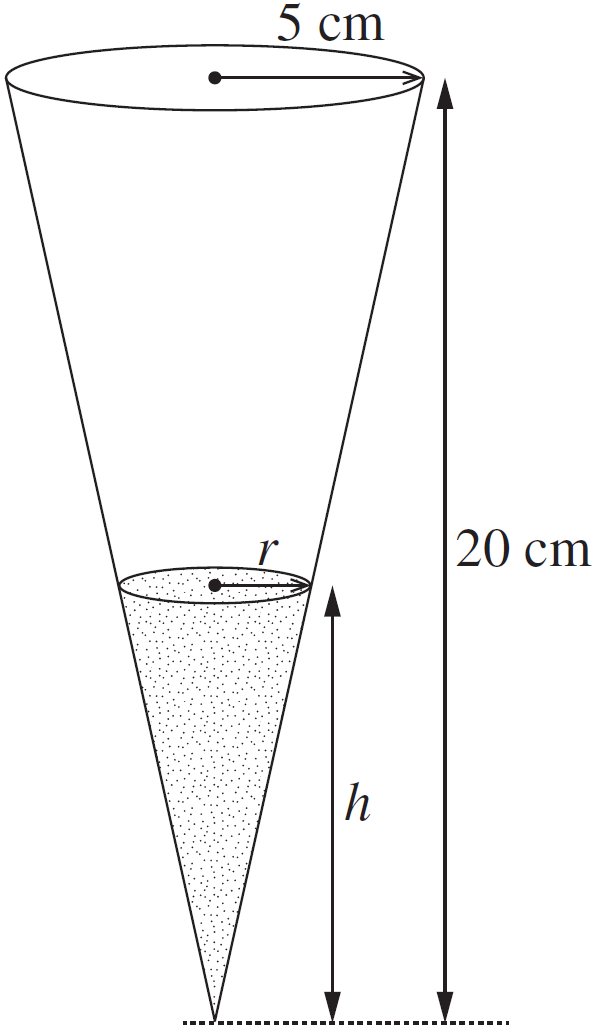
At any time `t` seconds, the top surface of the soap in the container is a circle of radius `r` cm and its height is `h` cm.
The volume of the soap is given by `v = 1/3 pir^2h`.
- Explain why `r = h/4`. (1 mark)
--- 8 WORK AREA LINES (style=lined) ---
- Show that `(dv)/(dh) = pi/16 h^2`. (1 mark)
--- 5 WORK AREA LINES (style=lined) ---
The dispenser has a leak which causes soap to drip from the container. The area of the circle formed by the top surface of the soap is decreasing at a constant rate of `0.04\ text(cm² s)^-1`.
- Show that `(dh)/(dt) = (−0.32)/(pih)`. (2 marks)
--- 6 WORK AREA LINES (style=lined) ---
- What is the rate of change of the volume of the soap, with respect to time, when `h = 10`? (2 marks)
--- 5 WORK AREA LINES (style=lined) ---
Show Worked Solution
| a. | 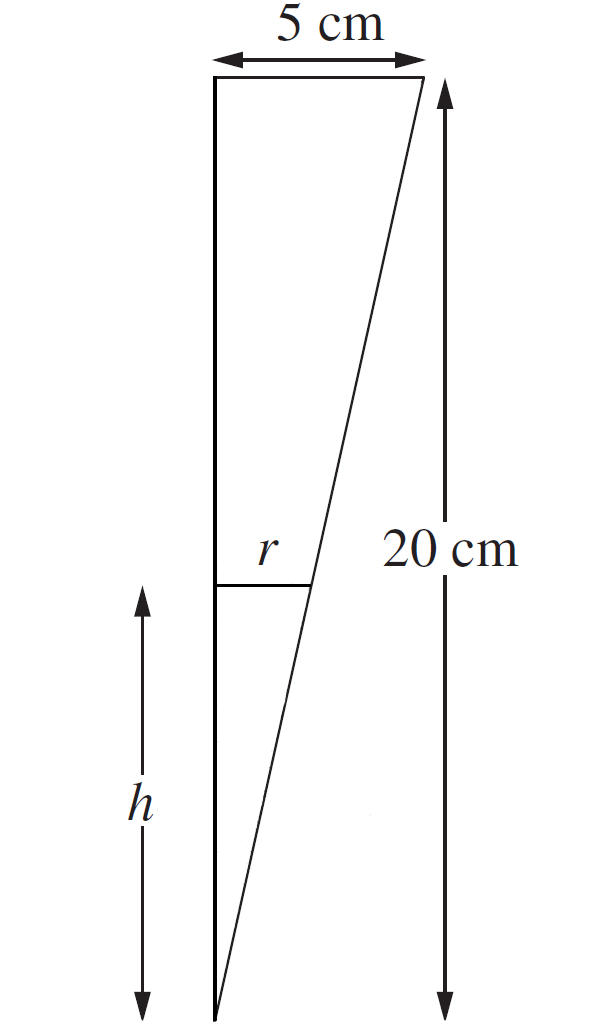 |
`text(Using similar triangles:)`
| `r/h` | `= 5/20` |
| `:. r` | `= h/4\ text(… as required)` |
b. `v= 1/3 pi r^2 h= 1/3 pi xx (h/4)^2 h= (pi h^3)/48`
`:. (dv)/(dh)= 3 xx (pi h^2)/48= (pi h^2)/16\ text(… as required.)`
c. `(dA)/(dt)= -0.04\ text{cm}^2\ \text{s}^-1`
`A= pi r^2= (pi h^2)/16`
`(dA)/(dh)= (pi h)/8`
| `(dA)/(dt)` | `= (dA)/(dh) xx (dh)/(dt)` |
| `-0.04` | `= (pi h)/8 xx (dh)/(dt)` |
| `:. (dh)/(dt)` | `= (-0.32)/(pi h)\ text(… as required.)` |
d. `(dv)/(dt)= (dv)/(dh) xx (dh)/(dt)= (pi h^2)/16 · (-0.32)/(pi h)= (-0.32 h)/16`
`text(When)\ \ h =10:`
`(dv)/(dt)= (-0.32 xx 10)/16= -0.2\ text{cm}^3\ \text{s}^-1`
Calculus, EXT1 C1 2004 HSC 3c
A ferry wharf consists of a floating pontoon linked to a jetty by a 4 metre long walkway. Let `h` metres be the difference in height between the top of the pontoon and the top of the jetty and let `x` metres be the horizontal distance between the pontoon and the jetty.

- Find an expression for `x` in terms of `h`. (1 mark)
--- 2 WORK AREA LINES (style=lined) ---
When the top of the pontoon is 1 metre lower than the top of the jetty, the tide is rising at a rate of 0.3 metres per hour.
- At what rate is the pontoon moving away from the jetty? (3 marks)
--- 10 WORK AREA LINES (style=lined) ---
Calculus, EXT1 C1 2006 HSC 5c

A hemispherical bowl of radius `r` cm is initially empty. Water is poured into it at a constant rate of `k` cm³ per minute. When the depth of water in the bowl is `x` cm, the volume, `V` cm³, of water in the bowl is given by
`V = pi/3 x^2 (3r-x).` (Do NOT prove this)
- Show that `(dx)/(dt) = k/(pi x (2r-x).` (2 marks)
--- 8 WORK AREA LINES (style=lined) ---
- Hence, or otherwise, show that it takes 3.5 times as long to fill the bowl to the point where `x = 2/3r` as it does to fill the bowl to the point where `x = 1/3r.` (2 marks)
--- 10 WORK AREA LINES (style=lined) ---
Calculus, EXT1 C1 2005 HSC 7a
An oil tanker at `T` is leaking oil which forms a circular oil slick. An observer is measuring the oil slick from a position `P`, 450 metres above sea level and 2 kilometres horizontally from the centre of the oil slick.
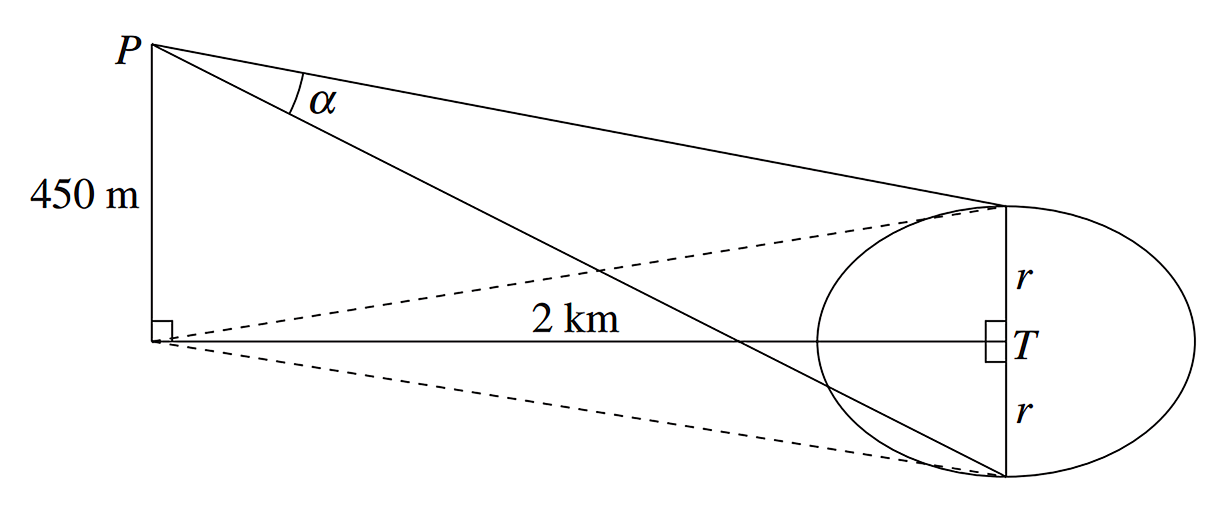
- At a certain time the observer measures the angle, `alpha`, subtended by the diameter of the oil slick, to be 0.1 radians. What is the radius, `r`, at this time? (2 marks)
--- 8 WORK AREA LINES (style=lined) ---
- At this time, `(d alpha)/(dt) = 0.02` radians per hour. Find the rate at which the radius of the oil slick is growing. (2 marks)
--- 6 WORK AREA LINES (style=lined) ---
Show Worked Solution
|
a. |
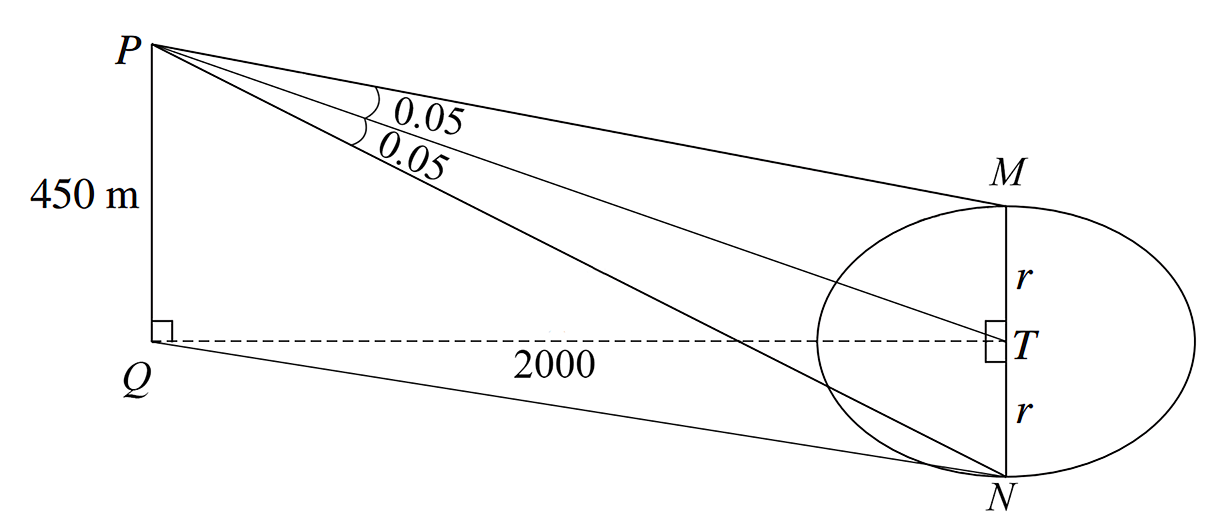 |
`text{Let}\ Q\ text{be the point on the sea such}\ /_PQT\ \text{is a right angle.}`
`text(Consider)\ \Delta PQT:`
`text(Using Pythagoras,)`
`PT^2= PQ^2 + QT^2= 450^2 + 2000^2`
`PT= sqrt(450^2 + 2000^2)= 2050\ text(m)`
`text(Consider)\ Delta PMT:`
| `tan\ /_ MPT` | `= r/(PT)` |
| `tan 0.05` | `= r/2050` |
| `:. r` | `= 2050 xx tan 0.05` |
| `= 102.585…` | |
| `= 102.6\ text{m (to 1 d.p.)}` |
b. `text(Find)\ (dr)/(dt)\ text(when)\ \ alpha = 0.1:`
`(dr)/(dt)= (dr)/(d alpha) xx (d alpha)/(dt)`
`r= 2050 xx tan\ alpha/2`
`(dr)/(d alpha)= 2050 xx 1/2 xx sec^2\ alpha/2= 1025 sec^2\ alpha/2`
`text(When)\ \ (d alpha)/(dt)= 0.02\ \ text(radians per hour), alpha = 0.1\ text{(given)}.`
| `:. (dr)/(dt)` | `= 1025\ sec^2 0.05 xx 0.02` |
| `= 20.5513…` | |
| `= 20.6\ text{metres per hour (to 1 d.p.)}` |
Calculus, EXT1 C1 2008 HSC 3c
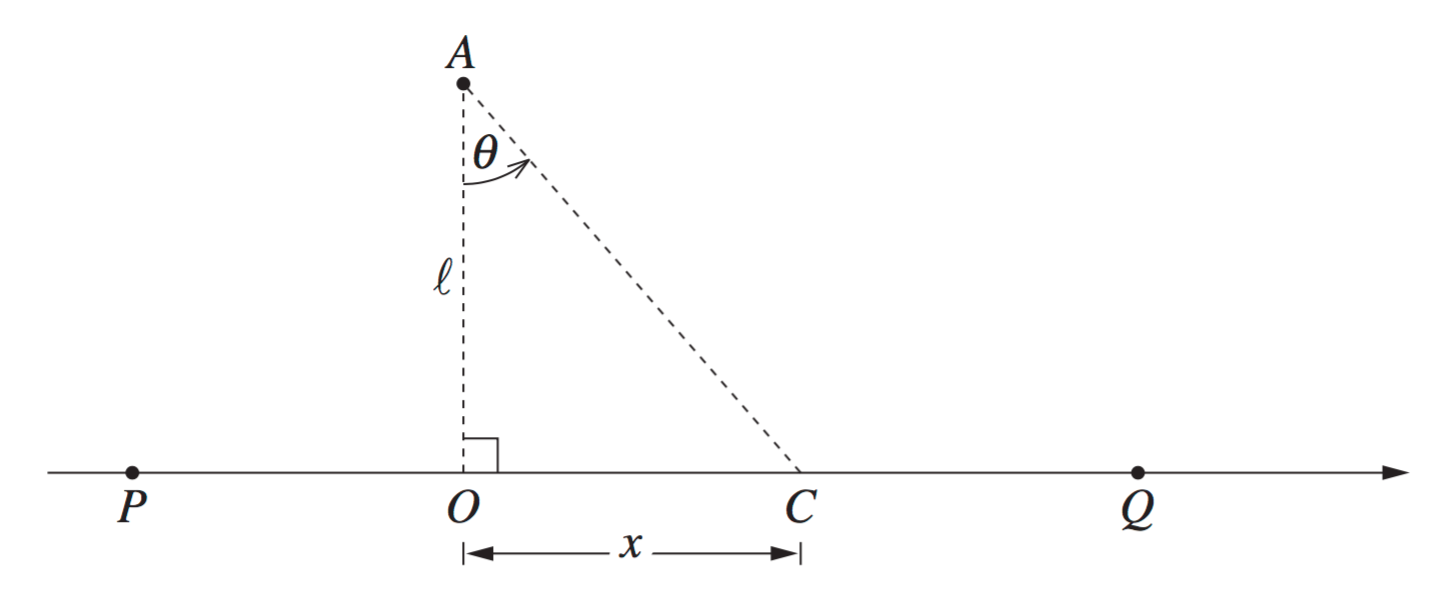
A race car is travelling on the `x`-axis from `P` to `Q` at a constant velocity, `v`.
A spectator is at `A` which is directly opposite `O`, and `OA = l` metres. When the car is at `C`, its displacement from `O` is `x` metres and `/_OAC = theta`, with `- pi/2 < theta < pi/2`.
- Show that `(d theta)/(dt) = (vl)/(l^2 + x^2)`. (2 marks)
--- 8 WORK AREA LINES (style=lined) ---
- Let `m` be the maximum value of `(d theta)/dt`.
Find the value of `m` in terms of `v` and `l`. (1 mark)
--- 2 WORK AREA LINES (style=lined) ---
- There are two values of `theta` for which `(d theta)/(dt) = m/4`.
Find these two values of `theta`. (2 marks)
--- 6 WORK AREA LINES (style=lined) ---
Calculus, EXT1 C1 2014 HSC 13b
One end of a rope is attached to a truck and the other end to a weight. The rope passes over a small wheel located at a vertical distance of 40 m above the point where the rope is attached to the truck.
The distance from the truck to the small wheel is `L` m, and the horizontal distance between them is `x` m. The rope makes an angle `theta` with the horizontal at the point where it is attached to the truck.
The truck moves to the right at a constant speed of 3 metres per second, as shown in the diagram.

- Using Pythagoras’ Theorem, or otherwise, show that `(dL)/(dx) = cos theta`. (2 marks)
--- 10 WORK AREA LINES (style=lined) ---
- Show that `(dL)/(dt) = 3 cos theta`. (1 mark)
--- 2 WORK AREA LINES (style=lined) ---
Show Worked Solution
| a. |  |
`text(Show)\ \ (dL)/(dx) = cos theta`
`text(Using Pythagoras:)`
| `L^2` | `=40^2 + x^2` |
| `L` | `=(40^2 + x^2)^(1/2)` |
| `(dL)/(dx)` | `=1/2 * 2x * (40^2 + x^2)^(-1/2)` |
| `=x/ sqrt((40^2 + x^2))` | |
| `=x/L` | |
| `=cos theta\ \ \ text(… as required.)` |
b. `text(Show)\ \ (dL)/(dt) = 3 cos theta`
| `(dL)/(dt)` | `= (dL)/(dx) * (dx)/(dt)` |
| `= cos theta xx 3` | |
| `= 3 cos theta\ \ \ text(… as required)` |
Calculus, EXT1 C1 2009 HSC 5b
The cross-section of a 10 metre long tank is an isosceles triangle, as shown in the diagram. The top of the tank is horizontal.
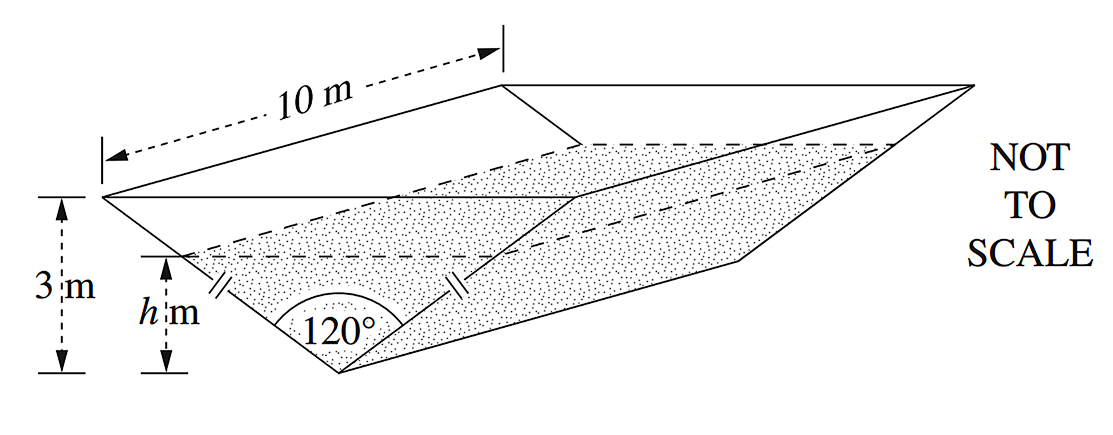
When the tank is full, the depth of water is 3 m. The depth of water at time `t` days is `h` metres.
- Find the volume, `V`, of water in the tank when the depth of water is `h` metres. (1 mark)
--- 4 WORK AREA LINES (style=lined) ---
- Show that the area, `A`, of the top surface of the water is given by `A = 20 sqrt3 h`. (1 mark)
--- 2 WORK AREA LINES (style=lined) ---
- The rate of evaporation of the water is given by `(dV)/(dt) = - kA`, where `k` is a positive constant.
Find the rate at which the depth of water is changing at time `t`. (2 marks)
--- 6 WORK AREA LINES (style=lined) ---
- It takes 100 days for the depth to fall from 3 m to 2 m. Find the time taken for the depth to fall from 2 m to 1 m. (1 mark)
--- 2 WORK AREA LINES (style=lined) ---
Show Worked Solution
MARKER’S COMMENT: Students who drew a diagram and included their working calculations on it were the most successful.
a. `text(Let)\ A = text(area of front)`
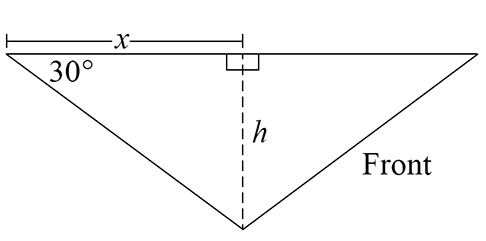
| `tan 30^@` | `= h/x` |
| `x` | `= h/(tan 30^@)= sqrt3 h` |
`A= 2 xx 1/2 xx sqrt 3 h xx h= sqrt 3 h^2\ text(m)^2`
`V= Ah= sqrt 3 h^2 xx 10= 10 sqrt3 h^2\ \ext(m)^3`
b. `text(Area of surface) = 10 xx 2 sqrt 3 h= 20 sqrt 3 h\ text(m)^2`
c. `(dV)/(dt)= -kA= -k\ 20 sqrt3 h`
| `V` | `= 10 sqrt3 h^2` |
| `(dV)/(dh)` | `= 20 sqrt 3 h` |
`text(Find)\ (dh)/(dt):`
MARKER’S COMMENT: Half marks awarded for stating an appropriate chain rule.
| `(dV)/(dt)` | `= (dV)/(dh) * (dh)/(dt)` |
| `(dh)/(dt)` | `= ((dV)/(dt))/((dV)/(dh))= (-k * 20 sqrt 3 h)/(20 sqrt 3 h)= -k` |
`:.\ text(The water depth is changing at a rate of)\ -k\ text(metres per day.)`
COMMENT: Interpreting a constant rate of change was very poorly understood!
d. `text(S)text(ince)\ (dh)/(dt)\ text(is a constant, each metre takes the same time.)`
`:.\ text(It takes 100 days to fall from 2 m to 1 m.)`
Calculus, EXT1 C1 2013 HSC 13a
A spherical raindrop of radius `r` metres loses water through evaporation at a rate that depends on its surface area. The rate of change of the volume `V` of the raindrop is given by
`(dV)/(dt) = -10^(-4) A`,
where `t` is time in seconds and `A` is the surface area of the raindrop. The surface area and the volume of the raindrop are given by `A = 4pir^2` and `V = 4/3 pi r^3` respectively.
- Show that `(dr)/(dt)` is constant. (1 mark)
--- 5 WORK AREA LINES (style=lined) ---
- How long does it take for a raindrop of volume `10^(–6)\ \text{m}^3` to completely evaporate? (2 marks)
--- 6 WORK AREA LINES (style=lined) ---
Calculus, EXT1 C1 2010 HSC 2d
A radio transmitter `M` is situated 6 km from a straight road. The closest point on the road to the transmitter is `S`.
A car is travelling away from `S` along the road at a speed of 100 km h−1. The distance from the car to `S` is `x` km and from the car to `M` is `r` km.

Find an expression in terms of `x` for `(dr)/(dt)`, where `t` is time in hours. (3 marks)
--- 8 WORK AREA LINES (style=lined) ---
Calculus, EXT1 C1 2011 HSC 7a
The diagram shows two identical circular cones with a common vertical axis. Each cone has height `h` cm and semi-vertical angle 45°.
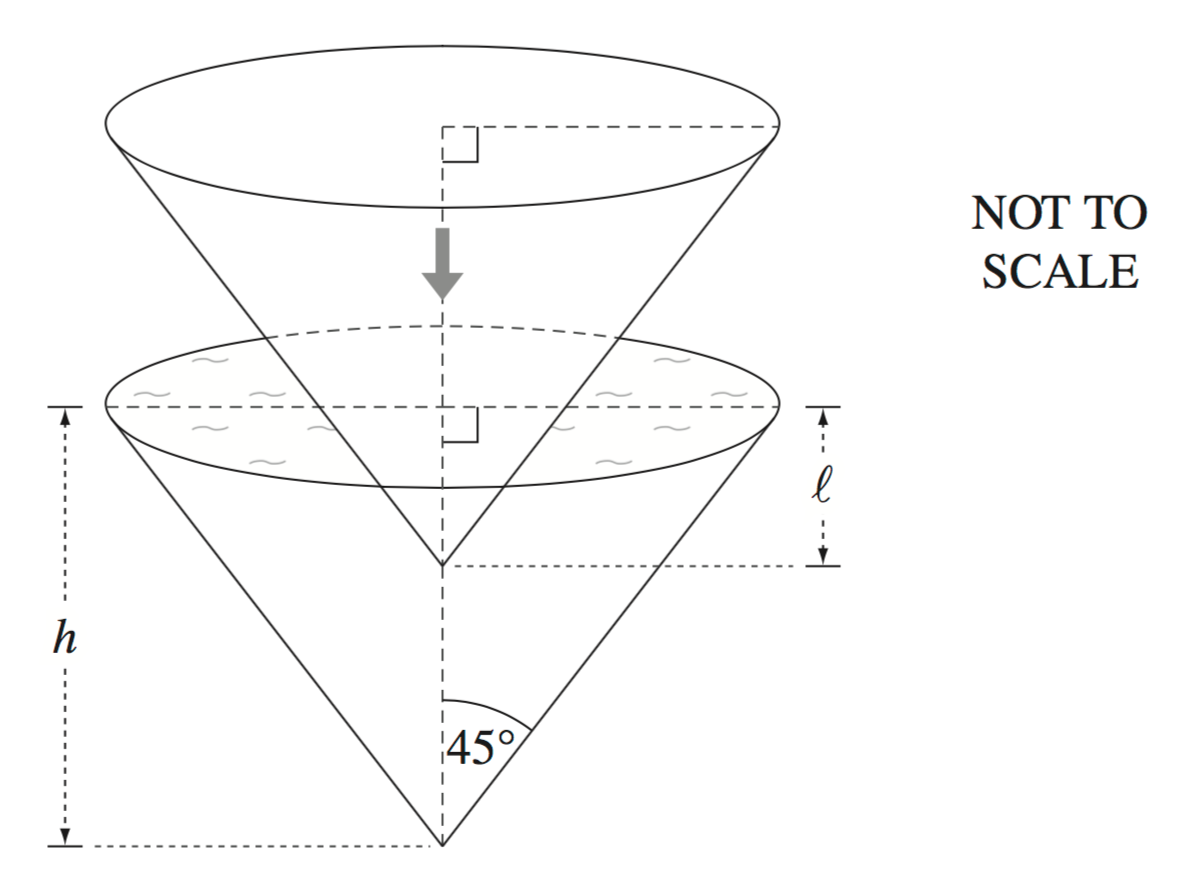
The lower cone is completely filled with water. The upper cone is lowered vertically into the water as shown in the diagram. The rate at which it is lowered is given by
`(dl)/(dt) = 10`,
where `l` cm is the distance the upper cone has descended into the water after `t` seconds.
As the upper cone is lowered, water spills from the lower cone. The volume of water remaining in the lower cone at time `t` is `V` cm³.
- Show that `V = pi/3(h^3-l^3)`. (1 mark)
--- 4 WORK AREA LINES (style=lined) ---
- Find the rate at which `V` is changing with respect to time when `l = 2`. (2 marks)
--- 5 WORK AREA LINES (style=lined) ---
- Find the rate at which `V` is changing with respect to time when the lower cone has lost `1/8` of its water. Give your answer in terms of `h`. (2 marks)
--- 6 WORK AREA LINES (style=lined) ---
Calculus, EXT1 C1 2012 HSC 14c
A plane `P` takes off from a point `B`. It flies due north at a constant angle `alpha` to the horizontal. An observer is located at `A`, 1 km from `B`, at a bearing 060° from `B`.
Let `u` km be the distance from `B` to the plane and let `r` km be the distance from the observer to the plane. The point `G` is on the ground directly below the plane.

- Show that `r = sqrt(1 + u^2 -u cos alpha)`. (3 marks)
--- 10 WORK AREA LINES (style=lined) ---
- The plane is travelling at a constant speed of 360 km/h.
- At what rate, in terms of `alpha`, is the distance of the plane from the observer changing 5 minutes after take-off? (2 marks)
--- 6 WORK AREA LINES (style=lined) ---