SmarterEd

Aussie Maths & Science Teachers: Save your time with SmarterEd

  • Login
  • Get Help
  • About

Calculus, EXT1* C1 2018 HSC 13c

The population of a country grew exponentially between 1910 and 2010. This population can be modelled by the equation  `P(t) = 92e^(kt)`, where  `P(t)`  is the population of the country in millions, `t` is the time in years after 1910 and `k` is a positive constant. The population of the country in 1960 was 184 million.

  1. Show that the value of `k` is 0.0139, correct to 4 decimal places.  (2 marks)

    --- 5 WORK AREA LINES (style=lined) ---

  2. Assuming that this model continues to be valid after 2010, estimate the population of the country in 2020 to the nearest million.  (2 marks)

    --- 4 WORK AREA LINES (style=lined) ---
Show Answers Only
  1. `text(Proof)\ \ text{(See Worked Solutions)}`
  2. `424\ text{million  (nearest million)}`
Show Worked Solution

i.   `P(t) = 92 e^(kt)`

`text(Find)\ \ k\ \ text(given)\ \ t = 50\ \ text(when)\ \ P = 184`

`184` `= 92 e^(50k)`
`e^(50 k)` `= 2`
`50k` `= ln 2`
`k` `= 1/50 xx ln 2`
  `= 0.01386…`
  `= 0.0139\ \ text{(to 4 d.p.)}`


ii.  `text(In 2020),\ t = 110`

`:.\ text(Estimated population)`

`= 92 e^(110 xx 0.0139)`

`= 92 e^1.529`

`= 424.44…`

`= 424\ text{million  (nearest million)}`

Filed Under: Exponential growth and decay, Standard Growth and Decay Tagged With: Band 3, smc-1081-10-Growth, smc-1081-40-Population

Calculus, EXT1* C1 2018 HSC 5 MC

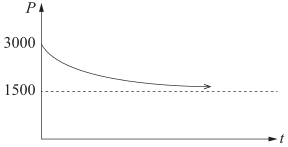
The diagram shows the number of penguins, `P(t)`, on an island at time `t`.


Which equation best represents this graph?

A.     `P(t) = 1500 + 1500e^(-kt)`

B.     `P(t) = 3000 - 1500e^(-kt)`

C.     `P(t) = 3000 + 1500e^(-kt)`

D.     `P(t) = 4500 - 1500e^(-kt)`

Show Answers Only

`A`

Show Worked Solution

`P(0) = 3000\ text{(from graph) → Eliminate B and C}`
 

`text(As),\ t -> oo,\ 1500e^(-kt) -> 0,`

`:. 1500 + 1500e^(-kt) => 1500`

`=>  A`

Filed Under: Exponential Growth and Decay EXT1, Standard Growth and Decay Tagged With: Band 4, smc-1081-20-Decay, smc-1081-40-Population

Calculus, EXT1* C1 2004 HSC 7b

At the beginning of 1991 Australia’s population was 17 million. At the beginning of 2004 the population was 20 million.

Assume that the population `P` is increasing exponentially and satisfies an equation of the form  `P = Ae^(kt)`, where  `A`  and  `k`  are constants, and  `t`  is measured in years from the beginning of 1991.

  1. Show that  `P = Ae^(kt)`  satisfies  `(dP)/(dt) =kP`.  (1 mark)

    --- 2 WORK AREA LINES (style=lined) ---

  2. What is the value of  `A`?  (1 mark)

    --- 2 WORK AREA LINES (style=lined) ---

  3. Find the value of  `k`.  (2 marks)

    --- 6 WORK AREA LINES (style=lined) ---

  4. Predict the year during which Australia’s population will reach 30 million.  (2 marks)

    --- 8 WORK AREA LINES (style=lined) ---

Show Answers Only
  1. `kP`
  2. `1.7 × 10^7`
  3. `0.013\ \ text(to 3 decimal places.)`
  4. `2036`
Show Worked Solution
i.   `P` `= Ae^(kt)`
  `(dP)/(dt)` `= kAe^(kt)`
    `= kP`


ii.  `P = Ae^(kt)`

`text(When)\ \ t = 0, \ P = 1.7 × 10^7`

`1.7 × 10^7` `= Ae^0`
`1.7 × 10^7`  `= A xx 1` 
`:. A` `= 1.7 × 10^7` 


iii.  `P = 1.7 × 10^7e^(kt)`

`text(When)\ t = 13, \ P = 2 × 10^7`

`2 × 10^7` `= 1.7 × 10^7e^(13k)`
`(2 × 10^7)/(1.7 × 10^7)` `= e^(13k)`
`ln (2/(1.7))` `= ln e^(13k)`
  `= 13k`
`:.k` `= 1/13 ln (2/(1.7))`
  `= 0.0125…`
  `= 0.013\ \ \ text{(to 3 d.p.)}`


iv.  `P` `= 1.7 × 10^7e^(kt)`

`text(Find)\ \ t\ \ text(when)\ \ P = 3 × 10^7,`

MARKER’S COMMENT: Many students had the correct calculations but didn’t answer the question by identifying the exact year and lost a valuable mark.
`3 × 10^7` `= 1.7 × 10^7e^(kt)`
`(3 × 10^7)/(1.7 × 10^7)` `= e^(kt)`
`ln (3/(1.7))` `= ln e^(kt)`
`ln (3/(1.7))` `= kt ln e`
  `= kt`
`:.t` `= (ln (3/(1.7)))/k`
 

`= (ln(3/(1.7)))/(0.0125…)`

  `= 45.433…`
  `= 45.4\ \ text{years    (to 1 d.p.)}`


`:.\ text(The population will reach 30 million in 2036.)`

Filed Under: Exponential growth and decay, Standard Growth and Decay Tagged With: Band 3, Band 4, smc-1081-10-Growth, smc-1081-40-Population

Calculus, EXT1* C1 2006 HSC 6b

A rare species of bird lives only on a remote island. A mathematical model predicts that the bird population, `P`, is given by

`P = 150 + 300 e^(-0.05t)`

where `t` is the number of years after observations began.

  1. According to the model, how many birds were there when observations began?  (1 mark)

    --- 2 WORK AREA LINES (style=lined) ---

  2. According to the model, what will be the rate of change in the bird population ten years after observations began?  (2 marks)

    --- 5 WORK AREA LINES (style=lined) ---

  3. What does the model predict will be the limiting value of the bird population?  (1 mark)

    --- 3 WORK AREA LINES (style=lined) ---

  4. The species will become eligible for inclusion in the endangered species list when the population falls below `200`. When does the model predict that this will occur?  (2 marks)

    --- 6 WORK AREA LINES (style=lined) ---

Show Answers Only
  1. `450\ text(birds)`
  2. `-9.1\ text{(to 1 d.p.)}`
  3. `150\ text(birds)`
  4. `text(After 35.83… years)`
Show Worked Solution

i.  `P = 150 + 300 e^(-0.05t)`

`text(When)\ \ t = 0`

`P` `= 150 + 300 e^0`
  `= 450`

 
`:.\ text(There were 450 birds when observations began.)`
 

ii.  `(dP)/dt` `= 300 xx (-0.05) xx e^(-0.05t)`
  `= -15 e^(-0.05t)`

 
`text(When)\ \ t = 10`

`(dP)/dt` `= -15 e^(-0.05 xx 10)`
  `= -15 e^(-0.5)`
  `= -9.097…`
  `= -9.1\ text{(to 1 d.p.)}`


`:.\ text(After 10 years, the bird population will be)`

`text(decreasing at a rate of 9.1 birds per year.)`


iii.  `text(As)\ t rarr oo`

`300 e^(-0.05t) rarr 0`

`:. P = 150 + 300 e^(-0.05t) rarr 150`

`:.\ text(The model predicts a limiting population)`

`text(of 150 birds.)`


iv.  `text(Find)\ t\ text(when)\ P < 200`

`150 + 300 e^(-0.05t)` `< 200`
`300 e^(-0.05t)` `< 50`
`e^(-0.05t)` `< 50/300`
`ln e^(-0.05t)` `< ln­ 1/6`
`-0.05t` `< ln­ 1/6`
`t` `> (ln­ 1/6)/(-0.05t)`
`t` `> 35.83…`


`:.\ text(The model predicts the population)`

`text(will fall below 200 after 35.83… years.)`

Filed Under: Exponential growth and decay, Standard Growth and Decay Tagged With: Band 3, Band 4, smc-1081-20-Decay, smc-1081-40-Population

Calculus, EXT1* C1 2010 HSC 8a

Assume that the population,  `P`,  of cane toads in Australia has been growing at a rate proportional to  `P`.  That is,  `(dP)/(dt)=kP`  where `k`  is a positive constant.

There were 102 cane toads brought to Australia from Hawaii in 1935.

Seventy-five years later, in 2010, it is estimated that there are 200 million cane toads in Australia.

If the population continues to grow at this rate, how many cane toads will there be in Australia in 2035?   (4 marks)

--- 8 WORK AREA LINES (style=lined) ---

Show Answers Only

`2.5xx10^10`

Show Worked Solution

`text(S)text(ince)\ (dP)/(dt)=kP\ \ \ =>\ P=P_0e^(kt)`

NOTE: Students should be comfortable converting 200 million into scientific notation. It can help noting that 200 million `=200xx10^6“=2 xx 10^8`

`text(At)\ \ t=0,\ \ P=102`

`102` `=P_0xxe^0`
`:.P_0` `=102`

 
`text(When)\ \ t=75,\ P=200\ text(million)=2xx10^8`

MARKER’S COMMENT: This question differed from previous years in that it did not ask students to verify that that  `P=P_0e^(kt)`  is a solution to  `(dP)/(dt)=kP`.
`:.2xx10^8` `=102e^(75xxk)`
`e^(75xxk)` `=(2xx10^8)/102`
`75k` `=ln((2xx10^8)/102)`
`k` `=1/75ln((2xx10^8)/102)`
  `=0.1931847…`

 
`text(Find)\ P\ text{when t = 100  (in 2035)`

`P` `=102xxe^(100k),\ \ \ \ \ k=ln((2xx10^8)/102)`
  `=2.503… xx10^10`
  `=2.5xx10^10\ \ text{(to 2 sig. figures)}`

 
`:.\ text(There will be)\ 2.5xx10^10\ text(cane toads.)`

Filed Under: Exponential growth and decay, Standard Growth and Decay Tagged With: Band 4, smc-1081-10-Growth, smc-1081-40-Population

Calculus, EXT1* C1 2012 HSC 14c

Professor Smith has a colony of bacteria. Initially there are 1000 bacteria. The number of bacteria,  `N(t)`,  after  `t`  minutes is given by

`N(t)=1000e^(kt)`. 

  1. After 20 minutes there are 2000 bacteria.


    Show that `k=0.0347`  correct to four decimal places.   (1 mark)

    --- 4 WORK AREA LINES (style=lined) ---

  2. How many bacteria are there when  `t=120`?    (1 mark)

    --- 2 WORK AREA LINES (style=lined) ---

  3. What is the rate of change of the number of bacteria per minute, when  `t=120`?     (1 mark)

    --- 5 WORK AREA LINES (style=lined) ---

  4. How long does it take for the number of bacteria to increase from 1000 to 100 000?    (2 marks)

    --- 7 WORK AREA LINES (style=lined) ---

Show Answers Only
  1. `text{Proof (See Worked Solutions).}`
  2. `64\ 328`
  3. `2232`
  4. `133\ text(minutes)` 
Show Worked Solution

i.   `N=1000e^(kt)\ text(and given)\ N=2000\ text(when)\  t=20`

`2000` `=1000e^(20xxk)`
`e^(20k)` `=2`
`lne^(20k)` `=ln2`
`20k` `=ln2`
`:.k` `=ln2/20`
  `=0.0347\ \ text{(to 4 d.p.)  … as required}`


 ii.  `text(Find)\ \ N\ \ text(when)\  t=120`

NOTE: Students could have used the exact value of  `k=ln2/20`  in parts (ii), (iii) and (iv), which would yield the answers (ii) 64,000, (iii) 2,218, and (iv) 133 minutes.
`N` `=1000e^(120xx0.0347)`
  `=64\ 328.321..`
  `=64\ 328\ \ text{(nearest whole number)}`

 
`:.\ text(There are)\  64\ 328\ text(bacteria when t = 120.)`
 

iii.  `text(Find)\ (dN)/(dt)\ text(when)\  t=120`

MARKER’S COMMENT: This part proved challenging for many students. Differentiation is required to find the rate of change in these type of questions.
`(dN)/(dt)` `=0.0347xx1000e^(0.0347t)`
  `=34.7e^(0.0347t)`

 
`text(When)\ \ t=120`

`(dN)/(dt)` `=34.7e^(0.0347xx120)`
  `=2232.1927…`
  `=2232\ \ text{(nearest whole)}`

 
`:.\ (dN)/(dt)=2232\ text(bacteria per minute at)\  t=120`


iv.  `text(Find)\ \ t\ \ text(such that)\  N=100,000`

`=>100\ 000` `=1000e^(0.0347t)`
`e^(0.0347t)` `=100`
`lne^(0.0347t)` `=ln100`
`0.0347t` `=ln100`
`t` `=ln100/0.0347`
  `=132.7138…`
  `=133\ \ text{(nearest minute)}`

 
`:.\ N=100\ 000\ text(when)\  t=133\ text(minutes.)`

Filed Under: Exponential growth and decay, Standard Growth and Decay Tagged With: Band 2, Band 3, Band 4, page-break-before-solution, smc-1081-10-Growth, smc-1081-40-Population

Calculus, EXT1* C1 2013 HSC 16b

Trout and carp are types of fish. A lake contains a number of trout. At a certain time, 10 carp are introduced into the lake and start eating the trout. As a consequence, the number of trout,  `N`,  decreases according to

`N=375-e^(0.04t)`,

where `t` is the time in months after the carp are introduced.

The population of carp,  `P`,  increases according to  `(dP)/(dt)=0.02P`.

  1. How many trout were in the lake when the carp were introduced?    (1 mark)

    --- 2 WORK AREA LINES (style=lined) ---

  2. When will the population of trout be zero?    (1 mark)

    --- 6 WORK AREA LINES (style=lined) ---

  3. Sketch the number of trout as a function of time.     (1 marks)

    --- 6 WORK AREA LINES (style=lined) ---

  4. When is the rate of increase of carp equal to the rate of decrease of trout?    (3 marks)

    --- 10 WORK AREA LINES (style=lined) ---

  5. When is the number of carp equal to the number of trout?    (2 marks)

    --- 8 WORK AREA LINES (style=lined) ---

Show Answers Only
  1. `text(374 trout)`
  2. `text{148 months (nearest month)}`
  3.  
     
    2UA 2013 HSC 16b Answer
  4. `text{After 80 months (nearest month)}`
  5. `text{After 135 months (nearest month)}`
Show Worked Solution

i.    `text(Carp introduced at)\ \ t=0`

MARKER’S COMMENT: A number of students did not equate `e^0=1` in this part.

`N=375-e^0=374`

`:.\ text(There was 374 trout when carp were introduced.)`


ii.    `text(Trout population will be zero when)`

NOTE: The last line of the solution isn’t necessary but is included as good practice as a check that the answer matches the exact question asked.
`N` `=375-e^(0.04t)=0`
`e^(0.04t)` `=375`
`0.04t` `=ln375`
`t` `=ln375/0.04`
  `=148.173 …`
  `=148\ text{months (nearest month)}`

 
`:.\ text(After 148 months, the trout population will be zero.)`
 

iii.   2UA 2013 HSC 16b Answer

♦♦ Mean mark 33% for part (iii)


iv.   `text(We need) \ |(dN)/(dt)|=(dP)/(dt)`

`text(Given)\ N=375-e^(0.04t)`

`(dN)/(dt)=-0.04e^(0.04t)`
  

`text(Find)\ P\ text(in terms of)\  t`

`text(Given)\ (dP)/(dt)=0.02P`

`=> P=Ae^(0.02t)`

♦♦♦ Mean mark 20%
COMMENT: Students who progressed to `0.2e^(0.02t)“=0.04e^(0.04t)` received 2 full marks in this part. Show your working!

 `text(Find)\ A\ \ =>text(when)\  t=0,\ P=10`

`10` `=Ae^0`
`:.A` `=10`
`=>(dP)(dt)` `=10xx0.02e^(0.02t)`
  `=0.2e^(0.02t)`

 
`text(Given that)\ \ (dP)/(dt)=|(dN)/(dt)|`

`0.2e^(0.02t)` `=0.04e^(0.04t)`
`5e^(0.02t)` `=e^(0.04t)`
`e^(0.04t)/e^(0.02t)` `=5`
`e^(0.04t-0.02t)` `=5`
`lne^(0.02t)` `=ln5`
`0.02t` `=ln5`
`t` `=ln5/0.02`
  `=80.4719…`
  `=80\ text{months (nearest month)}`


v.   `text(Find)\ t\ text(when)\ N=P`

`text(i.e.)\ \ 375-e^(0.04t)` `=10e^(0.02t)`
`e^(0.04t)+10e^(0.02t)-375` `=0`

`text(Let)\ X=e^(0.02t),\ text(noting)\ \ X^2=(e^(0.02t))^2=e^(0.04t)`

♦♦♦ Mean mark 4%!
MARKER’S COMMENT: Correctly applying substitution to exponentials to form a solvable quadratic proved very difficult for almost all students.
`:.\ X^2+10X-375` `=0`
`(X-15)(X+25)` `=0`

`X=15\ \ text(or)\ \ –25`

 
`text(S)text(ince)\  X=e^(0.02t)`

`e^(0.02t)` `=15\ \ \ \ (e^(0.02t)>0)`
`lne^(0.02t)` `=ln15`
`0.02t` `=ln15`
`t` `=ln15/0.02`
  `=135.4025…`
  `=135\ text(months)`

Filed Under: Exponential growth and decay, Standard Growth and Decay Tagged With: Band 3, Band 4, Band 5, Band 6, smc-1081-10-Growth, smc-1081-20-Decay, smc-1081-40-Population

Copyright © 2014–2025 SmarterEd.com.au · Log in