SmarterEd

Aussie Maths & Science Teachers: Save your time with SmarterEd

  • Login
  • Get Help
  • About

Statistics, STD1 S1 2024 HSC 13

Consider the following dataset.

\(1, \ 1, \ 2, \ 3, \ 5, \ 7, \ 15\)

  1. What is the interquartile range?   (1 mark)

    --- 2 WORK AREA LINES (style=lined) ---

  2. By using the outlier formula, determine whether 15 is an outlier.   (2 marks)

    --- 4 WORK AREA LINES (style=lined) ---
Show Answers Only

a.    \(\text{IQR = 6}\)

b.    \(15\ \text{is not an outlier as it is not greater than 16.}\)

Show Worked Solution

a.    \(Q_2=3, \ Q_1=1, \ Q_3=7\)

\(\therefore\ IQR=7-1=6\)
 

♦♦♦ Mean mark (a) 25%.

b.   \(\text{Find upper fence:}\)

\(Q_3+1.5\times IQR=7 + 1.5\times 6=16\)

\(\therefore\ \text{15 is not an outlier (15 < 16)}\)

♦♦ Mean mark (b) 32%.

Filed Under: Summary Statistics (Std 1) Tagged With: Band 5, Band 6, smc-1131-30-IQR and Outliers

Statistics, STD1 S1 2023 HSC 20

Consider the following dataset.

22, 27, 29, 32, 36, 37, 39, 45, 47, 58

Is 58 an outlier in this dataset? Justify your answer with working.  (3 marks)

--- 6 WORK AREA LINES (style=lined) ---

Show Answers Only

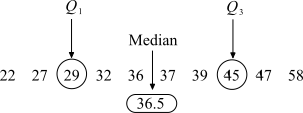
\(\text{Median}=\dfrac{36+37}{2}=36.5\)

\(Q_1=29\ \ \text{and}\ \ Q_3=45\)

\(IQR=Q_3-Q_1=45-29=16\)

\(Q_3+1.5\times IQR=45+1.5\times 16=69\)

\(\therefore\ \text{58 is not an outlier (58 < 69).}\)

Show Worked Solution

\(\text{Median}=\dfrac{36+37}{2}=36.5\)

\(Q_1=29\ \ \text{and}\ \ Q_3=45\)

\(IQR=Q_3-Q_1=45-29=16\)

\(Q_3+1.5\times IQR=45+1.5\times 16=69\)

\(\therefore\ \text{58 is not an outlier (58 < 69).}\)


♦♦♦ Mean mark 17%.

Filed Under: Summary Statistics (Std 1) Tagged With: Band 6, smc-1131-30-IQR and Outliers

Statistics, STD1 S1 2022 HSC 29

The ages of the 10 members in a tennis club are

`{:[24,25,27,33,34,34,35,39,47,59.]:}`

Could the age `59` be considered an outlier? Justify your answer with calculations.  (3 marks)

--- 6 WORK AREA LINES (style=lined) ---

Show Answers Only

`Q_1=27, \ Q_3=39`

`IQR = Q_3-Q_1 = 39-27 = 12`
 

`text{Upper limit:}`

`Q_3 + 1.5 xx IQR` `=39 + 1.5 xx 12`  
  `=39 + 1.5 xx 12`  
  `=57`  

  
`:.\ text{S}text{ince  59 > 57,  59 is an outlier.}`

Show Worked Solution

`Q_1=27, \ Q_3=39`

`IQR = Q_3-Q_1 = 39-27 = 12`
 

`text{Upper limit:}`

`Q_3 + 1.5 xx IQR` `=39 + 1.5 xx 12`  
  `=39 + 1.5 xx 12`  
  `=57`  

  
`:.\ text{S}text{ince  59 > 57,  59 is an outlier.}`


♦♦♦ Mean mark 11%.

Filed Under: Summary Statistics (Std 1) Tagged With: Band 6, smc-1131-30-IQR and Outliers

Statistics, STD2 S1 2021 HSC 17

The five-number summary of a dataset is given.

Lowest score = 1

Lowest quartile (`Q_1`) = 4

Median (`Q_2`) = 7

Upper quartile (`Q_3`) = 10

Highest score = 20

Is 20 an outlier? Justify your answer with calculations.  (2 marks)

--- 5 WORK AREA LINES (style=lined) ---

Show Answers Only

`text(20 is an outlier – See Worked Solution)`

Show Worked Solution

`IQR = Q_3 – Q_1 = 10-4=6`

COMMENT: Stating 20 > 19 is necessary to justify this answer.
`text(Upper Fence)` `= Q_3 + 1.5 xx IQR`
  `=10 + 1.5 xx 6`
  `=19`

  
`text{S}text{ince 20 > 19, 20 is an outlier.}`

Filed Under: Measures of Centre and Spread (Std2-2027), Summary Statistics - No Graph (Std 2), Summary Statistics (Std 1) Tagged With: Band 4, smc-1131-30-IQR and Outliers, smc-6312-30-IQR and Outliers, smc-824-30-IQR and Outliers

Statistics, STD1 S1 2019 HSC 19

The heights, in centimetres, of 10 players on a basketball team are shown.

170, 180, 185, 188, 192, 193, 193, 194, 196, 202

Is the height of the shortest player on the team considered an outlier? Justify your answer with calculations.  (3 marks)

Show Answers Only

`text(See Worked Solutions)`

Show Worked Solution

`Q_1 = 185, quad Q_3 = 194`

♦♦ Mean mark 24%.

`IQR = 194 – 185 = 9`

`text(Shortest player = 170)`

`text(Outlier height:)`

COMMENT: The last statement must be made to achieve full marks here!

`Q_1 – 1.5 xx IQR ` `= 185 – 1.5 xx 9`
  `= 171.5`

 
`:.\ text(S)text(ince 170 < 171.5, 170 is an outlier.)`

Filed Under: Summary Statistics (Std 1) Tagged With: Band 5, smc-1131-30-IQR and Outliers

Statistics, STD2 S1 2018 HSC 26e

A cumulative frequency table for a data set is shown.

\begin{array} {|c|c|}
\hline
\ \ \ \ \ \ \ \textit{Score}\ \ \ \ \ \ \   & \ \ \ \ \ \textit{Cumulative}\ \ \ \ \  \\ & \textit{frequency} \\
\hline
\rule{0pt}{2.5ex} \text{1} \rule[-1ex]{0pt}{0pt} & 5 \\
\hline
\rule{0pt}{2.5ex} \text{2} \rule[-1ex]{0pt}{0pt} & 9 \\
\hline
\rule{0pt}{2.5ex} \text{3} \rule[-1ex]{0pt}{0pt} & 16 \\
\hline
\rule{0pt}{2.5ex} \text{4} \rule[-1ex]{0pt}{0pt} & 20 \\
\hline
\rule{0pt}{2.5ex} \text{5} \rule[-1ex]{0pt}{0pt} & 34 \\
\hline
\rule{0pt}{2.5ex} \text{6} \rule[-1ex]{0pt}{0pt} & 42 \\
\hline
\end{array}

What is the interquartile range of this data set?   (2 marks)

--- 4 WORK AREA LINES (style=lined) ---

Show Answers Only

`2`

Show Worked Solution

`text(42 data points ⇒ median) = text(21st + 22nd)/2`

♦♦ Mean mark 27%.

`text(Q)_1` `= 11text(th data point) = 3`
`text(Q)_3` `= 32text(nd data point) = 5`


`:.\ text(IQR)` `= 5 – 3`
  `= 2`

Filed Under: Measures of Centre and Spread (Std2-2027), Summary Statistics - No Graph (Std 2), Summary Statistics - No graph (Y12), Summary Statistics (Std 1) Tagged With: Band 5, common-content, smc-1131-30-IQR and Outliers, smc-1131-60-Frequency Tables, smc-6312-30-IQR and Outliers, smc-6312-60-Frequency Tables, smc-824-30-IQR and Outliers, smc-824-60-Frequency Tables, smc-999-30-IQR and Outliers, smc-999-60-Frequency Tables

Statistics, STD2 S1 2017 HSC 30a

A set of data has a lower quartile (`Q_L`) of 10 and an upper quartile (`Q_U`) of 16.

What is the maximum possible range for this set of data if there are no outliers?  (2 marks)

--- 4 WORK AREA LINES (style=lined) ---

Show Answers Only

`24`

Show Worked Solution

`IQR = 16 – 10 = 6`

♦♦ Mean mark 34%.

`text(If no outliers,)`

`text(Upper limit)` `= Q_U + 1.5 xx IQR`
  `= 16 + 1.5 xx 6`
  `= 25`
`text(Lower limit)` `= Q_L – 1.5 xx IQR`
  `= 10 – 1.5 xx 6`
  `= 1`


`:.\ text(Maximum range)` `= 25 – 1`
  `= 24`

Filed Under: Measures of Centre and Spread (Std2-2027), Summary Statistics - No Graph (Std 2), Summary Statistics - No graph (Y12), Summary Statistics (no graph), Summary Statistics (Std 1) Tagged With: Band 5, common-content, smc-1131-30-IQR and Outliers, smc-6312-30-IQR and Outliers, smc-824-30-IQR and Outliers, smc-999-30-IQR and Outliers

Statistics, STD2 S1 2015 HSC 27d

In a small business, the seven employees earn the following wages per week:

\(\$300, \ \$490, \ \$520, \ \$590, \ \$660, \ \$680, \ \$970\)

  1.  Is the wage of $970 an outlier for this set of data? Justify your answer with calculations.  (3 marks)

    --- 6 WORK AREA LINES (style=lined) ---

  2.  Each employee receives a $20 pay increase.


     What effect will this have on the standard deviation?  (1 mark)

    --- 2 WORK AREA LINES (style=lined) ---

Show Answers Only

i.    \(\text{See Worked Solutions.} \)

ii.    \(\text{The standard deviation will remain the same.}\)

Show Worked Solution

i.    \(300, 490, 520, 590, 660, 680, 970\)

\(\text{Median}\) \(= 590\)
\(Q_1\) \(= 490\)
\(Q_3\) \(= 680\)
\(IQR\) \(= 680-490 = 190\)


\(\text{Outlier if \$970 is greater than:} \)

\(Q_3 + 1.5 x\times IQR = 680 + 1.5 \times 190 = \$965 \) 

\(\therefore\ \text{The wage \$970 per week is an outlier.}\)

♦ Mean mark (i) 39%.


ii. 
  \(\text{All values increase by \$20, but so too does the mean.} \)

\(\text{Therefore the spread about the new mean will not change} \)

\(\text{and therefore the standard deviation will remain the same.} \)

Filed Under: Measures of Centre and Spread (Std2-2027), Summary Statistics - No Graph (Std 2), Summary Statistics - No graph (Y12), Summary Statistics (no graph), Summary Statistics (Std 1) Tagged With: Band 4, Band 5, common-content, smc-1131-30-IQR and Outliers, smc-1131-50-Std Dev (by calc), smc-6312-30-IQR and Outliers, smc-6312-50-Std Dev (by Calc), smc-824-30-IQR and Outliers, smc-824-50-Std Dev (by calc), smc-999-30-IQR and Outliers, smc-999-50-Std Dev (by calc)

Statistics, STD2 S1 2007 HSC 21 MC

This set of data is arranged in order from smallest to largest.

 `5, \ 6, \ 11, \ x, \ 13, \ 18, \ 25`

The range is six less than twice the value of  `x`.

Which one of the following is true?

  1.    The median is 12 and the interquartile range is 7.
  2.    The median is 12 and the interquartile range is 12.
  3.    The median is 13 and the interquartile range is 7.
  4.    The median is 13 and the interquartile range is 12.
Show Answers Only

`D`

Show Worked Solution

`5, 6, 11, x, 13, 18, 25`

`text(Range)` `= 2x – 6`
`25 – 5` `= 2x – 6`
`2x` `= 26`
`x` `= 13`
`:.\ text(Median)` `= 13`

 
`Q_1 = 6\ \ \ \ \ Q_3 = 18`

`:.\ text(IQR) = 12`

 
`=>  D`

Filed Under: Measures of Centre and Spread (Std2-2027), Summary Statistics - No Graph (Std 2), Summary Statistics - No graph (Y12), Summary Statistics (no graph), Summary Statistics (Std 1) Tagged With: Band 5, common-content, smc-1131-20-Median and Mode, smc-1131-30-IQR and Outliers, smc-1131-70-Other, smc-6312-20-Median and Mode, smc-6312-30-IQR and Outliers, smc-6312-70-Other, smc-824-20-Median and Mode, smc-824-30-IQR and Outliers, smc-824-70-Other, smc-999-20-Median and Mode, smc-999-70-Other

Copyright © 2014–2025 SmarterEd.com.au · Log in