SmarterEd

Aussie Maths & Science Teachers: Save your time with SmarterEd

  • Login
  • Get Help
  • About

Complex Numbers, SPEC1 2022 VCAA 1

Consider the equation  `p(z)=z^2 + 6iz - 25`, `z ∈ C`.

  1. Express `p(z)` in the form  `p(z) = (z+ai)^2 + b`  where  `a`, ` b  ∈ R`.   (1 mark)

    --- 3 WORK AREA LINES (style=lined) ---

  2. Hence, or otherwise, find the solutions of the equation  `p(z) = 0`.   (2 marks)

    --- 4 WORK AREA LINES (style=lined) ---
Show Answers Only
  1. `p(z) = (z + 3i)^2-16`
  2. `z =  ± 4-3i`
Show Worked Solution
a.   `p(z)` `= (z + 3i)^2-(3i)^2-25`
    `=(z + 3i)^2 +9-25`
    `=(z + 3i)^2-16`


b.  
`(z + 3i)^2` `= 16`
  `z + 3i` `= ± 4`
  `z ` `= ± 4-3i`

Filed Under: Factors and Roots (SM) Tagged With: Band 3, smc-1172-10-Quadratic roots

Complex Numbers, SPEC1 2021 VCAA 8

  1. Solve  `z^2 + 2z + 2 = 0`  for `z`, where  `z ∈ C`.   (1 mark)

    --- 4 WORK AREA LINES (style=lined) ---
  2. Solve  `z^2 + 2barz + 2 = 0`  for `z`, where  `z ∈ C`.   (3 marks)

    --- 7 WORK AREA LINES (style=lined) ---

Show Answers Only
  1. `z = -1-i\ \ text(or)\ \ -1 + i`
  2. `z = 1 ± sqrt5 i`
Show Worked Solution
a.    `z^2 + 2z + 2` `= 0`
  `z^2 + 2z + 1 + 1` `= 0`
  `(z + 1)^2 + 1` `= 0`
  `(z + 1)^2-i^2` `= 0`
  `(z + 1 + i)(z + 1-i)` `= 0`

 
`:. z = -1-i\ \ \ text(or)\ \ -1 + i`


b.   `z = x + yi \ => \ barz = x-yi`

♦♦ Mean mark part (b) 28%.
`z^2 + 2barz + 2` `= 0`
`(x + yi)^2 + 2(x-yi) + 2` `= 0`
`x^2 + 2xyi-y^2 + 2x-2yi + 2` `= 0`
`x^2-y^2 + 2x + 2 + (2xy-2y)i` `= 0`


`text(Find)\ \ x, y\ text(such that)`

`x^2-y^2 + 2x + 2` `= 0\ …\ (1)`
`2xy-2y` `= 0\ …\ (2)`

 
`text(When)\ \ 2xy-2y = 0`

`2y(x-1)` `= 0`
`x` `= 1`

 
`text(Substitute)\ \ x = 1\ \ text{into (1)}`

`1-y^2 + 2 + 2` `= 0`
`y^2` `= 5`
`y` `= ±sqrt5`

 
`:. z = 1 ± sqrt5 i`

Filed Under: Factors and Roots (SM) Tagged With: Band 4, Band 5, smc-1172-10-Quadratic roots

Complex Numbers, SPEC2 2019 VCAA 2

  1. Show that the solutions of  `2z^2 + 4z + 5 = 0`, where  `z ∈ C`, are  `z = −1 ± sqrt6/2 i`.   (1 mark)

    --- 3 WORK AREA LINES (style=lined) ---

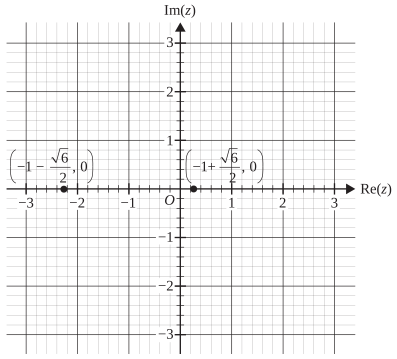
  2. Plot the solutions of  `2z^2 + 4z + 5 = 0`  on the Argand diagram below.   (1 mark)

    --- 0 WORK AREA LINES (style=lined) ---


Let  `|z + m| = n`, where  `m, n ∈ R`, represent the circle of minimum radius that passes through the solutions of  `2z^2 + 4z + 5 = 0`.

    1. Find  `m`  and  `n`.   (2 marks)

      --- 3 WORK AREA LINES (style=lined) ---

    2. Find the cartesian equation of the circle  `|z + m| = n`.   (1 mark)

      --- 2 WORK AREA LINES (style=lined) ---

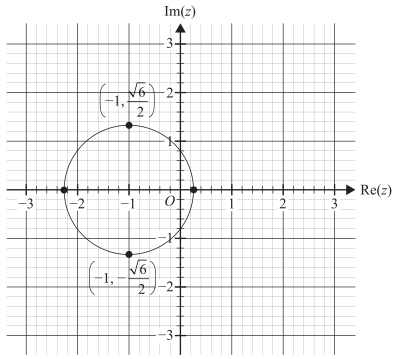
    3. Sketch the circle on the Argand diagram in part a.ii. Intercepts with the coordinate axes do not need to be calculated or labelled.   (1 mark)

      --- 0 WORK AREA LINES (style=lined) ---

  1. Find all values of  `d`, where  `d ∈ R`, for which the solutions of  `2z^2 + 4z + d = 0`  satisfy the relation  `|z + m| <= n`.   (2 marks)

    --- 4 WORK AREA LINES (style=lined) ---
  2. All complex solutions of  `az^2 + bz + c = 0`  have non-zero real and imaginary parts.


    Let  `|z + p| = q`  represent the circle of minimum radius in the complex plane that passes through these solutions, where  `a, b, c, p, q ∈ R`.


    Find  `p`  and  `q`  in terms of  `a, b`  and  `c`.   (2 marks)

    --- 4 WORK AREA LINES (style=lined) ---
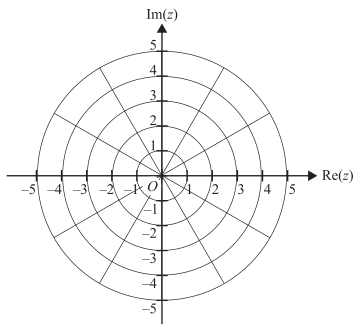
Show Answers Only
  1. `text(See Worked Solutions)`
  2.   
  3. `m = 1, n = sqrt6/2`
  4. `(x + 1)^2 + y^2 = 3/2`
  5. `−1 <= d <= 5\ \ (text(by CAS))`
  6. `p = b/(2a), \ q = |sqrt(b^2-4ac)/(2a)|`
Show Worked Solution
a.i.    `z` `= (−b ± sqrt(b^2-4ac))/(2a)`
    `= (−4 ± sqrt(16-4 · 2 · 5))/(4)`
    `= (−4 ± 2sqrt6 i)/(4)`
    `= −1 ± sqrt6/2 i\ \ …\ text(as required)`


a.ii.   


b.i.   `text(Radius of circle = )sqrt6/2`

 `text(Centre) = (0, −1)`

`:. m = 1, \ n = sqrt6/2`


b.ii.    `|z + 1|` `= sqrt6/2`
  `|x + iy + 1|` `= sqrt6/2`
  `(x + 1)^2 + y^2` `= 3/2`


b.iii.   


c.   `text(Solve:)\ 2z^2 + 4z + d = 0`

`z = −1 ± sqrt(4-2d)/2 = −1 ± sqrt((2-d)/2)`

`z + 1 = ± sqrt((2-d)/2)`
 

`text(Solve for)\ d\ text(such that:)`

`|sqrt((2-d)/2)| <= sqrt6/2`

`−1 <= d <= 5\ \ (text(by CAS))`


d.   `z = (−b ± sqrt(b^2-4ac))/(2a) = (−b)/(2a) ± sqrt(b^2-4ac)/(2a)`

`z + b/(2a)` `= ± sqrt(b^2-4ac)/(2a)`
`|z + b/(2a)|` `= |sqrt(b^2-4ac)/(2a)|`

 
`:. p = b/(2a), \ q = |sqrt(b^2-4ac)/(2a)|`

Filed Under: Factors and Roots (SM), Geometry and Complex Numbers (SM) Tagged With: Band 3, Band 4, Band 5, Band 6, smc-1172-10-Quadratic roots, smc-1172-60-Sketch solutions, smc-1173-10-Circles

Complex Numbers, SPEC2 2017 VCAA 4

  1. Express  `−2-2sqrt3 i`  in polar form.  (1 mark)

    --- 3 WORK AREA LINES (style=lined) ---
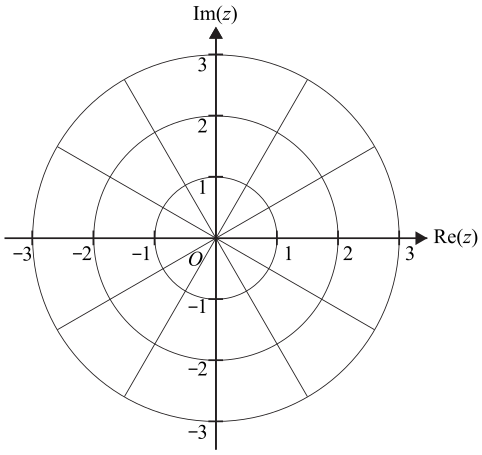
  2. Show that the roots of  `z^2 + 4z + 16 = 0`  are  `z = −2-sqrt3 i`  and  `z = −2 + 2sqrt3 i`.  (1 mark)

    --- 3 WORK AREA LINES (style=lined) ---
  3. Express the roots of  `z^2 + 4z + 16 = 0`  in terms of  `2-2sqrt3 i`.  (1 mark)

    --- 2 WORK AREA LINES (style=lined) ---

  4. Show that the cartesian form of the relation  `|z| = |z-(2-2sqrt3 i)|`  is  `x-sqrt3 y-4 = 0`  (2 marks)

    --- 5 WORK AREA LINES (style=lined) ---

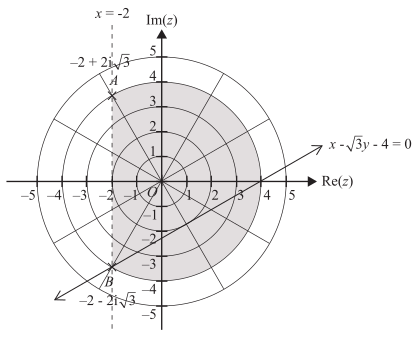
  5. Sketch the line represented by  `x-sqrt3y -4 = 0`  and plot the roots of  `z^2 + 4z + 16 = 0`  on the Argand diagram below.  (2 marks)

    --- 0 WORK AREA LINES (style=lined) ---


  6. The equation of the line passing through the two roots of  `z^2 + 4z + 16 = 0`  can be expressed as  `|z-a| = |z-b|`, where  `a, b ∈ C`.


    Find `b` in terms of `a`.  (1 mark)

    --- 3 WORK AREA LINES (style=lined) ---

  7. Find the area of the major segment bounded by the line passing through the roots of  `z^2 + 4z + 16 = 0`  and the major arc of the circle given by  `|z| = 4`.  (2 marks)

    --- 5 WORK AREA LINES (style=lined) ---

Show Answers Only
  1. `4text(cis)((−2pi)/3)`
  2. `text(See Worked Solutions)`
  3. `−(2-2sqrt3 i) and-bar((2-2sqrt3 i))`
  4. `text(See Worked Solutions)`
  5.  
  6. `−4-bara`
  7. `4sqrt3 + (32pi)/3`
Show Worked Solution
a.    `r` `= sqrt((−2)^2 + (−2sqrt3)^2)=4`


`theta` `= −pi + tan^(−1)((2sqrt3)/2)`
  `= −pi + pi/3`
  `=(-2pi)/3`

 
`:. −2-2sqrt3 i = 4text(cis)((−2pi)/3)`
 

b.   `z^2 + 4z + z^2-4 + 16` `=0`
`(z + 2)^2 + 12` `= 0`
`(z + 2)^2` `= -12`
`(z + 2)^2` `= 12i^2`
`z + 2` `= ±sqrt12 i`
`z + 2` `= ±2sqrt3 i`
`:. z` `= -2 ± 2sqrt3 i`


♦♦ Mean mark part (c) 31%.

c.    `z_1` `= -2 + 2sqrt3 i = -(2-2sqrt3 i)`
  `z_2` `=-2-2sqrt3 i =-bar((2-2sqrt3 i))`


d. `|z|` `= |z-(2-2sqrt3 i)|`
     `x^2 + y^2` `= (x-2)^2 + (y + 2sqrt3)^2`
    `x^2 + y^2` `= x^2-4x + 4+ y^2 + 4sqrt3 y + 12`
  `0` `= −4x + 4sqrt3 y + 16`
  `0` `= −x + sqrt3 y + 4`

 
`:. x-sqrt3 y-4=0`


e.   


f.   `x = − 2\ \ text(is equidistant from)\ \ z_1 = a\ \ text(and)\ \ z_2 = b`

♦♦♦ Mean mark 1%!

`=> text(Im)(a) = text(Im)(a)`
 

`text(Let)\ \ a = alpha + betai, \ b = gamma + betaj`

`(alpha + gamma)/2` `= −2`
`alpha + gamma` `= −4`
`gamma` `= -4-alpha`


`:. b` `= -4-alpha + betaj`
  `= -4-(alpha + betaj)`
  `= -4-bara`


♦♦ Mean mark 31%.

g.    `text(Area)\ DeltaOAB` `= 1/2 xx (4sqrt3 xx 2)`
    `= 4sqrt3`


`text(Area of sector)\ AOB` `= pi xx 4^2 xx (2 xx pi/3)/(2pi)`
  `= (16pi)/3`

 
`:.\ text(Area of major segment area)`

`=pi(4)^2-((16pi)/3-4sqrt3)`

`= 4sqrt3 + (32pi)/3`

Filed Under: Factors and Roots (SM), Geometry and Complex Numbers (SM) Tagged With: Band 3, Band 4, Band 5, Band 6, smc-1172-10-Quadratic roots, smc-1172-60-Sketch solutions, smc-1173-30-Sketch regions, smc-1173-40-Linear

Complex Numbers, SPEC2-NHT 2017 VCAA 2

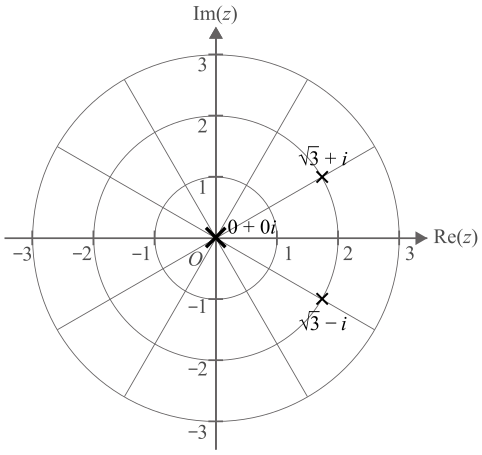
One root of a quadratic equation with real coefficients is  `sqrt 3 + i`.

    1. Write down the other root of the quadratic equation.   (1 mark)

      --- 2 WORK AREA LINES (style=lined) ---

    2. Hence determine the quadratic equation, writing it in the form  `z^2 + bz + c = 0`.   (2 marks)

      --- 5 WORK AREA LINES (style=lined) ---

  1. Plot and label the roots of   `z^3-2 sqrt 3 z^2 + 4z = 0`  on the Argand diagram below.   (3 marks)

    --- 0 WORK AREA LINES (style=lined) ---


  1. Find the equation of the line that is the perpendicular bisector of the line segment joining the origin and the point  `sqrt 3 + i`. Express your answer in the form  `y = mx + c`.   (2 marks)

    --- 5 WORK AREA LINES (style=lined) ---

  1. The three roots plotted in part b. lie on a circle.


    Find the equation of this circle, expressing it in the form  `|z-alpha| = beta`,  where  `alpha, beta in R`.   (3 marks)

    --- 5 WORK AREA LINES (style=lined) ---

Show Answers Only
    1. `z_2 = sqrt 3-i`
    2. `z^2-2 sqrt 3 z + 4 = 0`
  1. `text(See Worked Solutions)`
  2. `y = -sqrt 3 x + 2`
  3. `|z-2/sqrt 3 | = 2/sqrt 3`
Show Worked Solution

a.i.   `z_1 = sqrt 3 + i`

 `z_2 = bar z_1 = sqrt 3-i\ \ \ text{(conjugate root)}`


a.ii.    `(z-(sqrt 3 + i))(z-(sqrt 3-i))` `= 0`
  `((z-sqrt 3)-i)((z-sqrt 3) + i)` `= 0`
  `(z-sqrt 3)^2-i^2` `= 0`
  `z^2-2 sqrt 3 z + 3 + 1` `= 0`
  `z^2-2 sqrt 3 z + 4` `= 0`


b.    `z(z^2-2 sqrt 3 z + 4)` `= 0`
  `z(z-(sqrt 3 + i))(z-(sqrt 3-i))` `= 0`

 
`text(Convert to polar form:)`

  `sqrt 3 + i` `= sqrt((sqrt 3)^2 + 1^2) * text(cis) (tan^(-1)(1/sqrt 3))`
    `= 2 text(cis) (pi/6)`
  `=> sqrt 3-i` `= 2 text(cis) (-pi/6)`


c.   `text(Equidistant from)\ (0, 0) and (sqrt 3, 1)`

`text(Midpoint)\ (x_1, y_1)` `= (sqrt 3/2, 1/2)`

 
`m = (1-0)/(sqrt 3-0) = 1/sqrt 3`

`m_(_|_) = (-1)/m = -sqrt 3`
 

`:.\ text(Equation of ⊥ bisector:)`

`y-1/2` `=-sqrt3(x-sqrt3/2)`  
`y` `=-sqrt3 x +3/2+1/2`  
`:.y` `=-sqrt3 x +2`  


d.   `text(Let)\ O = (0, 0),\ P = (sqrt 3, 1),\ Q = (sqrt 3, -1)`

`text(⊥ bisector of two points on arc of a circle passes)`

`text(through the centre of the circle.)`
 

`OP = OQ = PQ = 2`

`=> Delta OPQ\ text(is equilateral)`
 

`text(⊥ bisector of)\ PQ\ text(is)\ y=0.`

`text(Centre of circle occurs when:)`

`0 = -sqrt 3 x + 2\ \ text{(using part c)`

`x=2/sqrt3`

`=>\ text(Radius)\ = 2/sqrt3`
 

`:. |z-2/sqrt 3| = 2/sqrt 3`

Filed Under: Factors and Roots (SM), Geometry and Complex Numbers (SM) Tagged With: Band 3, Band 4, Band 5, Band 6, smc-1172-10-Quadratic roots, smc-1172-20-Cubic roots, smc-1172-60-Sketch solutions

Copyright © 2014–2025 SmarterEd.com.au · Log in