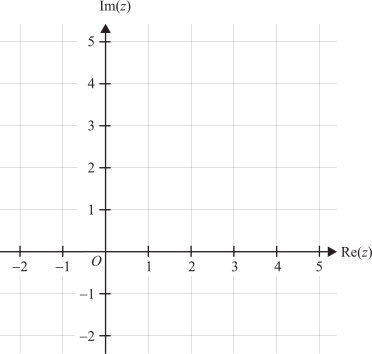
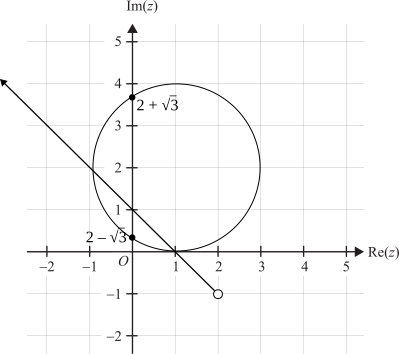
--- 4 WORK AREA LINES (style=lined) --- --- 5 WORK AREA LINES (style=lined) --- --- 2 WORK AREA LINES (style=lined) --- --- 0 WORK AREA LINES (style=lined) --- --- 2 WORK AREA LINES (style=lined) --- --- 4 WORK AREA LINES (style=lined) --- a. \(y=\dfrac{3}{2} x-\dfrac{11}{4}\) b. \(\abs{z-\left(\dfrac{5}{2}+i\right)} = \dfrac{\sqrt{13}}{2}\) c. d.i. \(\text{See image above}\) d.ii. \(\operatorname{Arg}(z-2+i)=\dfrac{3 \pi}{4}\) e. \(A=\pi-2\) a. \(\text{Method 1}\) \(z_1=1+2i, \quad z_2=4\) \(\abs{z-z_1}=\abs{z-z_2}\) \(\text{Equation can be written:}\) \(\text {Find line of points equidistant from \(\ z_1\) and \(z_2\)}\) \(m_{\text{line}\ z_1 z_2}=\dfrac{0-2}{4-1}=\dfrac{-2}{3}\) \(m_{\perp}=\dfrac{3}{2}\) \(\text{Mid point} \ z_1 z_2 =\dfrac{5+2i}{2}=\left(\dfrac{5}{2},1\right)\) \(\perp \ \text{bisector:} \ m=\dfrac{3}{2}, \ \text{passes through} \ \left(\dfrac{5}{2}, 1\right)\) b. \(\text{Centre of circle }=\text {midpoint}\left(z_1 z_2\right)\) \(z_c=\dfrac{z_1+z_2}{2}=\dfrac{5+2 i}{2}=\dfrac{5}{2}+i\) \(\text{Radius}(r)=\dfrac{1}{2} \times \text{diameter}\) \(r=\dfrac{1}{2} \sqrt{(4-1)^2+(0-2)^2}=\dfrac{\sqrt{13}}{2}\) \(\text{Circle equation:}\) \(\abs{z-\left(\dfrac{5}{2}+i\right)} = \dfrac{\sqrt{13}}{2}\) c. \(\text{Find \(y\)-axis intercepts \((z=y i)\):}\) \(4=\abs{z-(1+2i)}^2=\abs{yi-(1+2i)}^2=(-1)^2+(y-2)^2\) \(y^2-4y+1=0 \ \Rightarrow \ =2 \pm \sqrt{3}\) d.i. \(\text{See image above}\) d.ii. \(\operatorname{Arg}(z-2+i)=\dfrac{3 \pi}{4}\) e. \(\text{Circle radius}=2\) \(\text{Angle subtending minor segment}=\dfrac{\pi}{2}\) \(A=\dfrac{r^2}{2}(\theta-\sin \theta)=2\left(\dfrac{\pi}{2}-1\right)=\pi-2\)
\((x-1)^2+(y-2)^2\)
\(=(x-4)^2+y^2\)
\(-2x-4y+5\)
\(=-8x+16 \ \ \ \text{(all squares cancel)}\)
\(6x+4y\)
\(=11\)
\(y\)
\(=\dfrac{3}{2} x-\dfrac{11}{4}\)
\(\text{Method 2}\)
\(y-1\)
\(=\dfrac{3}{2}\left(x-\dfrac{5}{2}\right)\)
\(y\)
\(=\dfrac{3}{2} x-\dfrac{11}{4}\)
Complex Numbers, SPEC2 2022 VCAA 6 MC
Given `z=x+yi`, where `x, y \in R` and `z \in C`, an equation that has a graph that has two points of intersection with the graph given by `|z-5|=2` is
- `\text{Arg}(z-3)=\frac{\pi}{2}`
- `|z-1|=2`
- `\text{Im}(z)=2`
- `\text{Re}(z)+\text{Im}(z)=2`
- `|z-5-5 i|=4`
Complex Numbers, SPEC2 2021 VCAA 2
The polynomial `p(z) = z^3 + alpha z^2 + beta z + gamma`, where `z ∈ C` and `alpha, beta, gamma ∈ R`, can also be written as `p(z) = (z-z_1)(z-z_2)(z-z_3)`, where `z_1 ∈ R` and `z_2, z_3 ∈ C`.
- i. State the relationship between `z_2` and `z_3`. (1 mark)
--- 3 WORK AREA LINES (style=lined) ---
- ii. Determine the values of `alpha, beta` and `gamma`, given that `p(2) = -13, |z_2 + z_3| = 0` and `|z_2-z_3| = 6`. (3 marks)
--- 8 WORK AREA LINES (style=lined) ---
Consider the point `z_4 = sqrt3 + i`.
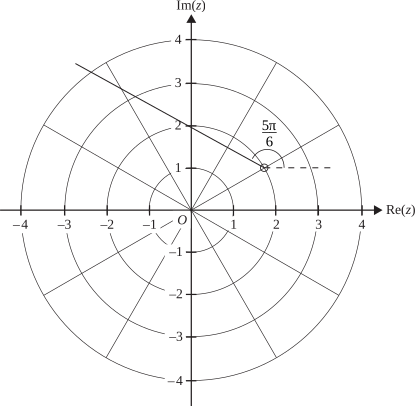
- Sketch the ray given by `text(Arg)(z-z_4) = (5pi)/6` on the Argand diagram below. (2 marks)
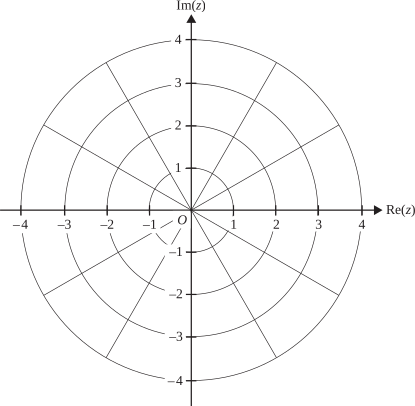
- The ray `text(Arg)(z-z_4) = (5pi)/6` intersects the circle `|z-3i| = 1`, dividing it into a major and a minor segment.
- i. Sketch the circle `|z-3i| = 1` on the Argand diagram in part b. (1 mark)
--- 0 WORK AREA LINES (style=lined) ---
- ii. Find the area of the minor segment. (2 marks)
--- 6 WORK AREA LINES (style=lined) ---
Show Answers Only
-
- `z_2 = barz_3`
- `alpha = -3, beta = 9, gamma = -27`
-
c.i.
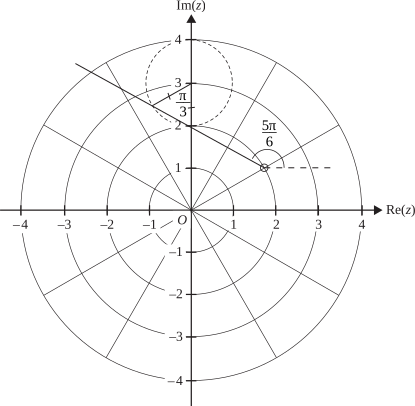
c.ii. `(2pi-3sqrt3)/12\ text(u²)`
Show Worked Solution
a.i. `text(By conjugate root theory)`
`z_2 = barz_3`
a.ii. `text(Let)\ \ z_1 = a + bi, \ z_2 = a-bi`
♦♦ Mean mark part (a.ii.) 35%.
`|z_2 + z_3| = |2a| = 0 \ => \ a = 0`
`|z_2-z_3| = |2b| = 6 \ => \ b = ±3`
`text(Using)\ \ p(2) = -13`
| `(2-z_1)(2-3i)(2 + 3i)` | `= -13` |
| `(2-z_1)(4 + 9)` | `= -13` |
| `2-z_1` | `= -1` |
| `z_1` | `= 3` |
| `p(z)` | `= (z-3)(z-3i)(z + 3i)` |
| `= (z-3)(z^2 + 9)` | |
| `= z^3-3z^2 + 9z-27` |
`:. alpha = –3, \ beta = 9, \ gamma = –27`
♦ Mean mark part (b) 45%.
MARKER’S COMMENT: Point of emanation is not part of required ray (see open circle).
MARKER’S COMMENT: Point of emanation is not part of required ray (see open circle).
b.
c.i.
c.ii. `text(Arg)(z-z_4) = (5pi)/6\ \ text(cuts)\ \ ytext(-axis at angle)\ pi/3`
♦♦ Mean mark part (c.ii.) 30%.
`=>\ text(angle at centre of segment) = pi/3\ (text(equilateral triangle))`
| `text(Area)` | `= (pi/3)/(2pi) xx pi xx 1^2-1/2 xx 1 xx 1 xx sin (pi/3)` |
| `= pi/6-sqrt3/4` | |
| `= (2pi-3sqrt3)/12\ text(u²)` |
Complex Numbers, SPEC2 2021 VCAA 5 MC
The graph of the circle given by `|z - 2 - sqrt3i| = 1`, where `z ∈ C`, is shown below.
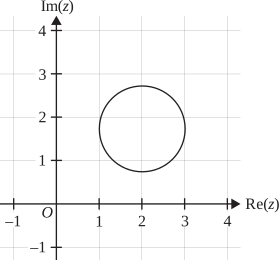
For points on this circle, the maximum value of `|z|` is
- `sqrt3 + 1`
- `3`
- `sqrt13`
- `sqrt7 + 1`
- `8`
Show Worked Solution
♦ Mean mark part 42%.
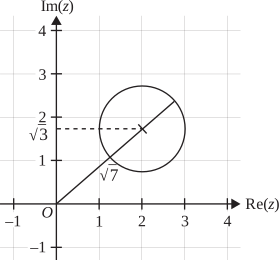
`text(Centre of circle at)\ (2, sqrt3)`
`text(Radius = 1)`
`text(By Pythagoras, line from)`
`text(origin to centre of circle)`
`d = sqrt(2^2 + sqrt(3)^2) = sqrt7`
`:. |z|\ text(max) = sqrt7 + 1`
`=>\ D`
Complex Numbers, SPEC2 2020 VCAA 2
Two complex numbers, `u` and `v`, are defined as `u = -2-i` and `v = −4-3i`.
- Express the relation `|z-u| = |z-v|` in the cartesian form `y = mx + c`, where `m, c ∈ R`. (3 marks)
--- 3 WORK AREA LINES (style=lined) ---
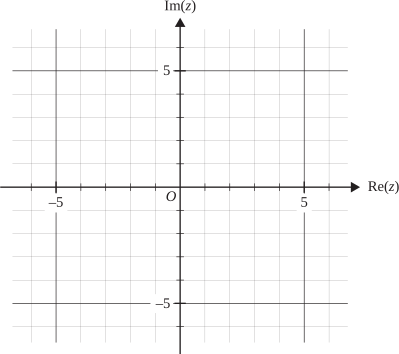
- Plot the points that represent `u` and `v` and the relation `|z-u| = |z-v|` on the Argand diagram below. (2 marks)
--- 0 WORK AREA LINES (style=lined) ---
- State a geometrical interpretation of the graph of `|z-u| = |z-v|` in relation to the points that represent `u` and `v`. (1 mark)
--- 2 WORK AREA LINES (style=lined) ---
- i. Sketch the ray given by `text(Arg)(z-u) = pi/4` on the Argand diagram in part b. (1 mark)
--- 0 WORK AREA LINES (style=lined) ---
- ii. Write down the function that describes the ray `text(Arg)(z-u) = pi/4`, giving the rule in cartesian form. (1 mark)
--- 2 WORK AREA LINES (style=lined) ---
- The points representing `u` and `v` and `−5i` lie on the circle given by `|z-z_c| = r`, where `z_c` is the centre of the circle and `r` is the radius.
- Find `z_c` in the form `a + ib`, where `a, b ∈ R`, and find the radius `r`. (3 marks)
--- 6 WORK AREA LINES (style=lined) ---
Show Answers Only
- `y = −x-5`
-
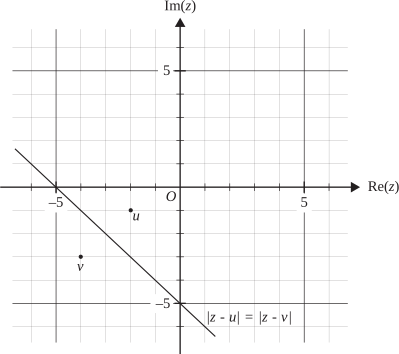
- `|z-u| = |z-v|\ text(is the perpendicular bisector of the line joining)\ u and v.`
- i.
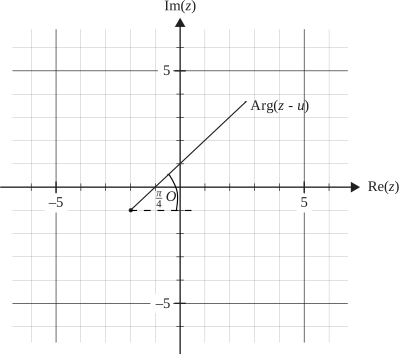
- ii. `f: (−2, ∞) ->, f(x) = x + 1`
- `z_c = −5/3-10/3 i and r = (5sqrt2)/3`
Show Worked Solution
a. `text(Let)\ \ z = x + iy`
`z-u = x + 2 + iy + i`
`z-v = x + 4 + iy + 3i`
`|z-u| = |z-v|`
| `(x + 2)^2 + (y + 1)^2` | `= (x + 4)^2 + (y + 3)^2` |
| `x^2 + 4x + 4 + y^2 + 2y + 1` | `= x^2 + 8x + 16 + y^2 + 6y + 9` |
| `-4y` | `= 4x + 20` |
| `y` | `= −x-5` |
| b. |
|
c. `|z-u| = |z-v|\ text(is the graph of the perpendicular bisector of the)`
`text(line joining)\ u and v.`
| d.i. |
|
♦♦ Mean mark (d.ii.) 25%.
d.ii. `text(Arg)(z-u) = pi/4 =>\ text(gradient) = 1, ytext(-intercept at)\ (0, 1)`
`:. f: (−2, ∞) -> RR, \ f(x) = x + 1`
e. `|z_c-u| = |z_c-v| = |z_c-(−5i)|`
♦ Mean mark (e) 40%.
| `z_c-u` | `= (a + 2) + (b + 1)i` |
| `z_c-v` | `= (a + 4) + (b + 3)i` |
| `z_c +5i` | `= a + (b + 5)i` |
`a^2 + (b + 5)^2 = (a + 2)^2 + (b + 1)^2\ …\ (1)`
`a^2 + (b + 5)^2 = (a + 4)^2 + (b + 3)^2\ …\ (2)`
`a = −5/3, b = −10/3\ \ text{(by CAS)}`
`:.z_c = −5/3-10/3 i`
| `:.r` | `= |z_c-(−5i)|` |
| `= sqrt((−5/3)^2 + (−10/3 + 5)^2)` | |
| `= (5sqrt2)/3` |
Complex Numbers, SPEC2-NHT 2019 VCAA 5 MC
The circle defined by `|z + a| = 3 |z + i|`, where `a ∈ R`, has a centre and radius respectively given by
- `(a/8, −9/8), \ 3/8sqrt(a^2 + 1)`
- `(a/8, −9/8), \ (9a^2 + 9)/64`
- `(a/8, −9/8), \ 1/8sqrt(153 - 7a^2)`
- `(−a/8, 9/8), \ (9a^2 + 9)/64`
- `(−a/8, 9/8), \ 3/8sqrt(a^2 + 1)`
Complex Numbers, SPEC2 2019 VCAA 2
- Show that the solutions of `2z^2 + 4z + 5 = 0`, where `z ∈ C`, are `z = −1 ± sqrt6/2 i`. (1 mark)
--- 3 WORK AREA LINES (style=lined) ---
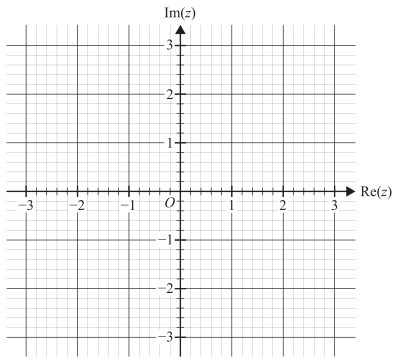
- Plot the solutions of `2z^2 + 4z + 5 = 0` on the Argand diagram below. (1 mark)
--- 0 WORK AREA LINES (style=lined) ---
Let `|z + m| = n`, where `m, n ∈ R`, represent the circle of minimum radius that passes through the solutions of `2z^2 + 4z + 5 = 0`.
-
- Find `m` and `n`. (2 marks)
--- 3 WORK AREA LINES (style=lined) ---
- Find the cartesian equation of the circle `|z + m| = n`. (1 mark)
--- 2 WORK AREA LINES (style=lined) ---
- Sketch the circle on the Argand diagram in part a.ii. Intercepts with the coordinate axes do not need to be calculated or labelled. (1 mark)
--- 0 WORK AREA LINES (style=lined) ---
- Find `m` and `n`. (2 marks)
- Find all values of `d`, where `d ∈ R`, for which the solutions of `2z^2 + 4z + d = 0` satisfy the relation `|z + m| <= n`. (2 marks)
--- 4 WORK AREA LINES (style=lined) ---
- All complex solutions of `az^2 + bz + c = 0` have non-zero real and imaginary parts.
Let `|z + p| = q` represent the circle of minimum radius in the complex plane that passes through these solutions, where `a, b, c, p, q ∈ R`.
Find `p` and `q` in terms of `a, b` and `c`. (2 marks)
--- 4 WORK AREA LINES (style=lined) ---
Show Answers Only
- `text(See Worked Solutions)`
-
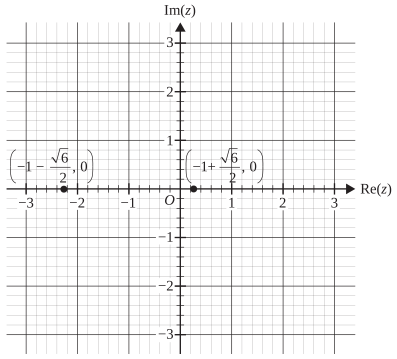
- `m = 1, n = sqrt6/2`
- `(x + 1)^2 + y^2 = 3/2`
- `−1 <= d <= 5\ \ (text(by CAS))`
- `p = b/(2a), \ q = |sqrt(b^2-4ac)/(2a)|`
Show Worked Solution
| a.i. | `z` | `= (−b ± sqrt(b^2-4ac))/(2a)` |
| `= (−4 ± sqrt(16-4 · 2 · 5))/(4)` | ||
| `= (−4 ± 2sqrt6 i)/(4)` | ||
| `= −1 ± sqrt6/2 i\ \ …\ text(as required)` |
| a.ii. | |
b.i. `text(Radius of circle = )sqrt6/2`
`text(Centre) = (0, −1)`
`:. m = 1, \ n = sqrt6/2`
| b.ii. | `|z + 1|` | `= sqrt6/2` |
| `|x + iy + 1|` | `= sqrt6/2` | |
| `(x + 1)^2 + y^2` | `= 3/2` |
| b.iii. | 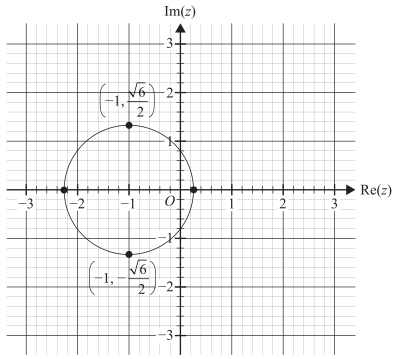 |
c. `text(Solve:)\ 2z^2 + 4z + d = 0`
`z = −1 ± sqrt(4-2d)/2 = −1 ± sqrt((2-d)/2)`
`z + 1 = ± sqrt((2-d)/2)`
`text(Solve for)\ d\ text(such that:)`
`|sqrt((2-d)/2)| <= sqrt6/2`
`−1 <= d <= 5\ \ (text(by CAS))`
d. `z = (−b ± sqrt(b^2-4ac))/(2a) = (−b)/(2a) ± sqrt(b^2-4ac)/(2a)`
| `z + b/(2a)` | `= ± sqrt(b^2-4ac)/(2a)` |
| `|z + b/(2a)|` | `= |sqrt(b^2-4ac)/(2a)|` |
`:. p = b/(2a), \ q = |sqrt(b^2-4ac)/(2a)|`
Complex Numbers, SPEC2 2011 VCAA 7 MC
In the complex plane, the circle with equation `|\ z - (2 + 3i)\ | = 1` is intersected exactly twice by the curve with equation
A. `|\ z - 3i\ | = 1`
B. `|\ z + 3\ | = |\ z - 3i\ |`
C. `|\ z - 3\ | = |\ z - 3i\ |`
D. `text(Im)(z) = 4`
E. `text(Re)(z) = 3`
Show Worked Solution
`text(Consider option C:)`
`|z – 3| = |z – 3i|`
`=> y = x\ text{(perpendicular bisector}`
`text{between (3, 0) and (0, 3)}`
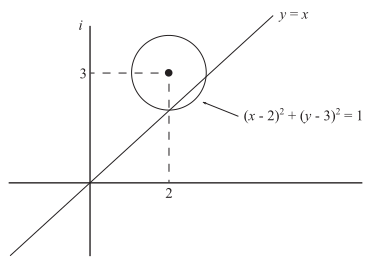
`=> C`
Complex Numbers, SPEC2 2013 VCAA 5 MC
The region in the complex plane that is outside the circle of radius `b` centred at the origin is given by the set of points `z`, where `z ∈ C`, such that
A. `|\ z\ | < b`
B. `|\ z\ | > b`
C. `|\ z\ | > b^2`
D. `|\ z\ | = b`
E. `|\ z\ | < b^2`
Complex Numbers, SPEC2-NHT 2018 VCAA 2
In the complex plane, `L` is the line given by `|z + 1| = |z + 1/2-sqrt 3/2 i|`.
- Show that the cartesian equation of `L` is given by `y = -1/sqrt 3 x`. (2 marks)
--- 4 WORK AREA LINES (style=lined) ---
- Find the point(s) of intersection of `L` and the graph of the relation `z bar z = 4` in cartesian form. (2 marks)
--- 4 WORK AREA LINES (style=lined) ---
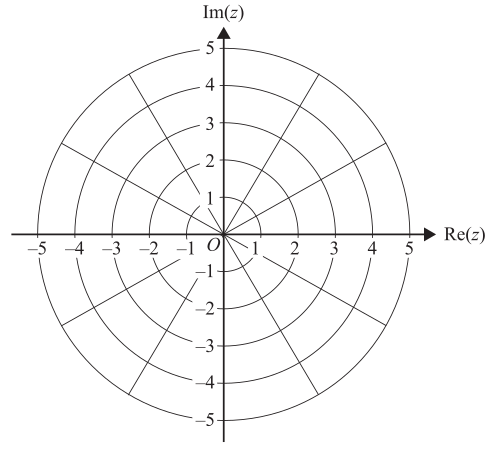
- Sketch `L` and the graph of the relation `z bar z = 4` on the Argand diagram below. (2 marks)
--- 0 WORK AREA LINES (style=lined) ---
The part of the line `L` in the fourth quadrant can be expressed in the form `text(Arg)(z) = a`.
- State the value of `a`. (1 mark)
--- 1 WORK AREA LINES (style=lined) ---
- Find the area enclosed by `L` and the graphs of the relations `z bar z = 4, \ text(Arg)(z) = pi/3` and `text(Re)(z) = sqrt 3`. (2 marks)
--- 4 WORK AREA LINES (style=lined) ---
- The straight line `L` can be written in the form `z = k bar z`, where `k in C`.
Find `k` in the form `r text(cis)(theta)`, where `theta` is the principal argument of `k`. (2 marks)
--- 4 WORK AREA LINES (style=lined) ---
Show Worked Solution
a. `(x + 1)^2 + y^2 = (x + 1/2)^2 + (y-sqrt 3/2)^2`
`x^2 + 2x + 1 + y^2 = x^2 + x + 1/4 + y^2-y sqrt 3 + 3/4`
| `0` | `=-x-y sqrt 3` |
| `y sqrt 3` | `= -x` |
| `:. y` | `= -1/sqrt 3 x` |
| b. | `(x + iy) (x-iy)` | `=4` |
| `x^2-i^2 y^2` | `=4` | |
| `x^2 + y^2` | `=4` |
`text(Substitute)\ \ y = -1/sqrt 3 x\ \ text(into)\ \ x^2 + y^2 = 4:`
| `x^2 + 1/3 x ^2` | `=4` |
| `4/3 x^2` | `=4` |
| `x^2` | `=3` |
| `x` | `=+- sqrt3` |
| `=>y` | `= +- 1` |
`:.\ text(Intersection at):\ (sqrt 3, -1), quad (-sqrt 3, 1)`
| c. | 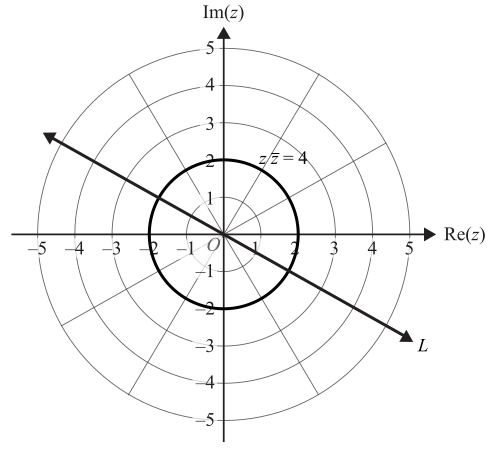 |
d. `alpha = tan^(-1) (-1/sqrt 3), quad alpha in (-pi/2, 0)`
`alpha = -pi/6`
e.
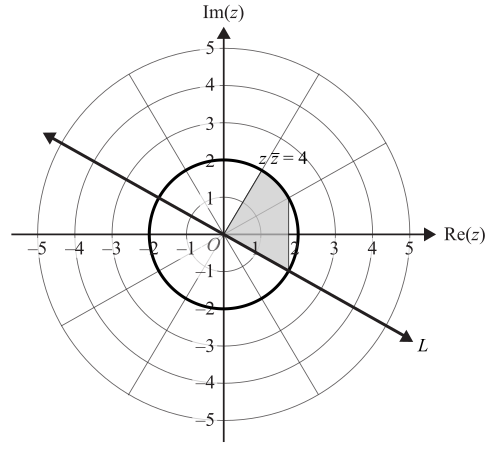
`text(Total Area)`
`=\ text(Area of sector + Area of triangle)`
`=pi xx 2^2 xx ((pi/3-pi/6)/(2 pi)) + 1/2 xx sqrt 3 xx 2`
`=4 pi (1/12) + sqrt3`
`=pi/3 + sqrt3\ \ text(u²)`
| f. | `r\ text(cis)(theta)` | `=k (r\ text(cis)(-theta))` |
| `:. k` | `=(r\ text(cis)(theta))/(r\ text(cis)(-theta))` | |
| `= text(cis)(2 xx ((-pi)/6))` | ||
| `= text(cis)(- pi/3)` |
Complex Numbers, SPEC2-NHT 2017 VCAA 2 MC
The equation `x^2 + y^2 + 2ky + 4 = 0`, where `k` is a real constant, will represent a circle only if
- `k > 2`
- `k < -2`
- `k != +- 2`
- `k < -2 \ or\ k > 2`
- `-2 < k < 2`
Complex Numbers, SPEC2 2015 VCAA 8 MC
A relation that does not represent a circle in the complex plane is
- `zbarz = 4`
- `|\ z + 3i\ | = 2|\ z − i\|`
- `|\ z − i\ | = |\ z + 2\ |`
- `|\ z − 1 + i\ | = 4`
- `|\ z\ | + 2|\ barz\ | = 4`
Complex Numbers, SPEC2 2018 VCAA 2
- State the centre in the form `(x, y)`, where `x, y in R`, and the state the radius of the circle given by `|z-(1 + 2i)| = 2`, where `z in C`. (1 mark)
--- 5 WORK AREA LINES (style=lined) ---
- Graph the circle given by `|z + 1| = sqrt 2 |z-i|` on the Argand diagram below, labelling the intercepts with the vertical axis. (2 marks)
--- 0 WORK AREA LINES (style=lined) ---
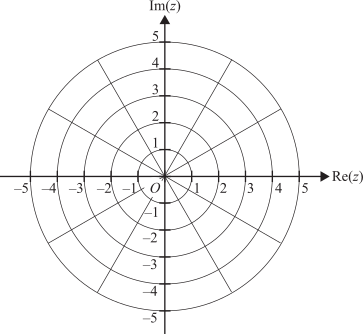
The line given by `|z-1| = |z-3|` intersects the circle given by `|z + 1| = sqrt 2 |z-i|` in two places.
- Draw the line given by `|z-1| = |z-3|` on the Argand diagram in part c. Label the points of intersection with their coordinates. (2 marks)
--- 5 WORK AREA LINES (style=lined) ---
- Find the area of the minor segment enclosed by an arc of the circle given by `|z + 1| = sqrt 2 |z-i|` and part of the line given by `|z-1| = |z-3|`. (3 marks)
--- 6 WORK AREA LINES (style=lined) ---
Show Worked Solution
a. `(x-1)^2 + (y-2)^2 = 2^2`
`:.\ text(Centre)\ (1, 2), quad text(radius) = 2`
| b. | `y^2 + (x + 1)^2` | `= (sqrt 2)^2 (x^2 + (y-1)^2)` |
| `y^2 + x^2 + 2x + 1` | `= 2(x^2 + y^2-2y + 1)` | |
| `y^2 + x^2 + 2x + 1` | `= 2x^2 + 2y^2-4y + 2` |
| `0` | `= 2x^2 + 2y^2-4y + 2-y^2-x^2-2x-1` |
| `0` | `= x^2 + y^2-4y-2x + 1` |
| `0` | `= (x^2-2x + 1) + (y^2-4y)` |
| `0` | `= (x-1)^2 + (y^2-4y + 2^2)-4` |
| `0` | `= (x-1)^2 + (y-2)^2-4` |
| `4` | `= (x-1)^2 + (y-2)^2` |
`:.\ text(Centre)\ (1, 2), quad text(radius) = 2`
c. `ytext(-axis intercepts occur when)\ \ x=0:`
| `(0-1)^2 + (y-2)^2` | `= 4` |
| `1 + (y-2)^2` | `= 4` |
| `(y-2)^2` | `= 3` |
| `y-2` | `= +- sqrt 3` |
| `y` | `= 2 +- sqrt 3` |

d. `|z-1| = |z-3|`
`=>\ text(Graph is a line equidistant from:)\ \ 1 + 0i and 3 + 0i`
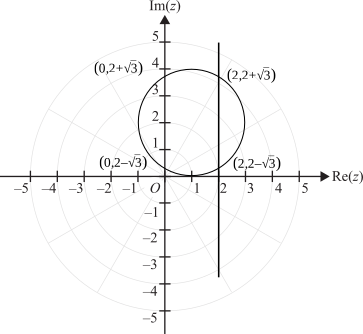

`text(Circle intercepts occur when)\ \ x=2:`
| `(2- 1)^2 + (y-2)^2` | `= 4` |
| `(y-2)^2` | `= 3` |
| `y-2` | `= +- sqrt 3` |
| `y` | `= 2 +- sqrt 3` |
e. `sin theta = sqrt3/2\ \ =>\ \ theta = pi/3`♦ Mean mark 39%.
MARKER’S COMMENT: Students who used standard formulae rather than definite integrals were more successful.
`text(Angle at centre of segment) = (2pi)/3`
`text(Height of triangle)\ (h) = 2^2-(sqrt3)^2 =1`
`:.\ text(Shaded Area)`
`=\ text(Area of segment – Area of triangle)`
`=((2pi)/3)/(2pi) xx pi xx 2^2-1/2 xx 2sqrt3 xx 1`
`=(4pi)/3-sqrt3`
Complex Numbers, SPEC2 2014 VCAA 9 MC
The circle `| z - 3 - 2i | = 2` is intersected exactly twice by the line given by
A. `| z - i | = | z + 1 |`
B. `| z - 3 - 2i | = | z - 5 |`
C. `| z - 3 - 2i | = | z - 10i |`
D. `text(Im)(z) = 0`
E. `text(Re)(z) = 5`
Complex Numbers, SPEC2-NHT 2018 VCAA 5 MC
Which one of the following graphs shows the set of points in the complex plane specified by the relation
`{z : (z + 2) (bar z + 2) = 4, \ z in C}`?
| A. | 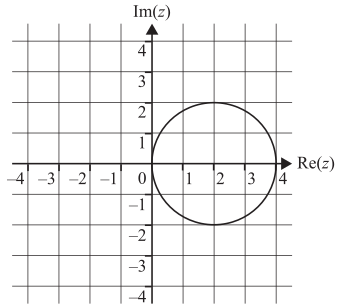 |
B. | 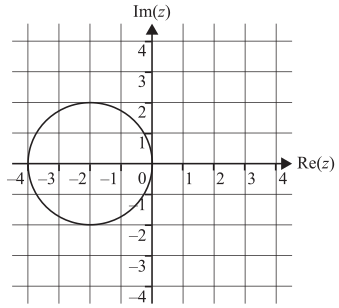 |
| C. | 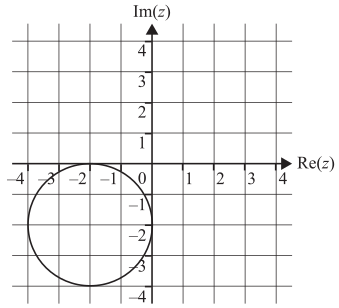 |
D. | 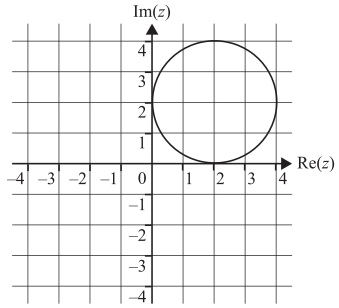 |
| E. | 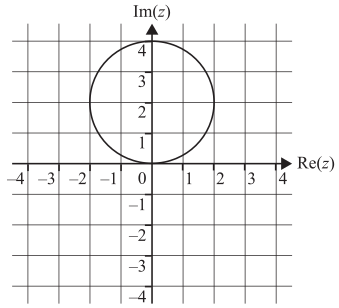 |
Complex Numbers, SPEC1-NHT 2018 VCAA 8
A circle in the complex plane is given by the relation `|z-1-i| = 2, \ z in C`.
- Sketch the circle on the Argand diagram below. (1 mark)
--- 0 WORK AREA LINES (style=lined) ---
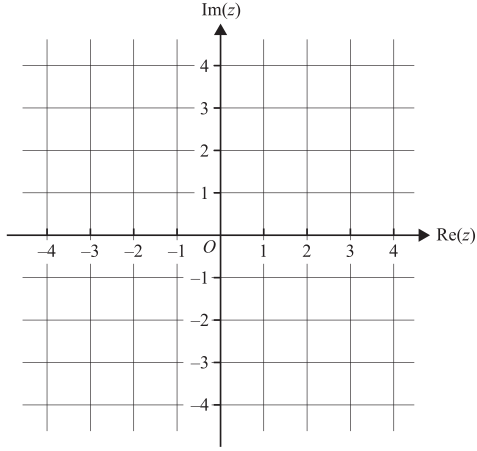
- i. Write the equation of the circle in the form `(x-a)^2 + (y-b)^2 = c` and show that the gradient of a tangent to the circle can be expressed as `(dy)/(dx) = (1-x)/(y-1)`. (2 marks)
--- 6 WORK AREA LINES (style=lined) ---
- ii. Find the gradient of the tangent to the circle where `x = 2` in the first quadrant of the complex plane. (1 mark)
--- 6 WORK AREA LINES (style=lined) ---
- Find the equations of all rays that are perpendicular to the circle in the form `text(Arg) (z) = alpha`. (2 marks)
--- 4 WORK AREA LINES (style=lined) ---
Show Worked Solution
| a. | 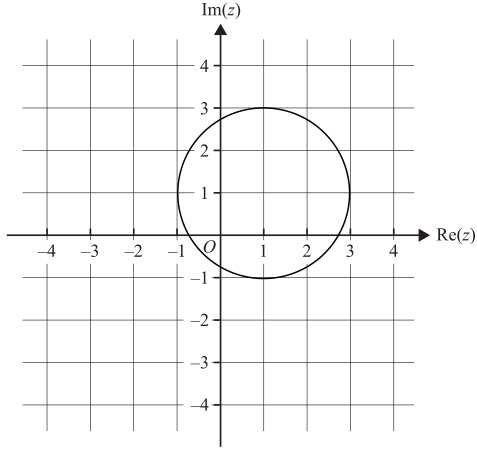 |
| b.i. | `(x-1)^2 + (y-1)^2` | `= 4` |
| `2(x-1) + d/(dx) ((y-1)^2)` | `= 0` | |
| `2(x-1) + 2(y-1)*(dy)/(dx)` | `= 0` | |
| `2 (y-1)*(dy)/(dx)` | `= -2(x-1)` | |
| `(dy)/(dx)` | `= (-(x-1))/(y-1)` | |
| `= (1-x)/(y-1)` |
| b.ii. | `(2-1)^2 + (y-1)^2` | `= 4` |
| `1 + (y-1)^2` | `= 4` | |
| `(y-1)^2` | `= 3` | |
| `y` | `= 1 + sqrt 3\ \ \ (y > 0)` | |
| `(dy)/(dx)|_{(2, 1 + sqrt 3)}` | `= (1-2)/(1 + sqrt 3-1` | |
| `= (-1)/sqrt 3` |
| c. | `P (0, 0) quad C(1, 1)` |
| `-> y = x` | |
| `:. alpha = pi/4, quad (-3 pi)/4` |
`text(Arg) (z) = pi/4`
`text(Arg) (z) = (-3 pi)/4`