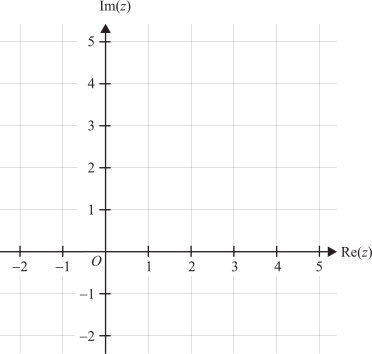
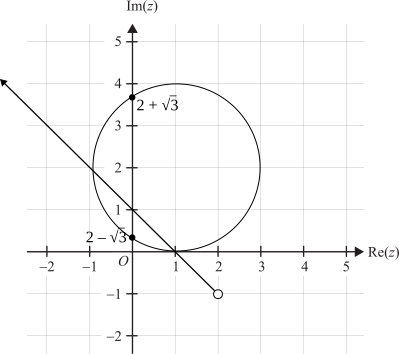
--- 4 WORK AREA LINES (style=lined) --- --- 5 WORK AREA LINES (style=lined) --- --- 2 WORK AREA LINES (style=lined) --- --- 0 WORK AREA LINES (style=lined) --- --- 2 WORK AREA LINES (style=lined) --- --- 4 WORK AREA LINES (style=lined) --- a. \(y=\dfrac{3}{2} x-\dfrac{11}{4}\) b. \(\abs{z-\left(\dfrac{5}{2}+i\right)} = \dfrac{\sqrt{13}}{2}\) c. d.i. \(\text{See image above}\) d.ii. \(\operatorname{Arg}(z-2+i)=\dfrac{3 \pi}{4}\) e. \(A=\pi-2\) a. \(\text{Method 1}\) \(z_1=1+2i, \quad z_2=4\) \(\abs{z-z_1}=\abs{z-z_2}\) \(\text{Equation can be written:}\) \(\text {Find line of points equidistant from \(\ z_1\) and \(z_2\)}\) \(m_{\text{line}\ z_1 z_2}=\dfrac{0-2}{4-1}=\dfrac{-2}{3}\) \(m_{\perp}=\dfrac{3}{2}\) \(\text{Mid point} \ z_1 z_2 =\dfrac{5+2i}{2}=\left(\dfrac{5}{2},1\right)\) \(\perp \ \text{bisector:} \ m=\dfrac{3}{2}, \ \text{passes through} \ \left(\dfrac{5}{2}, 1\right)\) b. \(\text{Centre of circle }=\text {midpoint}\left(z_1 z_2\right)\) \(z_c=\dfrac{z_1+z_2}{2}=\dfrac{5+2 i}{2}=\dfrac{5}{2}+i\) \(\text{Radius}(r)=\dfrac{1}{2} \times \text{diameter}\) \(r=\dfrac{1}{2} \sqrt{(4-1)^2+(0-2)^2}=\dfrac{\sqrt{13}}{2}\) \(\text{Circle equation:}\) \(\abs{z-\left(\dfrac{5}{2}+i\right)} = \dfrac{\sqrt{13}}{2}\) c. \(\text{Find \(y\)-axis intercepts \((z=y i)\):}\) \(4=\abs{z-(1+2i)}^2=\abs{yi-(1+2i)}^2=(-1)^2+(y-2)^2\) \(y^2-4y+1=0 \ \Rightarrow \ =2 \pm \sqrt{3}\) d.i. \(\text{See image above}\) d.ii. \(\operatorname{Arg}(z-2+i)=\dfrac{3 \pi}{4}\) e. \(\text{Circle radius}=2\) \(\text{Angle subtending minor segment}=\dfrac{\pi}{2}\) \(A=\dfrac{r^2}{2}(\theta-\sin \theta)=2\left(\dfrac{\pi}{2}-1\right)=\pi-2\)
\((x-1)^2+(y-2)^2\)
\(=(x-4)^2+y^2\)
\(-2x-4y+5\)
\(=-8x+16 \ \ \ \text{(all squares cancel)}\)
\(6x+4y\)
\(=11\)
\(y\)
\(=\dfrac{3}{2} x-\dfrac{11}{4}\)
\(\text{Method 2}\)
\(y-1\)
\(=\dfrac{3}{2}\left(x-\dfrac{5}{2}\right)\)
\(y\)
\(=\dfrac{3}{2} x-\dfrac{11}{4}\)
Complex Numbers, SPEC2-NHT 2019 VCAA 1
In the complex plane, `L` is the with equation `|z + 2| = |z-1-sqrt3 i|`.
- Verify that the point (0, 0) lies on `L`. (1 marks)
--- 4 WORK AREA LINES (style=lined) ---
- The line `L` can also be expressed in the form `|z-1| = |z-z_1|`, where `z_1 ∈ C`.
Find `z_1` in cartesian form. (2 marks)
--- 5 WORK AREA LINES (style=lined) ---
- Find, in cartesian form, the points(s) of intersection of `L` and the graph of `|z| = 4`. (2 marks)
--- 5 WORK AREA LINES (style=lined) ---
- Sketch `L` and the graph of `|z| = 4` on the Argand diagram below. (2 marks)
--- 0 WORK AREA LINES (style=lined) ---
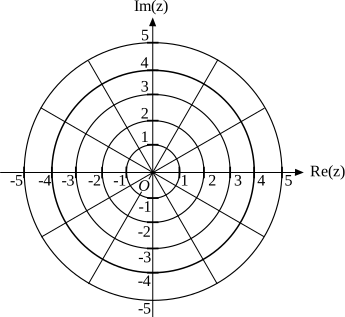
- Find the area of the sector defined by the part of `L` where `text(Re)(z) ≥ 0`, the graph of `|z| = 4` where `text(Re)(z) ≥ 0`, and imaginary axis where `text(Im)(z) > 0`. (1 marks)
--- 3 WORK AREA LINES (style=lined) ---
Show Answers Only
- `text(Proof(See Worked Solution))`
- `text(Proof(See Worked Solution))`
- `-(1)/(2)-(sqrt3)/(2) i`
- `(2,-2 sqrt3) text(and) (-2, 2 sqrt3)`
-
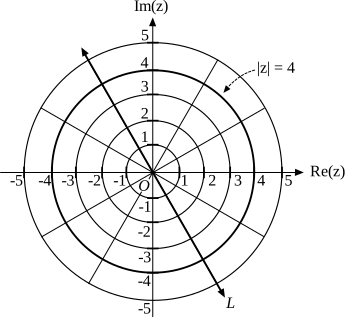
- `(20pi)/(3)`
Show Worked Solution
a. `text(Substitute)\ \ z = 0 + 0i\ \ text(into both sides:)`
`text(LHS) = |2| = 2`
`text(RHS) = |-1-sqrt3i| = sqrt{(-1)^2 + (-sqrt3)^2} = 2`
`:. (0,0)\ \ text(lies on both sides.)`
| b. | `|x + yi + 2|` | `= |x + yi-1-sqrt3 i|` |
| `|(x + 2) + yi|` | `= |(x-1) + (y-sqrt3) i|` | |
| `sqrt(x^2 + 4x + 4 + y^2` | `= sqrt(x^2-2x + 1 + y^2 -2 sqrt3 y + 3` | |
| `x^2 + 4x + 4 + y^2` | `= x^2-2x + 4-2 sqrt3 y + y^2` | |
| `6x` | `= -2 sqrt3 y` | |
| `y` | `= -(3)/(sqrt3) x` | |
| `y` | `= -sqrt3 x` |
c.
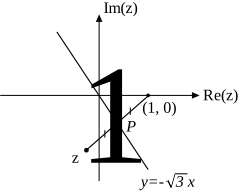
`m_text(perp) = (sqrt2)/(3) , text(through)\ (1, 0)`
`y = (sqrt3)/(3) (x-1)\ …\ L_1`
`text(Intersection) \ L\ text(and) \ L_1,`
`text(Solve:) \ (sqrt3)/3 (x-1) = -sqrt3 x\ \ \ text{(by CAS)}`
`=> x = (1)/(4) , y = -(sqrt3)/(4) \ \ \ text{(point}\ Ptext{)}`
`P(x_1,y_1) \ text(is midpoint of) \ \ z_1 \ text(and) \ \ (1, 0):`
`(x_1 + 1)/(2) = (1)/(4) \ => \ x_1 = -(1)/(2)`
`(y_1 + 0)/(2) = -sqrt3/(4) \ => \ y_1 = -sqrt3/(2)`
`:. \ z_1 = -(1)/(2)-(sqrt3)/(2) i`
d. `|z| = 4 => \ text(circle, centre) \ (0,0), \ text(radius) = 4`
`x^2 + y^2 = 16\ …\ (1)`
`y =-sqrt3 x\ …\ (2)`
`text(Substitute)\ (2) \ text(into) \ (1)`
`x^2 + 3x^2 = 16`
`x = ±2`
`:. \ text(Intersection at)\ (2,-2 sqrt3) \ text(and) \ (-2, 2 sqrt3)`
e.
f.
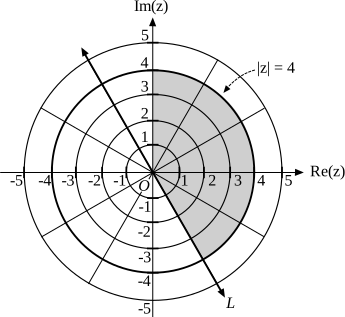
| `text(Area)` | `= (5)/(12) xx pi xx 4^2` |
| `= (20pi)/(3)` |
Complex Numbers, SPEC2 2012 VCAA 2
- Given that `cos(pi/12) = (sqrt (sqrt 3 + 2))/2`, show that `sin(pi/12) = (sqrt (2-sqrt 3))/2`. (2 marks)
--- 5 WORK AREA LINES (style=lined) ---
- Express `z_1 = (sqrt(sqrt3 + 2))/2 + i(sqrt(2-sqrt3))/2` in polar form. (1 mark)
--- 2 WORK AREA LINES (style=lined) ---
- i. Write down `z_1^4` in polar form. (1 mark)
--- 2 WORK AREA LINES (style=lined) ---
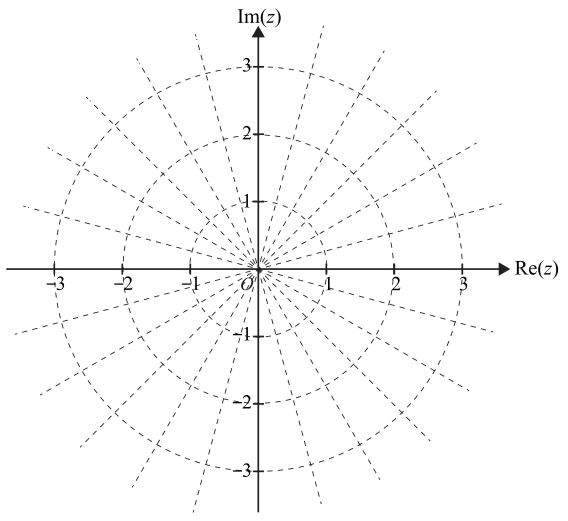
- ii. On the Argand diagram below, shade the region defined by
`{z: text(Arg)(z_1) <= text(Arg)(z) <= text(Arg)(z_1^4)} ∩ {z: 1 <= |\ z\ | <= 2}, z ∈ C`. (2 marks)
--- 0 WORK AREA LINES (style=lined) ---
- Find the area of the shaded region in part c. (2 marks)
--- 5 WORK AREA LINES (style=lined) ---
- i. Find the value(s) of `n` such that `text(Re)(z_1^n) = 0`, where `z_1 = (sqrt(sqrt3 + 2))/2 + i(sqrt(2-sqrt3))/2`. (3 marks)
--- 6 WORK AREA LINES (style=lined) ---
- ii. Find `z_1^n` for the value(s) of `n` found in part i. (1 mark)
--- 2 WORK AREA LINES (style=lined) ---
Show Worked Solution
| a. | `cos^2(pi/12) + sin^2(pi/12)` | `= 1` |
| `sin^2(pi/12)` | `= 1-(sqrt 3 + 2)/4` | |
| `= (2-sqrt 3)/4` |
`:. sin (pi/12) = sqrt(2-sqrt 3)/2,\ \ \ (sin (pi/12) > 0)`
| b.i. | `z_1` | `= cos(pi/12) + i sin (pi/12)` |
| `= text(cis)(pi/12)` |
| b.ii. | `z_1^4` | `= 1^4 text(cis) ((4 pi)/12)` |
| `= text(cis)(pi/3)` |
| c. | 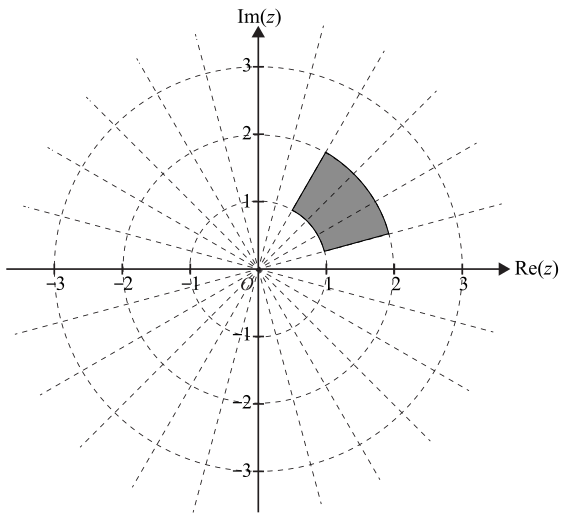 |
d. `text(Area of large sector)`Mean mark 51%.
`=theta/(2pi) xx pi r^2`
`=(pi/3-pi/12)/(2pi) xx pi xx 2^2`
`=pi/2`
`text(Area of small sector)`
`=1/2 xx pi/4 xx 1`
`=pi/8`
`:.\ text(Area shaded)`
`= pi/2-pi/8`
`= (3 pi)/8`
♦ Mean mark (e)(i) 34%.
| e.i. | `z_1^n` | `= 1^n text(cis) ((n pi)/12)` |
| `text(Re)(z_1^n)` | `= cos((n pi)/12) = 0` | |
| `(n pi)/12` | `=cos^(-1)0 +2pik,\ \ \ k in ZZ` | |
| `(n pi)/12` | `= pi/2 + k pi` | |
| `n` | `= 6 + 12k,\ \ \ k in ZZ` |
e.ii. `text(When)\ \ n=(6 + 12k):`♦ Mean mark (e)(ii) 36%.
| `z_1^n` | `= 1^(6 + 12k) text(cis) (((6 + 12k)pi)/12), quad k in ZZ` | |
| `= i xx sin (((6 + 12k)pi)/12)` | ||
| `= i xx sin (pi/2 + k pi)` |
`text(If)\ \ k=0 or text(even,)\ \ z_1^n=i`
`text(If)\ \ k\ text(is odd,)\ \ z_1^n=-i`
`:. z_1^n = +-i,\ \ \ k in ZZ`
Complex Numbers, SPEC2 2017 VCAA 4
- Express `−2-2sqrt3 i` in polar form. (1 mark)
--- 3 WORK AREA LINES (style=lined) ---
- Show that the roots of `z^2 + 4z + 16 = 0` are `z = −2-sqrt3 i` and `z = −2 + 2sqrt3 i`. (1 mark)
--- 3 WORK AREA LINES (style=lined) ---
- Express the roots of `z^2 + 4z + 16 = 0` in terms of `2-2sqrt3 i`. (1 mark)
--- 2 WORK AREA LINES (style=lined) ---
- Show that the cartesian form of the relation `|z| = |z-(2-2sqrt3 i)|` is `x-sqrt3 y-4 = 0` (2 marks)
--- 5 WORK AREA LINES (style=lined) ---
- Sketch the line represented by `x-sqrt3y -4 = 0` and plot the roots of `z^2 + 4z + 16 = 0` on the Argand diagram below. (2 marks)
--- 0 WORK AREA LINES (style=lined) ---
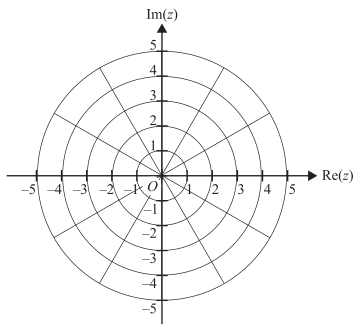
- The equation of the line passing through the two roots of `z^2 + 4z + 16 = 0` can be expressed as `|z-a| = |z-b|`, where `a, b ∈ C`.
Find `b` in terms of `a`. (1 mark)
--- 3 WORK AREA LINES (style=lined) ---
- Find the area of the major segment bounded by the line passing through the roots of `z^2 + 4z + 16 = 0` and the major arc of the circle given by `|z| = 4`. (2 marks)
--- 5 WORK AREA LINES (style=lined) ---
Show Answers Only
- `4text(cis)((−2pi)/3)`
- `text(See Worked Solutions)`
- `−(2-2sqrt3 i) and-bar((2-2sqrt3 i))`
- `text(See Worked Solutions)`
-
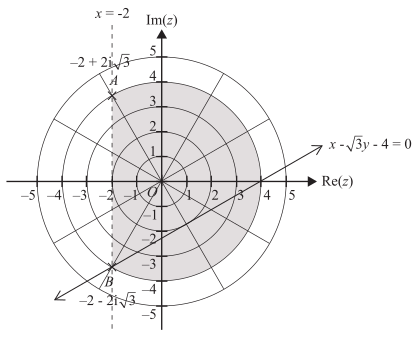
- `−4-bara`
- `4sqrt3 + (32pi)/3`
Show Worked Solution
| a. | `r` | `= sqrt((−2)^2 + (−2sqrt3)^2)=4` |
| `theta` | `= −pi + tan^(−1)((2sqrt3)/2)` |
| `= −pi + pi/3` | |
| `=(-2pi)/3` |
`:. −2-2sqrt3 i = 4text(cis)((−2pi)/3)`
| b. `z^2 + 4z + z^2-4 + 16` | `=0` |
| `(z + 2)^2 + 12` | `= 0` |
| `(z + 2)^2` | `= -12` |
| `(z + 2)^2` | `= 12i^2` |
| `z + 2` | `= ±sqrt12 i` |
| `z + 2` | `= ±2sqrt3 i` |
| `:. z` | `= -2 ± 2sqrt3 i` |
♦♦ Mean mark part (c) 31%.
| c. | `z_1` | `= -2 + 2sqrt3 i = -(2-2sqrt3 i)` |
| `z_2` | `=-2-2sqrt3 i =-bar((2-2sqrt3 i))` |
| d. | `|z|` | `= |z-(2-2sqrt3 i)|` |
| `x^2 + y^2` | `= (x-2)^2 + (y + 2sqrt3)^2` | |
| `x^2 + y^2` | `= x^2-4x + 4+ y^2 + 4sqrt3 y + 12` | |
| `0` | `= −4x + 4sqrt3 y + 16` | |
| `0` | `= −x + sqrt3 y + 4` |
`:. x-sqrt3 y-4=0`
| e. | |
f. `x = − 2\ \ text(is equidistant from)\ \ z_1 = a\ \ text(and)\ \ z_2 = b`♦♦♦ Mean mark 1%!
`=> text(Im)(a) = text(Im)(a)`
`text(Let)\ \ a = alpha + betai, \ b = gamma + betaj`
| `(alpha + gamma)/2` | `= −2` |
| `alpha + gamma` | `= −4` |
| `gamma` | `= -4-alpha` |
| `:. b` | `= -4-alpha + betaj` |
| `= -4-(alpha + betaj)` | |
| `= -4-bara` |
♦♦ Mean mark 31%.
| g. | `text(Area)\ DeltaOAB` | `= 1/2 xx (4sqrt3 xx 2)` |
| `= 4sqrt3` |
| `text(Area of sector)\ AOB` | `= pi xx 4^2 xx (2 xx pi/3)/(2pi)` |
| `= (16pi)/3` |
`:.\ text(Area of major segment area)`
`=pi(4)^2-((16pi)/3-4sqrt3)`
`= 4sqrt3 + (32pi)/3`
Complex Numbers, SPEC2-NHT 2018 VCAA 2
In the complex plane, `L` is the line given by `|z + 1| = |z + 1/2-sqrt 3/2 i|`.
- Show that the cartesian equation of `L` is given by `y = -1/sqrt 3 x`. (2 marks)
--- 4 WORK AREA LINES (style=lined) ---
- Find the point(s) of intersection of `L` and the graph of the relation `z bar z = 4` in cartesian form. (2 marks)
--- 4 WORK AREA LINES (style=lined) ---
- Sketch `L` and the graph of the relation `z bar z = 4` on the Argand diagram below. (2 marks)
--- 0 WORK AREA LINES (style=lined) ---
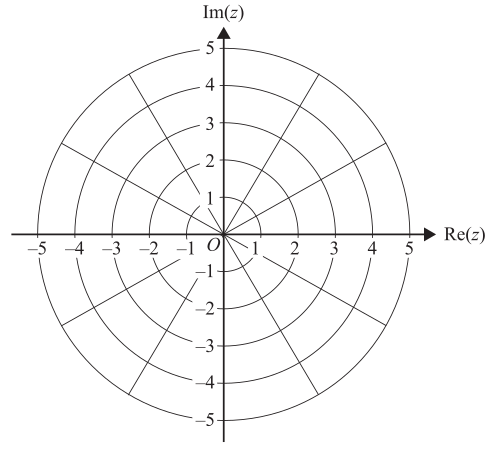
The part of the line `L` in the fourth quadrant can be expressed in the form `text(Arg)(z) = a`.
- State the value of `a`. (1 mark)
--- 1 WORK AREA LINES (style=lined) ---
- Find the area enclosed by `L` and the graphs of the relations `z bar z = 4, \ text(Arg)(z) = pi/3` and `text(Re)(z) = sqrt 3`. (2 marks)
--- 4 WORK AREA LINES (style=lined) ---
- The straight line `L` can be written in the form `z = k bar z`, where `k in C`.
Find `k` in the form `r text(cis)(theta)`, where `theta` is the principal argument of `k`. (2 marks)
--- 4 WORK AREA LINES (style=lined) ---
Show Worked Solution
a. `(x + 1)^2 + y^2 = (x + 1/2)^2 + (y-sqrt 3/2)^2`
`x^2 + 2x + 1 + y^2 = x^2 + x + 1/4 + y^2-y sqrt 3 + 3/4`
| `0` | `=-x-y sqrt 3` |
| `y sqrt 3` | `= -x` |
| `:. y` | `= -1/sqrt 3 x` |
| b. | `(x + iy) (x-iy)` | `=4` |
| `x^2-i^2 y^2` | `=4` | |
| `x^2 + y^2` | `=4` |
`text(Substitute)\ \ y = -1/sqrt 3 x\ \ text(into)\ \ x^2 + y^2 = 4:`
| `x^2 + 1/3 x ^2` | `=4` |
| `4/3 x^2` | `=4` |
| `x^2` | `=3` |
| `x` | `=+- sqrt3` |
| `=>y` | `= +- 1` |
`:.\ text(Intersection at):\ (sqrt 3, -1), quad (-sqrt 3, 1)`
| c. | 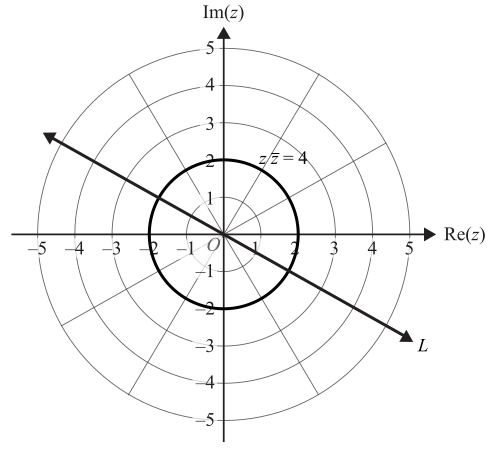 |
d. `alpha = tan^(-1) (-1/sqrt 3), quad alpha in (-pi/2, 0)`
`alpha = -pi/6`
e.
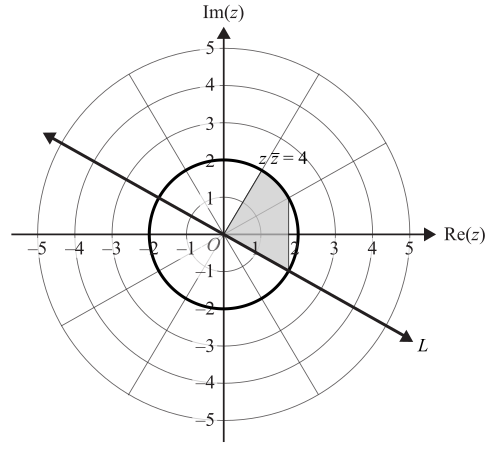
`text(Total Area)`
`=\ text(Area of sector + Area of triangle)`
`=pi xx 2^2 xx ((pi/3-pi/6)/(2 pi)) + 1/2 xx sqrt 3 xx 2`
`=4 pi (1/12) + sqrt3`
`=pi/3 + sqrt3\ \ text(u²)`
| f. | `r\ text(cis)(theta)` | `=k (r\ text(cis)(-theta))` |
| `:. k` | `=(r\ text(cis)(theta))/(r\ text(cis)(-theta))` | |
| `= text(cis)(2 xx ((-pi)/6))` | ||
| `= text(cis)(- pi/3)` |
Complex Numbers, SPEC2 2018 VCAA 2
- State the centre in the form `(x, y)`, where `x, y in R`, and the state the radius of the circle given by `|z-(1 + 2i)| = 2`, where `z in C`. (1 mark)
--- 5 WORK AREA LINES (style=lined) ---
- Graph the circle given by `|z + 1| = sqrt 2 |z-i|` on the Argand diagram below, labelling the intercepts with the vertical axis. (2 marks)
--- 0 WORK AREA LINES (style=lined) ---
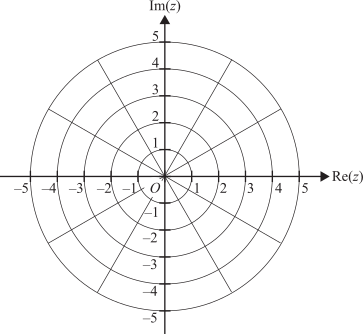
The line given by `|z-1| = |z-3|` intersects the circle given by `|z + 1| = sqrt 2 |z-i|` in two places.
- Draw the line given by `|z-1| = |z-3|` on the Argand diagram in part c. Label the points of intersection with their coordinates. (2 marks)
--- 5 WORK AREA LINES (style=lined) ---
- Find the area of the minor segment enclosed by an arc of the circle given by `|z + 1| = sqrt 2 |z-i|` and part of the line given by `|z-1| = |z-3|`. (3 marks)
--- 6 WORK AREA LINES (style=lined) ---
Show Worked Solution
a. `(x-1)^2 + (y-2)^2 = 2^2`
`:.\ text(Centre)\ (1, 2), quad text(radius) = 2`
| b. | `y^2 + (x + 1)^2` | `= (sqrt 2)^2 (x^2 + (y-1)^2)` |
| `y^2 + x^2 + 2x + 1` | `= 2(x^2 + y^2-2y + 1)` | |
| `y^2 + x^2 + 2x + 1` | `= 2x^2 + 2y^2-4y + 2` |
| `0` | `= 2x^2 + 2y^2-4y + 2-y^2-x^2-2x-1` |
| `0` | `= x^2 + y^2-4y-2x + 1` |
| `0` | `= (x^2-2x + 1) + (y^2-4y)` |
| `0` | `= (x-1)^2 + (y^2-4y + 2^2)-4` |
| `0` | `= (x-1)^2 + (y-2)^2-4` |
| `4` | `= (x-1)^2 + (y-2)^2` |
`:.\ text(Centre)\ (1, 2), quad text(radius) = 2`
c. `ytext(-axis intercepts occur when)\ \ x=0:`
| `(0-1)^2 + (y-2)^2` | `= 4` |
| `1 + (y-2)^2` | `= 4` |
| `(y-2)^2` | `= 3` |
| `y-2` | `= +- sqrt 3` |
| `y` | `= 2 +- sqrt 3` |

d. `|z-1| = |z-3|`
`=>\ text(Graph is a line equidistant from:)\ \ 1 + 0i and 3 + 0i`
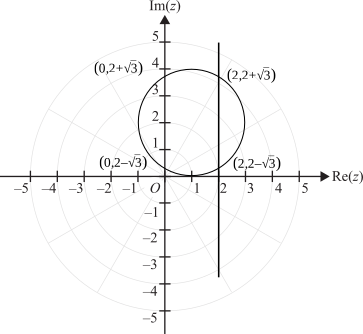

`text(Circle intercepts occur when)\ \ x=2:`
| `(2- 1)^2 + (y-2)^2` | `= 4` |
| `(y-2)^2` | `= 3` |
| `y-2` | `= +- sqrt 3` |
| `y` | `= 2 +- sqrt 3` |
e. `sin theta = sqrt3/2\ \ =>\ \ theta = pi/3`♦ Mean mark 39%.
MARKER’S COMMENT: Students who used standard formulae rather than definite integrals were more successful.
`text(Angle at centre of segment) = (2pi)/3`
`text(Height of triangle)\ (h) = 2^2-(sqrt3)^2 =1`
`:.\ text(Shaded Area)`
`=\ text(Area of segment – Area of triangle)`
`=((2pi)/3)/(2pi) xx pi xx 2^2-1/2 xx 2sqrt3 xx 1`
`=(4pi)/3-sqrt3`
Complex Numbers, SPEC1-NHT 2018 VCAA 8
A circle in the complex plane is given by the relation `|z-1-i| = 2, \ z in C`.
- Sketch the circle on the Argand diagram below. (1 mark)
--- 0 WORK AREA LINES (style=lined) ---
- i. Write the equation of the circle in the form `(x-a)^2 + (y-b)^2 = c` and show that the gradient of a tangent to the circle can be expressed as `(dy)/(dx) = (1-x)/(y-1)`. (2 marks)
--- 6 WORK AREA LINES (style=lined) ---
- ii. Find the gradient of the tangent to the circle where `x = 2` in the first quadrant of the complex plane. (1 mark)
--- 6 WORK AREA LINES (style=lined) ---
- Find the equations of all rays that are perpendicular to the circle in the form `text(Arg) (z) = alpha`. (2 marks)
--- 4 WORK AREA LINES (style=lined) ---
Show Worked Solution
| a. | 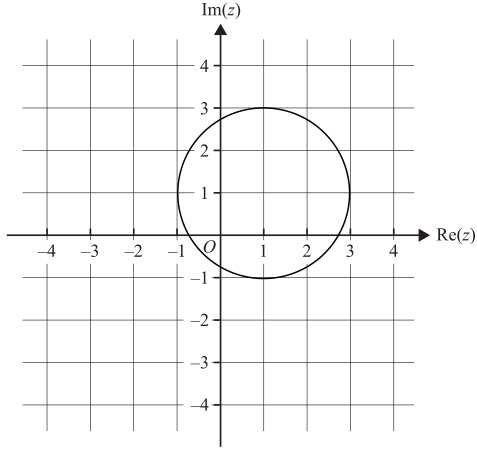 |
| b.i. | `(x-1)^2 + (y-1)^2` | `= 4` |
| `2(x-1) + d/(dx) ((y-1)^2)` | `= 0` | |
| `2(x-1) + 2(y-1)*(dy)/(dx)` | `= 0` | |
| `2 (y-1)*(dy)/(dx)` | `= -2(x-1)` | |
| `(dy)/(dx)` | `= (-(x-1))/(y-1)` | |
| `= (1-x)/(y-1)` |
| b.ii. | `(2-1)^2 + (y-1)^2` | `= 4` |
| `1 + (y-1)^2` | `= 4` | |
| `(y-1)^2` | `= 3` | |
| `y` | `= 1 + sqrt 3\ \ \ (y > 0)` | |
| `(dy)/(dx)|_{(2, 1 + sqrt 3)}` | `= (1-2)/(1 + sqrt 3-1` | |
| `= (-1)/sqrt 3` |
| c. | `P (0, 0) quad C(1, 1)` |
| `-> y = x` | |
| `:. alpha = pi/4, quad (-3 pi)/4` |
`text(Arg) (z) = pi/4`
`text(Arg) (z) = (-3 pi)/4`