A model yacht is sailing on a lake between two buoys. Its path from one buoy to the other, relative to an origin \(O\), is given by \({\underset{\sim}{r}}_{\text{Y}}(t)=3 \sec (t) \underset{\sim}{i}+2 \tan (t) \underset{\sim}{j}\), where \(\dfrac{2 \pi}{3} \leq t \leq \dfrac{4 \pi}{3}\) Displacement components are measured in metres, and time \(t\) is measured in minutes. --- 5 WORK AREA LINES (style=lined) --- --- 0 WORK AREA LINES (style=lined) ---
--- 5 WORK AREA LINES (style=lined) --- --- 3 WORK AREA LINES (style=lined) --- --- 2 WORK AREA LINES (style=lined) --- --- 2 WORK AREA LINES (style=lined) --- --- 2 WORK AREA LINES (style=lined) --- --- 2 WORK AREA LINES (style=lined) --- --- 6 WORK AREA LINES (style=lined) --- a. \(\left(\dfrac{x}{3}\right)^2-\left(\dfrac{y}{2}\right)^2=1\) c.iii. \(\abs{\underset{\sim}{\dot{r}(t)}}=2 \ \text{metres/min}\) c.iv \(\text{Yacht has coordinates} \ (-3,0) \ \text {when min speed occurs.}\) d.i \(\text{Distance }=\displaystyle \int_{\frac{2 \pi}{3}}^{\frac{4 \pi}{3}} \sqrt{(3 \sec \, t\, \tan\, t)^2+4\left(\sec ^2 t\right)}\,dt\) d.ii. \(\text{Distance}=9.4 \ \text{metres}\) e. \(D_{\min }=11.1 \ \text{m}\) c.ii. \(\text {Differentiate} \ \ \abs{\underset{\sim}{\dot{r}}(t)}^2: \) \(\dfrac{d}{d t}\left(\abs{\underset{\sim}{\dot{r}}(t)}^2\right)=\dfrac{52 \sin t}{\cos ^5 t}-\dfrac{18}{\cos ^3 t}=\dfrac{2 \sin t\left(26-9 \sin t\, \cos ^2 t\right)}{\cos ^5 t}\) \(\text{Find } t \text{ where } \ \sin t=0 \ \text { for } \ \dfrac{2 \pi}{3} \leq t \leq \dfrac{4 \pi}{3}:\) \(t=\pi\) \(\text{Minimum speed occurs at \( t=\pi\) min.}\) c.iii. \(\text{Find} \ \ \abs{\underset{\sim}{\dot{r}}(t)}^2 \text{when} \ \ t=\pi:\) \(\abs{\underset{\sim}{\dot{r}}(t)^2}=\dfrac{13}{\cos ^4 \pi}-\dfrac{9}{\cos ^2 \pi}=13-9=4\) \(\abs{\underset{\sim}{\dot{r}(t)}}=\sqrt{4}=2 \ \text{metres/min}\) \(\underset{\sim}{r}(\pi)=3 \sec \pi \underset{\sim}{i}+2 \tan \pi \underset{\sim}{j}=-3 \underset{\sim}{i}\) \(\text{Yacht has coordinates} \ (-3,0) \ \text {when min speed occurs.}\) d.i \(\text{Distance }=\displaystyle \int_{\frac{2 \pi}{3}}^{\frac{4 \pi}{3}} \sqrt{(3 \sec \, t\, \tan\, t)^2+4\left(\sec ^2 t\right)}\,dt\) d.ii. \(\text{Distance}=9.4 \ \text{metres}\) e. \({\underset{\sim}{r}}_\text{D}(t)=(2-3 t) \underset{\sim}{i}+(4 t-1) \underset{\sim}{j}+(6-t) \underset{\sim}{k} \quad(0 \leqslant t \leqslant 5)\) \(\underset{\sim}{r}(t)=3 \sec (t) \underset{\sim}{i}+2 \tan (t) \underset{\sim}{j} \quad\left(\dfrac{2 \pi}{3} \leqslant t \leqslant \dfrac{4 \pi}{3}\right)\) \(D=\sqrt{(3 \sec t-2+3 t)^2+(2 \tan t-4 t+1)^2+(t-6)^2}\) \(\text{Find} \ \ D_{\min } \ \text{for} \ \ \dfrac{2 \pi}{3} \leq t \leq \dfrac{4 \pi}{3}:\) \(D_{\min }=11.1 \ \text{m}\)
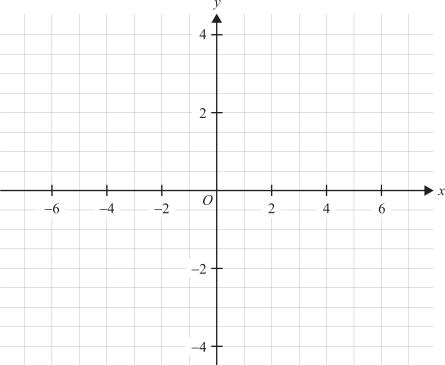
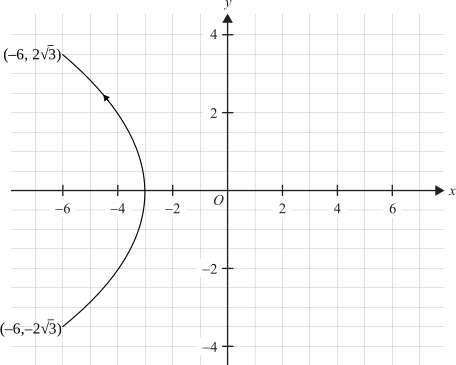
c.i. \(\abs{\underset{\sim}{\dot{r}}(t)}^2=13 \sec ^4 t-9 \sec ^2 t\)
a.
\(x\)
\(=3 \sec t \)
\(\ \Rightarrow \ \sec t\)
\(=\dfrac{x}{3}\)
\(y\)
\(=2 \tan t \)
\(\ \Rightarrow \ \tan t\)
\(=\dfrac{y}{2}\)
\(\sec ^2 t+1\)
\(=\tan ^2 t\)
\(\left(\dfrac{y}{2}\right)^2+1\)
\(=\left(\dfrac{x}{3}\right)^2\)
\(\left(\dfrac{x}{3}\right)^2-\left(\dfrac{y}{2}\right)^2\)
\(=1\)
c.i.
\(\underset{\sim}{r}\)
\(=3 \sec (t)\underset{\sim}{i}+2 \tan (t)\underset{\sim}{j}\)
\(\underset{\sim}{\dot{r}}(t)\)
\(=\dfrac{3 \sin t}{\cos ^2 t}\underset{\sim}{i}+\dfrac{2}{\cos ^2 t} \underset{\sim}{j}\)
\(\abs{\underset{\sim}{\dot{r}}(t)}^2\)
\(=\dfrac{9 \sin ^2 t}{\cos ^4 t}+\dfrac{4}{\cos ^4 t}\)
\(=\dfrac{9-9 \cos ^2 t+4}{\cos ^4 t}\)
\(=\dfrac{13}{\cos ^4 t}-\dfrac{9}{\cos ^2 t}\)
\(=13 \sec ^4 t-9 \sec ^2 t\)
c.iv \(\text{Find}\ \underset{\sim}{r}(t) \ \text{when} \ \ t=\pi:\)
Vectors, SPEC1 2023 VCAA 10
The position vector of a particle at time \(t\) seconds is given by
\(\underset{\sim}{\text{r}}(t)=\big{(}5-6 \ \sin ^2(t) \big{)} \underset{\sim}{\text{i}}+(1+6 \ \sin (t) \cos (t)) \underset{\sim}{\text{j}}\), where \(t \geq 0\).
- Write \(5-6\, \sin ^2(t)\) in the form \(\alpha+\beta\, \cos (2 t)\), where \(\alpha, \beta \in Z^{+}\). (1 mark)
--- 5 WORK AREA LINES (style=lined) ---
- Show that the Cartesian equation of the path of the particle is \((x-2)^2+(y-1)^2=9.\) (2 marks)
--- 6 WORK AREA LINES (style=lined) ---
- The particle is at point \(A\) when \(t=0\) and at point \(B\) when \(t=a\), where \(a\) is a positive real constant.
- If the distance travelled along the curve from \(A\) to \(B\) is \(\dfrac{3 \pi}{4}\), find \(a\). (1 mark)
--- 6 WORK AREA LINES (style=lined) ---
- Find all values of \(t\) for which the position vector of the particle, \(\underset{\sim}{\text{r}}(t)\), is perpendicular to its velocity vector, \(\underset{\sim}{\dot{\text{r}}}(t)\). (2 marks)
--- 8 WORK AREA LINES (style=lined) ---
Vectors, SPEC1 2021 VCAA 9
Let `underset~r(t) = (-1 + 4cos(t))underset~i + 2/sqrt3\ sin(t)underset~j` and `underset~s(t) = (3 sec(t)-1)underset~i + tan(t)underset~j` be the position vectors relative to a fixed point `O` of particle `A` and particle `B` respectively for `0 <= 1 <= c`, where `c` is a positive real constant.
-
- Show that the cartesian equation of the path of particle `A` is `((x + 1)^2)/16 + (3y^2)/4 = 1`. (1 mark)
--- 4 WORK AREA LINES (style=lined) ---
- Show that the cartesian equation of the path of particle `A` in the first quadrant can be written as `y = sqrt3/6 sqrt(-x^2-2x + 15)`. (1 mark)
--- 4 WORK AREA LINES (style=lined) ---
- Show that the cartesian equation of the path of particle `A` is `((x + 1)^2)/16 + (3y^2)/4 = 1`. (1 mark)
-
- Show that the particles `A` and `B` will collide. (1 mark)
--- 5 WORK AREA LINES (style=lined) ---
- Hence, find the coordinates of the point of collision of the two particles. (1 mark)
--- 3 WORK AREA LINES (style=lined) ---
- Show that the particles `A` and `B` will collide. (1 mark)
-
- Show that `d/(dx)(8arcsin ((x + 1)/4) + ((x + 1)sqrt(-x^2 -2x + 15))/2) = sqrt(-x^2-2x + 15)`. (2 marks)
--- 6 WORK AREA LINES (style=lined) ---
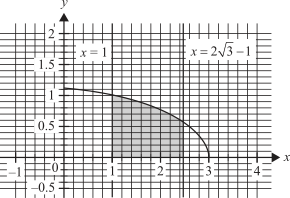
Hence, find the area bounded by the graph of `y = sqrt3/6 sqrt(-x^2-2x + 15)`, the `x`-axis and the lines `x = 1` and `x = 2sqrt3-1`, as shown in the diagram above. Give your answer in the form `(asqrt3pi)/b`, where `a` and `b` are positive integers. (2 marks)
--- 6 WORK AREA LINES (style=lined) ---
- Show that `d/(dx)(8arcsin ((x + 1)/4) + ((x + 1)sqrt(-x^2 -2x + 15))/2) = sqrt(-x^2-2x + 15)`. (2 marks)
Vectors, SPEC2 2020 VCAA 15 MC
Two forces, `underset~F_(text(A)) = 4 underset~i - 2 underset~j` and `underset~F_(text(B)) = 2 underset~i - 5 underset~j`, act on a particle of mass 3 kg. The particle is initially at rest at position `underset~i + underset~j`. All force components are measured in newtons and displacements are measured in metres.
The cartesian equation of the path of the particle is
- `y = x/2`
- `y = x/2 - 1/2`
- `y = ((x + 1)^2)/2 + 1`
- `y = ((x - 1)^2)/1 + 1`
- `y = x/2 + 1/2`
Vectors, SPEC2 2011 VCAA 13 MC
The position of a particle at time `t` is given by `underset~r(t) = (sqrt(t - 2))underset~i + (2t)underset~j` for `t >= 2`.
The cartesian equation of the path of the particle is
| A. `y = 2x^2 + 4`, | `x >= 2` |
| B. `y = 2x^2 + 2`, | `x >= 2` |
| C. `y = 2x^2 + 4`, | `x >= 0` |
| D. `y = sqrt((x - 4)/2)`, | `x >= 4` |
| E. `y = 2x^2 + 2`, | `x >= 0` |
Vectors, SPEC1 2013 VCAA 7
The position vector `underset ~r (t)` of a particle moving relative to an origin `O` at time `t` seconds is given by
`underset ~r(t) = 4 sec (t) underset ~i + 2 tan (t) underset ~j,\ t in [0, pi/2)`
where the components are measured in metres.
- Show that the cartesian equation of the path of the particle is `x^2/16-y^2/4 = 1.` (2 marks)
--- 5 WORK AREA LINES (style=lined) ---
- Sketch the path of the particle on the axes below, labelling any asymptotes with their equations. (2 marks)
--- 0 WORK AREA LINES (style=lined) ---
- Find the speed of the particle, in `text(ms)^-1`, when `t = pi/4.` (2 marks)
--- 5 WORK AREA LINES (style=lined) ---
Show Answers Only
- `text(Proof)\ \ text{(See Worked Solutions)}`
-
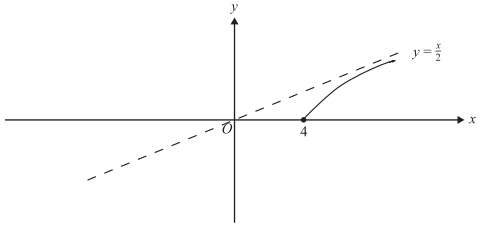
- `4 sqrt 3\ \ text(ms)^-1`
Show Worked Solution
| a. | `x` | `= 4sec(t)` |
| `x/4` | `= sec(t)` | |
| `y` | `= 2tan(t)` | |
| `y/2` | `= tan(t)` |
`text(Using)\ \ tan^2 (t) + 1 = sec^2(t),`
| `(x^2)/16 +1 ` | `= y^2/4` |
| `:. (x^2)/16-(y^2)/4` | `=1` |
b. `y^2/4 = x^2/16 -1\ \ =>\ \ y=+- sqrt(x^2/4 -4)`♦ Mean mark part (b) 45%.
`lim_(x->oo) y = +- x/2`
♦ Mean mark part (c) 39%.
| c. | `overset·underset~r(t)` | `= d/(dt)(4(cos(t))^(−1))underset~i + d/(dt)(2tan(t)) underset~j` |
| `= 4(−1)(−sin(t))(cos(t))^(−2)underset~i + 2sec^2(t)underset~j` | ||
| `= 4sin(t)sec^2(t)underset~i + 2sec^2(t)underset~i` |
| `|overset·underset~r(pi/4)|` | `= sqrt(16sin^2(pi/4)sec^4(pi/4) + 4sec^4(pi/4))` |
| `= sqrt(16(1/sqrt2)^2(sqrt2)^4 + 4(sqrt2)^4)` | |
| `= sqrt(16(1/2)(4) + 4(4))` | |
| `= sqrt(48)` | |
| `= 4sqrt3\ \ text(ms)^(-1)` |
Vectors, SPEC2 2018 VCAA 4
Two yachts, `A` and `B`, are competing in a race and their position vectors on a certain section of the race after time `t` hours are given by
`underset ~ r_A (t) = (t + 1) underset ~i + (t^2 + 2t) underset ~j \ and \ underset ~r_B (t) = t^2 underset ~i + (t^2 + 3) underset ~j, \ t >= 0`
where displacement components are measured in kilometres from a given reference buoy at origin `O`.
- Find the cartesian equation of the path for each yacht. (2 marks)
--- 4 WORK AREA LINES (style=lined) ---
- Show that the two yachts will not collide if they follow these paths. (2 marks)
--- 4 WORK AREA LINES (style=lined) ---
- Find the coordinates of the point where the paths of the two yachts cross. Give your coordinates correct to three decimal places. (2 marks)
--- 5 WORK AREA LINES (style=lined) ---
One of the rules for the race is that the yachts are not allowed to be within 0.2 km of each other. If this occurs there is a time penalty for the yacht that is travelling faster.
- For what values of `t` is yacht `A` travelling faster than yacht `B`? (2 marks)
--- 6 WORK AREA LINES (style=lined) ---
- If yacht `A` does not alter its course, for what period of time will yacht `A` be within 0.2 km of yacht `B`? Give your answer in minutes, correct to one decimal place. (2 marks)
--- 6 WORK AREA LINES (style=lined) ---
Vectors, SPEC1 2014 VCAA 2
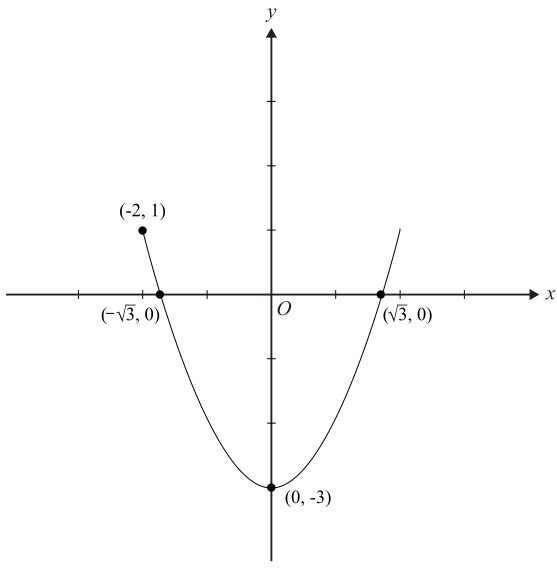
The position vector of a particle at time `t >= 0` is given by `underset ~r (t) = (t-2) underset ~ i + (t^2-4t + 1) underset ~j` --- 5 WORK AREA LINES (style=lined) --- --- 0 WORK AREA LINES (style=lined) --- --- 5 WORK AREA LINES (style=lined) ---
b. `t >= 0` `x = t-2\ \ =>\ \ x >= -2` Show Worked Solution
a.
`x`
`= t-2\ \ =>\ \ t=x+2`
`y`
`= t^2-4t + 1`
`= (x + 2)^2-4 (x + 2) + 1`
`y`
`= x^2 + 4x + 4-4x-8 + 1`
`= x^2-3`
`y(-2)`
`= (-2)^2-3`
`= 1`
`y(0)`
`= -3`
`0`
`= x^2-3`
`x^2`
`= 3`
`x`
`= +- sqrt 3`
c.
`underset ~ dot r (t)`
`= underset ~ dot i + (2t-4) underset ~j`
`underset ~ dot r (1)`
`= underset ~ dot i + (2-4) underset ~j`
`= underset ~ dot i-2 underset ~j`
`|underset ~ dot r(1)|`
`= sqrt (1^2 + (-2)^2)`
`= sqrt 5`
Calculus, SPEC1 2018 VCAA 9
A curve is specified parametrically by `underset ~r(t) = sec(t) underset ~i + sqrt 2/2 tan(t) underset ~j, \ t in R`. --- 6 WORK AREA LINES (style=lined) --- --- 5 WORK AREA LINES (style=lined) --- --- 8 WORK AREA LINES (style=lined) ---
Vectors, SPEC2 2017 VCAA 12 MC
Let `underset~r(t) = (1 - sqrt(a)sin(t))underset~i + (1 - 1/b cos(t))underset~j` for `t >= 0` and `a, b ∈ R^−` be the path of a particle moving in the cartesian plane.
The path of the particle will always be a circle if
- `ab^2 = 1`
- `a^2b = 1`
- `ab^2 != 1`
- `ab = 1`
- `a^2b != 1`