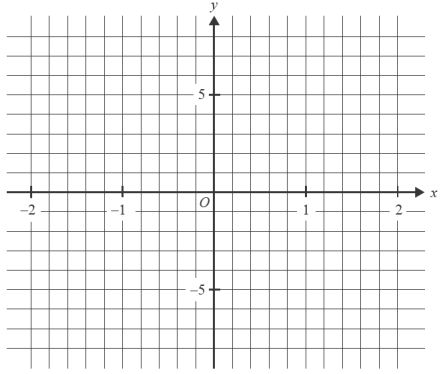
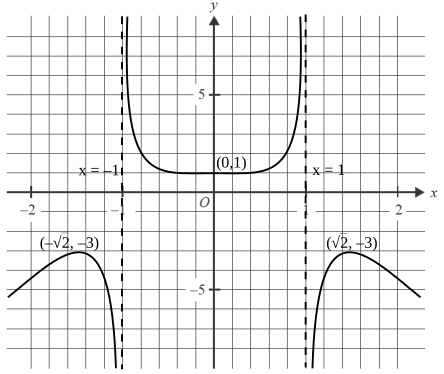
Consider the function \(f\) with rule \(f(x)=\dfrac{x^4-x^2+1}{1-x^2}\). --- 3 WORK AREA LINES (style=lined) --- --- 3 WORK AREA LINES (style=lined) --- --- 2 WORK AREA LINES (style=lined) --- --- 2 WORK AREA LINES (style=lined) --- --- 3 WORK AREA LINES (style=lined) --- --- 3 WORK AREA LINES (style=lined) --- --- 3 WORK AREA LINES (style=lined) --- a. b.i. \(V=\pi \displaystyle\int_1^6 \frac{1-y+\sqrt{y^2+2y-3}}{2} \, dy\) b.ii. \(V=11.2\ \text{u}^3\) c. \(b=-1\) d.i. \(b \leqslant-1\) d.ii. \(b \geqslant 0\) d.iii. \(-1<b<0\) a. \(\text{Using CAS (set domain, range to match image):}\) \(1-x^2 \neq 0 \ \Rightarrow \ \text {Vertical asymptotes at}\ \ x= \pm 1\) c. \(g(x)=\dfrac{x^4+b}{1-x^2}=-x^2-1+\dfrac{b+1}{1-x^2} \ \ \text{(by polynomial division)}\) \(\text{No asymptotes when}\ \ b+1=0\ \ \Rightarrow\ \ b=-1\) d.i. \(\text{Since \(g^{\prime}(0)=0\) provides 1 SP, no solutions are required for}\) \(\dfrac{(x^2-1)^2-(b+1)}{(1+x^2)^2}=0\) \(b+1<0 \ \Rightarrow \ b<-1\) \(\text{Consider} \ \ b=-1:\) \(\dfrac{\left(x^2-1\right)^2-0}{\left(1-x^2\right)^2}=1 \neq 0 \ \text{(no solution)}\) \(\therefore b \leqslant-1\) d.ii. \(\text{3 SPs:} \ \left(x^2-1\right)^2=b+1 \ \ \text{has two non-zero, real solutions}\) \(\Rightarrow \sqrt{b+1} \geqslant 1 \ \text{for 2 solution}\) \(\Rightarrow b \geqslant 0\) d.iii \(\text{5 SPs:} \ \left(x^2-1\right)^2 = b+1 \ \text{has four non-zero real solutions}\) \(x=\pm\sqrt{1 \pm \sqrt{b+1}} \ \ \text{has 4 solutions if}\)
b.i
\(V\)
\(=\pi \displaystyle \int_1^6 x^2 \ dy\)
\(=\pi \displaystyle\int_1^6 \frac{1-y+\sqrt{y^2+2y-3}}{2} \, dy \ \ \text{(by CAS)}\)
b.ii. \(V=11.2\ \text{u}^3 \ \text{(1 d.p.)}\)
♦♦♦ Mean mark (d.ii.) 27%.
♦♦♦ Mean mark (d.iii.) 25%.
\(x^2-1\)
\(= \pm \sqrt{b+1}\)
\(x\)
\(=\pm \sqrt{1 \pm \sqrt{b+1}}\)
\(b+1 >\)
\(0\)
\(\text{and}\)
\(\sqrt{b+1}<1\)
\(b >\)
\( -1\)
\(b<0\)
\(\therefore -1<b<0\)
Calculus, SPEC2 2024 VCAA 10 MC
The curve defined by the parametric equations
\(x=5 t, \ y=12 t\), for \(0 \leq t \leq k\)
is rotated about the \(y\)-axis to form a surface of revolution.
The area of this surface is
- \(65 \ k^2 \pi\)
- \(130 \ k^2 \pi\)
- \(156 \ k^2 \pi\)
- \(825 \ k^2 \pi\)
Calculus, SPEC2 2023 VCAA 11 MC
The area of the curved surface generated by revolving part of the curve with equation \(y=\cos ^{-1}(x)\) from \((0, \dfrac{\pi}{2})\) to \((1,0)\) about the \(y\)-axis can be found by evaluating
- \(2 \pi \displaystyle {\int_0^{\dfrac{\pi}{2}}\left(\cos ^{-1}(x) \sqrt{1+\dfrac{1}{x^2-1}}\right)} d x\)
- \(2 \pi \displaystyle {\int_0^1\left(\cos ^{-1}(x) \sqrt{1+\dfrac{1}{x^2-1}}\right)} d x\)
- \(2 \pi \displaystyle {\int_0^{\dfrac{\pi}{2}} \cos (y) \sqrt{1-\sin ^2(y)}} d y\)
- \(2 \pi \displaystyle {\int_0^{\dfrac{\pi}{2}} \sqrt{1+u^2} \ d u}\), where \(u=\sin (y)\)
- \(2 \pi \displaystyle {\int_0^1 \sqrt{1+u^2} \ d u } \), where \(u=\sin (y)\)
Calculus, SPEC2 2021 VCAA 3
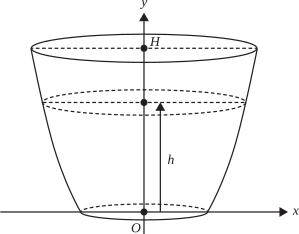
A thin-walled vessel is produced by rotating the graph of `y = x^3-8` about the `y`-axis for `0 <= y <= H`.
All lengths are measured in centimetres.
-
- Write down a definite integral in terms of `y` and `H` for the volume of the vessel in cubic centimetres. (1 mark)
--- 2 WORK AREA LINES (style=lined) ---
- Hence, find an expression for the volume of the vessel in terms of `H`. (1 mark)
--- 2 WORK AREA LINES (style=lined) ---
- Write down a definite integral in terms of `y` and `H` for the volume of the vessel in cubic centimetres. (1 mark)
Water is poured into the vessel. However, due to a crack in the base, water leaks out at a rate proportional to the square root of the depth `h` of water in the vessel, that is `(dV)/(dt) = -4sqrth`, where `V` is the volume of water remaining in the vessel, in cubic centimetres, after `t` minutes.
-
- Show that `(dh)/(dt) = (-4sqrth)/(pi(h + 8)^(2/3))`. (2 marks)
--- 4 WORK AREA LINES (style=lined) ---
- Find the maximum rate, in centimetres per minute, at which the depth of water in the vessel decreases, correct to two decimal places, and find the corresponding depth in centimetres. (2 marks)
--- 4 WORK AREA LINES (style=lined) ---
- Let `H = 50` for a particular vessel. The vessel is initially full and water continues to leak out at a rate of `4 sqrth` cm³ min`\ ^(-1)`.
- Find the maximum rate at which water can be added, in cubic centimetres per minute, without the vessel overflowing. (1 mark)
--- 2 WORK AREA LINES (style=lined) ---
- Show that `(dh)/(dt) = (-4sqrth)/(pi(h + 8)^(2/3))`. (2 marks)
- The vessel is initially full where `H = 50` and water leaks out at a rate of `4sqrth` cm³ min`\ ^(-1)`. When the depth of the water drops to 25 cm, extra water is poured in at a rate of `40sqrt2` cm³ min`\ ^(-1)`.
- Find how long it takes for the vessel to refill completely from a depht of 25 cm. Give your answer in minutes, correct to one decimal place. (3 marks)
--- 6 WORK AREA LINES (style=lined) ---
Calculus, SPEC2 2019 VCAA 1
A curve is defined parametrically by `x = sec(t) + 1, \ y = tan(t)`, where `t ∈ [0, pi/2)`.
- Show that the curve can be represent in cartesian form by the rule `y = sqrt(x^2-2x)`. (2 marks)
--- 5 WORK AREA LINES (style=lined) ---
- State the domain and range of the relation given by `y = sqrt(x^2-2x)`. (2 marks)
--- 4 WORK AREA LINES (style=lined) ---
- i. Express `(dy)/(dx)` in terms of `sin(t)`. (2 marks)
--- 4 WORK AREA LINES (style=lined) ---
- ii. State the limiting value of `(dy)/(dx)` as `t` approaches `pi/2`. (1 mark)
--- 4 WORK AREA LINES (style=lined) ---
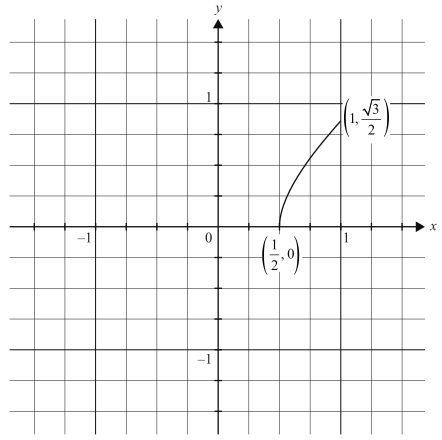
- Sketch the curve `y = sqrt(x^2-2x)` on the axes below for `x ∈ [2, 4]`, labelling the endpoints with their coordinates. (2 marks)
--- 0 WORK AREA LINES (style=lined) ---

- The portion of the curve given by `y = sqrt(x^2-2x)` for `x ∈ [2, 4]` is rotated about the `y`-axis to form a solid of revolution.
- Write down, but do not evaluate, a definite integral in terms of `t` that gives the volume of the solid formed. (2 marks)
--- 6 WORK AREA LINES (style=lined) ---
Show Answers Only
- `text(See Worked Solutions)`
- `text(Domain:)\ x ∈ [2, ∞)`
`text(Range:)\ y ∈ [0, ∞)`
-
- `(dy)/(dx) = ((dy)/(dt))/((dt)/(dx)) = (sec^2(t))/(sin(t)sec^2(t)) = 1/(sin(t))`
- `(dy)/(dx) -> 1`
-
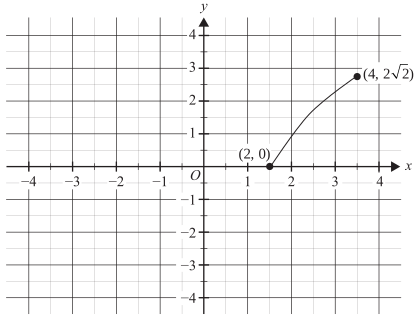
- ` V = pi int_0^(tan^(−1)(2sqrt2)) (sec(t) + 1)^2sec^2(t)dt`
Show Worked Solution
a. `x = sec(t) + 1 \ => \ sec(t) = x-1`
`y = tan(t)`
`text(Using)\ \ tan^2(t) + 1 = sec^2(t):`
| `y^2 + 1` | `= (x-1)^2` |
| `y^2 + 1` | `= x^2-2x + 1` |
| `y^2` | `= x^2-2x` |
| `y` | `= sqrt(x^2-2x), \ y >= 0\ \ text(as)\ \ t ∈ [0, pi/2)` |
b. `text(Sketch:)\ \ x = sec(t) + 1, \ y = tan(t)\ \ text(for)\ \ t ∈ [0, pi/2)`
`text(Domain:)\ \ x ∈ [2, ∞)`
`text(Range:)\ \ y ∈ [0, ∞)`
c.i. `(dy)/(dt) = sec^2(t), \ (dx)/(dt) = sin(t)sec^2(t)\ \ \ (text(by CAS))`
`(dy)/(dx) = ((dy)/(dt))/((dx)/(dt)) = (sec^2(t))/(sin(t)sec^2(t)) = 1/(sin(t))`
c.ii. `text(As)\ \ t -> pi/2:`
`(dy)/(dx) -> 1`
| d. | |
e. `V = pi int_0^(2sqrt2) x^2\ dy`
`x^2 = (sec(t) + 1)^2`
`(dy)/(dt) = sec^2(t) \ => \ dy = sec^2(t)\ dt`
`text(When)\ y = 0, t = 0`
`text(When)\ y = 2sqrt2, t = tan^(−1)(2sqrt2)`
`:. V = pi int_0^(tan^(−1)(2sqrt2)) (sec(t) + 1)^2sec^2(t)\ dt`
Calculus, SPEC2 2013 VCAA 10 MC
The region bounded by the lines `x = 0`, `y = 3` and the graph of `y = x^(4/3)` where `x ≥ 0` is rotated about the `y`-axis to form a solid of revolution.
The volume of this solid is
A. `(81pi3^(2/3))/11`
B. `(12pi3^(3/4))/7`
C. `(27pi3^(1/3))/7`
D. `(18pi3^(1/2))/5`
E. `(6pi3^(1/2))/5`
Calculus, SPEC2-NHT 2017 VCAA 1
- i. Use an appropriate double angle formula with `t = tan((5 pi)/12)` to deduce a quadratic equation of the form `t^2 + bt + c = 0`, where `b` and `c` are real values. (2 marks)
--- 5 WORK AREA LINES (style=lined) ---
- ii. Hence show that `tan((5 pi)/12) = 2 + sqrt 3`. (1 mark)
--- 2 WORK AREA LINES (style=lined) ---
Consider `f: [sqrt 3, 6 + 3 sqrt 3] -> R,\ \ f(x) = arctan (x/3)-pi/6`.
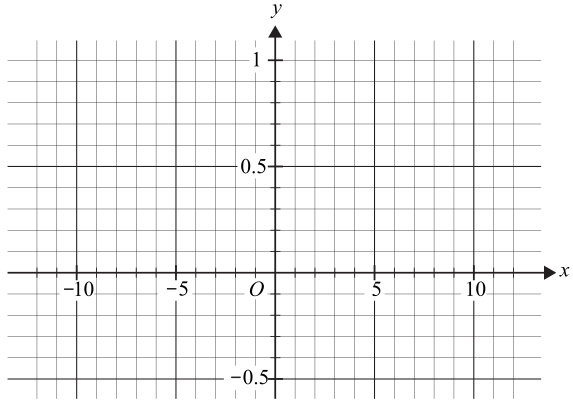
- Sketch the graph of `f` on the axes below, labelling the end points with their coordinates. (3 marks)
--- 3 WORK AREA LINES (style=lined) ---
- The region between the graph of `f` and the `y`-axis is rotated about the `y`-axis to form a solid of revolution.
- i. Write down a definite integral in terms of `y` that gives the volume of the solid formed. (2 marks)
--- 5 WORK AREA LINES (style=lined) ---
- ii. Find the volume of the solid, correct to the nearest integer. (1 mark)
--- 2 WORK AREA LINES (style=lined) ---
- A fish pond that has a shape approximately like that of the solid of revolution in part c. is being filled with water. When the depth is `h` metres, the volume, `V\ text(m)^3`, of water in the pond is given by
`qquad V = tan(h + pi/6)-h-sqrt 3/3`
If water is flowing into the pond at a rate of 0.03 m³ per minute, find the rate at which the depth is increasing when the depth is 0.6 m. Give your answer in metres per minute, correct to three decimal places. (3 marks)
--- 6 WORK AREA LINES (style=lined) ---
Show Worked Solution
a.i. `tan (theta/2) = tan ((5pi)/12) = t`
| `tan (theta)` | `=(2 tan (theta/2))/(1-tan^2(theta/2)` |
| `tan((5 pi)/6)` | `= (2tan ((5pi)/12))/(1-tan^2((5pi)/2)` |
| `-1/sqrt 3` | `= (2t)/(1-t^2), quad (t != +- 1)` |
| `-(1-t^2)` | `= 2t sqrt 3` |
| `-1 + t^2` | `= 2t sqrt 3` |
`:. t^2-2 sqrt 3 t-1 = 0`
| a.ii. | `t^2-2 sqrt 3 t + (-sqrt 3)^2 +3 -4 = 0` | |
| `(t-sqrt 3)^2` | `= 4` | |
| `t-sqrt 3` | `= +- 2` | |
| `t` | `= sqrt 3 +-2` | |
`=> tan ((5 pi)/12)\ \ text(is in 1st quadrant,)`
| `:. t` | `= tan ((5 pi)/12) = 2 + sqrt 3` |
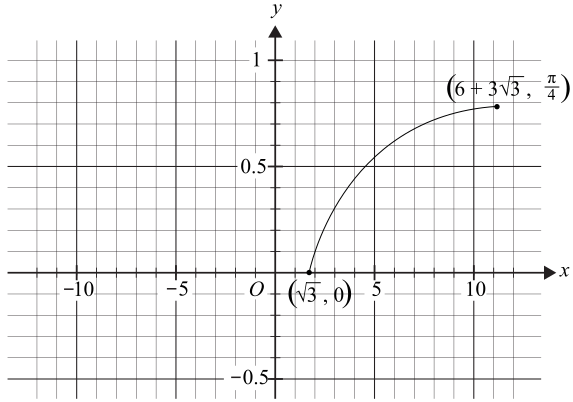
| b. | `f(sqrt 3)` | `= 0` |
| `f(6 + 3 sqrt 3)` | `=pi/4` |
`text(Graphing)\ \ f(x) = arctan (x/3)-pi/6\ \ text(on CAS will)`
`text(show the shape of the graph.)`
| c.i. | `y` | `= tan^(-1)(x/3)-pi/6` |
| `y + pi/6` | `= tan^(-1)(x/3)` | |
| `x/3` | `= tan(y + pi/6)` | |
| `x` | `= 3 tan (y + pi/6)` | |
| `x^2` | `= 9 tan^2 (y + pi/6)` |
| `:. V` | `= pi int_0^(pi/4) x^2\ dy` | |
| `=pi int_0^(pi/4) 9 tan^2 (y + pi/6)\ dy` |
c.ii. `pi int_0^(pi/4) 9 tan^2 (y + pi/6)\ dy`
`=66.99…`
`=67\ text(u³)`
| d. | `(dV)/(dt)` | `= 0.03` |
| `V` | `= tan(h + pi/6)-h-sqrt 3/3` | |
| `(dV)/(dh)` | `= tan^2 (h+pi/6)\ \ \ text{(by CAS)}` | |
| `(dh)/(dt)` | `= (dh)/(dV) * (dV)/(dt)` | |
| `= 1/(tan^2 (h+pi/6)) xx 3/100` |
`(dh)/(dt)|_(h = 0.6)~~0.007\ text(m/min)`
Calculus, SPEC2-NHT 2018 VCAA 1
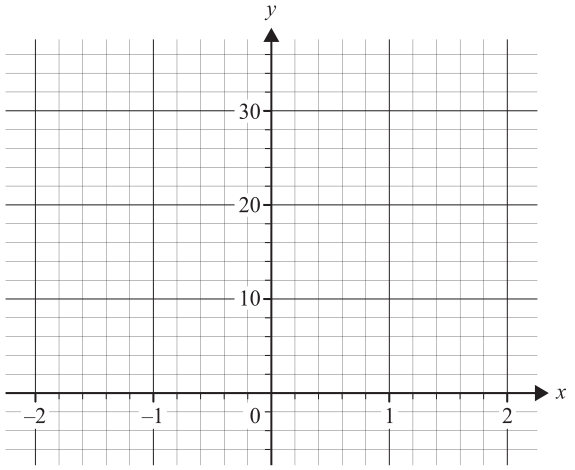
Consider the function `f` with rule `f(x) = 10 arccos (2-2x)`. --- 0 WORK AREA LINES (style=lined) --- --- 5 WORK AREA LINES (style=lined) --- --- 2 WORK AREA LINES (style=lined) --- --- 6 WORK AREA LINES (style=lined) --- --- 3 WORK AREA LINES (style=lined) ---
`2-2x in [-1, 1]` `-2x in [-3, -1]` `:. x in [1/2, 3/2]` c. `(dV)/(dt) = 20\ text(cm³/s)\ \ \ text{(given)}` `(dV)/(dh) = pi (1-1/2 cos (y/10))^2\ \ text(when)\ \ y=5pi` `=> (dV)/(dh) = pi` d. `f(x) = 10cos^(-1)(2-2x)` `l=int_(1/2)^(3/2) sqrt(1 + (f′(x))^2)\ dx` `~~31.4\ text(cm)\ \ \ text{(by CAS)}`Show Worked Solution
a.
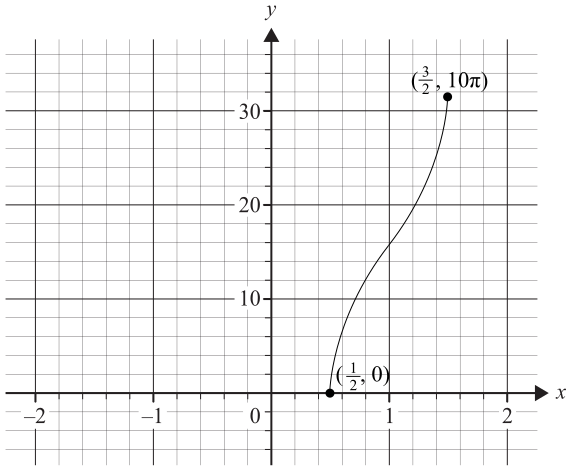
`f(1/2)`
`= 10 cos^(-1) (1)=0`
`f(3/2)`
`= 10 cos^(-1) (1)=10pi`
b.i.
`y`
`= 10 cos^(-1) (2-2x)`
`y/10`
`= cos^(-1) (2-2x)`
`cos (y/10)`
`= 2-2x`
`2x`
`= 2-cos (y/10)`
`x`
`= 1-1/2 cos (y/10)`
`:. V`
`= pi int_0^(10 pi) x^2\ dy`
`= pi int_0^(10 pi) (1-1/2 cos (y/10))^2\ dy`
b.ii.
`V = (45 pi^2)/4 text(cm)^3`
`:. (dh)/(dt)`
`= (dh)/(dV)*(dV)/(dt)`
`= 1/pi * 20`
`= 20/pi\ text(cm s)^(-1)`
Calculus, SPEC2 2018 VCAA 3
Part of the graph of `y = 1/2 sqrt(4x^2-1)` is shown below.
The curve shown is rotated about the `y`-axis to form a volume of revolution that is to model a fountain, where length units are in metres.
- Show that the volume, `V` cubic metres, of water in the fountain when it is filled to a depth of `h` metres is given by `V = pi/4(4/3h^3 + h)`. (2 marks)
--- 5 WORK AREA LINES (style=lined) ---
- Find the depth `h` when the fountain is filled to half's its volume. Give your answer in metres, correct to two decimal places. (2 marks)
--- 5 WORK AREA LINES (style=lined) ---
The fountain is initially empty. A vertical jet of water in the centre fills the fountain at a rate of 0.04 cubic metres per second and, at the same time, water flows out from the bottom of the fountain at a rate of `0.05 sqrt h` cubic metres per second when the depth is `h` metres.
- i. Show that `(dh)/(dt) = (4-5sqrt h)/(25 pi (4h^2 + 1))`. (2 marks)
--- 5 WORK AREA LINES (style=lined) ---
- ii. Find the rate, in metres per second, correct to four decimal places, at which the depth is increasing when the depth is 0.25 m. (1 mark)
--- 2 WORK AREA LINES (style=lined) ---
- Express the time taken for the depth to reach 0.25 m as a definite integral and evaluate this integral correct to the nearest tenth of a second. (2 marks)
--- 4 WORK AREA LINES (style=lined) ---
- After 25 seconds the depth has risen to 0.4 m.
Using Euler's method with a step size of five seconds, find an estimate of the depth 30 seconds after the fountain began to fill. Give your answer in metres, correct to two decimal places. (2 marks)
--- 4 WORK AREA LINES (style=lined) ---
- How far from the top of the fountain does the water level ultimately stabilise? Give your answer in metres, correct to two decimal places. (2 marks)
--- 4 WORK AREA LINES (style=lined) ---
Calculus, SPEC1 2015 VCAA 5
Find the volume generated when the region bounded by the graph of `y = 2x^2 - 3`, the line `y = 5` and the `y`-axis is rotated about the `y`-axis. (3 marks)
Show Worked Solution

`V = pi int_(−3)^5 x^2\ dy`
| `y` | `= 2x^2 – 3` |
| `2x^2` | `= y+3` |
| `x^2` | `= 1/2(y+3)` |
| `:. V` | `= pi/2 int_(−3)^5 (y + 3)\ dy` |
| `= pi/2[(y^2)/2 + 3y]_(−3)^5` | |
| `= pi/2(25/2 + 15 – (9/2 – 9))` | |
| `= pi/2(16/2 + 24)` | |
| `= 16pi` |