SmarterEd

Aussie Maths & Science Teachers: Save your time with SmarterEd

  • Login
  • Get Help
  • About

Calculus, SPEC2 2022 VCAA 10 MC

Consider the curve given by  `5 x^2 y-3 x y+y^2=10`.

The equation of the tangent to this curve at the point `(1, m)`, where `m` is a real constant, will have a negative gradient when

  1. `m \in R \backslash[-1,0]`
  2. `m=-\sqrt{11}-1 \ text {only}`
  3. `m \in R \backslash(-1,0]`
  4. `m=\sqrt{11}-1 \ text[only]`
  5. `m=-\sqrt{11}-1 or m=\sqrt{11}-1`
Show Answers Only

`E`

Show Worked Solution

`5 x^2 y-3 x y+y^2=10`

`text{At}\ (1,m):\ \ 5m-3m+m^2=10`

`text{Solve (by CAS):}\ \ m=-1+-sqrt{11}`

`text{Check the value of the derivative function at both values of}\ m\ (x=1)`

`text{By CAS, both values (gradients) are negative.}`

`=>E`

Filed Under: Tangents and Curve Sketching Tagged With: Band 6, smc-1182-10-Find gradient, smc-1182-50-Implicit functions

Calculus, SPEC1 2022 VCAA 7

A curve has equation `x cos(x+y)=(pi)/(48)`.

Find the gradient of the curve at the point `((pi)/(24),(7pi)/(24))`. Give your answer in the form `(asqrtb-pi)/(pi)`, where `a,b in Z`.   (3 marks)

--- 10 WORK AREA LINES (style=lined) ---

Show Answers Only

`(8sqrt3-pi)/pi`

Show Worked Solution

`text{Using implicit differentiation and the chain and product rules:}`

`d/(dx)(cos(x + y))`

`text{Let}\ \ u = x + y\ \ \=>\ \ y = cos(u)` 

`(du)/(dx) = 1 +dy/dx,\ \ (dy)/(du) = -sin(u)`

`cos (x+y)-x\ sin (x+y)(dy/dx+1)` `=0`  
`cos (x+y)-x\ sin(x+y)(dy/dx)-x\ sin(x+y)` `=0`  
`x\ sin(x+y)(dy/dx)` `=cos (x+y)-x\ sin(x+y)`  
`dy/dx` `=(cos (x+y))/(x\ sin(x+y)) – (x\ sin(x+y))/(x\ sin(x+y))`  
  `=(cos (x+y))/(x\ sin(x+y))-1`  

 
`text{At}\ ((pi)/(24),(7pi)/(24))\ \ \=>\ \ x+y = (pi)/(24)+(7pi)/(24) = (pi)/(3)`

`dy/dx` `=cos(pi/3)÷[(pi)/(24)sin(pi/3)]-1`  
  `=(1/2)/((pi)/(24) xx sqrt3/2)-1`  
  `=24/(sqrt3pi)-1`  
  `=(24-sqrt3pi)/(sqrt3pi) xx (sqrt3/sqrt3)`  
  `=(24sqrt3-3pi)/(3pi)`  
  `=(8sqrt3-pi)/pi`  

♦ Mean mark 50%.

Filed Under: Tangents and Curve Sketching Tagged With: Band 5, smc-1182-10-Find gradient, smc-1182-50-Implicit functions

Calculus, SPEC2 2023 VCAA 1

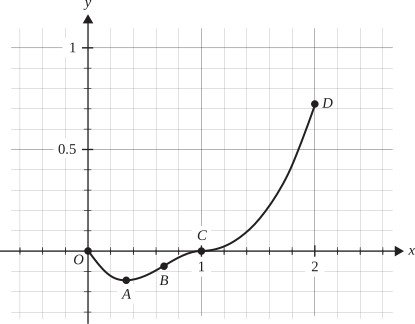
Viewed from above, a scenic walking track from point \(O\) to point \(D\) is shown below. Its shape is given by

\(f(x)= \begin{cases}-x(x+a)^2, & 0 \leq x \leq 1 \\ e^{x-1}-x+b, & 1<x \leq 2 .\end{cases}\)

The minimum turning point of section \(O A B C\) occurs at point \(A\). Point \(B\) is a point of inflection and the curves meet at point \(C(1,0)\). Distances are measured in kilometres.
 

  1. Show that  \(a=-1\)  and  \(b=0\).  (1 mark)

    --- 3 WORK AREA LINES (style=lined) ---

  2. Verify that the two curves meet smoothly at point \(C\).  (2 marks)

    --- 5 WORK AREA LINES (style=lined) ---

  3.  i. Find the coordinates of point \(A\).  (1 mark)

    --- 3 WORK AREA LINES (style=lined) ---

  4. ii. Find the coordinates of point \(B\).  (1 mark)

    --- 3 WORK AREA LINES (style=lined) ---

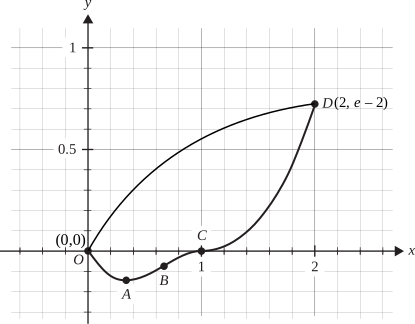
The return track from point \(D\) to point \(O\) follows an elliptical path given by

\(x=2 \cos (t)+2, y=(e-2) \sin (t)\), where \(t \in\left[\dfrac{\pi}{2}, \pi\right]\).

  1. Find the Cartesian equation of the elliptical path.  (2 marks)

    --- 3 WORK AREA LINES (style=lined) ---

  2. Sketch the elliptical path from \(D\) to \(O\) on the diagram above.  (1 mark)

    --- 0 WORK AREA LINES (style=lined) ---

  3.  i. Write down a definite integral in terms of \(t\) that gives the length of the elliptical path from \(D\) to \(O\).  (1 mark)

    --- 2 WORK AREA LINES (style=lined) ---

  4. ii. Find the length of the elliptical path from \(D\) to \(O\).
  5.     Give your answer in kilometres correct to three decimal places.   (1 mark)

    --- 2 WORK AREA LINES (style=lined) ---

Show Answers Only

a.    \(\text{At}\ C(1,0): \)

\(\underset{x \to 1^{-}}{\lim} f_1(x) = \underset{x \to 1^{-}}{\lim}-x(x+a)^2 = -1(1+a)^2 = 0 \)

    \(a=-1\)

\(\underset{x \to 1^{+}}{\lim} f_2(x)\ \underset{x \to 1^{+}}{\lim} (e^{x-1}-x+b) = e^0-1+b=b = 0 \)
 

b.    \(\text{Find derivative functions (by calc)}:\)

\(\dfrac{d}{dx} \big{(}-x(x-1)^2\big{)} = -(x-1)(3x-1)\ \ \Rightarrow \ \ \text{At}\ \ x=1, f_1^{′}(x)=0 \)

\(\dfrac{d}{dx} (e^{x-1}-x+b) = e^{x-1}-1\ \ \Rightarrow \ \ \text{At}\ \ x=1, f_2^{′}(x)=0 \)

\(\Rightarrow\ \text{Since gradients are equal, curves meet smoothly.}\)
 

c.i.  \(A\Big{(} \frac{1}{3}, -\frac{4}{27} \Big{)} \)
 

c.ii.  \(B\Big{(} \frac{2}{3}, -\frac{2}{27} \Big{)} \)
 

d.   \(\Big{(}\dfrac{x-2}{2}\Big{)}^2 + \Big{(}\dfrac{y}{e-2}\Big{)}^2=1\)
 

e.    


f.i.    \(\displaystyle{\int_{\frac{\pi}{2}}^{\pi}} \sqrt{4\,\sin^2(t)+(e-2)^2\cos^2(t)}\,dt\)
 

f.ii.  \(\text{Length}\ = 2.255\)

Show Worked Solution

a.    \(\text{At}\ C(1,0): \)

\(\underset{x \to 1^{-}}{\lim} f_1(x) = \underset{x \to 1^{-}}{\lim}-x(x+a)^2 = -1(1+a)^2 = 0 \)

    \(a=-1\)

\(\underset{x \to 1^{+}}{\lim} f_2(x)\ \underset{x \to 1^{+}}{\lim} (e^{x-1}-x+b) = e^0-1+b=b = 0 \)
 

b.    \(\text{Find derivative functions (by calc)}:\)

\(\dfrac{d}{dx} \big{(}-x(x-1)^2\big{)} = -(x-1)(3x-1)\ \ \Rightarrow \ \ \text{At}\ \ x=1, f_1^{′}(x)=0 \)

\(\dfrac{d}{dx} (e^{x-1}-x+b) = e^{x-1}-1\ \ \Rightarrow \ \ \text{At}\ \ x=1, f_2^{′}(x)=0 \)

\(\Rightarrow\ \text{Since gradients are equal, curves meet smoothly.}\)
 

c.i.  \(\dfrac{d}{dx} \big{(}-x(x-1)^2\big{)} = -(x-1)(3x-1)\ \Rightarrow \ \text{SP when}\ x=\dfrac{1}{3} \)

\(A\Big{(} \frac{1}{3}, -\frac{4}{27} \Big{)} \)
 

c.ii.  \(\text{POI at}\ B: \ f_1^{″}(x)=-6x+4=0\ \ \Rightarrow x=\dfrac{2}{3} \)

\(B\Big{(} \frac{2}{3}, -\frac{2}{27} \Big{)} \)
 

d.   \(\dfrac{x-2}{2}=\cos(t), \ \ \dfrac{y}{e-2}=\sin(t) \)

\(\Big{(}\dfrac{x-2}{2}\Big{)}^2 + \Big{(}\dfrac{y}{e-2}\Big{)}^2=1\)
 

e.    


f.i.    \(\dfrac{dx}{dt} = -2\sin(t),\ \ \dfrac{dy}{dt} = (e-2)\cos(t) \)

\(\displaystyle{\int_{\frac{\pi}{2}}^{\pi}} \sqrt{4\,\sin^2(t)+(e-2)^2\cos^2(t)}\,dt\)
 

f.ii.   \(\text{Evaluate the integral in part f.i.}\)

\(\Rightarrow \text{Length}\ = 2.255\)

Filed Under: Arc Lengths, Areas and Other, Tangents and Curve Sketching Tagged With: Band 3, Band 4, smc-1181-10-Arc length, smc-1181-40-Parametric functions, smc-1182-10-Find gradient, smc-1182-40-Other 1st/2nd deriv problems

Calculus, SPEC2 2023 VCAA 9 MC

The position of a particle moving in the Cartesian plane, at time \(t\), is given by the parametric equations

\(x(t)=\dfrac{6 t}{t+1}\)  and  \(y(t)=\dfrac{-8}{t^2+4}\), where  \(t \geq 0\).

What is the slope of the tangent to the path of the particle when  \(t=2\) ?

  1. \(-\dfrac{1}{3}\)
  2. \(-\dfrac{1}{4}\)
  3. \(\dfrac{1}{3}\)
  4. \(\dfrac{3}{4}\)
  5. \(\dfrac{4}{3}\)
Show Answers Only

\(D\)

Show Worked Solution

\(\text{At}\ \ t=2\ \text{(by calc):}\)

\(\dfrac{dx}{dt}=\dfrac{2}{3}, \ \dfrac{dy}{dt}=\dfrac{1}{2} \)

\(\dfrac{dy}{dx} = \dfrac{dy}{dt} \times \dfrac{dt}{dx} = \dfrac{1}{2} \times \dfrac{3}{2} = \dfrac{3}{4} \)

\(\Rightarrow D\)

Filed Under: Motion (SM), Tangents and Curve Sketching Tagged With: Band 5, smc-1159-70-Parametric, smc-1182-10-Find gradient, smc-1182-65-Paramatric functions

Calculus, SPEC1 2021 VCAA 5

Find the gradient of the curve with equation  `e^x e^(2y) = 2e^4`  at the point  `(2, 1)`.  (3 marks)

Show Answers Only

`-1/10`

Show Worked Solution

`e^x e^(2y) + e^(4y^2) = 2e^4`

`e^x · 2e^(2y) · (dy)/(dx) + e^x · e^(2y) + e^(4y^2) · 8y · (dy)/(dx)` `= 0`
`(dy)/(dx)(e^x ·2e^(2y) + e^(4y^2) · 8y)` `= -e^x · e^(2y)`

 
`(dy)/(dx) = (-e^x · e^(2y))/(e^x · 2e^(2y) + e^(4y^2) ·8y)`

 
`text(At)\ \ (2, 1):`

`(dy)/(dx)` `= (-e^2 · e^2)/(e^2 · 2e^2 + e^4 · 8)`
  `= (-e^4)/(e^4(2 + 8))`
  `= -1/10`

Filed Under: Tangents and Curve Sketching Tagged With: Band 4, smc-1182-10-Find gradient, smc-1182-50-Implicit functions

Calculus, SPEC1 2011 VCAA 10

Consider the relation  `y log_e (x) = e^(2y) + 3x - 4.`

Evaluate  `(dy)/(dx)`  at the point  `(1, 0).`  (4 marks)

Show Answers Only

`-3/2`

Show Worked Solution

`y log_e x = e^(2y) + 3x – 4`

`text(Using implicit differentiation:)`

`d/(dx)(y ln(x))` `= d/(dx)(e^(2y)) + d/(dx)(3x) – d/(dx)(4)`
`dy/dx*ln(x) + y(1/x)` `= 2e^(2y)*dy/dx + 3`

 
`text(At)\ \ (1,0):`

`dy/dx xx ln1 + 0` `= 2 e^0 * dy/dx+ 3`
`2*dy/dx` `= -3`
`:. dy/dx` `=- 3/2`

Filed Under: Tangents and Curve Sketching Tagged With: Band 3, smc-1182-10-Find gradient, smc-1182-50-Implicit functions

Calculus, SPEC1 2011 VCAA 5

For the curve with parametric equations

`x = 4 sin (t) - 1`

`y = 2 cos (t) + 3`

Find  `(dy)/(dx)`  at the point  `(1, sqrt 3 + 3).`  (3 marks)

Show Answers Only

`– sqrt 3/6`

Show Worked Solution

`(dx)/(dt) = 4cos(t)`

`(dy)/(dt) = −2sin(t)`

`(dy)/(dx)` `= ((dy)/(dt))/((dx)/(dt))`
  `= (-sin t)/(2cos t)`

 
`x = 4 sin (t) – 1\ \ text{(given)}\ \ =>\ \ sin(t)=(x+1)/4`

`y = 2 cos (t) + 3\ \ text{(given)}\ \ =>\ \ 2cos(t)=(y-3)`

`=> dy/dx= (-(x + 1)/4)/(y – 3)`
 

`text(At)\ \ (1, sqrt 3 + 3):`

`:. (dy)/(dx)` `= (-1/2)/(sqrt3+3 -3)`
  `= -1/(2sqrt3)`
  `= – sqrt3/6`

Filed Under: Tangents and Curve Sketching Tagged With: Band 4, smc-1182-10-Find gradient, smc-1182-65-Paramatric functions

Calculus, SPEC1 2012 VCAA 6

Find the gradient of the tangent to the curve  `xy^2 + y + (log_e (x - 2))^2 = 14`  at the point  `(3, 2).`  (3 marks)

Show Answers Only

`(dy)/(dx) = -4/13`

Show Worked Solution

`xy^2 + y + (log_e (x – 2))^2 = 14`

`text(Using implicit differentiation:)`

`d/(dx) (xy^2) + d/(dx) (y) + d/(dx) ((ln (x – 2))^2) = d/(dx)(14)`

`d/(dx) (x) ⋅ y^2 + d/(dx) (y^2) ⋅ x + (dy)/(dx) + 2 xx 1/(x – 2) xx ln(x – 2) = 0`

`y^2 + 2xy* (dy)/(dx) + (dy)/(dx) + (2 ln (x – 2))/(x – 2) = 0`

`text{At (3,2):}`

`2^2 + 2(2)(3) m + m + (2 ln(1))/1` `= 0`
`4 + 12m + m` `= 0`
`13m` `= -4`
`:. m` `= -4/13`

Filed Under: Tangents and Curve Sketching Tagged With: Band 4, smc-1182-10-Find gradient, smc-1182-50-Implicit functions

Graphs, SPEC1 2013 VCAA 4

  1. State the maximal domain and the range of  `y = arccos(1-2x).`   (2 marks)

    --- 4 WORK AREA LINES (style=lined) ---

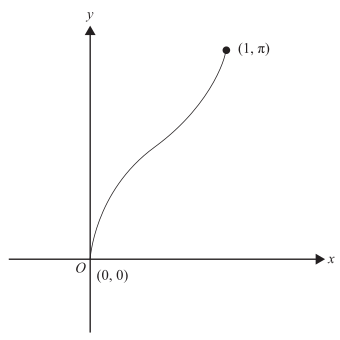
  2. Sketch the graph of  `y = arccos(1-2x)`  over its maximal domain. Label the endpoints with their coordinates.   (2 marks)


              VCAA 2013 spec 4b
     

  3. Find the gradient of the tangent to the graph of  `y = arccos (1 – 2x)`  at  `x = 1/4.`   (2 marks)

    --- 4 WORK AREA LINES (style=lined) ---

Show Answers Only
  1. `text(Maximal domain)\ \ [0, 1];\ \ \ text(Range)\ \ [0, pi]`
  2.  

  3. `4/sqrt3`
Show Worked Solution

a.  `text(Maximal domain:)`

`1-2x` `∈ [−1, 1]`
`-2x` `∈ [−2, 0]`
`x` `∈ [0, 1]`

 
`text(When)\ \ x = 0,\ \ y = cos^-1 1= 0;`

`text(When)\ \ x = 1,\ \ y = cos^-1 (-1)= pi`

`:.\ text(Range is)\ \ [0, pi]`


b.   


c.   `y = cos^-1 (1-2x),`

`(dy)/(dx)` `= (-1(-2))/sqrt(1-(1-2x)^2)`
  `= 2/sqrt(1-(1-2x)^2)`

 
`text(At)\ \ x = 1/4,`

`m_T` `= 2/sqrt(1-(1-1/2)^2)`
  `=2/sqrt(3/4)`
  `= 4/sqrt 3`
  `= (4 sqrt 3)/3`

Filed Under: Inverse Trig Functions (SM), Tangents and Curve Sketching Tagged With: Band 4, smc-1153-20-arccos, smc-1182-10-Find gradient, smc-1182-35-Sketch curve

Calculus, SPEC1 2013 VCAA 6

Find the value of `c`, where  `c in R`, such that the curve defined by

`y^2 + (3e^{(x - 1)})/(x - 2) = c`

has a gradient of 2 where  `x = 1.`   (4 marks)

Show Answers Only

`-3/4`

Show Worked Solution

`text(Using implicit differentiation:)`

`d/(dx)(y^2) + d/(dx)((3e^(x – 1))/(x – 2))` `= d/(dx)(c)`
`2y(dy)/(dx) + ((x – 2)3e^(x – 1) – 3e^(x – 1))/(x – 2)^2` `= 0`
`2y(dy)/(dx) +(3e^(x – 1) (x – 3))/(2y(x – 2)^2)` `=0`

 
`:. (dy)/(dx) = -(3e^(x – 1) (x – 3))/(2y(x – 2)^2)`

`text(When)\ \ x=1,\ \ dy/dx=2`

`2=(-6)/(-2y)\ \ =>\ \ y=3/2`

`text(Substituting into curve equation:)`

`(3/2)^2 + (3e^0)/(1 – 2)` `= c`
`9/4 – 3` `= c`
`c` `= -3/4`

Filed Under: Tangents and Curve Sketching Tagged With: Band 4, smc-1182-10-Find gradient, smc-1182-50-Implicit functions

Calculus, SPEC1-NHT 2017 VCAA 3

Find the gradient of the curve with equation  `x = sin (y/15)`  when  `x = 1/4`. Give your answer in the form  `a sqrt b`, where  `a, b \ in Z^+`.  (3 marks)

Show Answers Only

 `m = 4 sqrt 15`

Show Worked Solution
`x` `= sin (y/15)`
`sin^(-1)x` `= y/15`
`y` `= 15 sin^(-1)x`
`dy/dx` `= 15/(sqrt(1-x^2))`


`text(When)\ \ x=1/4:`

`dy/dx` `= 15/(sqrt(1-(1/4)^2))`
  `= 15/(sqrt(15/16))`
  `= 60/sqrt15`
  `=4sqrt15`

 
`:. m = 4 sqrt 15`

Filed Under: Tangents and Curve Sketching Tagged With: Band 4, smc-1182-10-Find gradient, smc-1182-60-Inverse Trig functions

Calculus, SPEC1 2015 VCAA 9

Consider the curve represented by  `x^2 - xy + 3/2 y^2 = 9.`

  1. Find the gradient of the curve at any point  `(x, y).`  (2 marks)
  2. Find the equation of the tangent to the curve at the point  `(3, 0)`  and find the equation of the tangent to the curve at the point `(0, sqrt 6).`


    Write each equation in the form  `y = ax + b.`  (2 marks)

  3. Find the acute angle between the tangent to the curve at the point  `(3, 0)`  and the tangent to the curve at the point  `(0, sqrt 6).`


    Give your answer in the form  `k pi`, where `k` is a real constant  (2 marks)

Show Answers Only
  1. `(dy)/(dx) = (2x – y)/(x – 3y)`
  2. `y = 2(x – 3);\ \ \ y = 1/3 x + sqrt 6`
  3. `theta = pi/4`
Show Worked Solution
a.    `d/(dx)(x^2) – d/(dx)(xy) + 3/2* d/(dx) (y^2)` `= 0`
  `2x – x*(dy)/(dx) – y + 3/2(2y)*(dy)/(dx)` `= 0`
  `(dy)/(dx)(−x + 3y)` `= y – 2x`
  `:. (dy)/(dx)` `= (y – 2x)/(3y – x)`


b.   `m_{(3,0)} = (0 – 6)/(0 – 3) = 2`

`:.\ text{Equation of tangent at (3, 0):}`

`y = 2(x – 3)`

  `= 2x – 6`


`m_{(0,sqrt6)} = (sqrt6 – 0)/(3sqrt6 – 0) = 1/3`

`:.\ text{Equation of tangent at}\ (0,sqrt6):`

`y -sqrt6` `= 1/3(x – 0)`  
`y` `=1/3 x + sqrt6`  


c.   `m_1 = 2 = tan(theta_1), \ \ m_2 = 1/3 = tan(theta_2)`

`alpha` `= theta_1 – theta_2`
  `= tan^(−1)(2) – tan^(−1)(1/3)`
`tan(alpha)` `= tan(tan^(−1)(2) – tan^(−1)(1/3))`
  `= (tan(tan^(−1)(2)) – tan(tan^(−1)(1/3)))/(1 + tan(tan^(−1)(2)tan(tan^(−1)(1/3))))`
  `= (2 – 1/3)/(1 + 2/3)`
  `= 1`

 
`:. alpha = pi/4\ \ \ (alpha ∈ (0, pi/2))`

Filed Under: Tangents and Curve Sketching Tagged With: Band 4, Band 6, smc-1182-10-Find gradient, smc-1182-20-Find tangent, smc-1182-50-Implicit functions

Calculus, SPEC1-NHT 2018 VCAA 9

  1.    i. Given that  `cot(2 theta) = a`, show that  `tan^2(theta) + 2a tan(theta)-1 = 0`.   (2 marks)

    --- 5 WORK AREA LINES (style=lined) ---

  2.  ii. Show that  `tan(theta) = -a +- sqrt(a^2 + 1)`.  (1 mark)

    --- 4 WORK AREA LINES (style=lined) ---

  3. iii. Hence, show that  `tan(pi/12) = 2-sqrt 3`, given that  `cot(2 theta) = sqrt 3`, where  `theta in (0, pi)`.   (1 mark)

    --- 5 WORK AREA LINES (style=lined) ---

  4.  Find the gradient of the tangent to the curve  `y = tan (theta)`  at  `theta = pi/12`.   (2 marks)

    --- 5 WORK AREA LINES (style=lined) ---

  5.  A solid of revolution is formed by rotating the region between the graph of  `y = tan(theta)`, the horizontal axis, and the lines  `theta = pi/12`  and  `theta = pi/3`  about the horizontal axis.
  6. Find the volume of the solid of revolution.   (3 marks)

    --- 6 WORK AREA LINES (style=lined) ---

Show Answers Only

    1. `text(Proof)\ \ text{(See Worked Solutions)}`
    2. `text(Proof)\ \ text{(See Worked Solutions)}`
    3. `text(Proof)\ \ text{(See Worked Solutions)}`
  1. `8-4 sqrt 3`
  2. `pi (2 sqrt 3-2-pi/4)`

Show Worked Solution

a.i.   `1/(tan 2 theta)` `= a`
  `1` `= a tan (2 theta)`
  `1` `= a ((2 tan (theta))/(1-tan^2(theta)))`
  `1/a (1-tan^2 (theta))` `= 2 tan (theta)`
  `1-tan^2 (theta)` `= 2a tan (theta)`
  `:. tan^2 (theta) + 2 a tan (theta)-1` `=0\ \ text(… as required)`


a.ii.   `[tan^2 (theta) + 2a tan (theta) + a^2]-a^2-1` `= 0`
  `(tan (theta) + a)^2` `= a^2 + 1`
  `tan (theta) + a` `= +- sqrt(a^2 + 1)`
  `:. tan (theta)` `= -a +- sqrt(a^2 + 1)`


a.iii.   `theta in (0, pi) \ => \ 2 theta in (0, 2 pi)`

`text(S)text(ince)\ \ cot(2theta)=sqrt3\ \ \ =>\ \ \ tan(2theta)=1/sqrt3`

  `:. 2 theta` `= pi/6, pi + pi/6`
  `theta` `= pi/12, (7 pi)/12`
  `tan (theta)` `=-sqrt 3 +- sqrt((sqrt 3)^2 + 1)`
    `=-sqrt 3 +- sqrt(3 + 1)`
    `=-sqrt 3 +- 2`

 
`:. tan (pi/12) = 2-sqrt 3,\ \ \ \ (tan (pi/12) > 0)`


b.   `y` `=tan(theta)`
  `y prime` `= sec^2 (theta)`
    `= 1 + tan^2 (theta)`


`y prime (pi/12)` `= 1 + tan^2 (pi/12)`
  `= 1 + (2-sqrt 3)^2`
  `= 1 + 4-4 sqrt 3 + 3`
  `= 8-4 sqrt 3`


c.   `V` `= pi int_(pi/12)^(pi/3) y^2\ d theta`
    `= pi int_(pi/12)^(pi/3) tan^2 (theta)\ d theta`
    `= pi int_(pi/12)^(pi/3) (1 + tan^2 (theta)-1)\ d theta`
    `= pi int_(pi/12)^(pi/3) (sec^2 (theta)-1)\ d theta`
    `= pi [tan (theta)-theta]_(pi/12)^(pi/3)`
    `= pi (tan (pi/3)-pi/3-(tan (pi/12)-pi/12))`
    `= pi (sqrt 3-(4 pi)/12-(2-sqrt 3) + pi/12)`
    `= pi (2 sqrt 3-2-pi/4)\ \ text(u³)`

Filed Under: Solids of Revolution, Tangents and Curve Sketching Tagged With: Band 3, Band 4, Band 5, smc-1180-20-Trig function, smc-1180-50-x-axis rotations, smc-1182-10-Find gradient

Calculus, SPEC1 2018 VCAA 3

Find the gradient of the curve with equation  `2x^2 sin(y) + xy = pi^2/18`  at the point  `(pi/6, pi/6)`.

Give your answer in the form  `a/(pi sqrt b + c)`, where `a, b` and `c` are integers.  (4 marks)

Show Answers Only

`m = (-18)/(pi sqrt 3 + 6)`

Show Worked Solution

`d/(dx) (2x^2 sin (y)) + d/(dx) (xy) = d/(dx) (pi^2/18)`

`4x sin(y) + 2x^2 cos(y) (dy)/(dx) + y + x (dy)/(dx)` `=0`  
`(4 pi)/6 sin (pi/6) + (2 pi^2)/36 cos (pi/6) m + pi/6 + pi/6 m` `=0`  
`(2 pi)/3 xx 1/2 + pi^2/18 xx sqrt 3/2 m + pi/6 + pi/6 m` `=0`  
`pi/3 + pi/6 + ((pi^2 sqrt 3)/36 + pi/6) m` `=0`  
`pi/2 + pi/36 (pi sqrt 3 + 6) m` `=0`  
`(pi m)/36 (pi sqrt 3 + 6)` `= (-pi)/2`
`m (pi sqrt 3 + 6)` `= -18`
`:. m` `= (-18)/(pi sqrt 3 + 6)`

Filed Under: Tangents and Curve Sketching Tagged With: Band 3, smc-1182-10-Find gradient, smc-1182-50-Implicit functions

Copyright © 2014–2025 SmarterEd.com.au · Log in