SmarterEd

Aussie Maths & Science Teachers: Save your time with SmarterEd

  • Login
  • Get Help
  • About

Trigonometry, 2ADV T3 2020 HSC 31

The population of mice on an isolated island can be modelled by the function.

`m(t) = a sin (pi/26 t) + b`,

where  `t`  is the time in weeks and  `0 <= t <= 52`. The population of mice reaches a maximum of 35 000 when  `t=13`  and a minimum of 5000 when  `t = 39`. The graph of  `m(t)`  is shown.
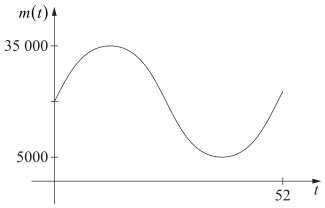
 

  1. What are the values of `a` and `b`?  (2 marks)

    --- 3 WORK AREA LINES (style=lined) ---

  2. On the same island, the population of cats can be modelled by the function
     
    `\ \ \ \ \ c(t) = −80cos(pi/26 (t - 10)) + 120`
     
    Consider the graph of  `m(t)`  and the graph of  `c(t)`.


    Find the values of  `t, \ 0 <= t <= 52`, for which both populations are increasing.  (3 marks)

    --- 7 WORK AREA LINES (style=lined) ---

  3. Find the rate of change of the mice population when the cat population reaches a maximum.  (2 marks)

    --- 5 WORK AREA LINES (style=lined) ---

Show Answers Only
  1. `a = 15\ 000, b = 20\ 000`
  2. `text(Both populations are increasing when)\ 10 < t < 13`
  3. `\text(– 643 mice per week)`
Show Worked Solution
a.    `b` `= (35\ 000 + 5000)/2`
    `= 20\ 000`


`a` `=\ text(amplitude of sin graph)`
  `= 35\ 000 – 20\ 000`
  `= 15\ 000`


b.   `text(By inspection of the)\ \ m(t)\ \ text(graph)`

♦♦ Mean mark part (b) 30%.

`m^{′}(t) > 0\ \ text(when)\ \ 0 <= t < 13\ \ text(and)\ \ 39 < t <= 52`

`text(Sketch)\ \ c(t):`
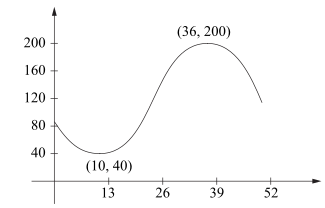
`text(Minimum)\ \ (cos0)\ \ text(when)\ \ t = 10`

`text(Maximum)\ \ (cospi)\ \ text(when)\ \ t = 36`

`:. c^{′}(t) > 0\ \ text(when)\ \ 10 < t < 36`

`:. text(Both populations are increasing when)\ \ 10 < t < 13`


c.   `c(t)\ text(maximum when)\ \ t = 36`

♦♦♦ Mean mark part (c) 27%.
`m(t)` `= 15\ 000 sin(pi/26 t) + 20\ 000`
`m^{′}(t)` `= (15\ 000pi)/26 cos(pi/26 t)`
`m^{′}(36)` `= (15\ 000pi)/26 · cos((36pi)/26)`
  `= -642.7`

 
`:.\ text(Mice population is decreasing at 643 mice per week.)`

Filed Under: Rates of Change (Y12), Trig Applications (Y12) Tagged With: Band 4, Band 5, Band 6, smc-1091-25-Other Themes, smc-1091-40-Trig Function, smc-1188-10-Population

Trigonometry, 2ADV T3 SM-Bank 10

The population of wombats in a particular location varies according to the rule  `n(t) = 1200 + 400 cos ((pi t)/3)`, where `n` is the number of wombats and `t` is the number of months after 1 March 2018.

  1. Find the period and amplitude of the function `n`.  (2 marks)

    --- 4 WORK AREA LINES (style=lined) ---

  2. Find the maximum and minimum populations of wombats in this location.  (2 marks)

    --- 3 WORK AREA LINES (style=lined) ---

  3. Find  `n(10)`.  (1 mark)

    --- 2 WORK AREA LINES (style=lined) ---

  4. Over the 12 months from 1 March 2018, find the fraction of time when the population of wombats in this location was less than  `n(10)`.  (2 marks)

    --- 4 WORK AREA LINES (style=lined) ---

Show Answers Only
  1. `text(Period) = text(6 months);\ text(Amplitude) = 400`
  2. `text(Max) = 1600;\ text(Min) = 800`
  3. `1000`
  4. `1/3`
Show Worked Solution

i.   `text(Period) = (2pi)/n = (2pi)/(pi/3) = 6\ text(months)`

`text(A)text(mplitude) = 400`
 

ii.   `text(Max:)\ 1200 + 400 = 1600\ text(wombats)`

`text(Min:)\ 1200 – 400 = 800\ text(wombats)`
 

iii.    `n(10)` `=1200 + 400 cos ((10 pi)/3)`
    `=1200 + 400 cos ((2 pi)/3)`
    `=1200-400 xx 1/2`
    `= 1000\ text(wombats)`


iv.  `text(Find)\ \ t\ \ text(when)\ \ n(t)=1000`

`1000` `=1200 + 400 cos((pit)/3)`  
`cos((pit)/3)` `=- 1/2`  
`(pit)/3` `=(2pi)/3, (4pi)/3, (8pi)/3, (10pi)/3, … `  
`t` `=2,4,8,10`  

 
`text(S)text(ince)\ \ n(0)=1600,`

`=> n(t)\ \ text(drops below 1000 between)\ \ t=2\ \ text(and)\ \ t=4,`

`text(and between)\ \ t=8\ \ text(and)\ \ t=10.`
 

`:.\ text(Fraction)` `= (2 + 2)/12`
  `= 1/3\ \ text(year)`

Filed Under: Trig Applications (Y12) Tagged With: Band 3, Band 4, Band 5, smc-1188-10-Population

Trigonometry, 2ADV T3 2013 HSC 13a

The population of a herd of wild horses is given by

`P(t) = 400 + 50 cos (pi/6 t)`

where  `t`  is time in months. 

  1. Find all times during the first 12 months when the population equals 375 horses.    (2 marks)

    --- 5 WORK AREA LINES (style=lined) ---

  2. Sketch the graph of  `P(t)`  for  `0 <= t <= 12`.    (2 marks)

    --- 8 WORK AREA LINES (style=lined) ---

Show Answers Only
  1. `t=4\ text(months and 8 months)`
  2. `text(See Worked Solutions.)`
Show Worked Solution

i.  `P(t) = 400 + 50 cos (pi/6 t)`

`text(Need to find)\ t\ text(when)\ P(t) = 375`

`375` `= 400 + 50 cos (pi/6 t)`
`50 cos (pi/6 t)` `=-25`
`cos (pi/6 t)` `= – 1/2`
   
`text(S)text(ince)\ \ cos(pi/3)=1/2, text(and cos is)`
`text(negative in)\ 2^text(nd) // 3^text(rd)\ text(quadrants:)`
`=>pi/6 t` `= (pi\ – pi/3),\ (pi + pi/3),\ (3pi\ – pi/3)`
  `= (2pi)/3,\ (4pi)/3,\ (8pi)/3,\ …`
`:.t` `= 4,\ 8,\ 16,\ …`

 
`:.\ text(In the 1st 12 months,)\ P(t) = 375\ text(when)`

`t=4\ text(months and 8 months.)`


♦ Mean mark 39%
ii. 2UA 2013 13a ans

Filed Under: Exact Trig Ratios and Other Identities, Trig Applications (Y12), Trig graphs Tagged With: Band 4, Band 5, smc-1188-10-Population

Copyright © 2014–2025 SmarterEd.com.au · Log in