SmarterEd

Aussie Maths & Science Teachers: Save your time with SmarterEd

  • Login
  • Get Help
  • About

Vectors, EXT2 V1 2024 HSC 15a

Consider the three vectors  \(\underset{\sim}{a}=\overrightarrow{O A}, \underset{\sim}{b}=\overrightarrow{O B}\) and \(\underset{\sim}{c}=\overrightarrow{O C}\), where \(O\) is the origin and the points \(A, B\) and \(C\) are all different from each other and the origin.

The point \(M\) is the point such that  \(\dfrac{1}{2}(\underset{\sim}{a}+\underset{\sim}{b})=\overrightarrow{O M}\).

  1. Show that \(M\) lies on the line passing through \(A\) and \(B\).   (1 mark)

    --- 2 WORK AREA LINES (style=lined) ---

  2. The point \(G\) is the point such that  \(\dfrac{1}{3}(\underset{\sim}{a}+\underset{\sim}{b}+\underset{\sim}{c})=\overrightarrow{O G}\).
  3. Show that \(G\) lies on the line passing through \(M\) and \(C\), and lies between \(M\) and \(C\).   (2 marks)

    --- 5 WORK AREA LINES (style=lined) ---

  4. The complex numbers \(x, w\) and \(z\) are all different and all have modulus 1.
  5. Using part (ii), or otherwise, show that  \(\dfrac{1}{3}(x+w+z)\) is never a cube root of \(x w z\).   (2 marks)

    --- 5 WORK AREA LINES (style=lined) ---

Show Answers Only

i.    \(\text{Equation of line through \(A\) and \(B\)}\)

\(\Rightarrow \ell_1=\overrightarrow{O A}+\lambda \overrightarrow{A B}\)

  \(\overrightarrow{O M}\) \(=\dfrac{1}{2} \underset{\sim}{a}+\dfrac{1}{2} \underset{\sim}{b}\)
    \(=\underset{\sim}{a}-\dfrac{1}{2} \underset{\sim}{a}+\dfrac{1}{2} \underset{\sim}{b}\)
    \(=\overrightarrow{O A}+\dfrac{1}{2}(\underset{\sim}{b}-\underset{\sim}{a})\)
    \(=\overrightarrow{O A}+\dfrac{1}{2} \overrightarrow{A B}\)

 
\(\therefore \overrightarrow{OM} \ \text{lies on} \ \ell_1\).
 

ii.    \(\text{Equation of line through \(M\) and \(C\)}\)

\(\Rightarrow \ell_2=\overrightarrow{OC}+\lambda \overrightarrow{CM}\)

  \(\overrightarrow{O G}\) \(=\dfrac{1}{3}(\underset{\sim}{a}+\underset{\sim}{b}+\underset{\sim}{c})\)
    \(=\underset{\sim}{c}-\dfrac{2}{3} \underset{\sim}{c}+\dfrac{1}{3} \underset{\sim}{a}+\dfrac{1}{3} \underset{\sim}{b}\)
    \(=\overrightarrow{OC}+\dfrac{2}{3}\left(\dfrac{1}{2} \underset{\sim}{a}+\dfrac{1}{2} \underset{\sim}{b}-\underset{\sim}{c}\right)\)
    \(=\overrightarrow{OC}+\dfrac{2}{3} \overrightarrow{CM}\)

 
\(\therefore \overrightarrow{O G} \ \ \text{lies on} \ \ \ell_2\)

\(\ \ \overrightarrow{O G} \neq \overrightarrow{O C}  \ \ \text{and} \ \ \overrightarrow{O G} \neq \overrightarrow{O M}\)

\(\therefore G \ \ \text{lies between} \ \ C \ \text{and} \ M\).
 

iii.  \(\text{Place}\ x, w,\ \text{and}\ z\ \text{on unit circle.}\)
 

\(\abs{w}=\abs{x}=\abs{z}=1\)

\(\text{Using part (ii):}\)

\(G \equiv \dfrac{1}{3}(x+w+z)\)

\(G \ \text{lies on} \ CM \Rightarrow G \ \text{is inside the unit circle.}\)

\(\Rightarrow\left|\dfrac{1}{3}(x+w+z)\right|<1\)

\(\text{Since}\ \ \abs{xwz}=\abs{x}\abs{w}\abs{z}=1\)

\(\Rightarrow \ \text{All cube roots have modulus = 1.}\)

\(\therefore \dfrac{1}{3}(x+w+z) \ \ \text{cannot be a cube root of  \(xwz\).}\)

Show Worked Solution

i.    \(\text{Equation of line through \(A\) and \(B\)}\)

\(\Rightarrow \ell_1=\overrightarrow{O A}+\lambda \overrightarrow{A B}\)

  \(\overrightarrow{O M}\) \(=\dfrac{1}{2} \underset{\sim}{a}+\dfrac{1}{2} \underset{\sim}{b}\)
    \(=\underset{\sim}{a}-\dfrac{1}{2} \underset{\sim}{a}+\dfrac{1}{2} \underset{\sim}{b}\)
    \(=\overrightarrow{O A}+\dfrac{1}{2}(\underset{\sim}{b}-\underset{\sim}{a})\)
    \(=\overrightarrow{O A}+\dfrac{1}{2} \overrightarrow{A B}\)

 
\(\therefore \overrightarrow{OM} \ \text{lies on} \ \ell_1\).
 

ii.    \(\text{Equation of line through \(M\) and \(C\)}\)

\(\Rightarrow \ell_2=\overrightarrow{OC}+\lambda \overrightarrow{CM}\)

  \(\overrightarrow{O G}\) \(=\dfrac{1}{3}(\underset{\sim}{a}+\underset{\sim}{b}+\underset{\sim}{c})\)
    \(=\underset{\sim}{c}-\dfrac{2}{3} \underset{\sim}{c}+\dfrac{1}{3} \underset{\sim}{a}+\dfrac{1}{3} \underset{\sim}{b}\)
    \(=\overrightarrow{OC}+\dfrac{2}{3}\left(\dfrac{1}{2} \underset{\sim}{a}+\dfrac{1}{2} \underset{\sim}{b}-\underset{\sim}{c}\right)\)
    \(=\overrightarrow{OC}+\dfrac{2}{3} \overrightarrow{CM}\)

 
\(\therefore \overrightarrow{O G} \ \ \text{lies on} \ \ \ell_2\)

\(\ \ \overrightarrow{O G} \neq \overrightarrow{O C}  \ \ \text{and} \ \ \overrightarrow{O G} \neq \overrightarrow{O M}\)

\(\therefore G \ \ \text{lies between} \ \ C \ \text{and} \ M\).

♦ Mean mark (ii) 43%.

iii.  \(\text{Place}\ x, w,\ \text{and}\ z\ \text{on unit circle.}\)
 

♦♦♦ Mean mark (iii) 10%.

\(\abs{w}=\abs{x}=\abs{z}=1\)

\(\text{Using part (ii):}\)

\(G \equiv \dfrac{1}{3}(x+w+z)\)

\(G \ \text{lies on} \ CM \Rightarrow G \ \text{is inside the unit circle.}\)

\(\Rightarrow\left|\dfrac{1}{3}(x+w+z)\right|<1\)

\(\text{Since}\ \ \abs{xwz}=\abs{x}\abs{w}\abs{z}=1\)

\(\Rightarrow \ \text{All cube roots have modulus = 1.}\)

\(\therefore \dfrac{1}{3}(x+w+z) \ \ \text{cannot be a cube root of  \(xwz\).}\)

Filed Under: Vectors and Vector Equations of Lines Tagged With: Band 4, Band 5, Band 6, smc-1196-25-Point lies on line, smc-1196-70-2D vectors, smc-1196-85-Complex Numbers

Vectors, EXT2 V1 2024 HSC 12e

The line \(\ell\) passes through the points \(A(3,5,-4)\) and \(B(7,0,2)\).

  1. Find a vector equation of the line \(\ell\).   (1 mark)

    --- 4 WORK AREA LINES (style=lined) ---

  2. Determine, giving reasons, whether the point \(C(10,5,-2)\) lies on the line \(\ell\).   (2 marks)

    --- 7 WORK AREA LINES (style=lined) ---

Show Answers Only

i.    \(\text{ Equation of line:} \ \left(\begin{array}{c}3 \\ 5 \\ -4\end{array}\right)+\lambda\left(\begin{array}{c}4 \\ -5 \\ 6\end{array}\right),\ (\lambda \in \mathbb{R} )\)

ii.    \(\text{If \(C\) lies on the line}, \ \exists \lambda \in \mathbb{R}\  \ \text{such that:}\)

\(\left(\begin{array}{c}10 \\ 5 \\ -2\end{array}\right)=\left(\begin{array}{c}3 \\ -5 \\ 6\end{array}\right)+\lambda\left(\begin{array}{c}4 \\ -5 \\ 6\end{array}\right)\)

 
\(\text{Find \(\lambda\) for \(x\)-component: }\)

\(10=3+4 \lambda \ \Rightarrow \ \lambda=\dfrac{7}{4}\)

\(\text{Check \(\lambda=\dfrac{7}{4}\) for \(y\)-component:}\)

\(5=-5+\dfrac{7}{4}(-5) \ \ \Rightarrow\ \ \text{not correct}\)

\(\therefore C\  \text{does not lie on the line.}\)

Show Worked Solution

i.     \(A(3,5,-4), \quad B(7,0,2)\)

\(\overrightarrow{A B}=\left(\begin{array}{l}7 \\ 0 \\ 2\end{array}\right)-\left(\begin{array}{c}3 \\ 5 \\ -4\end{array}\right)=\left(\begin{array}{c}4 \\ -5 \\ 6\end{array}\right)\)

\(\therefore \text{ Equation of line:} \ \left(\begin{array}{c}3 \\ 5 \\ -4\end{array}\right)+\lambda\left(\begin{array}{c}4 \\ -5 \\ 6\end{array}\right),\ (\lambda \in \mathbb{R} )\)
 

ii.    \(\text{If \(C\) lies on the line}, \ \exists \lambda \in \mathbb{R}\  \ \text{such that:}\)

\(\left(\begin{array}{c}10 \\ 5 \\ -2\end{array}\right)=\left(\begin{array}{c}3 \\ -5 \\ 6\end{array}\right)+\lambda\left(\begin{array}{c}4 \\ -5 \\ 6\end{array}\right)\)

 
\(\text{Find \(\lambda\) for \(x\)-component: }\)

\(10=3+4 \lambda \ \Rightarrow \ \lambda=\dfrac{7}{4}\)

\(\text{Check \(\lambda=\dfrac{7}{4}\) for \(y\)-component:}\)

\(5=-5+\dfrac{7}{4}(-5) \ \ \Rightarrow\ \ \text{not correct}\)

\(\therefore C\  \text{does not lie on the line.}\)

Filed Under: Vectors and Vector Equations of Lines Tagged With: Band 3, smc-1196-10-Find line given 2 points, smc-1196-25-Point lies on line

Vectors, EXT2 V1 2023 HSC 5 MC

Which of the following is a true statement about the lines  \(\ell_1={\displaystyle\left(\begin{array}{cc}-1 \\ 2 \\ 5\end{array}\right)+\lambda\left(\begin{array}{c}-1 \\ 3 \\ 1\end{array}\right)}\)  and  \(\ell_2=\left(\begin{array}{c}3 \\ -10 \\ 1\end{array}\right)+\mu\left(\begin{array}{c}1 \\ -3 \\ -1\end{array}\right) ?\)

  1. \(\ell_1\) and \(\ell_2\) are the same line.
  2. \(\ell_1\) and \(\ell_2\) are not parallel and they intersect.
  3. \(\ell_1\) and \(\ell_2\) are parallel and they do not intersect.
  4. \(\ell_1\) and \(\ell_2\) are not parallel and they do not intersect.
Show Answers Only

\(A\)

Show Worked Solution

\(\text{Since}\ \ \left(\begin{array}{c}-1 \\ 3 \\ 1\end{array}\right) = -1 \left(\begin{array}{c}1 \\ -3 \\ -1\end{array}\right), \ \ell_1\ \text{is parallel to}\ \ell_2 \)

\(\text{Test if point}\ (3,-10,1)\ \text{lies on}\ \ell_1: \)

\(\text{i.e.}\ \ \exists \lambda\ \ \text{such that} \)

♦ Mean mark 49%.

\( \left(\begin{array}{cc}3 \\ -10 \\ 1\end{array}\right) = \left(\begin{array}{cc}-1 \\ 2 \\ 5\end{array}\right) + \lambda \left(\begin{array}{cc}-1 \\ 3 \\ 1\end{array}\right)\)

\(\lambda = -4\ \ \text{satisfies equation} \)

\(\therefore\ \ell_1\ \text{and}\ \ell_2\ \text{are the same line.}\)

\(\Rightarrow A\)

Filed Under: Vectors and Vector Equations of Lines Tagged With: Band 5, smc-1196-25-Point lies on line, smc-1196-30-Parallel

Vectors, EXT2 V1 2022 HSC 14a

  1. The two non-parallel vectors `\vec{u}` and `\vec{v}` satisfy  `lambda vec(u)+mu vec(v)= vec(0)`  for some real numbers `\lambda` and `\mu`.
  2. Show that  `\lambda=\mu=0`.  (2 marks)

    --- 3 WORK AREA LINES (style=lined) ---

  3. The two non-parallel vectors `\vec{u}` and `\vec{v}` satisfy  `\lambda_1 \vec{u}+\mu_1 \vec{v}=\lambda_2 \vec{u}+\mu_2 \vec{v}`  for some real numbers `\lambda_1, \lambda_2, \mu_1` and `\mu_2`.
  4. Using part (i), or otherwise, show that  `\lambda_1=\lambda_2`  and  `\mu_1=\mu_2`. (1  mark)

    --- 5 WORK AREA LINES (style=lined) ---

The diagram below shows the tetrahedron with vertices `A, B, C` and `S`.

The point `K` is defined by  `vec(SK)=(1)/(4) vec(SB)+(1)/(3) vec(SC)`, as shown in the diagram.

The point `L` is the point of intersection of the straight lines `S K` and `B C`.
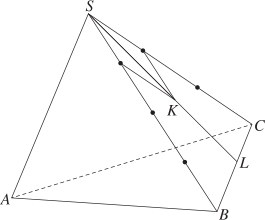


  1. Using part (ii), or otherwise, determine the position of `L` by showing that  `vec(BL)=(4)/(7) vec(BC)`.  (2 marks)

    --- 6 WORK AREA LINES (style=lined) ---

  2. The point `P` is defined by  `vec(AP)=-6 vec(AB)-8 vec(AC)`.
  3. Does `P` lie on the line `A L`? Justify your answer.  (2 marks)

    --- 5 WORK AREA LINES (style=lined) ---

Show Answers Only
  1. `text{Proof (See Worked Solution)}`
  2. `text{Proof (See Worked Solution)}`
  3. `text{Proof (See Worked Solution)}`
  4. `P\ text{lies on}\ vec(AL)\ \ text{(See Worked Solution)}`
Show Worked Solution
i.    `lambda vecu+mu vecv` `=0`
  `lambda vecu` `=-mu vecv`

 
`lambda=0\ \ text{or}\ \ vecu=-(mu/lambda)vecv=k vecv\ \ (kinRR)`

`text{S}text{ince}\ \ vecu and vecv\ \ text{are not parallel}`

`=> lambda=mu=0`
 

ii.  `\lambda_1 \vec{u}+\mu_1 \vec{v}=\lambda_2 \vec{u}+\mu_2 \vec{v}`

`\lambda_1 \vec{u}-\lambda_2 \vec{u}+\mu_1 \vec{v}-\mu_2 \vec{v}` `=vec0`  
`(\lambda_1-\lambda_2)\vec{u}+(\mu_1-\mu_2)\vec{v}` `=vec0`  


`text{Using part (i):}`

`(\lambda_1-\lambda_2)=0 and (\mu_1-\mu_2)=0`

`:.\lambda_1=\lambda_2  and  \mu_1=\mu_2\ …\ text{as required}`


Mean mark (ii) 56%.
iii.   `vec(BL)` `=lambda vec(BC)`
    `=lambda(vec(BS)+vec(SC))\ \ \ …\ (1)`


`vec(BL)` `=vec(BS)+mu vec(SK)`  
  `=-vec(SB)+mu(1/4vec(SB)+1/3vec(SC))`  
  `=-vec(SB)+mu/4vec(SB)+mu/3vec(SC)`  
  `=mu/3vec(SC)+(mu/4-1)vec(SB)\ \ \ …\ (2)`  


♦♦♦ Mean mark (iii) 25%.

`text{Using}\ \ (1) = (2):`

`lambda vec(BS)+ lambda vec(SC)=mu/3vec(SC)+(mu/4-1)vec(SB)`

`mu/3=lambda, \ \ 1-mu/4=lambda`

`mu/3` `=1-mu/4`  
`(4mu+3mu)/12` `=1`  
`(7mu)/12` `=1`  
`mu` `=12/7`  

 
`lambda=(12/7)/3=4/7`

`:.vec(BL)=(4)/(7) vec(BC)\ \ text{… as required}`
 

iv.  `vec(AP)=-6 vec(AB)-8 vec(AC)`

`text{If}\ P\ text{lies on}\ AL, ∃k\ text{such that}\ \ vec(AP)=k vec(AL)`


♦♦♦ Mean mark (iv) 23%.
`-6 vec(AB)-8 vec(AC)` `=k vec(AL)`  
`-6 vec(AB)-8 (vec(AB)+vec(BC))` `=k(vec(AB)+vec(BL))`  
`-14 vec(AB)-8vec(BC)` `=k(vec(AB)+4/7vec(BC))\ \ text{(see part (iii))}`  
`-14 vec(AB)-8vec(BC)` `=kvec(AB)+(4k)/7vec(BC)`  

 
`k=-14, \ \ (4k)/7=-8\ \ =>\ \ k=-14`

`:.\ P\ text{lies on}\ \ AL.`

Filed Under: Vectors and Geometry, Vectors and Vector Equations of Lines Tagged With: Band 4, Band 5, Band 6, smc-1196-25-Point lies on line, smc-1196-30-Parallel, smc-1196-80-3D vectors, smc-1210-20-Pyramid, smc-1210-70-3D problems

Vectors, EXT2 V1 SM-Bank 24

Show that the points  `A(2, 1, text{−1}), \ B(4, 2, text{−3})`  and  `C(text{−4}, text{−2}, 5)`  are collinear.  (2 marks)

Show Answers Only

`text(Proof)\ \ text{(See Worked Solutions)}`

Show Worked Solution

`vec(AB) = ((4), (2), (text{−3})) – ((2), (1), (text{−1})) = ((2), (1), (text{−2}))`

`vec(AC) = ((text{−4}), (text{−2}), (5)) – ((2), (1), (text{−1})) = ((text{−6}), (text{−3}), (6)) = -3((2), (1), (text{−2}))`


`text(S) text(ince)\ vec(AB)\ text(||)\ vec(AC) and A\ text(lies on both lines,)`

`A, B, C\ \ text(are collinear).`

Filed Under: Vectors and Vector Equations of Lines Tagged With: Band 3, smc-1196-25-Point lies on line, smc-1196-80-3D vectors

Vectors, EXT2 V1 SM-Bank 10

  1. Determine the point of intersection of  `underset ~a`  and  `underset ~b`  given.

`qquad underset ~a = ((3), (5), (1)) + lambda ((1), (3), (text{−2})),`  and
 

`qquad underset ~b = ((text{−2}), (2), (text{−1})) + mu ((1), (text{−1}), (2))`  (2 marks)

--- 6 WORK AREA LINES (style=lined) ---

 
  1. Determine if the point  `(2, text{−2}, 5)`  lies on  `underset ~b`.  (1 mark)

    --- 3 WORK AREA LINES (style=lined) ---

Show Answers Only
  1. `((1), (text{−1}), (5))`
  2. `text(See Worked Solutions)`
Show Worked Solution

i.     `text(At point of intersection:)`

`3 + lambda` `= -2 + mu\ \ text{… (1)}`
`5 + 3 lambda` `= 2 – mu\ \ text{… (2)}`
`1 – 2 lambda` `= -1 + 2 mu\ \ text{… (3)}`

 
`(1) + (2)`

`8 + 4 lambda` `= 0`
`lambda` `= -2,\ \ mu = 3`

 
`text{Intersection (using}\ lambda = –2 text{)}:`
 

`((x), (y), (z)) = ((3 – 2 xx 1), (5 – 2 xx 3), (1 – 2 xx text{−2})) = ((1), (text{−1}), (5))`


ii.   `text(If)\ \ (2, text{−2}, text{−10})\ \ text(lies on)\ underset ~b, ∃ mu\ \ text(that satisfies:)`

`-2 + mu` `= 2\ \ text{… (1)}\ => \ mu = 4`
`2 – mu` `= ­text{−2}\ \ text{… (2)}\ => \ mu = 4`
`-1 + 2 mu` `= 5\ \ text{… (3)}\ => \ mu = 3`

 
`=>\  text(No solution)`

`:. (2, text{−2}, 5)\ \ text(does not lie on)\ underset ~b.`

Filed Under: Vectors and Vector Equations of Lines Tagged With: Band 3, Band 4, smc-1196-20-Intersection, smc-1196-25-Point lies on line

Vectors, EXT2 V1 SM-Bank 9

  1. Find the equation of line vector  `underset ~r`, given it passes through  `(1, 3, –2)`  and  `(2, –1, 2)`.   (2 marks)

    --- 4 WORK AREA LINES (style=lined) ---

  2. Determine if  `underset ~r`  passes through  `(4, –9, 10)`.   (1 mark)

    --- 4 WORK AREA LINES (style=lined) ---

Show Answers Only
  1. `underset ~r = ((1), (3), (-2)) + lambda ((1), (-4), (4)) or`


    `underset ~r = ((2), (-1), (2)) + lambda ((-1), (4), (-4))`

  2. `text(See Worked Solutions)`
Show Worked Solution

i.     `text(Method 1)`

`text(Let)\ \ A(1, 3, –2) and B(2, –1, 2)`

`vec (AB)` `= ((2), (-1), (2))-((1), (3), (-2)) = ((1), (-4), (4))`
`underset ~r` `= ((1), (3), (-2)) + lambda ((1), (-4), (4))`


`text (Method 2)`

`vec (BA)` `= ((1), (3), (-2))-((2), (-1), (2)) = ((-1), (4), (-4))`
`underset ~r` `= ((2), (-1), (2)) + lambda ((-1), (4), (-4))`


ii.   `text(If)\ \ (4, –9, 10)\ \ text(lies on the vector line,)`

`∃ lambda\ \ text(that satisfies:)`

`1 + lambda` `= 4\ \ text{… (1)}`
`3-4 lambda` `= -9\ \ text{… (2)}`
`-2 + 4 lambda` `= 10\ \ text{… (3)}`


`lambda = 3\ \ text(satisfies all equations)`

`:. (4, –9, 10)\ \ text(lies on the line.)`

Filed Under: Vectors and Vector Equations of Lines Tagged With: Band 2, Band 3, smc-1196-10-Find line given 2 points, smc-1196-25-Point lies on line, smc-1196-80-3D vectors

Copyright © 2014–2025 SmarterEd.com.au · Log in