SmarterEd

Aussie Maths & Science Teachers: Save your time with SmarterEd

  • Login
  • Get Help
  • About

Functions, EXT1 F2 2023 HSC 14b

Consider the hyperbola  \(y=\dfrac{1}{x}\)  and the circle  \((x-c)^2+y^2=c^2\), where \(c\) is a constant.

  1. Show that the \(x\)-coordinates of any points of intersection of the hyperbola and circle are zeros of the polynomial  \(P(x)=x^4-2 c x^3+1\).   (1 mark)

    --- 4 WORK AREA LINES (style=lined) ---

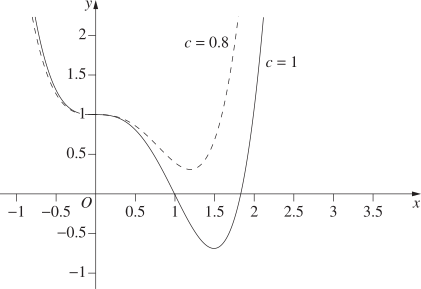
  2. The graphs of  \(y=x^4-2 c x^3+1\)  for  \(c=0.8\)  and  \(c=1\) are shown.
     

  1. By considering the given graphs, or otherwise, find the exact value of  \(c>0\)  such that the hyperbola  \(y=\dfrac{1}{x}\)  and the circle  \((x-c)^2+y^2=c^2\)  intersect at only one point.   (3 marks)

    --- 10 WORK AREA LINES (style=lined) ---
Show Answers Only

i.    \(\text{See Worked Solutions}\)

ii.   \(\sqrt[4]{\dfrac{16}{27}}\approx 0.877\)

Show Worked Solution

i.     \(y=\dfrac{1}{x}\ …\ (1) \)

\((x-c)^2+y^2=c^2\ …\ (2) \)

\(\text{Substitute (1) into (2):}\)

\((x-c)^2+\Big{(}\dfrac{1}{x}\Big{)}^2 \) \(=c^2\)  
\(x^2-2cx+c^2+\dfrac{1}{x^2}\) \(=c^2\)  
\(x^4-2cx^3+1\) \(=0\)  
Mean mark (i) 53%.

ii.    \(\text{Graphs show that for some value of}\ \ 0.8 \leq c \leq 1,\)

\(P(x)\ \text{has a minimum that touches the}\ x\text{-axis once.}\)

\(P(x)\) \(=x^4-2cx^3+1\)  
\(P^{′}(x)\) \(=4x^3-6cx^2\)  

 
\(\text{Find}\ x\ \text{when}\ P^{′}(x)=0: \)

\(4x^3-6cx^2\) \(=0\)  
\(2x^2(2x-3c)\) \(=0\)  
\(x\) \(=\dfrac{3c}{2}\ \ (x \neq 0)\)  

 
\(\text{Find}\ c\ \text{when}\ P(\frac{3c}{2})=0: \)

\(\Big{(} \dfrac{3c}{2} \Big{)}^4-2c\Big{(} \dfrac{3c}{2} \Big{)}^3+1 \) \(=0\)  
\(\dfrac{81c^4}{16}-\dfrac{54c^4}{8}+1\) \(=0\)  
\(\dfrac{(108-81)c^4}{16}\) \(=1\)  
\(\dfrac{27c^4}{16}\) \(=1\)  
\(c^4\) \(=\dfrac{16}{27}\)  
\(c\) \(=\sqrt[4]{\dfrac{16}{27}}\approx 0.877\)  
Mean mark (ii) 19%.

Filed Under: Multiplicity of Zeroes in Polynomials, Sum, Products and Multiplicity of Roots Tagged With: Band 4, Band 6, smc-1205-20-Multiplicity of Roots, smc-1205-30-Other, smc-7292-50-Other Problems

Functions, EXT1′ F2 2019 HSC 16ai

Consider the equation  `x^3-px + q = 0`, where `p` and `q` are real numbers and  `p > 0`.

Let  `r = sqrt((4p)/3)`  and  `cos 3 theta = (-4q)/r^3`.

Show that `r cos theta` is a root of  `x^3-px + q = 0`.

You may use the result  `4 cos^3 theta-3 cos theta = cos 3 theta`.  (Do NOT prove this.)   (2 marks)

--- 5 WORK AREA LINES (style=lined) ---

Show Answers Only

`text(Proof)\ text{(See Worked Solutions)}`

Show Worked Solution

`x^3-px + q = 0\ …\ (1)`

♦ Mean mark 49%.

`r = sqrt((4p)/3) \ => \ p=(3r^2)/4`

`cos 3 theta = (-4q)/r^3 \ => \ q = (-r^3 cos 3 theta)/4`

`text(Given)\ \ 4 cos^3 theta-3 cos theta = cos 3 theta\ …\ (2)` 

 
`text(Substitute)\ \ x = r cos theta\ \ text{into (1):}`

`r^3 cos^3 theta-(3r^2)/4 r cos theta-(r^3 cos 3 theta)/4` `= 0`
`r^3/4  underbrace((4 cos^3 theta-3 cos theta-cos 3 theta))_(=\ 0\ text{(see (2) above)})` `= 0`

 
`:.r cos theta\ \ text(is a root).`

Filed Under: Roots and Coefficients, Sum, Products and Multiplicity of Roots, Sums and Products of Zeroes Tagged With: Band 5, smc-1205-30-Other, smc-6645-30-Other Problems

Functions, EXT1 F2 2019 HSC 14b

The diagram shows the graph of  `y = 1/(x-k)`, where `k` is a positive real number.
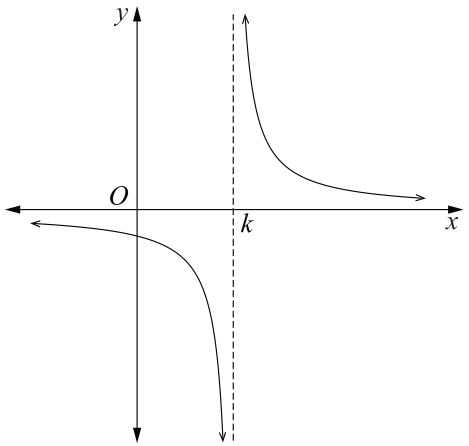


By considering the graphs of  `y = x^2`  and  `y = 1/(x - k)`, explain why the function  `f(x) = x^3-kx^2-1`  has exactly one real zero.   (2 marks)

--- 6 WORK AREA LINES (style=lined) ---

Show Answers Only

`text(See Worked Solutions)`

Show Worked Solution

`text(Draw)\ y = x^2\ text(on the diagram:)`
 

`
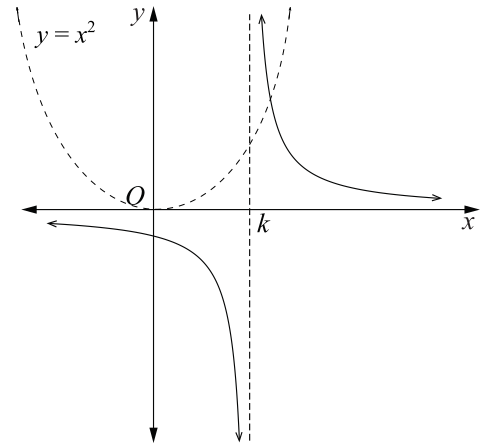
 

`text(One point of intersection occurs when)`

`x^2` `= 1/(x-k)`
`x^3-kx^2` `= 1`
`x^3-kx^2-1` `= 0`

 
`text(S)text(ince only 1 point of intersection)`

`=> x^3-kx^2-1 = 0\ \ text(has exactly 1 zero)`

Filed Under: Sum, Products and Multiplicity of Roots, Sums and Products of Zeroes Tagged With: Band 4, smc-1205-30-Other, smc-6645-30-Other Problems

Functions, EXT1 F2 2016 HSC 10 MC

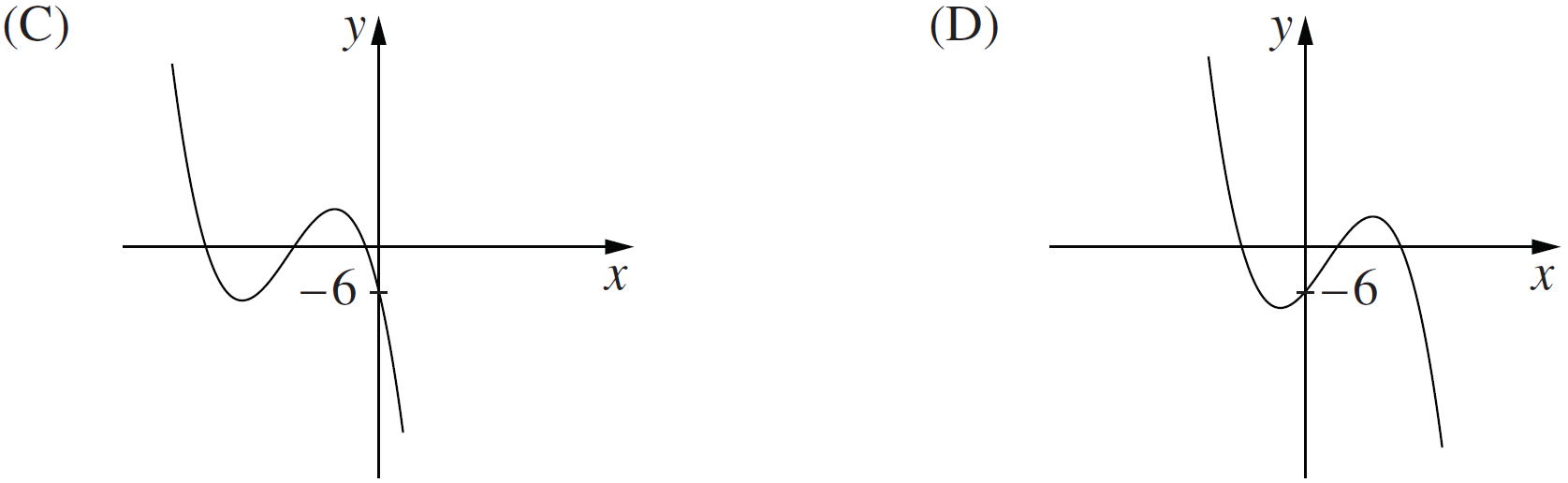
Consider the polynomial  `p(x) = ax^3 + bx^2 + cx-6`  with `a` and `b` positive.

Which graph could represent `p(x)`?
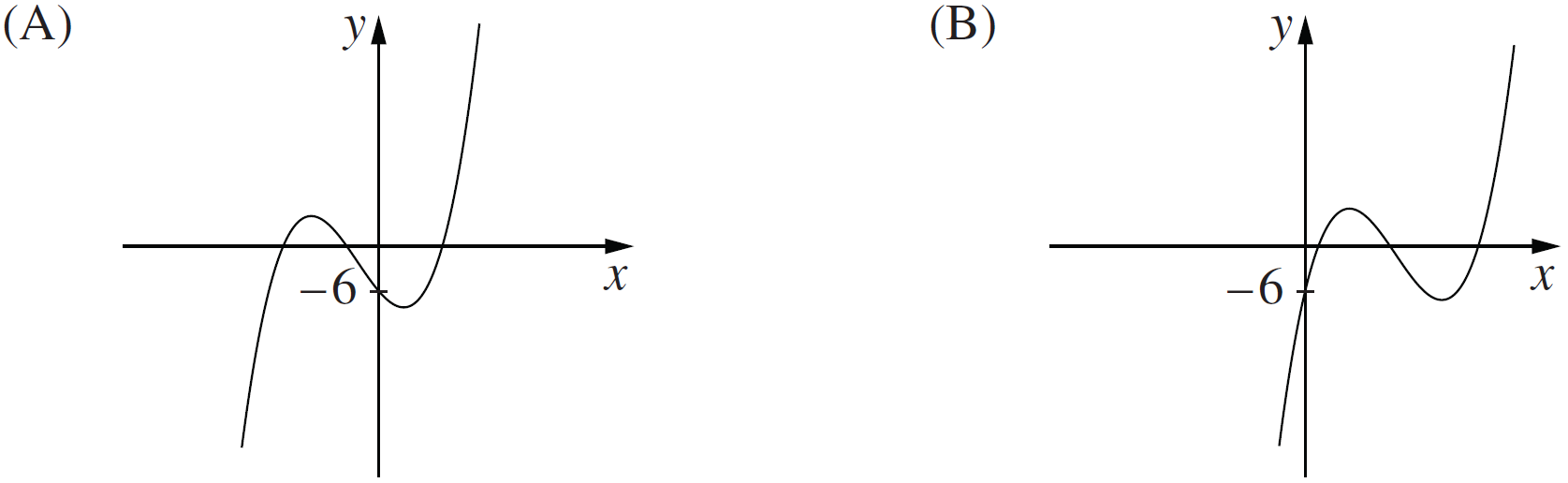
 

ext1-2016-hsc-10-mc-ab

ext1-2016-hsc-10-mc-cd

Show Answers Only

`A`

Show Worked Solution
`p(x)` `= ax^3 + bx^2 + cx – 6`
`p^{′}(x)` `= 3ax^2 + 2bx + c`
`p^{″}(x)` `= 6ax + 2b`

 
`text(S) text(ince)\ \ a, b > 0,`

`text(As)\ \ x -> oo,\ \ p(x) -> oo`

`:.\ text(Eliminate)\ \ C and D.`
 

`text(POI occurs when)\ \ p^{″}(x) = 0,`

`6 ax + 2b` `= 0`
 `x` `= -b/(3a) < 0,\ \ \ (a, b > 0)`

 
`:.\ text(Eliminate)\ \ B`

`=>   A`

Filed Under: Roots, Remainders and Factors, Sum, Products and Multiplicity of Roots Tagged With: Band 4, smc-1205-30-Other

Copyright © 2014–2026 SmarterEd.com.au · Log in