Consider the hyperbola \(y=\dfrac{1}{x}\) and the circle \((x-c)^2+y^2=c^2\), where \(c\) is a constant. --- 4 WORK AREA LINES (style=lined) --- --- 10 WORK AREA LINES (style=lined) ---
Aussie Maths & Science Teachers: Save your time with SmarterEd
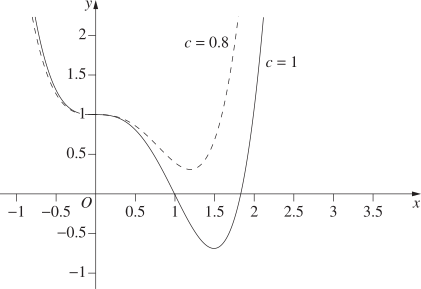
Consider the hyperbola \(y=\dfrac{1}{x}\) and the circle \((x-c)^2+y^2=c^2\), where \(c\) is a constant. --- 4 WORK AREA LINES (style=lined) --- --- 10 WORK AREA LINES (style=lined) --- i. \(\text{See Worked Solutions}\) ii. \(\sqrt[4]{\dfrac{16}{27}}\approx 0.877\) i. \(y=\dfrac{1}{x}\ …\ (1) \) \((x-c)^2+y^2=c^2\ …\ (2) \) \(\text{Substitute (1) into (2):}\) ii. \(\text{Graphs show that for some value of}\ \ 0.8 \leq c \leq 1,\) \(P(x)\ \text{has a minimum that touches the}\ x\text{-axis once.}\)
Show Answers Only
Show Worked Solution
\((x-c)^2+\Big{(}\dfrac{1}{x}\Big{)}^2 \)
\(=c^2\)
\(x^2-2cx+c^2+\dfrac{1}{x^2}\)
\(=c^2\)
\(x^4-2cx^3+1\)
\(=0\)
Mean mark (i) 53%.
\(P(x)\)
\(=x^4-2cx^3+1\)
\(P^{′}(x)\)
\(=4x^3-6cx^2\)
\(\text{Find}\ x\ \text{when}\ P^{′}(x)=0: \)
\(4x^3-6cx^2\)
\(=0\)
\(2x^2(2x-3c)\)
\(=0\)
\(x\)
\(=\dfrac{3c}{2}\ \ (x \neq 0)\)
\(\text{Find}\ c\ \text{when}\ P(\frac{3c}{2})=0: \)
\(\Big{(} \dfrac{3c}{2} \Big{)}^4-2c\Big{(} \dfrac{3c}{2} \Big{)}^3+1 \)
\(=0\)
\(\dfrac{81c^4}{16}-\dfrac{54c^4}{8}+1\)
\(=0\)
\(\dfrac{(108-81)c^4}{16}\)
\(=1\)
\(\dfrac{27c^4}{16}\)
\(=1\)
\(c^4\)
\(=\dfrac{16}{27}\)
\(c\)
\(=\sqrt[4]{\dfrac{16}{27}}\approx 0.877\)
Mean mark (ii) 19%.