SmarterEd

Aussie Maths & Science Teachers: Save your time with SmarterEd

  • Login
  • Get Help
  • About

Vectors, EXT2 V1 2023 HSC 15b

On the triangular pyramid \(A B C D, L\) is the midpoint of \(A B, M\) is the midpoint of \(A C, N\) is the midpoint of \(A D, P\) is the midpoint of \(C D, Q\) is the midpoint of \(B D\) and \(R\) is the midpoint of \(B C\).
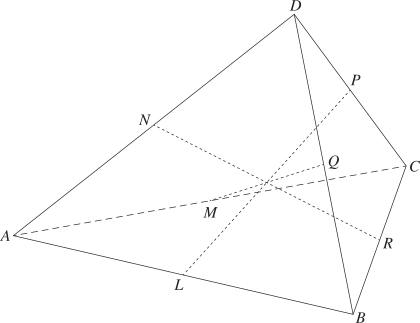
 

Let  \(\underset{\sim}{b}=\overrightarrow{A B}, \underset{\sim}{c}=\overrightarrow{A C}\)  and  \(\underset{\sim}{d}=\overrightarrow{A D}\).

  1. Show that \(\overrightarrow{L P}=\dfrac{1}{2}(-\underset{\sim}{b}+\underset{\sim}{c}+\underset{\sim}{d})\).  (1 mark)

    --- 4 WORK AREA LINES (style=lined) ---

  2. It can be shown that

\(\overrightarrow{M Q}=\dfrac{1}{2}(\underset{\sim}{b}-\underset{\sim}{c}+\underset{\sim}{d})\)  and

\(\overrightarrow{N R}=\dfrac{1}{2}(\underset{\sim}{b}+\underset{\sim}{c}-\underset{\sim}{d})\).   (Do NOT prove these.) 

  1. Prove that

  \( \Big{|}\overrightarrow{A B}\Big{|}^2+\Big{|}\overrightarrow{A C}\Big{|}^2+\Big{|}\overrightarrow{A D}\Big{|}^2+\Big{|}\overrightarrow{B C}\Big{|}^2+\Big{|}\overrightarrow{B D}\Big{|}^2+\Big{|}\overrightarrow{C D}\Big{|}^2 \)

\(=4\left(\Big{|}\overrightarrow{L P}\Big{|}^2+\Big{|}\overrightarrow{M Q}\Big{|}^2+\Big{|}\overrightarrow{N R}\Big{|}^2\right)\)  (3 marks)

--- 10 WORK AREA LINES (style=lined) ---
Show Answers Only
  1. \(\text{See Worked Solutions}\)
  2. \(\text{Proof (See Worked Solutions)}\)
Show Worked Solution
i.     \(\overrightarrow{LP}\) \(=\overrightarrow{LA}+\overrightarrow{AC}+\overrightarrow{CP} \)
    \(=\dfrac{1}{2} \overrightarrow{BA}+\overrightarrow{AC}+\dfrac{1}{2}\overrightarrow{CD} \)
    \(=-\dfrac{1}{2} \underset{\sim}b +\underset{\sim}c + \dfrac{1}{2}(\underset{\sim}d-\underset{\sim}c) \)
    \(=-\dfrac{1}{2} \underset{\sim}b +\underset{\sim}c + \dfrac{1}{2}\underset{\sim}d-\dfrac{1}{2}\underset{\sim}c\)
    \(=\dfrac{1}{2} (-\underset{\sim}b+\underset{\sim}c+\underset{\sim}d) \)


ii.   \(\overrightarrow{M Q}=\dfrac{1}{2}(\underset{\sim}{b}-\underset{\sim}{c}+\underset{\sim}{d})\)

\(\overrightarrow{N R}=\dfrac{1}{2}(\underset{\sim}{b}+\underset{\sim}{c}-\underset{\sim}{d})\).

\(\text{RHS}\) \(=4\left(\Big{|}\overrightarrow{L P}\Big{|}^2+\Big{|}\overrightarrow{M Q}\Big{|}^2+\Big{|}\overrightarrow{N R}\Big{|}^2\right)\)  
  \(=4\left(\overrightarrow{L P}\cdot \overrightarrow{L P} +\overrightarrow{MQ}\cdot \overrightarrow{MQ} +\overrightarrow{NR}\cdot \overrightarrow{NR}\right)\)  
  \(=4\Bigg{(}\dfrac{1}{4}(-\underset{\sim}b+\underset{\sim}c+\underset{\sim}d) \cdot(-\underset{\sim}b+\underset{\sim}c+\underset{\sim}d) +  \)  
  \( \dfrac{1}{4}(\underset{\sim}{b}-\underset{\sim}{c}+\underset{\sim}{d}) \cdot(\underset{\sim}{b}-\underset{\sim}{c}+\underset{\sim}{d}) +  \)  
  \( \dfrac{1}{4}(\underset{\sim}{b}+\underset{\sim}{c}-\underset{\sim}{d}) \cdot(\underset{\sim}{b}+\underset{\sim}{c}-\underset{\sim}{d}) \Bigg{)}\)  
  \(=(\underset{\sim}c+(\underset{\sim}d-\underset{\sim}b)) \cdot(\underset{\sim}c+(\underset{\sim}d-\underset{\sim}b))+(\underset{\sim}d+(\underset{\sim}b-\underset{\sim}c))\cdot (\underset{\sim}d+(\underset{\sim}b-\underset{\sim}c)) + \)  
  \( (\underset{\sim}b+(\underset{\sim}c-\underset{\sim}d))\cdot (\underset{\sim}b+(\underset{\sim}c-\underset{\sim}d))  \)  
  \(=|\underset{\sim}c|^2+2\underset{\sim}c(\underset{\sim}d-\underset{\sim}b) + |\underset{\sim}d-\underset{\sim}b|^2 + \)  
  \(|\underset{\sim}d|^2+2\underset{\sim}d(\underset{\sim}b-\underset{\sim}c) + |\underset{\sim}b-\underset{\sim}c|^2 + \)  
  \( |\underset{\sim}b|^2+2\underset{\sim}b(\underset{\sim}c-\underset{\sim}d) + |\underset{\sim}c-\underset{\sim}d|^2 \)  
  \(=|\underset{\sim}b|^2+|\underset{\sim}c|^2+|\underset{\sim}d|^2+|\underset{\sim}b-\underset{\sim}c|^2+|\underset{\sim}d-\underset{\sim}b|^2+|\underset{\sim}c-\underset{\sim}d|^2 + \)  
  \( 2(\underset{\sim}c \cdot\underset{\sim}d-\underset{\sim}c \cdot\underset{\sim}b+\underset{\sim}d \cdot\underset{\sim}b-\underset{\sim}d \cdot\underset{\sim}c+\underset{\sim}b \cdot\underset{\sim}c-\underset{\sim}b \cdot\underset{\sim}d) \)  
  \(=\Big{|}\overrightarrow{A B}\Big{|}^2+\Big{|}\overrightarrow{A C}\Big{|}^2+\Big{|}\overrightarrow{A D}\Big{|}^2+\Big{|}\overrightarrow{B C}\Big{|}^2+\Big{|}\overrightarrow{B D}\Big{|}^2+\Big{|}\overrightarrow{C D}\Big{|}^2 + 0\)  
  \(=\ \text{LHS} \)  

♦♦ Mean mark (ii) 34%.

Filed Under: Vectors and Geometry Tagged With: Band 4, Band 5, smc-1210-20-Pyramid, smc-1210-70-3D problems

Vectors, EXT2 V1 EQ-Bank 13

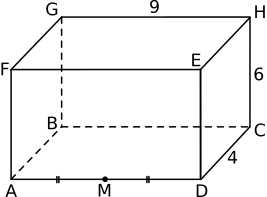
In a rectangular prism, `M` is the midpoint of `AD`.

Use vector methods to find

  1. `angle HBD` to 1 decimal place  (2 marks)

    --- 6 WORK AREA LINES (style=lined) ---

  2. `angle HBM` to 1 decimal place  (2 marks)

    --- 4 WORK AREA LINES (style=lined) ---

Show Answers Only
  1. `40.5°`
  2. `51.5°`
Show Worked Solution

i.   `text{Consider the position vectors of points using}\ B\ text{as origin:}`

`vec(BH)=((0),(9),(6)), \ abs(vec(BH))=sqrt(9^2+6^2)=sqrt117`

`vec(BD)=((4),(9),(0)), \ abs(vec(BD))=sqrt(4^2+9^2)=sqrt97`

`cos angleHBD` `=(vec(BH)*vec(BD))/(abs(vec(BH))*abs(vec(BD)))`  
  `=(0xx4+9xx9+6xx0)/(sqrt117 xx sqrt97)`  
`angleHBD` `=cos^(-1)(81/(sqrt117 xx sqrt97))`  
  `=40.5°`  


ii.   `vec(BM)=((4),(9/2),(0)), \ abs(vec(BM))=sqrt(4^2+(9/2)^2)=sqrt(145/4)`

`cos angleHBM` `=(vec(BH) * vec(BM))/(abs(vec(BH))*abs(vec(BM)))`  
  `=(0xx4+9xx9/2+6xx0)/(sqrt117 xx sqrt(145/4))`  
`angleHBM` `=cos^(-1)(40.5/(sqrt117 xx sqrt(145/4)))`  
  `=51.5°\ \text{(1 d.p.)}`  

Filed Under: Vectors and Geometry Tagged With: Band 4, smc-1210-10-Cube/Rect Prism, smc-1210-70-3D problems

Vectors, EXT2 V1 EQ-Bank 9

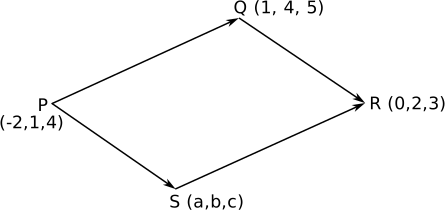
A parallelogram is formed by joining the points  `P(-2,1,4), Q(1,4,5), R(0,2,3)` and `S(a,b,c)`.

Use vector methods to find `a,b` and `c`.  (2 marks)

--- 6 WORK AREA LINES (style=lined) ---

Show Answers Only

`a=-3, b=-1, c=2`

Show Worked Solution

`text{Opposite sides of a parallelogram are equal and parallel.}`

`=> vec(PQ)=vec(SR)`
 

`vec(PQ)=((1+2),(4-1),(5-4))=((3),(3),(1))`
 

`vec(SR)=((-a),(2-b),(3-c))`
 

`text{Equating coordinates:}`

`-a=3\ \ =>\ \ a=-3`

`2-b=3\ \ =>\ \ b=-1`

`3-c=1\ \ =>\ \ c=2`

Filed Under: Basic Concepts and Arithmetic, Vectors and Geometry Tagged With: Band 3, smc-1210-30-Quadrilateral, smc-1210-70-3D problems

Vectors, EXT2 V1 EQ-Bank 8

Classify the triangle formed by joining the points  `A(3,1,0), B(-2,4,3)` and `C(3,3,-2)`.  (4 marks)

--- 10 WORK AREA LINES (style=lined) ---
Show Answers Only

`text{ΔABC is a right-angled (scalene) triangle with a right-angle at B.}`

`text{(See Worked Solutions)}`

Show Worked Solution

`text{Calculating the side lengths:}`

`abs(AB)=sqrt((3+2)^2+(1-4)^2+(0-3)^2)=sqrt43`

`abs(BC)=sqrt((-2-3)^2+(4-3)^2+(3+2)^2)=sqrt51`

`abs(AC)=sqrt((3-3)^2+(1-3)^2+(0+2)^2)=sqrt8`

`=>\ text{Triangle is scalene.}`
 

`text{From above,}`

`abs(BC)^2=abs(AB)^2+abs(AC)^2\ \ (angleBAC=90°)`
 

`text{Consider scalar product of direction vectors:}`

`vec(AB)=((3),(1),(0))+lambda((-2-3),(4-1),(3-0))=((3),(1),(0))+lambda((-5),(3),(3))`
 

`vec(AC)=((3),(1),(0))+mu((3-3),(3-1),(-2-0))=((3),(1),(0))+mu((0),(2),(-2))`
 

`vec(AB)*vec(AC)=((-5),(3),(3))((0),(2),(-2))=0+6-6=0`

`:.vec(AB) ⊥ vec(AC)`

`:.\ text{ΔABC is a right-angled (scalene) triangle with a right-angle at A.}`

Filed Under: Vectors and Geometry, Vectors and Vector Equations of Lines Tagged With: Band 4, smc-1196-10-Find line given 2 points, smc-1196-40-Perpendicular, smc-1210-40-Triangle, smc-1210-70-3D problems

Vectors, EXT2 V1 2022 HSC 14a

  1. The two non-parallel vectors `\vec{u}` and `\vec{v}` satisfy  `lambda vec(u)+mu vec(v)= vec(0)`  for some real numbers `\lambda` and `\mu`.
  2. Show that  `\lambda=\mu=0`.  (2 marks)

    --- 3 WORK AREA LINES (style=lined) ---

  3. The two non-parallel vectors `\vec{u}` and `\vec{v}` satisfy  `\lambda_1 \vec{u}+\mu_1 \vec{v}=\lambda_2 \vec{u}+\mu_2 \vec{v}`  for some real numbers `\lambda_1, \lambda_2, \mu_1` and `\mu_2`.
  4. Using part (i), or otherwise, show that  `\lambda_1=\lambda_2`  and  `\mu_1=\mu_2`. (1  mark)

    --- 5 WORK AREA LINES (style=lined) ---
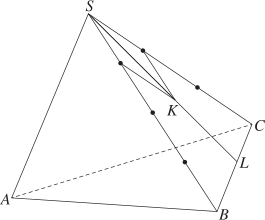
The diagram below shows the tetrahedron with vertices `A, B, C` and `S`.

The point `K` is defined by  `vec(SK)=(1)/(4) vec(SB)+(1)/(3) vec(SC)`, as shown in the diagram.

The point `L` is the point of intersection of the straight lines `S K` and `B C`.


  1. Using part (ii), or otherwise, determine the position of `L` by showing that  `vec(BL)=(4)/(7) vec(BC)`.  (2 marks)

    --- 6 WORK AREA LINES (style=lined) ---
  2. The point `P` is defined by  `vec(AP)=-6 vec(AB)-8 vec(AC)`.
  3. Does `P` lie on the line `A L`? Justify your answer.  (2 marks)

    --- 5 WORK AREA LINES (style=lined) ---
Show Answers Only
  1. `text{Proof (See Worked Solution)}`
  2. `text{Proof (See Worked Solution)}`
  3. `text{Proof (See Worked Solution)}`
  4. `P\ text{lies on}\ vec(AL)\ \ text{(See Worked Solution)}`
Show Worked Solution
i.    `lambda vecu+mu vecv` `=0`
  `lambda vecu` `=-mu vecv`

 
`lambda=0\ \ text{or}\ \ vecu=-(mu/lambda)vecv=k vecv\ \ (kinRR)`

`text{S}text{ince}\ \ vecu and vecv\ \ text{are not parallel}`

`=> lambda=mu=0`
 

ii.  `\lambda_1 \vec{u}+\mu_1 \vec{v}=\lambda_2 \vec{u}+\mu_2 \vec{v}`

`\lambda_1 \vec{u}-\lambda_2 \vec{u}+\mu_1 \vec{v}-\mu_2 \vec{v}` `=vec0`  
`(\lambda_1-\lambda_2)\vec{u}+(\mu_1-\mu_2)\vec{v}` `=vec0`  


`text{Using part (i):}`

`(\lambda_1-\lambda_2)=0 and (\mu_1-\mu_2)=0`

`:.\lambda_1=\lambda_2  and  \mu_1=\mu_2\ …\ text{as required}`


Mean mark (ii) 56%.
iii.   `vec(BL)` `=lambda vec(BC)`
    `=lambda(vec(BS)+vec(SC))\ \ \ …\ (1)`


`vec(BL)` `=vec(BS)+mu vec(SK)`  
  `=-vec(SB)+mu(1/4vec(SB)+1/3vec(SC))`  
  `=-vec(SB)+mu/4vec(SB)+mu/3vec(SC)`  
  `=mu/3vec(SC)+(mu/4-1)vec(SB)\ \ \ …\ (2)`  


♦♦♦ Mean mark (iii) 25%.

`text{Using}\ \ (1) = (2):`

`lambda vec(BS)+ lambda vec(SC)=mu/3vec(SC)+(mu/4-1)vec(SB)`

`mu/3=lambda, \ \ 1-mu/4=lambda`

`mu/3` `=1-mu/4`  
`(4mu+3mu)/12` `=1`  
`(7mu)/12` `=1`  
`mu` `=12/7`  

 
`lambda=(12/7)/3=4/7`

`:.vec(BL)=(4)/(7) vec(BC)\ \ text{… as required}`
 

iv.  `vec(AP)=-6 vec(AB)-8 vec(AC)`

`text{If}\ P\ text{lies on}\ AL, ∃k\ text{such that}\ \ vec(AP)=k vec(AL)`


♦♦♦ Mean mark (iv) 23%.
`-6 vec(AB)-8 vec(AC)` `=k vec(AL)`  
`-6 vec(AB)-8 (vec(AB)+vec(BC))` `=k(vec(AB)+vec(BL))`  
`-14 vec(AB)-8vec(BC)` `=k(vec(AB)+4/7vec(BC))\ \ text{(see part (iii))}`  
`-14 vec(AB)-8vec(BC)` `=kvec(AB)+(4k)/7vec(BC)`  

 
`k=-14, \ \ (4k)/7=-8\ \ =>\ \ k=-14`

`:.\ P\ text{lies on}\ \ AL.`

Filed Under: Vectors and Geometry, Vectors and Vector Equations of Lines Tagged With: Band 4, Band 5, Band 6, smc-1196-25-Point lies on line, smc-1196-30-Parallel, smc-1196-80-3D vectors, smc-1210-20-Pyramid, smc-1210-70-3D problems

Vectors, EXT2 V1 2021 HSC 12e

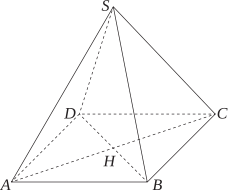
The diagram shows the pyramid  `ABCDS`  where  `ABCD`  is a square. The diagonals of the square bisect each other at `H`.
 

  1. Show that  `overset->{HA} + overset->{HB} + overset->{HC} + overset->{HD} = underset~0`   (1 mark)

    --- 5 WORK AREA LINES (style=lined) ---
    Let `G` be the point such that  `overset->{GA} + overset->{GB} + overset->{GC} + overset->{GD} + overset->{GS}  =  underset~0`.

  1. Using part (i), or otherwise, show that  `4 overset->{GH} + overset->{GS}  =  underset~0`.   (2 marks)

    --- 8 WORK AREA LINES (style=lined) ---

  2. Find the value of  `λ`  such that  `overset->{HG} = λ overset->{HS}`   (1 mark)

    --- 5 WORK AREA LINES (style=lined) ---

Show Answers Only
  1. `text{See Worked Solution}`
  2. `text{See Worked Solution}`
  3. `1/5`
Show Worked Solution

i.    `text{S} text{ince diagonal} \ overset->{AC} \ text{is bisected by H:}`

`overset->{HA} =- overset->{HC}`

`text{Similarly for diagonal} \ overset->{BD}`

`overset->{HB} = – overset->{HD}`
 

`:. \ overset->{HA} + overset->{HB} + overset->{HC} + overset->{HD}` `= – overset->{HC} – overset->{HD} +  overset->{HC} + overset->{HD}`
  `= underset~0`
 
 
ii.    `overset->{GA} = overset->{GH} + overset->{HA} \ , \ overset->{GB} = overset->{GH} + overset->{HB}`
`overset->{GC} = overset->{GH} + overset->{HC} \ , \ overset->{GD} = overset->{GH} + overset->{HD}`
 
`overset->{GA} + overset->{GB} + overset->{GC} + overset->{GD} + overset->{GS}`
`= overset->{GH} + overset->{HA} + overset->{GH} + overset->{HB} + overset->{GH} + overset->{HC} + overset->{GH} + overset->{HD} + overset->{GS}`
`= 4 overset->{GH} + (overset->{HA} + overset->{HB} + overset->{HC} + overset->{HD} + overset->{GS})`
`= 4 overset->{GH} + overset->{GS}`
 
`overset->{GA} + overset->{GB} + overset->{GC} + overset->{GD} + overset->{GS} = underset~0\ \ \ text{(given)}`
`:. 4 overset->{GH} + overset->{GS} = underset~0`
 
iii.  `overset->{HS} = overset->{HG} + overset->{GS}`
`overset->{GS} = overset->{HS} + overset->{GH}`
♦ Mean mark 48%.


`text{Using part (ii):}`
`4 overset->{GH} + overset->{HS} + overset->{GH}` `= underset~0`
`5 overset->{GH}` `= overset->{SH}`
`overset->{GH}` `= 1/5 overset->{SH}`
`overset->{HG}` `= 1/5 overset->{HS}`

`:. \ λ = 1/5`

Filed Under: Vectors and Geometry Tagged With: Band 3, Band 4, Band 5, smc-1210-20-Pyramid, smc-1210-55-Ratios, smc-1210-70-3D problems

Vectors, EXT2 V1 2021 HSC 1 MC

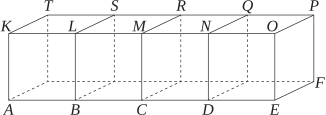
Four cubes are placed in a line as shown on the diagram.


Which of the following vectors is equal to `overset->{AB}  +  overset->{CQ}`

  1. `overset->{AQ}`
  2. `overset->{CP}`
  3. `overset->{PB}`
  4. `overset->{RA}`
Show Answers Only

`B`

Show Worked Solution
`overset->{AB} \ + \ overset->{CQ}` `= overset->{CD} + overset->{DP}`  
  `= overset->{CP}`  

`=>\ B`

Filed Under: Vectors and Geometry Tagged With: Band 2, smc-1210-10-Cube/Rect Prism, smc-1210-70-3D problems

Vectors, EXT2 V1 2019 SPEC2 4

The base of a pyramid is the parallelogram  `ABCD`  with vertices at points  `A(2,−1,3),  B(4,−2,1),  C(a,b,c)`  and  `D(4,3,−1)`. The apex (top) of the pyramid is located at  `P(4,−4,9)`.

  1. Find the values of  `a, b`  and  `c`.  (2 marks)

    --- 4 WORK AREA LINES (style=lined) ---

  2. Find the cosine of the angle between the vectors  `overset(->)(AB)`  and  `overset(->)(AD)`.  (2 marks)

    --- 4 WORK AREA LINES (style=lined) ---

  3. Find the area of the base of the pyramid.  (2 marks)

    --- 4 WORK AREA LINES (style=lined) ---

Show Answers Only
  1. `a = 6, b = 2, c = −3`
  2. `4/9`
  3. `2sqrt65\ text(u²)`
Show Worked Solution
i.    `overset(->)(AB)` `= (4 – 2)underset~i + (−2 + 1)underset~j + (1 – 3)underset~k`
    `= 2underset~i – underset~j – 2underset~k`

 
`text(S)text(ince)\ ABCD\ text(is a parallelogram)\ => \ overset(->)(AB)= overset(->)(DC)`

`overset(->)(DC) = (a – 4)underset~i + (b – 3)underset~j + (c + 1)underset~k`

`a – 4 = 2 \ => \ a = 6`

`b – 3 = −1 \ => \ b = 2`

`c + 1 = −2 \ => \ c = −3`


ii.   `overset(->)(AB) = 2underset~i – underset~j – 2underset~k`

`overset(->)(AD) = 2underset~i + 4underset~j – 4underset~k`

`cos angleBAD` `= (overset(->)(AB) · overset(->)(AD))/(|overset(->)(AB)| · |overset(->)(AD)|)`
  `= (4 – 4 + 8)/(sqrt(4 + 1 + 4) · sqrt(4 + 16 + 16))`
  `= 4/9`


iii.    `1/2 xx text(Area)_(ABCD)` `= 1/2 ab sin c`
  `text(Area)_(ABCD)` `= |overset(->)(AB)| · |overset(->)(AD)| *sin(cos^(−1)\ 4/9)`


`:. text(Area)_(ABCD)` `= 3 · 6 · sqrt65/9`
  `= 2sqrt65\ text(u²)`

Filed Under: Vectors and Geometry Tagged With: Band 3, Band 4, Band 5, smc-1210-20-Pyramid, smc-1210-30-Quadrilateral, smc-1210-70-3D problems

Vectors, EXT2, V1 SM-Bank 16


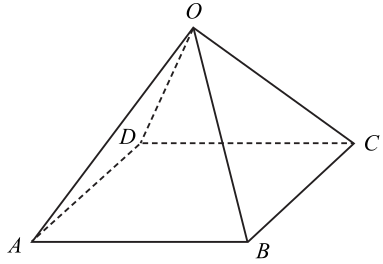
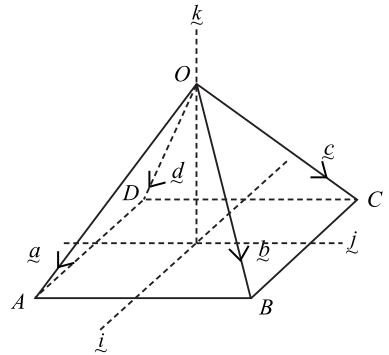
Let  `OABCD`  be a right square pyramid where  `underset ~a = vec(OA),\ underset ~b = vec(OB),\ underset ~c = vec(OC)`  and  `underset ~d = vec(OD)`.

Show that  `underset~a + underset~c = underset~b + underset~d`.   (3 marks)

--- 6 WORK AREA LINES (style=lined) ---

Show Answers Only

`text(See Worked Solution)`

Show Worked Solution

`text(Let)\ \ A=(p,–p,–k),`

`underset ~a` `= overset(->)(OA) = punderset~i – punderset~j – qunderset~k`
`underset ~b` `= overset(->)(OB) = punderset~i + punderset~j – qunderset~k`
`underset ~c` `= overset(->)(OC) = −punderset~i + punderset~j – qunderset~k`
`underset ~d` `= overset(->)(OA) = −punderset~i – punderset~j – qunderset~k`


`underset~a + underset~c` `= −2qunderset~k`
`underset ~b + underset ~d` `= −2qunderset~k`

 
`:. underset~a + underset~c = underset~b + underset~d`

Filed Under: Vectors and Geometry Tagged With: Band 4, smc-1210-20-Pyramid, smc-1210-70-3D problems

Vectors, EXT2 V1 SM-Bank 23

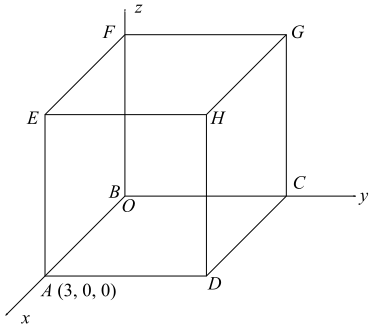
A cube with side length 3 units is pictured below.


  1. Calculate the magnitude of vector `vec(AG)`.  (1 mark)

    --- 3 WORK AREA LINES (style=lined) ---

  2. Find the acute angle between the diagonals `vec(AG)` and `vec(BH)`.  (3 marks)

    --- 7 WORK AREA LINES (style=lined) ---

Show Answers Only
  1. `3 sqrt 3\ text(units)`
  2. `70^@32′`
Show Worked Solution

i.   `A(3, 0 , 0), \ \ G(0, 3, 3)`

  `vec(AG)` `= ((0), (3), (3)) – ((3), (0), (0)) = ((text{−3}), (3), (3))`
  `|\ vec(AG)\ |` `= sqrt (9 + 9 + 9)`
    `= 3 sqrt 3\ text(units)`


ii.    `H (3, 3, 3)`
  `vec(BH) = ((3), (3), (3))`
`vec(AG) ⋅ vec(BH)` `= |\ vec(AG)\ | ⋅ |\ vec(BH)\ |\ cos theta`
`((text{−3}), (3), (3)) ⋅ ((3), (3), (3))` `= sqrt (9 + 9 + 9) ⋅ sqrt (9 + 9 + 9) cos theta`
`-9 + 9 + 9` `= 27 cos theta`
`cos theta` `= 1/3`
`theta` `= 70.52…`
  `= 70^@32′`

Filed Under: Vectors and Geometry Tagged With: Band 3, Band 4, smc-1210-10-Cube/Rect Prism, smc-1210-70-3D problems

Vectors, EXT2 V1 SM-Bank 22

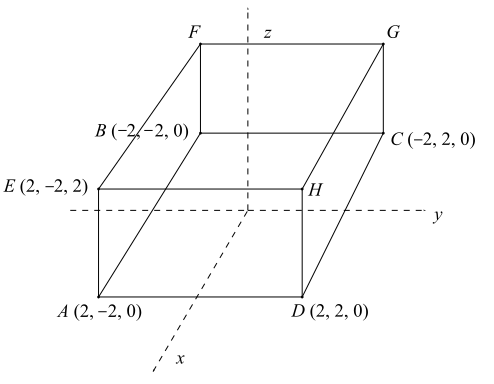
`ABCDEFGH` are the vertices of a rectangular prism.


  1. Show that the internal diagonals of the prism, `AG` and `DF`, intersect.  (2 marks)

    --- 4 WORK AREA LINES (style=lined) ---

  2. Calculate the acute angle, `theta`, between the diagonals, to the nearest minute.  (2 marks)

    --- 6 WORK AREA LINES (style=lined) ---

Show Answers Only
  1. `text(Proof)\ \ text{(See Worked Solutions)}`
  2. `83^@37′`
Show Worked Solution
i.    `A(2, text{−2}, 0),`   `G(text{−2}, 2, 2)`
  `D(2, 2, 0),`   `F (text{−2}, text{−2}, 2)`


`text(Midpoint)\ AG = ((1/2 (2 – 2)),(1/2 (text{−2} + 2)),(1/2 (0 + 2))) = ((0), (0), (1))`

`text(Midpoint)\ DF = ((1/2 (2 – 2)),(1/2 (2 – 2)),(1/2 (0 + 2))) = ((0), (0), (1))`
 

`text(S) text(ince midpoints are the same), AG and DF\ text(intersect.)`


ii.    `vec(AG) = ((text{−2}), (2), (2)) – ((2), (text{−2}), (0)) = ((text{−4}), (4), (2))`
  `vec(DF) = ((text{−2}), (text{−2}), (2)) – ((2), (2), (0)) = ((text{−4}), (text{−4}), (2))`


`vec (AG) ⋅ vec (DF) = |\ vec (AG)\ | ⋅ |\ vec(DF)\ |\  cos theta`

`((text{−4}), (4), (2)) ⋅ ((text{−4}), (text{−4}), (2)) = sqrt 36 sqrt 36 cos theta`

`16 – 16 + 4` `= 36 cos theta`
`cos theta` `= 1/9`
`theta` `= 83.62…`
  `= 83^@37′`

Filed Under: Vectors and Geometry Tagged With: Band 4, smc-1210-10-Cube/Rect Prism, smc-1210-70-3D problems

Copyright © 2014–2025 SmarterEd.com.au · Log in