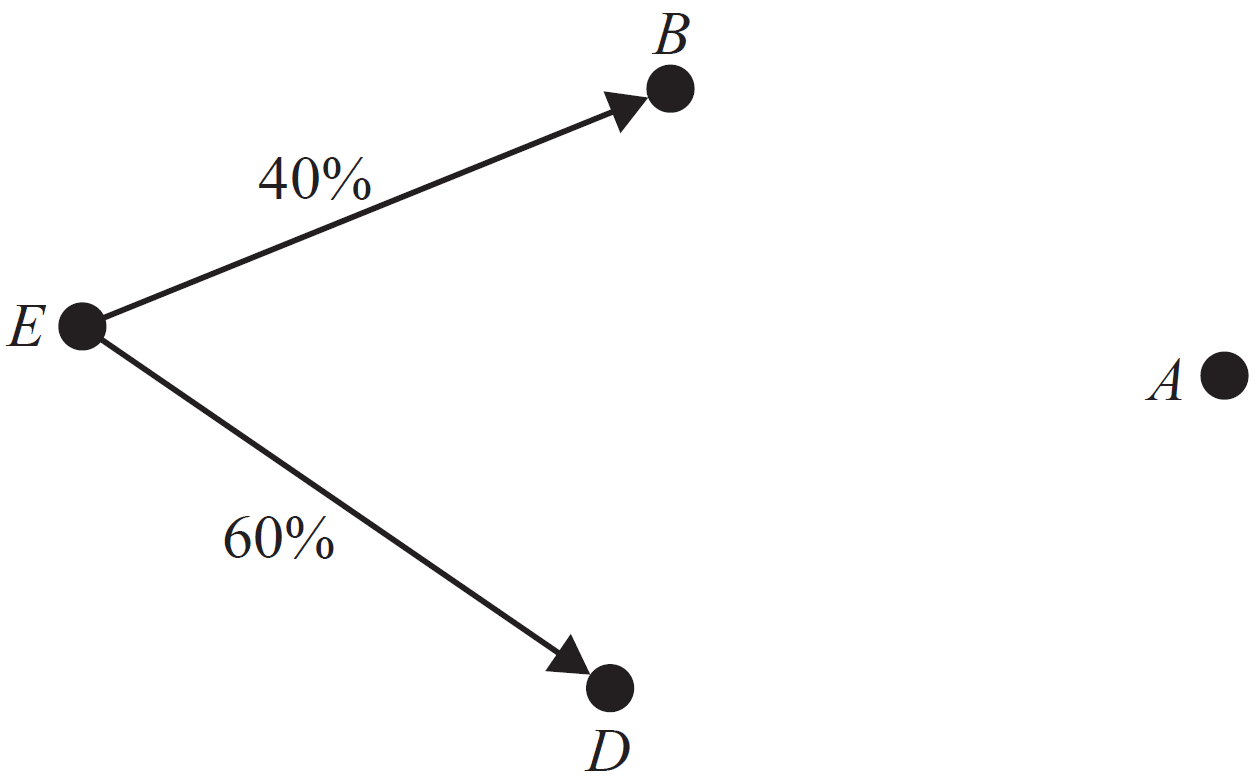
When the construction company established the construction site at the beginning of 2023, it employed 390 staff to work on the site. The staff comprised 330 construction workers \((C)\), 50 foremen \((F)\) and 10 managers \((M)\). At the beginning of each year, staff can choose to stay in the same job, move to a different job on the site, or leave the site \((L)\) and not return. The transition diagram below shows the proportion of staff who are expected to change their job at the site each year. This situation can be modelled by the recurrence relation \(S_{n+1}=T S_n\), where \(T\) is the transitional matrix, \(S_0=\left[\begin{array}{c}330 \\ 50 \\ 10 \\ 0\end{array}\right] \begin{aligned} & C \\ & F \\ & M \\ & L \end{aligned}\) and \(n\) is the number of years after 2023. --- 4 WORK AREA LINES (style=lined) --- --- 2 WORK AREA LINES (style=lined) --- To encourage more construction workers \((C)\) to stay, the construction company has given workers an incentive to move into the job of foreman \((F)\). Matrix \(R\) below shows the ways in which staff are expected to change their jobs from year to year with this new incentive in place. \begin{aligned} The site always requires at least 330 construction workers. To ensure that this happens, the company hires an additional 190 construction workers \((C)\) at the beginning of 2024 and each year thereafter. The matrix \(V_{n+1}\) will then be given by \(V_{n+1}=R V_n+Z\), where \(V_0=\left[\begin{array}{c}330 \\ 50 \\ 10 \\ 0\end{array}\right] \begin{aligned} & C \\ & F \\ & M \\ & L\end{aligned} \quad\quad\quad Z=\left[\begin{array}{c}190 \\ 0 \\ 0 \\ 0\end{array}\right] \begin{aligned} & C \\ & F \\ & M \\ & L\end{aligned} \ \ \) and \(n\) is the number of years after 2023. --- 4 WORK AREA LINES (style=lined) --- --- 4 WORK AREA LINES (style=lined) ---
& \quad \quad \ \ \textit{this year} \\
& \quad C \quad \ \ F \quad \ \ M \quad L\\
R = & \begin{bmatrix}
0.4 & 0.2 & 0 & 0 \\
0.4 & 0.2 & 0.4 & 0 \\
0 & 0.2 & 0.3 & 0 \\
0.2 & 0.4 & 0.3 & 1
\end{bmatrix}\begin{array}{l}
C\\
F\\
M\\
L
\end{array} \quad \textit{next year}
\end{aligned}
Matrices, GEN1 2024 VCAA 32 MC
A large sporting event is held over a period of four consecutive days: Thursday, Friday, Saturday and Sunday.
People can watch the event at four different sites throughout the city: Botanical Gardens \((G)\), City Square \((C)\), Riverbank \((R)\) or Main Beach \((M)\).
Let \(S_n\) be the state matrix that shows the number of people at each location \(n\) days after Thursday.
The expected number of people at each location can be determined by the matrix recurrence rule
\(S_{n+1}=TS_n+A\)
\begin{aligned}
& \quad \quad \quad \quad \quad \quad \quad \quad \quad \textit{this day} \\
& \quad \quad \quad \quad \quad \quad \quad \ G \quad \ \ C \quad \ \ R \quad \ \ M \\
& \text{where} \quad T=\begin{bmatrix}
0.4 & 0.2 & 0.4 & 0 \\
0.4 & 0.1 & 0.3 & 0.3 \\
0.1 & 0.4 & 0.1 & 0.2 \\
0.1 & 0.3 & 0.2 & 0.5
\end{bmatrix}\begin{array}{l}
G \\
C \\
R \\
M
\end{array} \text { next day } \quad \text{and}& A=\begin{bmatrix}
300 \\
200\\
100 \\
300
\end{bmatrix}\begin{array}{l}
G \\
C \\
R \\
M
\end{array}
\end{aligned}
\begin{aligned} \text{Given the state matrix}& \quad \quad S_3=\begin{bmatrix}
5620\\
6386\\
4892\\
6902
\end{bmatrix}\begin{array}{l}
G \\
C \\
R \\
M
\end{array}
\end{aligned}
the number of people watching the event at the Botanical Gardens \((G)\) from Thursday to Sunday has
- decreased by 162
- decreased by 212
- increased by 124
- increased by 696
MATRICES, FUR2 2021 VCAA 3
A market research study of shoppers showed that the buying preferences for the three olive oils, Carmani (`C`), Linelli (`L`) and Ohana (`O`), change from month to month according to the transition matrix `T` below.
`qquadqquadqquadqquad \ text(this month)`
`T = {:(qquad\ C quadquadqquad \ L quadquad \ O ),([(0.85,0.10, 0.05),(0.05,0.80,0.05),(0.10,0.10,0.90)]{:(C),(L),(O):} qquad text(next month)):}`
The initial state matrix `S_0` below shows the number of shoppers who bought each brand of olive oil in July 2021.
`S_0 = {:[(3200),(2000),(2800)]{:(C),(L),(O):} :}`
Let `S_n` represent the state matrix describing the number of shoppers buying each brand `n` months after July 2021.
- How many of these 8000 shoppers bought a different brand of olive oil in August 2021 from the brand bought in July 2021? (1 mark)
--- 3 WORK AREA LINES (style=lined) ---
- Using the rule `S_(n+1) = T xx S_(n)`, complete the matrix `S_1` below. (1 mark)
--- 0 WORK AREA LINES (style=lined) ---
`S_1 = {:[(3060),(text{_____}),(text{_____})]{:(C),(L),(O):} :}`
- Consider the shoppers who were expected to buy Carmani olive oil in August 2021.
- What percentage of these shoppers also bought Carmani olive oil in July 2021?
- Round your answer to the nearest percentage. (1 mark)
--- 3 WORK AREA LINES (style=lined) ---
- Write a calculation that shows Ohana olive oil is the brand bought by 50% of these shoppers in the long run. (1 mark)
--- 2 WORK AREA LINES (style=lined) ---
- Further research suggests more shoppers will buy olive oil in the coming months.
- A rule to model this situation is `R_(n+1) = T xx R_n + B`, where `R_n` represents the state matrix describing the number of shoppers `n` months after July 2021.
`qquadqquadqquadqquad \ text(this month)`
`T = {:(qquad\ C quadquadqquad \ L quadquad \ O ),([(0.85,0.10, 0.05),(0.05,0.80,0.05),(0.10,0.10,0.90)]{:(C),(L),(O):} ):} qquad text(next month) \ , \ B = {:[(200),(100),(k)]{:(C),(L),(O):} :}, \ R_0 = {:[(3200),(2000),(2800)]{:(C),(L),(O):} :}`
- `k` represents the extra number of shoppers expected to buy Ohana olive oil each month.
- If `R_2 = {:[(3333),(2025),(3642)]:}`, what is the value of `k`? (1 mark)
--- 4 WORK AREA LINES (style=lined) ---
MATRICES, FUR1 2021 VCAA 7 MC
The matrix `S_{n + 1}` is determined from the matrix `S_n` using the recurrence relation `S_{n + 1} = T xx S_n - C`, where
`T= [(0.6,0.1,0.3),(0.3,0.8,0.2),(0.1,0.1,0.5)] , qquad S_0 = [(21),(51),(31)], qquad S_1 = [(24.0),(54.3),(20.7)] `
and `C` is a column matrix.
Matrix `S_2` is equal to
| A. `[(23.04),(55.78),(16.18)]` | B. `[(25.34),(56.28),(17.38)]` | |
| C. `[(26.04),(54.78),(18.18)]` | D. `[(28.34),(55.28),(19.38)]` | |
| E. `[(29.04),(53.78),(20.18)]` |
MATRICES, FUR2 2020 VCAA 4
A second market research project also suggested that if the Westmall shopping centre were sold, each of the three centres (Westmall, Grandmall and Eastmall) would continue to have regular shoppers but would attract and lose shoppers on a weekly basis.
Let `R_n` be the state matrix that shows the expected number of shoppers at each of the three centres `n` weeks after Westmall is sold.
A matrix recurrence relation that generates values of `R_n` is
`R_(n+1) = TR_n + B`
`{:(quad qquad qquad qquad qquad qquad qquad qquad text(this week)),(qquad qquad qquad qquad qquad qquad quad \ W qquad quad G qquad quad \ E),(text(where)\ T = [(quad 0.78, 0.13, 0.10),(quad 0.12, 0.82, 0.10),(quad 0.10, 0.05, 0.80)]{:(W),(G),(E):}\ text(next week,) qquad qquad B = [(-400), (700), (500)]{:(W),(G),(E):}):}`
The matrix `R_2` is the state matrix that shows the expected number of shoppers at each of the three centres in the second week after Westmall is sold
`R_2 = [(239\ 060), (250\ 840), (192\ 900)]{:(W),(G),(E):}`
- Determine the expected number of shoppers at Westmall in the third week after it is sold. (1 mark)
--- 3 WORK AREA LINES (style=lined) ---
- Determine the expected number of shoppers at Westmall in the first week after it is sold. (1 mark)
--- 3 WORK AREA LINES (style=lined) ---
MATRICES, FUR2-NHT 2019 VCAA 4
After 5.00 pm, tourists will start to arrive in Gillen and they will stay overnight.
As a result, the number of people in Gillen will increase and the television viewing habits of the tourists will also be monitored.
Assume that 50 tourists arrive every hour.
It is expected that 80% of arriving tourists will watch only `C_2` during the hour that they arrive.
The remaining 20% of arriving tourists will not watch television during the hour that they arrive.
Let `W_m` be the state matrix that shows the number of people in each category `m` hours after 5.00 pm on this day.
The recurrence relation that models the change in the television viewing habits of this increasing number of people in Gillen `m` hours after 5.00 pm on this day is shown below.
`W_(m + 1) = TW_m + V`
where
`{:(quad qquad qquad qquadqquadqquadquadtext(this hour)),(qquadqquadqquad quad \ C_1 qquad quad C_2 qquad \ C_3 quad \ NoTV),(T = [(quad 0.50, 0.05, 0.10, 0.20 quad),(quad 0.10, 0.60, 0.20, 0.20 quad),(quad 0.25, 0.10, 0.50, 0.10 quad),(quad 0.15, 0.25, 0.20, 0.50 quad)]{:(C_1),(C_2),(C_3),(NoTV):}\ text(next hour,) qquad and qquad W_0 = [(400), (600), (300),(700)]):}`
- Write down matrix `V`. (1 mark)
--- 3 WORK AREA LINES (style=lined) ---
- How many people in Gillen are expected to watch `C_2` at 7.00 pm on this day? (2 marks)
--- 5 WORK AREA LINES (style=lined) ---
MATRICES, FUR2 2019 VCAA 3
On Sunday, matrix `V` is used when calculating the expected number of visitors at each location every hour after 10 am. It is assumed that the park will be at its capacity of 2000 visitors for all of Sunday.
Let `L_0` be the state matrix that shows the number of visitors at each location at 10 am on Sunday.
The number of visitors expected at each location at 11 am on Sunday can be determined by the matrix product
`{:(qquadqquadqquadqquadqquadqquadqquadqquadqquadqquadqquadqquadqquadqquadqquadqquadqquadqquadqquadqquadqquadqquadqquadqquad text(this hour)),(qquadqquadqquadqquadqquadqquadqquadqquadqquadqquadqquadqquadqquadqquadqquadqquadqquadqquadqquad qquad qquad \ A qquad quad F qquad \ G \ quad quad W),({:V xx L_0 qquad text(where) qquad L_0 = [(500), (600), (500), (400)]{:(A),(F),(G),(W):}, qquad text(and):} qquad V = [(0.3,0.4,0.6,0.3),(0.1,0.2,0.1,0.2),(0.1,0.2,0.2,0.1),(0.5,0.2,0.1,0.4)]{:(A),(F),(G),(W):}\ text(next hour)):}`
- Safety restrictions require that all four locations have a maximum of 600 visitors.
- Which location is expected to have more than 600 visitors at 11 am on Sunday? (1 mark)
--- 3 WORK AREA LINES (style=lined) ---
- Whenever more than 600 visitors are expected to be at a location on Sunday, the first 600 visitors can stay at that location and all others will be moved directly to Ground World `(G)`.
- State matrix `R_n` contains the number of visitors at each location `n` hours after 10 am on Sunday, after the safety restrictions have been enforced.
- Matrix `R_1` can be determined from the matrix recurrence relation
- `qquad qquad qquad R_0 = [(500),(600),(500),(400)]{:(A),(F),(G),(W):}, qquad qquad R_1 = V xx R_0 + B_1`
- where matrix `B_1` shows the required movement of visitors at 11 am.
-
- Determine the matrix `B_1`. (1 mark)
--- 4 WORK AREA LINES (style=lined) ---
- State matrix `R_2` can be determined from the new matrix rule
- `qquad qquad R_2 = VR_1 + B_2`
- where matrix `B_2` shows the required movement of visitors at 12 noon.
- Determine the state matrix `R_2`. (1 mark)
--- 3 WORK AREA LINES (style=lined) ---
- Determine the matrix `B_1`. (1 mark)
MATRICES, FUR1 2018 VCAA 7 MC
A study of the antelope population in a wildlife park has shown that antelope regularly move between three locations, east (`E`), north (`N`) and west (`W`).
Let `A_n` be the state matrix that shows the population of antelope in each location `n` months after the study began.
The expected population of antelope in each location can be determined by the matrix recurrence rule
`A_(n + 1) = T A_n - D`
where
`{:(),(),(T=):}{:(qquadquadtext(this month)),((qquadE,quadN,quadW)),([(0.4,0.2,0.2),(0.3,0.6,0.3),(0.3,0.2,0.5)]):}{:(),(),({:(E),(N),(W):}):}{:(),(),(text(next month)):}`
and
`D = [(50),(50),(50)]{:(E),(N),(W):}`
The state matrix, `A_3`, below shows the population of antelope three months after the study began.
`A_3 = [(1616),(2800),(2134)]{:(E),(N),(W):}`
The number of antelope in the west (`W`) location two months after the study began, as found in the state matrix `A_2`, is closest to
- 2060
- 2130
- 2200
- 2240
- 2270
MATRICES, FUR2 2018 VCAA 4
Beginning in the year 2021, a new company takes over the maintenance of the 2700 km highway with a new contract.
Each year sections of highway must be graded `(G)`, resurfaced `(R)` or sealed `(S)`.
The remaining highway will need no maintenance `(N)` that year.
Let `M_n` be the state matrix that shows the highway maintenance schedule of this company for the `n`th year after 2020.
The maintenance schedule for 2020 is shown in matrix `M_0` below.
For these 2700 km of highway, the matrix recurrence relation shown below can be used to determine the number of kilometres of this highway that will require each type of maintenance from year to year.
`qquad qquad M_(n + 1) = TM_n + B`
where
| `{:(\ \ qquad qquad qquad qquad quad text(this year)),(qquad qquad quad quad G qquad quad R qquad quad S quad quad \ N):}` | ||
| `M_0 = [(500),(400),(300),(1500)]{:(G),(R),(S),(N):}text (,)` | `T = [(0.2,0.1,0.0,0.2),(0.1,0.1,0.0,0.2),(0.2,0.1,0.2,0.1),(0.5, 0.7,0.8,0.5)]{:(G),(R),(S),(N):} \ text(next year,)` | `B = [(k),(20),(10),(-60)]` |
- Write down the value of `k` in matrix `B`. (1 mark)
--- 2 WORK AREA LINES (style=lined) ---
- How many kilometres of highway are expected to be graded `(G)` in the year 2022? (1 mark)
--- 3 WORK AREA LINES (style=lined) ---
MATRICES, FUR1 2017 VCAA 7 MC
At a fish farm:
-
- young fish (`Y`) may eventually grow into juveniles (`J`) or they may die (`D`)
- juveniles (`J`) may eventually grow into adults (`A`) or they may die (`D`)
- adults (`A`) eventually die (`D`).
The initial state of this population, `F_0`, is shown below.
`F_0 = [(50\ 000),(10\ 000),(7000),(0)]{:(Y),(J),(A),(D):}`
Every month, fish are either sold or bought so that the number of young, juvenile and adult fish in the farm remains constant.
The population of fish in the fish farm after `n` months, `F_n`, can be determined by the recurrence rule
`F_(n + 1) = [(0.65,0,0,0),(0.25,0.75,0,0),(0,0.20,0.95,0),(0.10,0.05,0.05,1)]\ F_n + B`
where `B` is a column matrix that shows the number of young, juvenile and adult fish bought or sold each month and the number of dead fish that are removed.
Each month, the fish farm will
- sell 1650 adult fish.
- buy 1750 adult fish.
- sell 17 500 young fish.
- buy 50 000 young fish.
- buy 10 000 juvenile fish.
MATRICES, FUR2 2016 VCAA 3
A travel company is studying the choice between air (`A`), land (`L`), sea (`S`) or no (`N`) travel by some of its customers each year.
Matrix `T`, shown below, contains the percentages of customers who are expected to change their choice of travel from year to year.
`{:(qquadqquadqquadqquadqquadquadtext(this year)),(qquadqquadqquadquadAqquadqquadLqquadqquadSqquadquadN),(T = [(0.65,0.25,0.25,0.50),(0.15,0.60,0.20,0.15),(0.05,0.10,0.25,0.20),(0.15,0.05,0.30,0.15)]{:(A),(L),(S),(N):}text(next year)):}`
Let `S_n` be the matrix that shows the number of customers who choose each type of travel `n` years after 2014.
Matrix `S_0` below shows the number of customers who chose each type of travel in 2014.
`S_0 = [(520),(320),(80),(80)]{:(A),(L),(S),(N):}`
Matrix `S_1` below shows the number of customers who chose each type of travel in 2015.
`S_1 = TS_0 = [(478),(d),(e),(f)]{:(A),(L),(S),(N):}`
- Find the values missing from matrix `S_1 (d, e, f )`. (1 mark)
--- 2 WORK AREA LINES (style=lined) ---
- Write a calculation that shows that 478 customers were expected to choose air travel in 2015. (1 mark)
--- 2 WORK AREA LINES (style=lined) ---
- Consider the customers who chose sea travel in 2014.
- How many of these customers were expected to choose sea travel in 2015? (1 mark)
--- 3 WORK AREA LINES (style=lined) ---
- Consider the customers who were expected to choose air travel in 2015.
- What percentage of these customers had also chosen air travel in 2014?
- Round your answer to the nearest whole number. (1 mark)
--- 4 WORK AREA LINES (style=lined) ---
In 2016, the number of customers studied was increased to 1360.
Matrix `R_2016`, shown below, contains the number of these customers who chose each type of travel in 2016.
`R_2016 = [(646),(465),(164),(85)]{:(A),(L),(S),(N):}`
- The company intends to increase the number of customers in the study in 2017 and in 2018.
- The matrix that contains the number of customers who are expected to choose each type of travel in 2017 (`R_2017`) and 2018 (`R_2018`) can be determined using the matrix equations shown below.
`R_2017 = TR_2016 + BqquadqquadqquadR_2018 = TR_2017 + B`
`{:(qquadqquadqquadqquadqquadquadtext(this year)),(qquadqquadqquadquadAqquadqquadLqquadqquadSqquadquadN),(T = [(0.65,0.25,0.25,0.50),(0.15,0.60,0.20,0.15),(0.05,0.10,0.25,0.20),(0.15,0.05,0.30,0.15)]{:(A),(L),(S),(N):}text(next year)):}qquadqquad{:(),(),(B = [(80),(80),(40),(−80)]{:(A),(L),(S),(N):}):}`
-
- The element in the fourth row of matrix `B` is – 80.
- Explain this number in the context of selecting customers for the studies in 2017 and 2018. (1 mark)
--- 2 WORK AREA LINES (style=lined) ---
- Determine the number of customers who are expected to choose sea travel in 2018.
- Round your answer to the nearest whole number. (2 marks)
--- 5 WORK AREA LINES (style=lined) ---
MATRICES, FUR2 2007 VCAA 2
To study the life-and-death cycle of an insect population, a number of insect eggs (`E`), juvenile insects (`J`) and adult insects (`A`) are placed in a closed environment. The initial state of this population can be described by the column matrix `S_0 = [(400),(200),(100),(0)]{:(E),(J),(A),(D):}` A row has been included in the state matrix to allow for insects and eggs that die (`D`). --- 1 WORK AREA LINES (style=lined) --- In this population In this population, the adult insects have been sterilised so that no new eggs are produced. In these circumstances, the life-and-death cycle of the insects can be modelled by the transition matrix `{:(qquadqquadqquadqquadquadtext(this week)),((qquadqquadqquadE,quad\ J,quadA,\ D)),(T = [(0.4,0,0,0),(0.5,0.4,0,0),(0,0.5,0.8,0),(0.1,0.1,0.2,1)]{:(E),(J),(A),(D):}):}` --- 1 WORK AREA LINES (style=lined) --- --- 1 WORK AREA LINES (style=lined) --- --- 3 WORK AREA LINES (style=lined) --- --- 1 WORK AREA LINES (style=lined) --- --- 4 WORK AREA LINES (style=lined) --- --- 3 WORK AREA LINES (style=lined) --- --- 3 WORK AREA LINES (style=lined) --- --- 3 WORK AREA LINES (style=lined) ---
MATRICES, FUR2 2009 VCAA 4
A series of extra rehearsals commenced in April. Each week participants could choose extra dancing rehearsals or extra singing rehearsals.
A matrix equation used to determine the number of students expected to attend these extra rehearsals is given by
`L_(n + 1) = [(0.85,0.25),(0.15,0.75)] xx L_n-[(5),(7)]`
where `L_n` is the column matrix that lists the number of students attending in week `n`.
The attendance matrix for the first week of extra rehearsals is given by
`L_1 = [(95),(97)]{:(text(dancing)),(text(singing)):}`
- Calculate the number of students who are expected to attend the extra singing rehearsals in week 3. (1 mark)
--- 3 WORK AREA LINES (style=lined) ---
- Of the students who attended extra rehearsals in week 3, how many are not expected to return for any extra rehearsals in week 4? (1 mark)
--- 3 WORK AREA LINES (style=lined) ---
MATRICES, FUR2 2013 VCAA 2
10 000 trout eggs, 1000 baby trout and 800 adult trout are placed in a pond to establish a trout population.
In establishing this population
-
- eggs (`E`) may die (`D`) or they may live and eventually become baby trout (`B`)
- baby trout (`B`) may die (`D`) or they may live and eventually become adult trout (`A`)
- adult trout (`A`) may die (`D`) or they may live for a period of time but will eventually die.
From year to year, this situation can be represented by the transition matrix `T`, where
`{:(qquadqquadqquadqquadqquadtext(this year)),((qquadqquadqquadE,quad\ B,quad\ A,\ D)),(T = [(0,0,0,0),(0.4,0,0,0),(0,0.25,0.5,0),(0.6,0.75,0.5,1)]):}{:(),(),(E),(B),(A),(D):}{:(),(),(qquadtext(next year)):}`
- Use the information in the transition matrix `T` to
The initial state matrix for this trout population, `S_0`, can be written as
`S_0 = [(10\ 000),(1000),(800),(0)]{:(E),(B),(A),(D):}`
Let `S_n` represent the state matrix describing the trout population after `n` years.
- Using the rule `S_n = T S_(n-1)`, determine each of the following.
- `S_1` (1 mark)
--- 3 WORK AREA LINES (style=lined) ---
- the number of adult trout predicted to be in the population after four years (1 mark)
--- 3 WORK AREA LINES (style=lined) ---
- `S_1` (1 mark)
- The transition matrix `T` predicts that, in the long term, all of the eggs, baby trout and adult trout will die.
- How many years will it take for all of the adult trout to die (that is, when the number of adult trout in the population is first predicted to be less than one)? (1 mark)
--- 2 WORK AREA LINES (style=lined) ---
- What is the largest number of adult trout that is predicted to be in the pond in any one year? (1 mark)
--- 3 WORK AREA LINES (style=lined) ---
- How many years will it take for all of the adult trout to die (that is, when the number of adult trout in the population is first predicted to be less than one)? (1 mark)
- Determine the number of eggs, baby trout and adult trout that, if added to or removed from the pond at the end of each year, will ensure that the number of eggs, baby trout and adult trout in the population remains constant from year to year. (2 marks)
--- 4 WORK AREA LINES (style=lined) ---
The rule `S_n = T S_(n – 1)` that was used to describe the development of the trout in this pond does not take into account new eggs added to the population when the adult trout begin to breed.
- To take breeding into account, assume that 50% of the adult trout lay 500 eggs each year.
- The matrix describing the population after one year, `S_1`, is now given by the new rule
- `S_1 = T S_0 + 500\ M\ S_0`
- where `T=[(0,0,0,0),(0.40,0,0,0),(0,0.25,0.50,0),(0.60,0.75,0.50,1.0)], M=[(0,0,0.50,0),(0,0,0,0),(0,0,0,0),(0,0,0,0)]\ text(and)\ S_0=[(10\ 000),(1000),(800),(0)]`
- Use this new rule to determine `S_1`. (1 mark)
--- 4 WORK AREA LINES (style=lined) ---
- Use this new rule to determine `S_1`. (1 mark)
- This pattern continues so that the matrix describing the population after `n` years, `S_n`, is given by the rule
- `S_n = T\ S_(n-1) + 500\ M\ S_(n-1)`
- Use this rule to determine the number of eggs in the population after two years (2 marks)
--- 6 WORK AREA LINES (style=lined) ---
- Use this rule to determine the number of eggs in the population after two years (2 marks)
MATRICES, FUR1 2013 VCAA 8 MC
The matrix `S_(n+1)` is determined from the matrix `S_n` using the rule `S_(n+1) = TS_n - C,` where `T, S_0` and `C` are defined as follows.
`T = [(0.5, 0.6), (0.5,0.4)], \ S_0 = [(100), (250)] quad text(and) quad C = [(20), (20)]`
Given this information, the matrix `S_2` equals
A. `[(100), (250)]`
B. `[(148), (122)]`
C. `[(170), (140)]`
D. `[(180), (130)]`
E. `[(190), (160)]`

