SmarterEd

Aussie Maths & Science Teachers: Save your time with SmarterEd

  • Login
  • Get Help
  • About

Data Analysis, GEN2 2024 NHT 5

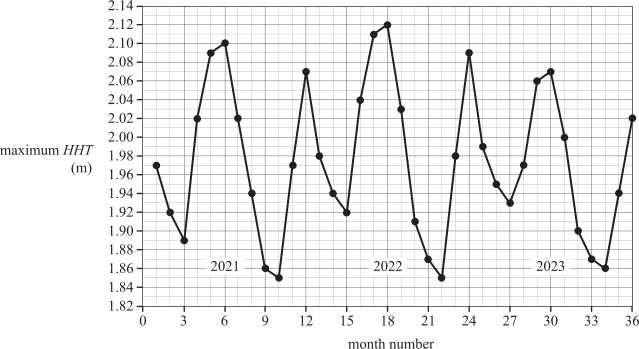
The height, in metres, of the maximum highest high tides \((HHT)\) for Sydney Harbour change from month to month during the year. This is shown in the time series plot below for the years 2021, 2022 and 2023.

In this graph, month number 1 is January 2021, month number 2 is February 2021, and so on.
 

The average height, in metres, of the maximum \(H H T\) for each year, rounded to two decimal places, is given in the table below.

Table 5

\begin{array}{|l|c|c|c|}
\hline
\rule{0pt}{2.5ex}\text{Year} \rule[-1ex]{0pt}{0pt}&\ \ \ \ 2021\ \ \ \  &\ \ \ \ 2022\ \ \ \ &\ \ \ \ 2023\ \ \ \ \\
\hline
\rule{0pt}{2.5ex}\text{Average height of the} &1.98 &1.99&1.96\\
\rule[-1ex]{0pt}{0pt} \text{maximum \(HTT\) (m)}\\
\hline
\end{array}

The three years of data shown in this graph and in Table 5 will be used to calculate seasonal indices.

Determine the seasonal index for March.

Round your answer to two decimal places.    (2 marks)

--- 5 WORK AREA LINES (style=lined) ---
Show Answers Only

\(0.97\)

Show Worked Solution

\(\text{March index (2021)}\ = \dfrac{1.89}{1.98}\)

\(\text{March index (2022)}\ = \dfrac{1.92}{1.99}\)

\(\text{March index (2023)}\ = \dfrac{1.93}{1.96}\)

\(\therefore\ \text{Seasonal index (Mar)}\ = \left( \dfrac{1.89}{1.98}+\dfrac{1.92}{1.99}+\dfrac{1.93}{1.96}\right)\ ÷\ 3= 0.97\ \text{(2 d.p.)}\)

Filed Under: Time Series Tagged With: Band 5, smc-266-10-Seasonal Index from a Table

Data Analysis, GEN1 2024 NHT 16 MC

Seasonal indices for visitor numbers to a theme park in a particular year are given in the table below. The seasonal index for summer is not given.

\begin{array}{|l|c|c|c|c|}
\hline
\rule{0pt}{2.5ex} \textbf{Season} \rule[-1ex]{0pt}{0pt}& \text{ Spring } & \text{Summer} & \text{Autumn} & \text{ Winter } \\
\hline
\rule{0pt}{2.5ex}\textbf{Seasonal index} \rule[-1ex]{0pt}{0pt}& 0.85 & & 0.96 & 0.45 \\
\hline
\end{array}

In this particular year, 33 120 visitors attended during summer.

The total annual attendance for this particular year is closest to

  1. 73 960
  2. 74 520
  3. 75 820
  4. 76 140
  5. 77 380
Show Answers Only

\(D\)

Show Worked Solution

\(\text{Summer index}\ =4-(0.85+0.96+0.45)=1.74\)

\(\dfrac{33\,120}{\text{Average}}\) \(=1.74\)  
\(\text{Average}\) \(=\dfrac{33\,120}{1.74}\)  
  \(=19\,034.48…\)  

 
\(\text{Total annual attendance}\ = 4 \times 19\,034\approx 76\,140\)

\(\Rightarrow D\)

Filed Under: Time Series Tagged With: Band 5, smc-266-10-Seasonal Index from a Table

Data Analysis, GEN1 2024 VCAA 16 MC

The table below shows the seasonal indices for the monthly takings of a bistro.

The seasonal indices for months 3 and 6 are missing.

\begin{array}{|l|c|c|c|c|c|c|c|c|c|c|c|c|}
\hline
\rule{0pt}{2.5ex} \textbf{Month} \rule[-1ex]{0pt}{0pt}& 1 & 2 & \ \ 3\ \ & 4 & 5 & \ \ 6 \ \ & 7 & 8 & 9 & 10 & 11 & 12 \\
\hline
\rule{0pt}{2.5ex}\textbf{Seasonal}& 1.08 & 1.13 & & 0.92 & 0.67 & & 1.09 & 1.35 & 0.82 & 0.88 & 1.01 & 0.98 \\
\textbf{index} \\
\hline
\end{array}

The seasonal index for month 3 is twice the seasonal index for month 6 .

The seasonal index for month 3 is closest to

  1. 0.69
  2. 1.04
  3. 1.38
  4. 2.07
Show Answers Only

\(C\)

Show Worked Solution

\(\text{Let}\ x=\text{seasonal index for month 6}\)

\(\rightarrow 2x=\text{seasonal index for month 3}\)
  

\(\dfrac{3x+1.08+1.13+0.92+0.67+1.09+1.35+0.82+0.88+1.01+0.98}{12}=1\)

\(3x+9.93\) \(=12\)  
\(x\) \(=\dfrac{12-9.93}{3}\)  
  \(=0.69\)  

 
\(\therefore\ \text{Seasonal Index month 3}\ =2\times 0.69=1.38\)

\(\Rightarrow C\)

Mean mark 58%.

Filed Under: Time Series Tagged With: Band 4, smc-266-10-Seasonal Index from a Table

Data Analysis, GEN2 2023 VCAA 4

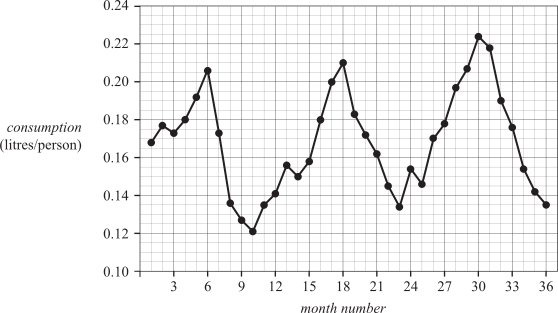
The time series plot below shows the average monthly ice cream consumption recorded over three years, from January 2010 to December 2012.

The data for the graph was recorded in the Northern Hemisphere.

In this graph, month number 1 is January 2010, month number 2 is February 2010 and so on.
 

  1. Identify a feature of this plot that is consistent with this time series having a seasonal component.  (1 mark)

    --- 3 WORK AREA LINES (style=lined) ---
  2. The long-term seasonal index for April is 1.05
  3. Determine the deseasonalised value for average monthly ice cream consumption in April 2010 (month 4).
  4. Round your answer to two decimal places.  (1 mark)

    --- 2 WORK AREA LINES (style=lined) ---

  5. The table below shows the average monthly ice cream consumption for 2011 . 
Consumption (litres/person)
Year Jan Feb Mar Apr May Jun Jul Aug Sept Oct Nov Dec
2011 0.156 0.150 0.158 0.180 0.200 0.210 0.183 0.172 0.162 0.145 0.134 0.154
  1. Show that, when rounded to two decimal places, the seasonal index for July 2011 estimated from this data is 1.10.  (2 marks)

    --- 5 WORK AREA LINES (style=lined) ---
Show Answers Only

a.    \(\text{Maximum values are 12 months apart.}\)

b.    \(\text{Deseasonalised (Apr)}\ = \dfrac{0.180}{1.05} = 0.1714… = 0.17\ \text{(2 d.p.)}\)

c.    \(\text{2011 monthly mean}\ =\dfrac{2.004}{12}=0.167\)
 

\(\text{Seasonal index (July)}\) \(=\dfrac{0.183}{0.167}\)  
  \(=1.095…\)  
  \(=1.10\ \text{(2 d.p.)}\)  
Show Worked Solution
a.    \(\text{Maximum values are 12 months apart.}\)
♦♦♦ Mean mark (a) 26%.

 
b.
    \(\text{Deseasonalised (Apr)}\ = \dfrac{0.180}{1.05} = 0.1714… = 0.17\ \text{(2 d.p.)}\)

 
c.
    \(\text{2011 monthly mean}\)

\(=(0.156+0.15+0.158+0.18+0.2+0.21+0.183+0.172+\)

\(0.162+0.145+0.134+0.154)\ ÷\ 12 \)

\(=\dfrac{2.004}{12}\)

\(=0.167\)
 

\(\text{Seasonal index (July)}\) \(=\dfrac{0.183}{0.167}\)  
  \(=1.095…\)  
  \(=1.10\ \text{(2 d.p.)}\)  
♦♦ Mean mark (c) 36%.

Filed Under: Time Series Tagged With: Band 4, Band 5, smc-266-10-Seasonal Index from a Table, smc-266-20-(De)Seasonalising Data, smc-266-40-Time Series Trends

CORE, FUR1 2021 VCAA 15 MC

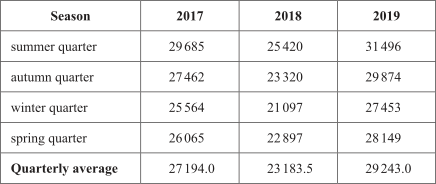
The table below shows the number of visitors to an art gallery during the summer, autumn, winter and spring quarters for the years 2017 to 2019.

The quarterly average is also shown for each of these years.


The seasonal index for summer is closest to

  1. 1.077
  2. 1.081
  3. 1.088
  4. 1.092
  5. 1.096
Show Answers Only

`C`

Show Worked Solution

`text{Find summer seasonal proportion for each year:}`

`2017 \ : \ (29\ 685)/(27\ 194) = 1.09160 …`

`2018 \ : \ (25\ 420)/(23\ 183.5) = 1.09646 …`

`2019 \ : \ (31\ 496)/(29\ 243) = 1.07704 …`
 

`text{Seasonal index for summer}`

`= {1.09160 + 1.09646 + 1.07704}/{3}`

`= 1.0883`
 

`=> C`

Filed Under: Time Series Tagged With: Band 4, smc-266-10-Seasonal Index from a Table

CORE, FUR1 2020 VCAA 15-16 MC

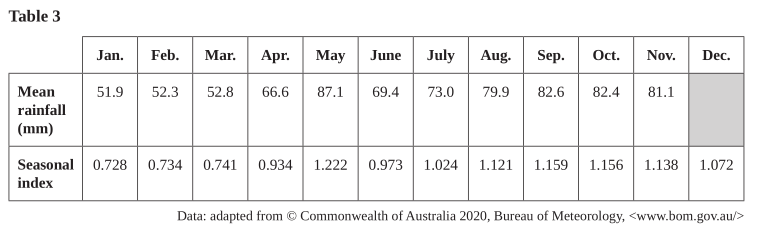
Table 3 below shows the long-term mean rainfall, in millimetres, recorded at a weather station, and the associated long-term seasonal indices for each month of the year.

The long-term mean rainfall for December is missing.


Part 1

To correct the rainfall in March for seasonality, the actual rainfall should be, to the nearest per cent

  1. decreased by 26%
  2. increased by 26%
  3. decreased by 35%
  4. increased by 35%
  5. increased by 74%

 
Part 2

The long-term mean rainfall for December is closest to

  1. 64.7 mm
  2. 65.1 mm
  3. 71.3 mm
  4. 76.4 mm
  5. 82.0 mm
Show Answers Only

`text(Part 1:)\ C`

`text(Part 2:)\ D`

Show Worked Solution

Part 1

`text(Deseasonalised rainfall for March)`

`= 52.8/0.741`

`= 71.255`

`:.\ text(Percentage increase)` `= (71.255 – 52.8)/() xx 100`
  `~~ 35%`

`=> D`
 

Part 2

`text(Mean) = 51.9/0.728 = 71.3`

`text(Actual December)` `= 71.3 xx 1.072`
  `~~ 76.4\ text(mm)`

`=> D`

Filed Under: Time Series Tagged With: Band 4, Band 5, smc-266-10-Seasonal Index from a Table, smc-266-20-(De)Seasonalising Data

Data Analysis, GEN1 2019 NHT 15 MC

The table below shows the long-term monthly average heating cost, in dollars, for a small office.

The seasonal index for April is closest to

  1.  0.80
  2.  0.87
  3.  0.96
  4.  1.25
  5.  1.56
Show Answers Only

`B`

Show Worked Solution

`text(Average cost per month = 125)`

`text{S.I. (April)}` `= 109/125`
  `= 0.872`

 
`=>\ B`

Filed Under: Time Series Tagged With: Band 4, smc-266-10-Seasonal Index from a Table

CORE, FUR2 2019 VCAA 6

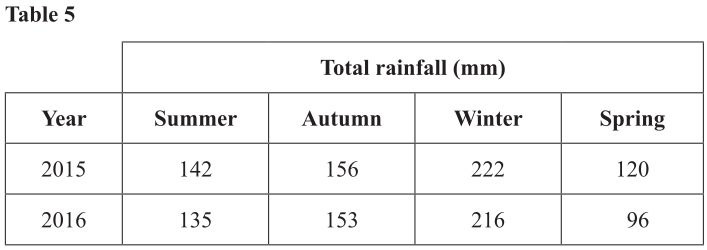
The total rainfall, in millimetres, for each of the four seasons in 2015 and 2016 is shown in Table 5 below.

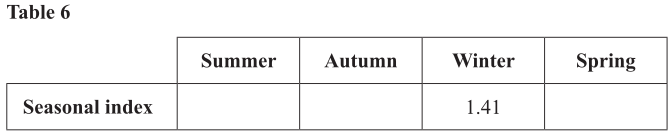
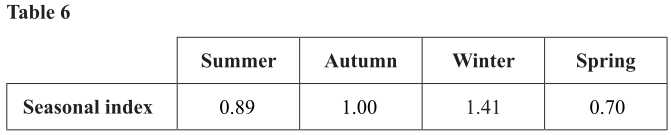
  1. The seasonal index for winter is shown in Table 6 below.


    Use the values in Table 5 to find the seasonal indices for summer, autumn and spring.

  2. Write your answers in Table 6, rounded to two decimal places.   (2 marks)

    --- 4 WORK AREA LINES (style=lined) ---


  3. The total rainfall for each of the four seasons in 2017 is shown in Table 7 below.


    Use the appropriate seasonal index from Table 6 to deseasonalise the total rainfall for winter in 2017.


    Round your answer to the nearest whole number.   (1 mark)

    --- 2 WORK AREA LINES (style=lined) ---

Show Answers Only
  1. `text(See Worked Solutions)`
  2. `186\ text(mm)`
Show Worked Solution
a.  

`text{Average rainfall (2015)}\ = (142 + 156 + 222 + 120)/4 = 160`

`text{Average rainfall (2016)}\ = (135 + 153 + 216 + 96)/4= 150`

`text{SI (Summer)}` `= 1/2 (142/160 + 135/150)=0.89`
`text{SI (Autumn)}` `= 1/2(156/160 + 153/150)=1.00`
`text{SI (Spring)}` `= 1/2 (120/160 + 96/150)=0.70`


b.   `text{Winter (deseasonalised)}` `= 262/1.41`
    `~~ 186\ text(mm)`

Filed Under: Time Series Tagged With: Band 4, Band 5, smc-266-10-Seasonal Index from a Table, smc-266-20-(De)Seasonalising Data

CORE, FUR1 2018 VCAA 16 MC

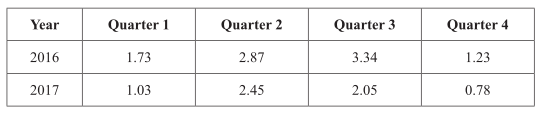
The quarterly sales figures for a large suburban garden centre, in millions of dollars, for 2016 and 2017 are displayed in the table below.

Using these sales figures, the seasonal index for Quarter 3 is closest to

  1.  1.28
  2.  1.30
  3.  1.38
  4.  1.46
  5.  1.48
Show Answers Only

`C`

Show Worked Solution

`text{Quarterly average (2016)}`

Mean mark 51%.

`= (1.73 + 2.87 + 3.34 + 1.23) ÷ 4`

`= 2.2925`

`text{Quarterly average (2017)}`

`= (1.03 + 2.45 + 2.05 + 0.78) ÷ 4`

`= 1.5775`

`:.\ text{Seasonal Index (Q3)}` `= (3.34/2.2925 + 2.05/1.5775)-: 2`
  `= 1.3782…`

`=> C`

Filed Under: Time Series Tagged With: Band 4, smc-266-10-Seasonal Index from a Table

CORE, FUR1 2016 VCAA 14-16 MC

The table below shows the long-term average of the number of meals served each day at a restaurant. Also shown is the daily seasonal index for Monday through to Friday.


Part 1

The seasonal index for Wednesday is 0.84

This tells us that, on average, the number of meals served on a Wednesday is

  1. 16% less than the daily average.
  2. 84% less than the daily average.
  3. the same as the daily average.
  4. 16% more than the daily average.
  5. 84% more than the daily average.


Part 2

Last Tuesday, 108 meals were served in the restaurant.

The deseasonalised number of meals served last Tuesday was closest to

  1.   `93`
  2. `100`
  3. `110`
  4. `131`
  5. `152`


Part 3

The seasonal index for Saturday is closest to

  1. `1.22`
  2. `1.31`
  3. `1.38`
  4. `1.45`
  5. `1.49`
Show Answers Only

`text(Part 1:)\ A`

`text(Part 2:)\ E`

`text(Part 3:)\ D`

Show Worked Solution

`text(Part 1)`

`1 – 0.84 = 0.16`

`:.\ text(A seasonal index of 0.84 tell us)`

`text(16% less meals are served.)`

`=> A`


`text(Part 2)`

`text{Deseasonalised number (Tues)}`

`= text(actual number)/text(seasonal index)`

`= 108/0.71`

`~~ 152`

`=> E`


`text(Part 3)`

`text(S)text(ince the same number of deseasonalised)`

`text(meals are served each day.)`

`text{S.I. (Sat)}/190` `= 1.10/145`
`text{S.I. (Sat)}` `= (1.10 xx 190)/145`
  `= 1.44…`

`=> D`

Filed Under: Time Series Tagged With: Band 3, Band 4, Band 5, smc-266-10-Seasonal Index from a Table, smc-266-20-(De)Seasonalising Data

CORE, FUR2 2009 VCAA 4

  1. Table 2 shows the seasonal indices for rainfall in summer, autumn and winter. Complete the table by calculating the seasonal index for spring.   (1 mark)

    --- 0 WORK AREA LINES (style=lined) ---


    CORE, FUR2 2009 VCAA 4

  2. In 2008, a total of 188 mm of rain fell during summer.


    Using the appropriate seasonal index in Table 2, determine the deseasonalised value for the summer rainfall in 2008. Write your answer correct to the nearest millimetre.   (1 mark)

    --- 3 WORK AREA LINES (style=lined) ---

  3. What does a seasonal index of 1.05 tell us about the rainfall in autumn?   (1 mark)

    --- 2 WORK AREA LINES (style=lined) ---

Show Answers Only
  1. `1.10`
  2. `241\ text(mm)`
  3. `text(The Autumn rainfall is 5% above the average)`
    `text(for the four seasons of the year.)`
Show Worked Solution

a.   `text(Seasonal index for Spring)`

`=4-(0.78 + 1.05 + 1.07)`

`= 1.10`


b.   `text{Deseasonalised value (Summer)}`

`= 188/0.78`

`=241.02…`

`=241\ text{mm (nearest mm)}`

♦ Part (c) was “poorly answered” (no exact data).
MARKER’S COMMENT: A common error was to say rainfall was above average monthly rainfall.


c.   `text(The Autumn rainfall is 5% above the average)`

`text(for the four seasons of the year.)`


Filed Under: Time Series Tagged With: Band 3, Band 4, Band 5, smc-266-10-Seasonal Index from a Table, smc-266-20-(De)Seasonalising Data

CORE, FUR1 2006 VCAA 11-13 MC

The following information relates to Parts 1, 2 and 3.

The table shows the seasonal indices for the monthly unemployment numbers for workers in a regional town.

Part 1

The seasonal index for October is missing from the table.

The value of the missing seasonal index for October is

A.   `0.93`

B.   `0.95`

C.   `0.96`

D.   `0.98`

E.   `1.03`


Part 2

The actual number of unemployed in the regional town in September is 330.

The deseasonalised number of unemployed in September is closest to

A.   `310`

B.   `344`

C.   `351`

D.   `371`

E.   `640`


Part 3

A trend line that can be used to forecast the deseasonalised number of unemployed workers in the regional town for the first nine months of the year is given by

deseasonalised number of unemployed = 373.3 – 3.38 × month number

where month 1 is January, month 2 is February, and so on.

The actual number of unemployed for June is predicted to be closest to

A.   `304`

B.   `353`

C.   `376`

D.   `393`

E.   `410`

Show Answers Only

`text (Part 1:)\ D`

`text (Part 2:)\ C`

`text (Part 3:)\ A`

Show Worked Solution

`text (Part 1)`

`text(Oct index)` `=12-text(sum of other 11)`
  `=12-11.02`
  `=0.98`

`rArr D`


`text (Part 2)`

`text(Deseasonalised number)` `= text(Actual)/text(Index)`
  `=330/0.94`
  `=351.06…`

`rArr C`


`text (Part 3)`

♦♦ Mean mark 29%.
MARKERS’ COMMENT: 59% of students correctly found the deseasonalised number but failed to convert it to the actual.

`text(Deseasonalised number)`

`=373.3 – 3.38 xx 6`

`=353.02`

`text(Actual number)` `= text(Deseasonalised) xx text(Index)`
  `=353.02 xx 0.86`
  `=303.59…`

`rArr A`

Filed Under: Time Series Tagged With: Band 4, Band 6, smc-266-10-Seasonal Index from a Table, smc-266-20-(De)Seasonalising Data

CORE, FUR1 2007 VCAA 11-13 MC

The following information relates to Parts 1, 2 and 3.

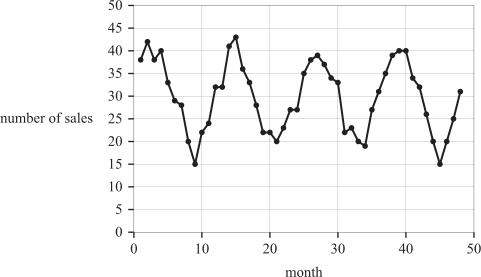
The time series plot below shows the revenue from sales (in dollars) each month made by a Queensland souvenir shop over a three-year period.

Part 1

This time series plot indicates that, over the three-year period, revenue from sales each month showed

A.   no overall trend.

B.   no correlation.

C.   positive skew.

D.   an increasing trend only.

E.   an increasing trend with seasonal variation.


Part 2

A three median trend line is fitted to this data.

Its slope (in dollars per month) is closest to

A.   `125`

B.   `146`

C.   `167`

D.   `188`

E.   `255`


Part 3

The revenue from sales (in dollars) each month for the first year of the three-year period is shown below.

If this information is used to determine the seasonal index for each month, the seasonal index for September will be closest to

A.   `0.80`

B.   `0.82`

C.   `1.16`

D.   `1.22`

E.   `1.26`

Show Answers Only

`text (Part 1:)\ E`

`text (Part 2:)\ C`

`text (Part 3:)\ E`

Show Worked Solution

`text (Part 1)`

`text(The time series plot clearly shows an increasing)`

`text(trend and a seasonal spike and drop over the)`

`text(Summer months.)`

`rArr E`


`text (Part 2)`

♦ Mean mark 37%.
MARKERS’ COMMENT: A common error was to incorrectly use the 6 month and 30 month data points as the median.

`text(From the graph, the median of the bottom third)`

`text(of data points is)\ \ (6.5, 3000).`

`text(From the graph, the median of the top third of)`

`text(data points is)\ \ (30.5, 7000).`

`:.\ text(Gradient of the three median line)`

`=(7000 – 3000)/(30.5 – 6.5)`

`=166.66…`

`rArr C`


`text (Part 3)`

`text(Average monthly sales)\ ` `= (43\ 872)/12`
  `=3656`

`:.\ text(Seasonal index for September)`

`=4597/3656`

`=1.257…` 

`rArr E`

Filed Under: Time Series Tagged With: Band 2, Band 4, Band 5, smc-266-10-Seasonal Index from a Table, smc-266-40-Time Series Trends

CORE, FUR1 2014 VCAA 10-11 MC

The seasonal indices for the first 11 months of the year, for sales in a sporting equipment store, are shown in the table below.

Part 1

The seasonal index for December is

A.  `0.89`

B.  `0.97`

C.  `1.02`

D.  `1.23`

E.  `1.29`


Part 2

In May, the store sold $213 956 worth of sporting equipment.

The deseasonalised value of these sales was closest to

A.  `$165\ 857`

B.  `$190\ 420`

C.  `$209\ 677`

D.  `$218\ 322`

E.  `$240\ 400`

Show Answers Only

`text(Part 1:)\ E`

`text(Part 2:)\ E`

Show Worked Solution

`text(Part 1)`

`text(Sum of seasonal indices) = 12`

`:.\ text(December’s seasonal index)`

`=12 – text{(1.23 + 0.96 + 1.12 + 1.08 + 0.89}`
`text{+ 0.98 + 0.86 + 0.76 + 0.76 + 0.95 + 1.12)}`
`=1.29`

`=>E`


`text(Part 2)`

`text(May Index)` `=\ text(Actual Sales)/text{Deseasonalised Sales (D)}`
`0.89` `= (213\ 956)/(text{D})`
`:.\ text(D)` `= (213\ 956)/0.89`
  `= $240\ 400`

`=>  E`

Filed Under: Time Series Tagged With: Band 3, smc-266-10-Seasonal Index from a Table, smc-266-20-(De)Seasonalising Data

CORE, FUR1 2012 VCAA 11-12 MC

Use the following information to answer Parts 1 and 2.

The table below shows the long-term average rainfall (in mm) for summer, autumn, winter and spring. Also shown are the seasonal indices for summer and autumn. The seasonal indices for winter and spring are missing.

Part 1

The seasonal index for spring is closest to

A.  `0.90`

B.  `1.03`

C.  `1.13`

D.  `1.15`

E.  `1.17`


Part 2

In 2011, the rainfall in autumn was 48.9 mm.

The deseasonalised rainfall (in mm) for autumn is closest to

A.  `48.4`

B.  `48.9`

C.  `49.4`

D.  `50.9`

E.  `54.0`

Show Answers Only

`text (Part 1:)\ C`

`text (Part 2:)\ A`

Show Worked Solution

`text (Part 1)`

`text (Average Seasonal Rainfall)`

`= (52.0 + 54.5 + 48.8 + 61.3)/4` 

`=54.15`

`:.\ text {Seasonal index (Spring)}`

`= 61.3/54.15`

`= 1.132…`

`rArr C`


`text (Part 2)`

`:.\ text {Deseasonalised Rainfall (Autumn)}`

`= 48.9/1.01`

`=48.415`

`rArr A`

Filed Under: Time Series Tagged With: Band 4, smc-266-10-Seasonal Index from a Table, smc-266-20-(De)Seasonalising Data

Copyright © 2014–2025 SmarterEd.com.au · Log in