SmarterEd

Aussie Maths & Science Teachers: Save your time with SmarterEd

  • Login
  • Get Help
  • About

Probability, MET2 2024 VCAA 9 MC

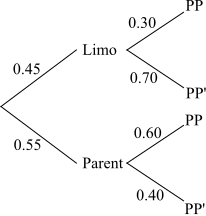
At a Year 12 formal, 45% of the students travelled to the event in a hired limousine, while the remaining 55% were driven to the event by a parent.

Of the students who travelled in a hired limousine, 30% had a professional photo taken.

Of the students who were driven by a parent, 60% had a professional photo taken.

Given that a student had a professional photo taken, what is the probability that the student travelled to the event in a hired limousine?

  1. \(\dfrac{1}{8}\)
  2. \(\dfrac{27}{200}\)
  3. \(\dfrac{9}{31}\)
  4. \(\dfrac{22}{31}\)
Show Answers Only

\(C\)

Show Worked Solution

\(\text{Pr(Limo|PP)}\) \(=\dfrac{\text{Pr(Limo)}\ \cap\ \text{Pr(PP)}}{\text{Pr(PP)}}\)
  \(=\dfrac{0.45\times 0.30}{(0.45\times 0.30)+(0.55\times 0.6)}\)
  \(=\dfrac{0.135}{0.465}\)
  \(=\dfrac{9}{31}\)

\(\Rightarrow C\)

Filed Under: Conditional Probability and Set Notation Tagged With: Band 4, smc-2736-10-Conditional probability

Probability, MET2 2021 VCAA 15 MC

Four fair coins are tossed at the same time.

The outcome for each coin is independent of the outcome for any other coin.

The probability that there is an equal number of heads and tails, given that there is at least one head; is

  1. `1/2`
  2. `1/3`
  3. `3/4`
  4. `2/5`
  5. `4/7`
Show Answers Only

`D`

Show Worked Solution

`X\ ~\ text(Bi) (4, 1/2)`

♦ Mean mark 48%.

`text(By CAS):`

`text(Pr) (X = 2 | X ≥ 1)` `= {text(Pr) (X = 2)}/{text(Pr) (X ≥ 1)}`
  `= 0.375/0.9375`
  `= 2/5`

`=> D`

Filed Under: Binomial, Conditional Probability and Set Notation Tagged With: Band 5, smc-2736-10-Conditional probability, smc-638-50-Conditional

Probability, MET1 2021 VCAA 6

An online shopping site sells boxes of doughnuts.

A box contains 20 doughnuts. There are only four types of doughnuts in the box. They are:

    • glazed, with custard
    • glazed, with no custard
    • not glazed, with custard
    • not glazed, with no custard

It is known that, in the box:

    • `1/2`  of the doughnuts are with custard
    • `7/10`  of the doughnuts are not glazed
    • `1/10`  of the doughnuts are glazed, with custard
  1. A doughnut is chosen at random from the box.
  2. Find the probability that it is not glazed, with custard.  (1 mark)

    --- 5 WORK AREA LINES (style=lined) ---

  3. The 20 doughnuts in the box are randomly allocated to two new boxes, Box A and Box B.
  4. Each new box contains 10 doughnuts.
  5. One of the two new boxes is chosen at random and then a doughnut from that box is chosen at random.
  6. Let `g` be the number of glazed doughnuts in Box A.
  7. Find the probability, in terms of `g`, that the doughnut comes from box B given that it is glazed.  (2 marks)

    --- 5 WORK AREA LINES (style=lined) ---

  8. The online shopping site has over one million visitors per day.
  9. It is know that half of these visitors are less than 25 years old.
  10. Let  `overset^P`  be the random variable representing the proportion of visitors who are less than 25 years old in a random sample of five visitors.
  11. Find  `text{Pr}(overset^P >= 0.8)`. Do not use a normal approximation.  (3 marks)

    --- 6 WORK AREA LINES (style=lined) ---

Show Answers Only

  1. `2/5`
  2. `(6-g)/6`
  3. `3/16`

Show Worked Solution

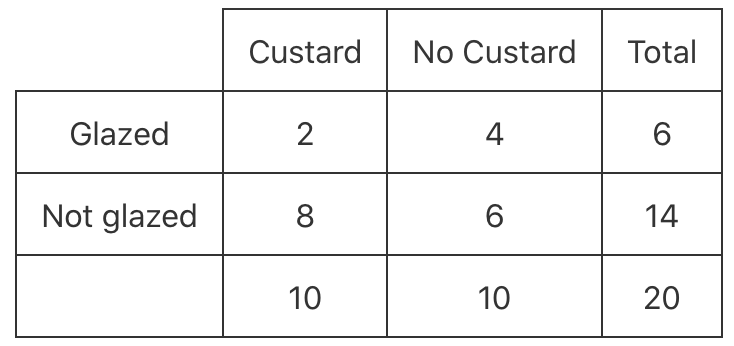
a.   `text(Create a 2-way table:)`

`text{Pr(not glazed with custard)}` `=8/20`  
  `=2/5`  

 
b.
   `A_text{glazed} = g \ => \ B_text{glazed} = 6-g`

♦♦♦ Mean mark part (b) 20%.

`text{Pr(glazed)} = 6/20`

`text{Pr}(B | text{glazed})` `= (text{Pr}(B ∩ text{glazed}))/text{Pr(glazed)}`  
  `=(1/2 xx (6-g)/10)/(6/20)`  
  `=(6-g)/20 xx 20/6`  
  `=(6-g)/6`  

 
c.
   `text(Let)\ \ X=\ text(number of visitors < 25 years)`

♦ Mean mark part (c) 40%.

`X\ ~\ text{Bi}(5, 0.5)`

`text{Pr}(hatP>=0.8)` `= text{Pr}(X>=4)`  
  `=\ ^5C_4 * (1/2)^4(1/2) + (1/2)^5`  
  `=5/32 + 1/32`  
  `=3/16`  

Filed Under: Binomial, Conditional Probability and Set Notation Tagged With: Band 4, Band 5, Band 6, smc-2736-10-Conditional probability

Probability, MET1 2019 VCAA 3

The only possible outcomes when a coin is tossed are a head or a tail. When an unbiased coin is tossed, the probability of tossing a head is the same as the probability of tossing a tail.

Jo has three coins in her pocket; two are unbiased and one is biased. When the biased coin is tossed, the probability of tossing a head is `1/3`.

Jo randomly selects a coin from her pocket and tosses it.

  1. Find the probability that she tosses a head.  (2 marks) 

    --- 5 WORK AREA LINES (style=lined) ---

  2.  Find the probability that she selected an unbiased coin, given that she tossed a head.  (1 mark)

    --- 3 WORK AREA LINES (style=lined) ---

Show Answers Only

  1. `4/9`
  2. `3/4`

Show Worked Solution

a.    `text(Pr)(B) = 1/3,\ \text(Pr)(B^{\prime}) = 2/3`

`text(Pr)(H|B) = 1/3,\ \ text(Pr)(H|B^{\prime}) = 1/2`


`:. text(Pr)(H)` `= text(Pr)(B) xx text(Pr)(H nn B) + text(Pr)(B^{\prime}) xx text(Pr)(H nn B^{\prime})`
  `= 1/3 xx 1/3 + 2/3 xx 1/2`
  `= 1/9 + 1/3`
  `= 4/9`


b.    `text(Pr)(B^{\prime}|H)` `= (text(Pr)(B^{\prime} nn H))/(text(Pr)(H))`
    `= (2/3 xx 1/2)/(4/9)`
    `= 3/4`

Filed Under: Conditional Probability and Set Notation Tagged With: Band 4, Band 5, smc-2736-10-Conditional probability

Probability, MET1 2018 VCAA 6

Two boxes each contain four stones that differ only in colour.

Box 1 contains four black stones.

Box 2 contains two black stones and two white stones.

A box is chosen randomly and one stone is drawn randomly from it.

Each box is equally likely to be chosen, as is each stone.

  1.  What is the probability that the randomly drawn stone is black?  (2 marks)

    --- 3 WORK AREA LINES (style=lined) ---

  2.  It is not known from which box the stone has been drawn.
  3. Given that the stone that is drawn is black, what is the probability that it was drawn from Box 1?  (2 marks)

    --- 3 WORK AREA LINES (style=lined) ---

Show Answers Only

  1. `3/4`
  2. `2/3`

Show Worked Solution

a.    `text(Pr)(text(Black))` `= text{Pr(Box 1)} · text{Pr(B)} + text{Pr(Box 2)} · text{Pr(B)}`
    `= 0.5 xx 4/4 + 0.5 xx 2/4`
    `= 3/4`


b.    `text(Pr)(text(Box 1 | black))` `= (text{Pr(Box 1)}\ ∩\ text{Pr(Black)})/text{Pr(Black)}`
    `= (1/2)/(3/4)`
    `= 2/3`

Filed Under: Conditional Probability and Set Notation Tagged With: Band 3, Band 4, smc-2736-10-Conditional probability

Probability, MET1 2016 VCAA 7

A company produces motors for refrigerators. There are two assembly lines, Line A and Line B. 5% of the motors assembled on Line A are faulty and 8% of the motors assembled on Line B are faulty. In one hour, 40 motors are produced from Line A and 50 motors are produced from Line B. At the end of an hour, one motor is selected at random from all the motors that have been produced during that hour.

  1. What is the probability that the selected motor is faulty? Express your answer in the form `1/b`, where `b` is a positive integer.  (2 marks)

    --- 5 WORK AREA LINES (style=lined) ---

  2. The selected motor is found to be faulty.
  3. What is the probability that it was assembled on Line A? Express your answer in the form `1/c`, where `c` is a positive integer.  (1 mark)

    --- 4 WORK AREA LINES (style=lined) ---

Show Answers Only

  1. `1/15`
  2. `1/3`

Show Worked Solution

a.   `text(Construct tree diagram)`

`text(Pr)(AF) + text(Pr)(BF)`

`= 4/9 xx 1/20 + 5/9 xx 2/25`

`= 1/45 + 2/45`

`= 1/15`
 

`:. text(Pr)(F) = 1/15`


♦♦ Mean mark 32%.

b.    `text(Pr)(A|F)` `= (text(Pr)(A ∩ F))/(text(Pr)(F))`
    `= (4/9 xx 1/20)/(1/15)`
    `= 1/45 xx 15`
    `= 1/3`

Filed Under: Conditional Probability and Set Notation Tagged With: Band 4, Band 5, smc-2736-10-Conditional probability

Probability, MET2 2011 VCAA 2*

In a chocolate factory the material for making each chocolate is sent to one of two machines, machine A or machine B.

The time, `X` seconds, taken to produce a chocolate by machine A, is normally distributed with mean 3 and standard deviation 0.8.

The time, `Y` seconds, taken to produce a chocolate by machine B, has the following probability density function
 

`f(y) = {{:(0,y < 0),(y/16,0 <= y <= 4),(0.25e^(−0.5(y-4)),y > 4):}`
 

  1. Find correct to four decimal places

    1. `text(Pr)(3 <= X <= 5)`   (1 mark)

      --- 3 WORK AREA LINES (style=lined) ---

    2. `text(Pr)(3 <= Y <= 5)`   (3 marks)

      --- 3 WORK AREA LINES (style=lined) ---

  2. Find the mean of `Y`, correct to three decimal places.   (3 marks)

    --- 5 WORK AREA LINES (style=lined) ---

  3. It can be shown that  `text(Pr)(Y <= 3) = 9/32`. A random sample of 10 chocolates produced by machine B is chosen. Find the probability, correct to four decimal places, that exactly 4 of these 10 chocolate took 3 or less seconds to produce.   (2 marks)

    --- 5 WORK AREA LINES (style=lined) ---

All of the chocolates produced by machine A and machine B are stored in a large bin. There is an equal number of chocolates from each machine in the bin.

It is found that if a chocolate, produced by either machine, takes longer than 3 seconds to produce then it can easily be identified by its darker colour.

  1. A chocolate is selected at random from the bin. It is found to have taken longer than 3 seconds to produce.
  2. Find, correct to four decimal places, the probability that it was produced by machine A.   (3 marks)

    --- 6 WORK AREA LINES (style=lined) ---

Show Answers Only

a.i.  `0.4938`

a.ii. `0.4155`

b.    `4.333`

c.    `0.1812`

d.    `0.4103`

Show Worked Solution

a.i.   `X ∼\ N(3,0.8^2)`

`text(Pr)(3 <= X <= 5) = 0.4938\ \ text{(4 d.p.)}`


a.ii.    `text(Pr)(3 <= Y <= 5)` `= text(Pr)(3 <= Y <= 4) + (4 < Y <= 5)`
    `= int_3^4 (y/16)dy + int_4^5(1/4 e^(−1/2(y-4)))dy`
    `= 0.4155\ \ text{(4 d.p.)}`


b.    `text(E)(Y)` `= int_0^4 y(y/16)dy + int_4^∞ 0.25ye^(−1/2(y-4))dy`
    `= 4.333\ \ text{(3 d.p.)}`


c.   `text(Solution 1)`

`text(Let)\ \ W = #\ text(chocolates from)\ B\ text(that take less)`

`text(than 3 seconds)`

`W ∼\ text(Bi)(10, 9/32)`

`text(Using CAS: binomPdf)(10, 9/32,4)`

`text(Pr)(W = 4) = 0.1812\ \ text{(4 d.p.)}`
 

`text(Solution 2)`

`text(Pr)(W = 4)`  `=((10),(4)) (9/32)^4 (23/32)^6` 
  `=0.1812`

♦♦♦ Mean mark part (e) 19%.
MARKER’S COMMENT: Students who used tree diagrams were the most successful.


d.   
`text(Pr)(A | L)` `= (text(Pr)(AL))/(text(Pr)(L))`
  `= (0.5 xx 0.5)/(0.5 xx 0.5 + 0.5 xx 23/32)`
  `= 0.4103\ \ text{(4 d.p.)}`

Filed Under: Binomial, Conditional Probability and Set Notation, Normal Distribution, Probability density functions Tagged With: Band 4, Band 5, Band 6, smc-2736-10-Conditional probability, smc-637-10-E(X), smc-637-45-Other probability, smc-637-70-Exp/Log PDF, smc-638-10-binomial expansion (non-calc), smc-638-20-binomCdf (CAS), smc-646-20-Multi-stage events, smc-719-10-Single z-score, smc-719-30-Other z-score intervals

Probability, MET1 2007 VCAA 11

There is a daily flight from Paradise Island to Melbourne. The probability of the flight departing on time, given that there is fine weather on the island, is 0.8, and the probability of the flight departing on time, given that the weather on the island is not fine, is 0.6.

In March the probability of a day being fine is 0.4.

Find the probability that on a particular day in March

  1. the flight from Paradise Island departs on time  (2 marks)

    --- 6 WORK AREA LINES (style=lined) ---

  2. the weather is fine on Paradise Island, given that the flight departs on time.  (2 marks)

    --- 5 WORK AREA LINES (style=lined) ---

Show Answers Only

  1. `0.68`
  2. `8/17`

Show Worked Solution

a.   

 
`text{Pr(FT)}\ +\ text{Pr(F′T)}`

`= 0.4 xx 0.8 + 0.6 xx 0.6`

`= 0.32 + 0.36`

`= 0.68`


b.   `text(Conditional probability:)`

♦♦ Mean mark 29%.
MARKER’S COMMENT: Students continue to struggle with conditional probability. Attention required here.

`text(Pr)(F\ text(|)\ T)` `= (text(Pr)(F ∩ T))/(text(Pr)(T))`
  `= 0.32/0.68`


`:. text(Pr)(F\ text(|)\ T) = 8/17`

Filed Under: Conditional Probability and Set Notation Tagged With: Band 4, Band 5, smc-2736-10-Conditional probability

Probability, MET1 2009 VCAA 5

Four identical balls are numbered 1, 2, 3 and 4 and put into a box. A ball is randomly drawn from the box, and not returned to the box. A second ball is then randomly drawn from the box.

  1. What is the probability that the first ball drawn is numbered 4 and the second ball drawn is numbered 1?  (1 mark)

    --- 3 WORK AREA LINES (style=lined) ---

  2. What is the probability that the sum of the numbers on the two balls is 5?  (1 mark)

    --- 3 WORK AREA LINES (style=lined) ---

  3. Given that the sum of the numbers on the two balls is 5, what is the probability that the second ball drawn is numbered 1?  (2 marks)

    --- 4 WORK AREA LINES (style=lined) ---

Show Answers Only

  1. `1/12`
  2. `1/3`
  3. `1/4`

Show Worked Solution

a.   `text(Pr) (4, 1)`

`= 1/4 xx 1/3`

`= 1/12`


b.   `text(Pr) (text(Sum) = 5)`

`= text(Pr) (1, 4) + text(Pr) (2, 3) + text(Pr) (3, 2) + text(Pr) (4, 1)`

`= 4 xx (1/4 xx 1/3)`

`= 1/3`


c.   `text(Conditional Probability)`

♦ Mean mark 46%.

`text(Pr) (2^{text(nd)} = 1\ |\ text(Sum) = 5)`

`= (text{Pr} (4, 1))/(text{Pr} (text(Sum) = 5))`

`= (1/12)/(1/3)`

`= 1/4`

Filed Under: Conditional Probability and Set Notation Tagged With: Band 3, Band 4, Band 5, smc-2736-10-Conditional probability

Probability, MET1 2014 VCAA 9

Sally aims to walk her dog, Mack, most mornings. If the weather is pleasant, the probability that she will walk Mack is `3/4`, and if the weather is unpleasant, the probability that she will walk Mack is `1/3`.

Assume that pleasant weather on any morning is independent of pleasant weather on any other morning.

  1. In a particular week, the weather was pleasant on Monday morning and unpleasant on Tuesday morning.
  2. Find the probability that Sally walked Mack on at least one of these two mornings.  (2 marks)

    --- 5 WORK AREA LINES (style=lined) ---

  3. In the month of April, the probability of pleasant weather in the morning was `5/8`.
  4.  i. Find the probability that on a particular morning in April, Sally walked Mack.  (2 marks)

    --- 5 WORK AREA LINES (style=lined) ---

  5. ii. Using your answer from part b.i., or otherwise, find the probability that on a particular morning in April, the weather was pleasant, given that Sally walked Mack that morning.  (2 marks)

    --- 5 WORK AREA LINES (style=lined) ---

Show Answers Only

  1. `5/6`
    1. `19/32`
    2. `15/19`

Show Worked Solution

a.    `text{Pr(at least 1 walk)}` `= 1 – text{Pr(no walk)}`
    `= 1 – 1/4 xx 2/3`
    `= 5/6`


b.i.   `text(Construct tree diagram:)`
 

met1-2014-vcaa-q9-answer1 
 

`text(Pr)(PW) + text(Pr)(P′W)` `= 5/8 xx 3/4 + 3/8 xx 1/3`
  `= 19/32`


♦ Part (b)(ii) mean mark 38%.

b.ii.    `text(Pr)(P | W)` `= (text(Pr)(P ∩ W))/(text(Pr)(W))`
    `= (5/8 xx 3/4)/(19/32)`
    `= 15/32 xx 32/19`
    `= 15/19`

Filed Under: Conditional Probability and Set Notation Tagged With: Band 4, Band 5, smc-2736-10-Conditional probability

Probability, MET1 2015 VCAA 9

An egg marketing company buys its eggs from farm A and farm B. Let `p` be the proportion of eggs that the company buys from farm A. The rest of the company’s eggs come from farm B. Each day, the eggs from both farms are taken to the company’s warehouse.

Assume that `3/5` of all eggs from farm A have white eggshells and `1/5` of all eggs from farm B have white eggshells.

  1. An egg is selected at random from the set of all eggs at the warehouse.
  2. Find, in terms of `p`, the probability that the egg has a white eggshell.  (1 mark)

    --- 4 WORK AREA LINES (style=lined) ---

  3. Another egg is selected at random from the set of all eggs at the warehouse.


    1. Given that the egg has a white eggshell, find, in terms of `p`, the probability that it came from farm B.  (2 marks)

      --- 5 WORK AREA LINES (style=lined) ---

    2. If the probability that this egg came from farm B is 0.3, find the value of `p`.  (1 mark)

      --- 5 WORK AREA LINES (style=lined) ---

Show Answers Only

  1. `(2p+1)/5`
    1. `(1 – p)/(2p + 1)`
    2. `7/16`

Show Worked Solution

a.  

met1-2015-vcaa-q9-answer1


`text(Pr)(AW) + text(Pr)(BW)` `= p xx 3/5 + (1-p) xx 1/5`
  `=(3p)/5+1/5-p/5`
  `= (2p+1)/5`


♦ Part (b) mean mark 41%.
MARKER’S COMMENT: Algebraic fractions “were not handled well”!

b.i.    `text(Pr)(B | W)` `= (text(Pr)(B ∩ W))/(text(Pr)(W))`
    `= ((1 – p)/5)/((2p + 1)/5)`
    `=(1-p)/5 xx 5/(2p+1)`
    `= (1 – p)/(2p + 1)`


♦♦♦ Part (c) mean mark 19%.
STRATEGY: Previous parts of a question are gold dust for directing your strategy in many harder questions.

b.ii.    `text(Pr)(B | W)` `= 3/10`
  `(1 – p)/(2p + 1)` `= 3/10`
  `10 – 10p` `= 6p + 3`
  `7` `= 16p`
  `:. p` `= 7/16`

Filed Under: Conditional Probability and Set Notation Tagged With: Band 4, Band 5, Band 6, smc-2736-10-Conditional probability

Probability, MET1 2015 VCAA 8

For events `A` and `B` from a sample space, `text(Pr)(A | B) = 3/4`  and  `text(Pr)(B) = 1/3`.

  1. Calculate  `text(Pr)(A ∩ B)`.   (1 mark)

    --- 4 WORK AREA LINES (style=lined) ---

  2. Calculate  `text(Pr)(A^{′} ∩ B)`, where `A^{′}` denotes the complement of `A`.   (1 mark)

    --- 4 WORK AREA LINES (style=lined) ---

  3. If events `A` and `B` are independent, calculate  `text(Pr)(A ∪ B)`.   (1 mark)

    --- 6 WORK AREA LINES (style=lined) ---

Show Answers Only

  1. `1/4`
  2. `1/12`
  3. `5/6`

Show Worked Solution

a.   `text(Using Conditional Probability:)`

`text(Pr)(A | B)` `= (text(Pr)(A ∩ B))/(text(Pr)(B))`
`3/4` `= (text(Pr)(A ∩ B))/(1/3)`
`:. text(Pr)(A ∩ B)` `= 1/4`


b.    met1-2015-vcaa-q8-answer
`text(Pr)(A^{′} ∩ B)` `= text(Pr)(B)-text(Pr)(A ∩B)`
  `= 1/3-1/4`
  `= 1/12`


c.   `text(If)\ A, B\ text(independent)`

♦♦ Mean mark 28%.
MARKER’S COMMENT: A lack of understanding of independent events was clearly evident.

`text(Pr)(A ∩ B)` `= text(Pr)(A) xx Pr(B)`
`1/4` `= text(Pr)(A) xx 1/3`
`:. text(Pr)(A)` `= 3/4`


`text(Pr)(A ∪ B)` `= text(Pr)(A) + text(Pr)(B)-text(Pr)(A ∩ B)`
  `= 3/4 + 1/3-1/4`
`:. text(Pr)(A ∪ B)` `= 5/6`

Filed Under: Conditional Probability and Set Notation Tagged With: Band 3, Band 4, Band 5, smc-2736-10-Conditional probability, smc-2736-30-Venn Diagrams, smc-2736-50-Complement

Probability, MET2 2014 VCAA 14 MC

If `X` is a random variable such that  `text(Pr)(X > 5) = a`  and  `text(Pr)(X > 8) = b`, then  `text(Pr)(X < 5 | X < 8)`  is

  1. `a/b`
  2. `(a - b)/(1 - b)`
  3. `(1 - b)/(1 - a)`
  4. `(ab)/(1 - b)`
  5. `(a - 1)/(b - 1)`
Show Answers Only

`E`

Show Worked Solution

`text(Pr)(X < 5) | text(Pr)(X < 8)`

♦ Mean mark 45%.

`=(text(Pr)(X<5 ∩ X<8))/(text(Pr)(X < 8))`

`= (text(Pr)(X < 5))/(text(Pr)(X < 8))`

`= (1 – a)/(1 – b)`

`= (a – 1)/(b – 1)`
 

`=>   E`

Filed Under: Conditional Probability and Set Notation Tagged With: Band 5, smc-2736-10-Conditional probability

Probability, MET2 2013 VCAA 17 MC

`A` and `B` are events of a sample space.

Given that  `text(Pr)(A|B) = p,\ \ text(Pr)(B) = p^2` and `text(Pr)(A) = p^(1/3),\ text(Pr)(B|A)`  is equal to

  1. `p`
  2. `p^(4/3)`
  3. `p^(7/3)`
  4. `p^(8/3)`
  5. `p^3`
Show Answers Only

`D`

Show Worked Solution
`text(Pr)(A | B)` `= (text(Pr)(A ∩ B))/(text(Pr)(B)`
`p` `= (text(Pr)(A ∩ B))/(p^2)`
`:. text(Pr)(A ∩ B)` `= p^3`
♦ Mean mark 49%.


`text(Pr)(B | A)` `= (text(Pr)(A ∩ B))/(text(Pr)(A))`
  `= (p^3)/(p^(1/3))`
`:. text(Pr)(B | A)` `= p^(8/3)`


`=>   D`

Filed Under: Conditional Probability and Set Notation Tagged With: Band 5, smc-2736-10-Conditional probability, smc-2736-20-Set Notation

Probability, MET2 2012 VCAA 13 MC

`A` and `B` are events of a sample space `S.`

`text(Pr)(A nn B) = 2/5` and `text(Pr)(A nn B prime) = 3/7`

`text(Pr)(B prime | A)` is equal to

  1. `6/35`
  2. `15/29`
  3. `14/35`
  4. `29/35`
  5. `2/3`
Show Answers Only

`B`

Show Worked Solution

met2-2012-vcaa-13-mc-answer

`text(Pr)(B prime | A)` `= (text(Pr)(B prime nn A))/(text(Pr)(A))`
  `= (text(Pr)(B prime nn A))/(text(Pr)(B prime nn A)+ text(Pr)(A nn B))`
  `= (3/7)/(3/7 + 2/5)`
  `= 15/29`

`=>   B`

Filed Under: Conditional Probability and Set Notation Tagged With: Band 4, smc-2736-10-Conditional probability, smc-2736-20-Set Notation

Copyright © 2014–2025 SmarterEd.com.au · Log in