SmarterEd

Aussie Maths & Science Teachers: Save your time with SmarterEd

  • Login
  • Get Help
  • About

BIOLOGY, M5 2019 VCE 5 MC

Which one of the following statements about proteins is correct?

  1. The activity of a protein may be affected by the temperature and pH of its environment.
  2. The primary structure of a protein refers to its three-dimensional protein shape.
  3. Proteins are not involved in the human immune response.
  4. A protein with a quaternary structure will be an enzyme.
Show Answers Only

\(A\)

Show Worked Solution

Consider option A:

  • Changes in temperature or pH can disrupt the interactions that stabilise a protein’s higher-order structure.
  • This causes it to lose its three-dimensional shape and become denatured which usually results in a non-functional protein (Option A is Correct)

\(\Rightarrow A\)

Filed Under: DNA and Polypeptide Synthesis Tagged With: Band 2, smc-3650-60-Proteins

BIOLOGY, M5 2020 VCE 8 MC

The primary structure of a protein is important because it

  1. is the active, functional form of the protein.
  2. has a very specific three-dimensional shape.
  3. influences the way that the polypeptide folds.
  4. directly controls the way proteins are transported into a cell.
Show Answers Only

\(C\)

Show Worked Solution

Consider each option:

  • Option A: Incorrect – The active form depends on the 3D structure, not just the primary sequence.
  • Option B: Incorrect – The primary structure itself is linear, not 3D.
  • Option C: Correct – The primary structure (linear sequence of amino acids) influences how the polypeptide chain folds into its 3D conformation.
  • Option D: Incorrect – Protein transport is controlled by signal sequences, not directly by the primary structure.

\(\Rightarrow C\)

Filed Under: DNA and Polypeptide Synthesis Tagged With: Band 4, smc-3650-60-Proteins

BIOLOGY, M6 2023 HSC 35

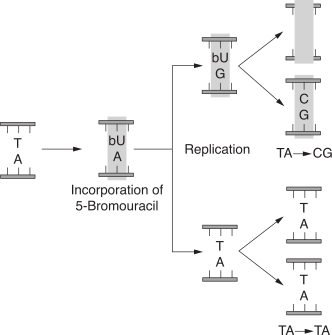
5-Bromouracil (bU) is a synthetic chemical mutagen. It bonds with adenine in place of thymine in DNA. During replication, it then binds with guanine.

This will then make a guanine-cytosine pair on one strand of DNA instead of an adenine-thymine pair.
 

  1. Identify the type of mutation that is caused by bU.   (1 mark)

    --- 2 WORK AREA LINES (style=lined) ---

  2. Describe the possible effects on a protein if this mutation occurred within a gene.   (4 marks)

    --- 8 WORK AREA LINES (style=lined) ---

Show Answers Only

a.   Point mutation or substitution mutation

b.   Protein effects if mutation within gene:

  • If this mutation occurred within coding DNA, then the RNA produced would be G–C instead of A–T (depending on the strand).
  • As a result, when it is read by a ribosome a different codon will be read, which may or may not code for the same amino-acid.
  • If the mutation codes for a different amino-acid, a different polypeptide chain will form. 
  • This mutation process could cause the protein to fold differently which can alter it’s function or render it completely dysfunctional.
  • Alternatively, the new codon could also be interpreted as a stop codon, pre-emptively stopping production of the rest of the polypeptide chain. 

Show Worked Solution

a.   Point mutation or substitution mutation

b.   Protein effects if mutation within gene:

  • If this mutation occurred within coding DNA, then the RNA produced would be G–C instead of A–T (depending on the strand).
  • As a result, when it is read by a ribosome a different codon will be read, which may or may not code for the same amino-acid.
  • If the mutation codes for a different amino-acid, a different polypeptide chain will form. 
  • This mutation process could cause the protein to fold differently which can alter it’s function or render it completely dysfunctional.
  • Alternatively, the new codon could also be interpreted as a stop codon, pre-emptively stopping production of the rest of the polypeptide chain. 
♦ Mean mark (b) 46%.

Filed Under: DNA and Polypeptide Synthesis, Mutation Tagged With: Band 4, Band 5, smc-3650-20-Translation, smc-3650-30-Transcription, smc-3650-60-Proteins, smc-3652-30-Point Mutations, smc-3652-60-Mutagens

BIOLOGY, M5 2023 HSC 11 MC

The diagram shows part of a protein molecule.
 

Which row of the table is correct?

\begin{align*}
\begin{array}{l}
\rule{0pt}{2.5ex}\ \rule[-1ex]{0pt}{0pt}& \\
\rule{0pt}{2.5ex} \textbf{A.}\rule[-1ex]{0pt}{0pt}\\
\rule{0pt}{2.5ex} \textbf{B.}\rule[-1ex]{0pt}{0pt}\\
\rule{0pt}{2.5ex} \textbf{C.}\rule[-1ex]{0pt}{0pt}\\
\rule{0pt}{2.5ex} \textbf{D.}\rule[-1ex]{0pt}{0pt}\\
\end{array}
\begin{array}{|c|c|}
\hline \rule{0pt}{2.5ex}X \rule[-1ex]{0pt}{0pt}& \textit{Level of protein structure} \\
\hline \rule{0pt}{2.5ex} \text {Amino Acid} \rule[-1ex]{0pt}{0pt}& \text {Primary} \\
\hline \rule{0pt}{2.5ex} \text {Amino Acid} \rule[-1ex]{0pt}{0pt}& \text {Secondary} \\
\hline \rule{0pt}{2.5ex} \text {Polypeptide} \rule[-1ex]{0pt}{0pt}& \text {Primary} \\
\hline \rule{0pt}{2.5ex} \text {Polypeptide} \rule[-1ex]{0pt}{0pt}& \text {Secondary} \\
\hline
\end{array}
\end{align*}

Show Answers Only

\(A\)

Show Worked Solution
  • The diagram shows that \(X\) is an amino acid which is part of the polypeptide chain, and therefore the level of protein structure is primary.

\(\Rightarrow A\)

Filed Under: DNA and Polypeptide Synthesis Tagged With: Band 4, smc-3650-60-Proteins

BIOLOGY, M5 2014 HSC 32a

  1. Name the process for the synthesis of a polypeptide chain from a messenger-RNA base sequence.   (1 mark)

    --- 2 WORK AREA LINES (style=lined) ---

  2. Outline the steps in the formation of a functional enzyme from polypeptide chains.   (3 marks)

    --- 6 WORK AREA LINES (style=lined) ---

Show Answers Only

i.    Translation

ii.   Formation of a functional enzyme from polypeptide chains

  • A polypeptide will fold in a certain three-dimensional shape dependent on the amino acids, such as a sheet or a coil.
  • Multiple polypeptide chains will then link together to form a more specific shape. This shape will then go on to do a specific task as a protein.

Note: The following point is old syllabus knowledge.

  • One type of protein is an enzyme, which acts as a biological catalyst on certain substrates, primarily in metabolic reactions. The certain shape an enzyme makes due to the polypeptide chains within it is what dictates which substrate it will act on. 
Show Worked Solution

i.    Translation

ii.   Formation of a functional enzyme from polypeptide chains

  • A polypeptide will fold in a certain three-dimensional shape dependent on the amino acids, such as a sheet or a coil.
  • Multiple polypeptide chains will then link together to form a more specific shape. This shape will then go on to do a specific task as a protein.

Note: The following point is old syllabus knowledge.

  • One type of protein is an enzyme, which acts as a biological catalyst on certain substrates, primarily in metabolic reactions. The certain shape an enzyme makes due to the polypeptide chains within it is what dictates which substrate it will act on. 

♦♦ Mean mark (ii) 31%.

Filed Under: DNA and Polypeptide Synthesis Tagged With: Band 5, Band 6, smc-3650-11-RNA, smc-3650-60-Proteins

BIOLOGY, M5 2018 HSC 26a

Compare proteins and polypeptides.   (2 marks)

Show Answers Only

Proteins and Polypeptides

  • Both composed of amino acids
  • Polypeptides are single chain amino acids coded for a single gene (not folded and non-functional).
  • Proteins are composed of one or more polypeptides (folded and functional).
Show Worked Solution

Proteins and Polypeptides

  • Both composed of amino acids
  • Polypeptides are single chain amino acids coded for a single gene (not folded and non-functional).
  • Proteins are composed of one or more polypeptides (folded and functional).

Filed Under: DNA and Polypeptide Synthesis Tagged With: Band 4, smc-3650-60-Proteins

BIOLOGY, M5 2020 HSC 32b

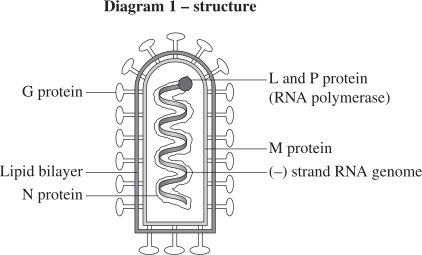
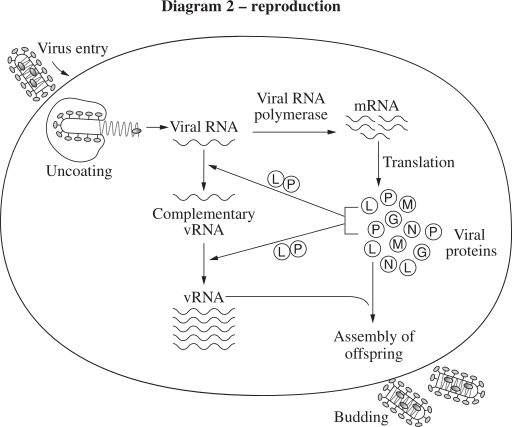
The rabies virus is a single-stranded RNA virus. It contains and codes for only five proteins. The diagrams show the structure and reproduction of the virus.


  1. Use the information provided in Diagram 1 to explain why the rabies virus cannot be classified as a cellular pathogen.   (3 marks)

    --- 5 WORK AREA LINES (style=lined) ---

  2. After infection the virus reproduces in muscle cells near the bite site and in the central nervous system. This requires the single-stranded rabies RNA to be transcribed, translated and replicated in the cytoplasm of host cells. These processes are shown in Diagram 2.
  3. Use the information provided in Diagrams 1 and 2 to explain the role of viral RNA polymerase in the reproduction of the virus.   (5 marks)

    --- 12 WORK AREA LINES (style=lined) ---

Show Answers Only

i.   Rabies virus cannot be a singular pathogen:

  • This pathogen contains only a single strand of RNA which only codes for five proteins.
  • Cellular pathogens such as bacteria contain a much larger genome in the form of DNA that allows the pathogen to perform complex processes without relying on a host. 

ii.   The Role of Viral RNA 

  • The viral RNA polymerase (which is made from L and P proteins) is responsible for the production of the viral proteins and RNA, components of the rabies viruses.
  • RNA polymerase is responsible for transcription of viral RNA into mRNA, which is then used by the host’s ribosomes to produce respective viral proteins.
  • RNA polymerase is also responsible for the replication of the viral RNA. In this process, a complementary RNA strand is produced from the original RNA strand. This strand is then used as a template for RNA polymerase to rapidly produce more RNA, complementary to the template. The new RNA will therefore be identical to the original.
  • In this way, RNA polymerase is essential in producing viral proteins and new RNA strands which form new rabies virus particles.
Show Worked Solution

i.   Rabies virus cannot be a singular pathogen:

  • This pathogen contains only a single strand of RNA which only codes for five proteins.
  • Cellular pathogens such as bacteria contain a much larger genome in the form of DNA that allows the pathogen to perform complex processes without relying on a host.

♦♦ Mean mark (i) 33%.

ii.   The Role of Viral RNA 

  • The viral RNA polymerase (which is made from L and P proteins) is responsible for the production of the viral proteins and RNA which are components of the rabies viruses.
  • RNA polymerase is responsible for transcription of viral RNA into mRNA, which is then used by the host’s ribosomes to produce viral proteins.
  • RNA polymerase is also responsible for the replication of the viral RNA. In this process, a complementary RNA strand is produced from the original RNA strand. This strand is then used as a template for RNA polymerase to rapidly produce more RNA, complementary to the template. The new RNA will therefore be identical to the original.
  • In this way, RNA polymerase is essential in producing viral proteins and new RNA strands which form new rabies virus particles.

♦♦♦ Mean mark (ii) 29%.

Filed Under: Causes of Infectious Disease, DNA and Polypeptide Synthesis Tagged With: Band 5, Band 6, smc-3650-11-RNA, smc-3650-60-Proteins, smc-3655-10-Classifying Pathogens

Copyright © 2014–2025 SmarterEd.com.au · Log in