SmarterEd

Aussie Maths & Science Teachers: Save your time with SmarterEd

  • Login
  • Get Help
  • About

BIOLOGY, M6 2025 HSC 30

PAI-1 protein is encoded by the SERPINE 1 gene in humans. Anopheles mosquitoes have been genetically modified to express PAI-1, which blocks the entry of the malarial Plasmodium into the mosquito gut. This disrupts the Plasmodium life cycle, resulting in reduced transmission of malaria. 

  1. Describe a process that could be used to produce mosquitoes which express PAI-1.   (4 marks)

    --- 11 WORK AREA LINES (style=lined) ---

  2. 'Genetic technologies are beneficial for society.'
  3. Evaluate this statement.   (7 marks)

    --- 24 WORK AREA LINES (style=lined) ---

Show Answers Only

a.    Mosquito Production

  • The SERPINE 1 gene is isolated from human DNA using restriction enzymes that cut at specific recognition sites.
  • The same restriction enzymes are used to cut mosquito DNA, creating complementary sticky ends.
  • The human PAI-1 gene is inserted into the mosquito DNA using DNA ligase to form recombinant DNA.
  • The recombinant DNA is introduced into mosquito eggs or embryos using a vector or microinjection technique.
  • Modified mosquitoes are screened to confirm PAI-1 gene expression and successful integration into the genome.
  • Transgenic mosquitoes produce PAI-1 protein that blocks Plasmodium entry into the gut, disrupting malaria transmission.

b.    Evaluation Statement

Genetic technologies are highly beneficial for society when evaluated against health improvements and food security criteria. Despite some ethical and environmental concerns requiring careful management, the overall benefits are substantial.

Health Benefits
Evidence supporting includes:

  • Genetically modified mosquitoes expressing PAI-1 significantly reduce malaria transmission, potentially saving millions of lives annually.
  • Recombinant DNA technology produces insulin and vaccines, improving accessibility to life-saving treatments for diabetes and infectious diseases.
  • Gene therapy offers potential cures for inherited genetic disorders, dramatically improving quality of life for affected individuals.

The health criterion strongly meets beneficial status because these technologies address major global health challenges.

Food Security and Agricultural Benefits
Evidence supporting includes:

  • Genetically modified crops like Bt cotton and Golden Rice increase crop yields and nutritional content, addressing food scarcity.
  • Drought-resistant GM crops enable farming in challenging environments, supporting population growth and farmer livelihoods.

However, concerns exist about reduced genetic diversity and corporate control over seeds, creating inequalities in access.

Final Evaluation

Weighing these factors shows genetic technologies are substantially beneficial for society. The health improvements and food security gains outweigh the manageable ethical concerns. While challenges like biodiversity impacts and equitable access require ongoing attention, the overall societal benefit remains considerable through life-saving medical applications and enhanced food production.
Show Worked Solution

a.    Mosquito Production

  • The SERPINE 1 gene is isolated from human DNA using restriction enzymes that cut at specific recognition sites.
  • The same restriction enzymes are used to cut mosquito DNA, creating complementary sticky ends.
  • The human PAI-1 gene is inserted into the mosquito DNA using DNA ligase to form recombinant DNA.
  • The recombinant DNA is introduced into mosquito eggs or embryos using a vector or microinjection technique.
  • Modified mosquitoes are screened to confirm PAI-1 gene expression and successful integration into the genome.
  • Transgenic mosquitoes produce PAI-1 protein that blocks Plasmodium entry into the gut, disrupting malaria transmission.

b.    Evaluation Statement

Genetic technologies are highly beneficial for society when evaluated against health improvements and food security criteria. Despite some ethical and environmental concerns requiring careful management, the overall benefits are substantial.

Health Benefits
Evidence supporting includes:

  • Genetically modified mosquitoes expressing PAI-1 significantly reduce malaria transmission, potentially saving millions of lives annually.
  • Recombinant DNA technology produces insulin and vaccines, improving accessibility to life-saving treatments for diabetes and infectious diseases.
  • Gene therapy offers potential cures for inherited genetic disorders, dramatically improving quality of life for affected individuals.

The health criterion strongly meets beneficial status because these technologies address major global health challenges.

Food Security and Agricultural Benefits
Evidence supporting includes:

  • Genetically modified crops like Bt cotton and Golden Rice increase crop yields and nutritional content, addressing food scarcity.
  • Drought-resistant GM crops enable farming in challenging environments, supporting population growth and farmer livelihoods.

However, concerns exist about reduced genetic diversity and corporate control over seeds, creating inequalities in access.

Final Evaluation

Weighing these factors shows genetic technologies are substantially beneficial for society. The health improvements and food security gains outweigh the manageable ethical concerns. While challenges like biodiversity impacts and equitable access require ongoing attention, the overall societal benefit remains considerable through life-saving medical applications and enhanced food production.
Filed Under: Biotechnology, Genetic Technologies Tagged With: Band 5, Band 6, smc-3653-20-Evaluating Genetic Technology, smc-3654-05-Transgenic Organisms

BIOLOGY, M6 2023 HSC 34

Cattle have been domesticated by humans for approximately 10 000 years. Many biotechnologies have been employed in the farming of cattle.

The table shows examples of the application of these biotechnologies.

\begin{array} {|l|l|}
\hline
\rule{0pt}{2.5ex} \textbf{Biotechnology} \rule[-1ex]{0pt}{0pt} & \textbf{Example} \\
\hline
\rule{0pt}{2.5ex} \text{Selective breeding} & \text{The offspring of highest milk producing female cows were} \\
\text{} & \text{retained and over time cows that produced more milk were bred,} \\
\text{} \rule[-1ex]{0pt}{0pt} & \text{leading to dairy breeds.} \\
\hline
\rule{0pt}{2.5ex} \text{Artificial} & \text{An American bull holds the current record for artificial} \\
\text{insemination} & \text{insemination. He produced 2.4 million units of semen and has} \\
\text{} \rule[-1ex]{0pt}{0pt} & \text{sired cattle in 50 countries.} \\
\hline
\rule{0pt}{2.5ex} \text{Whole organism} & \text{The success rate of cloning cattle is low. There are currently 30-40} \\
\text{cloning} \rule[-1ex]{0pt}{0pt} & \text{cloned cattle in Australia. They are not used commercially.} \\
\hline
\rule{0pt}{2.5ex} \text{Hybridisation } & \text{There are two species of domestic cattle, Bos taurus and Bos} \\
\text{} & \text{indicus. They can be hybridised to breed cattle with} \\
\text{} \rule[-1ex]{0pt}{0pt} & \text{characteristics of both species.} \\
\hline
\rule{0pt}{2.5ex} \text{Transgenic} & \text{The first transgenic cow produced human serum albumin in its} \\
\text{organisms} \rule[-1ex]{0pt}{0pt}& \text{milk. The use of transgenic cattle is not widespread.} \\
\hline
\end{array}

With reference to the table, evaluate the effect of biotechnologies on the biodiversity of cattle.  (5 marks)

Show Answers Only

  • Biotechnologies can increase, decrease or maintain the size of the gene pool in populations and species, particularly in the case of cattle which have been subject to a range of biotechnologies.
  • Selective breeding, which decreases biodiversity, has been used for hundreds of years by farmers who oversee the reproduction of cattle with favourable characteristics, such as females who produce the most milk.
  • Artificial insemination, which typically reduces biodiversity, allows a single bull to sire many offspring. This process breeds out certain characteristics of cattle, reducing the diversity of the species. However, in certain circumstances, the gene pool of specific communities can be diversified through the introduction of new alleles.
  • Whole cattle cloning reduces biodiversity by making cloned organisms that are identical genotypes to the parent. As the success rate is low and cloned animals are infertile, this does not have the potential to have a large impact on biodiversity.
  • Hybridisation generally increases biodiversity by naturally mating two different cattle species and in the process, introducing genes not originally present. 
  • Hybridisation can however also reduce biodiversity if cattle hybrids are then selectively bred in preference to the original breeds.
  • Transgenic organisms are produced where new alleles are artificially introduced into the species, increasing biodiversity. As this process is expensive and not widespread, it will not have a large effect on biodiversity.
  • In summary, the most wide spread and influential biotechnologies have the overall effect of decreasing the biodiversity of cattle.

Show Worked Solution

  • Biotechnologies can increase, decrease or maintain the size of the gene pool in populations and species, particularly in the case of cattle which have been subject to a range of biotechnologies.
  • Selective breeding, which decreases biodiversity, has been used for hundreds of years by farmers who oversee the reproduction of cattle with favourable characteristics, such as females who produce the most milk.
  • Artificial insemination, which typically reduces biodiversity, allows a single bull to sire many offspring. This process breeds out certain characteristics of cattle, reducing the diversity of the species. However, in certain circumstances, the gene pool of specific communities can be diversified through the introduction of new alleles.
  • Whole cattle cloning reduces biodiversity by making cloned organisms that are identical genotypes to the parent. As the success rate is low and cloned animals are infertile, this does not have the potential to have a large impact on biodiversity.
  • Hybridisation generally increases biodiversity by naturally mating two different cattle species and in the process, introducing genes not originally present. 
  • Hybridisation can however also reduce biodiversity if cattle hybrids are then selectively bred in preference to the original breeds.
  • Transgenic organisms are produced where new alleles are artificially introduced into the species, increasing biodiversity. As this process is expensive and not widespread, it will not have a large effect on biodiversity.
  • In summary, the most wide spread and influential biotechnologies have the overall effect of decreasing the biodiversity of cattle.

Filed Under: Biotechnology, Genetic Technologies Tagged With: Band 4, Band 5, smc-3653-10-Biodiversity, smc-3653-20-Evaluating Genetic Technology, smc-3654-05-Transgenic Organisms, smc-3654-20-Agriculture, smc-3654-51-Reproductive Technologies, smc-3654-70-Whole Organism Cloning

BIOLOGY, M6 EQ-Bank 24

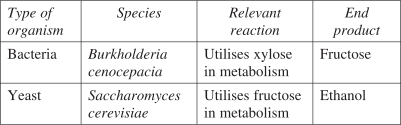
The yeast Saccharomyces cerevisiae cannot naturally ferment the sugar xylose. Low value biomass, such as straw and wood fibres, contains up to 20% xylose. S. cerevisiae was modified to enable it to produce ethanol from xylose. Information on the two species involved in making the modified S. cerevisiae is shown in the table.
 

  1. Explain why biotechnology was needed to modify S. cerevisiae.   (2 marks)

    --- 5 WORK AREA LINES (style=lined) ---

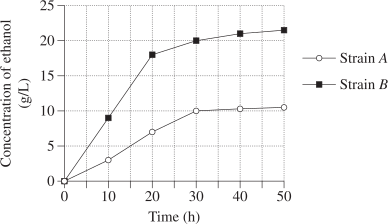
  2. Two strains of genetically modified S.cerevisiae were produced. The two strains were compared under the same conditions. The results are shown.


  3. Justify which of these two strains would be better to use to produce commercial quantities of ethanol using low value biomass. In your answer, refer to information from the graph.   (3 marks)

    --- 6 WORK AREA LINES (style=lined) ---

Show Answers Only

a.    The table shows that the organisms are from different genera.

  • Genetic material generally can’t be transferred between organisms of different genera.
  • Genetic technology was therefore needed to cut out and insert the required genes from B. cenocepacia to create the genetically modified S. cerevisiae as this process could not occur naturally. 

b.    Best strain for commercial production

  •  Strain B would be the more effective strain to use as it consistently produces double the ethanol of Strain A.
  • This can be seen even at the plateau of both strains, where at 30 hrs Strain B produced 20g/L of ethanol whilst Strain A only produced 10g/L.
  • These data in the graph indicates that Strain B will be more efficient at producing commercial ethanol in any given time-frame.
Show Worked Solution

a.    The table shows that the organisms are from different genera.

  • Genetic material generally can’t be transferred between organisms of different genera.
  • Genetic technology was therefore needed to cut out and insert the required genes from B. cenocepacia to create the genetically modified S. cerevisiae as this process could not occur naturally. 

b.    Best strain for commercial production

  •  Strain B would be the more effective strain to use as it consistently produces double the ethanol of Strain A.
  • This can be seen even at the plateau of both strains, where at 30 hrs Strain B produced 20g/L of ethanol whilst Strain A only produced 10g/L.
  • These data in the graph indicates that Strain B will be more efficient at producing commercial ethanol in any given time-frame.

Filed Under: Biotechnology, Genetic Technologies Tagged With: Band 4, Band 5, smc-3653-20-Evaluating Genetic Technology, smc-3654-05-Transgenic Organisms, smc-3654-20-Agriculture

BIOLOGY, M6 EQ-Bank 3 MC

A New Zealand research team inserted a single gene into an onion to reduce the activity of the enzyme that makes your eyes water, resulting in an onion that you can cut without crying.

Which term best describes this team's process?

  1. Cloning
  2. Artificial pollination
  3. Genetic engineering
  4. Artificial insemination
Show Answers Only

`C`

Show Worked Solution
  • Manually altering an organisms genome (such as in transgenic organisms) is referred to as genetic engineering.

`=>C`

Filed Under: Genetic Technologies Tagged With: Band 3, smc-3654-05-Transgenic Organisms, smc-3654-20-Agriculture

BIOLOGY, M6 2014 HSC 16 MC

What is the best explanation for the successful development of transgenic species?

  1. Artificial pollination works across the plant kingdom.
  2. Nuclear transplantation from cell to cell is easily achieved.
  3. DNA in the biosphere is composed of the same chemical components.
  4. Genes from different animals within the one species are easily combined.
Show Answers Only

`C`

Show Worked Solution
  • The development of transgenic species is only possible since all nucleotides in all of the worlds’ life is chemically identical.

`=>C`


♦♦ Mean mark 35%.

Filed Under: Genetic Technologies Tagged With: Band 5, smc-3654-05-Transgenic Organisms

BIOLOGY, M6 2021 HSC 33b

Genetically engineered Atlantic salmon have been produced and approved for aquaculture in the US.

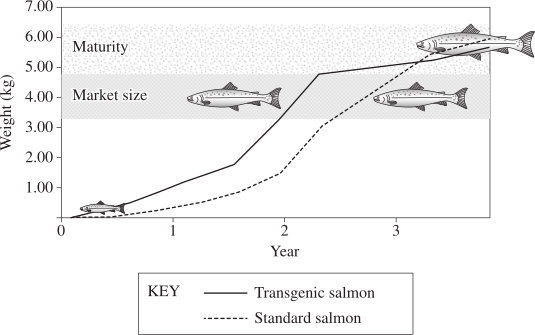
The graph summarises the growth of standard salmon and transgenic salmon.


  1.  
    Explain ONE potential benefit of using transgenic salmon in aquaculture. Support your answer with data from the graph.   (3 marks)

    --- 6 WORK AREA LINES (style=lined) ---

Show Answers Only
  • The graph shows that transgenic salmon grow faster than standard salmon in the first two years.
  • Consequently, they reach market size 5 months earlier than standard salmon.
  • This saves money in producing fish for market size as there are lower food and maintenance costs.
Show Worked Solution
  • The graph shows that transgenic salmon grow faster than standard salmon in the first two years.
  • Consequently, they reach market size 5 months earlier than standard salmon.
  • This saves money in producing fish for market size as there are lower food and maintenance costs.

Filed Under: Genetic Technologies Tagged With: Band 4, smc-3654-05-Transgenic Organisms, smc-3654-20-Agriculture, smc-3654-30-Benefits

BIOLOGY, M6 2021 HSC 33a

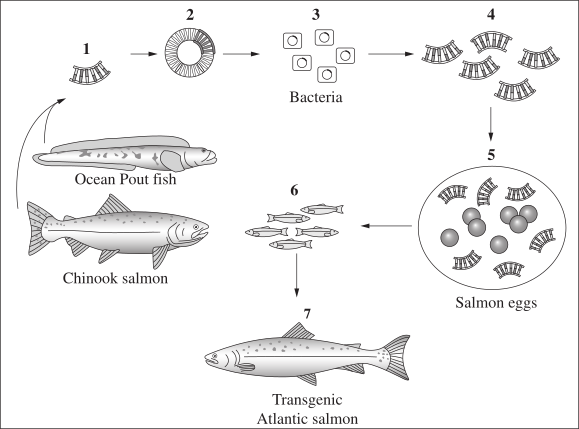
Genetically engineered Atlantic salmon have been produced and approved for aquaculture in the US. These salmon have a transgene that includes a protein-coding sequence from a Chinook salmon's growth hormone gene and the promoter region of an Ocean Pout's antifreeze protein gene. The following diagram provides an overview of the production of the transgenic salmon.
 

Explain the processes shown in steps 1-4.   (3 marks)

--- 5 WORK AREA LINES (style=lined) ---

Show Answers Only

Step 1–2: The transgene is inserted into a plasmid by using enzymes.

Step 2–3: The hybrid plasmid is then placed into a bacterial host.

Step 3–4: As the bacteria replicates via binary fission, multiple copies of the hybrid plasmid are obtained.

Show Worked Solution

Step 1–2: The transgene is inserted into a plasmid by using enzymes.

Step 2–3: The hybrid plasmid is then placed into a bacterial host.

Step 3–4: As the bacteria replicates via binary fission, multiple copies of the hybrid plasmid are obtained.


Mean mark 54%.

Filed Under: Genetic Technologies Tagged With: Band 5, smc-3654-05-Transgenic Organisms

BIOLOGY, M6 2019 HSC 19-20 MC

Use the following diagram to answer Questions 19-20.

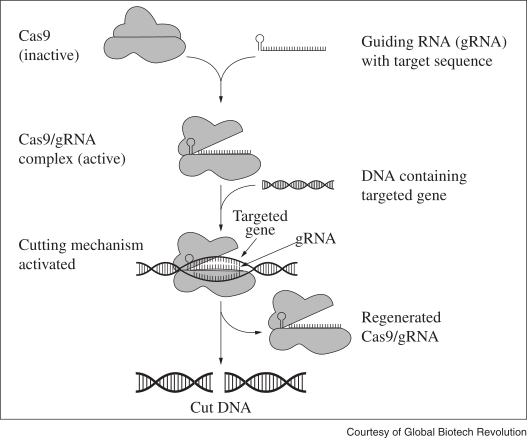
The diagram shows how CRISPR/Cas9 can be used as a new tool for genetic engineering. This technology has dramatically improved scientists' ability to successfully modify genomes.
 

Question 19

What type of structure must Cas9 be?

  1. Enzyme
  2. mRNA
  3. Ribosome
  4. tRNA

 
Question 20

Scientists have been able to use biotechnology to 'cut and paste' DNA for decades.

Why would the new CRISPR/Cas9 technology have improved the scientists' success in cutting DNA of specific genes?

  1. Cas9 is able to combine with specific DNA.
  2. Cas 9 has an active site that cuts target DNA.
  3. gRNA has the same nucleotides as the target DNA.
  4. gRNA has nucleotides complementary to the target DNA.
Show Answers Only

Question 19: `A`

Question 20: `D`

Show Worked Solution

Question 19

  • Cas9 performs a ‘cutting mechanism’, a property of DNA helicase, a known enzyme.
  • Cas9 also contains a recognition site which it uses to perform its tasks, another property of enzymes.

`=>A`
  

Question 20

  • Cas9 has gRNA with complementary bases to the target gene, as displayed in the diagram above.
  • The improvement is due to this feature, as scientists can now use multiple gRNA sequences to cut various amounts of genes and various recognition sites.

`=>D`


♦♦♦ Mean mark (Q20) 23%.

Filed Under: Biotechnology, Genetic Technologies Tagged With: Band 4, Band 6, smc-3653-20-Evaluating Genetic Technology, smc-3654-05-Transgenic Organisms, smc-3654-80-Gene Cloning

BIOLOGY, M6 2022 HSC 29

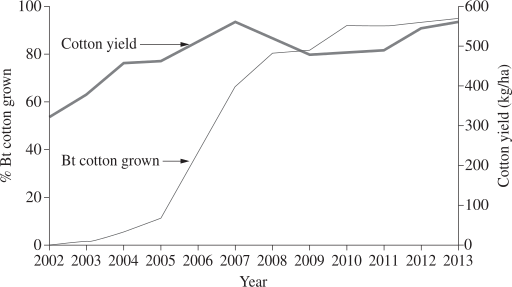
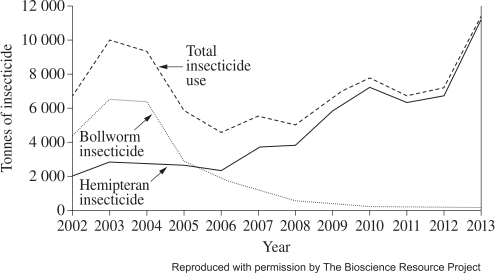
Bt cotton has been genetically engineered to produce an insecticide that kills cotton bollworm. It was introduced to a cotton-producing nation in 2002.

The graphs show trends of national cotton yield, % Bt cotton grown, total insecticide use, insecticide use to control bollworms and insecticide use to control another insect pest (hemiptera).


  1. Explain ONE reason why cotton yield changed between 2002 and 2013.  (2 marks)

    --- 4 WORK AREA LINES (style=lined) ---

  2. To what extent do the data support the use of Bt cotton as a method of disease control in cotton?  (5 marks)

    --- 12 WORK AREA LINES (style=lined) ---

Show Answers Only

a.   Cotton yield increase between 2002-2013:

  • The cotton yield increased because the pesticide produced by Bt cotton will decrease the likelihood of the plant contracting Bollworm, which kills the plant.
  • This increases the percentage of healthy cotton, increasing the yield of cotton that is harvested.  

b.   Use of Bt cotton for disease control:

  • Bt cotton is effective in producing plants resistant to Bollworm.
  • The amount of pesticide used for Bollworm dropped to less than 500 tonnes by 2008, and approaching zero by 2013.
  • This saves farmers money which can be spent on other measures effective for disease control, such as better hygiene in the workplace.
  • The top graph also shows an increase in cotton yield, further supporting the statement above.
     
  • Bt cotton however is not effective as a method of disease control against Hemipteran.
  • The amount of pesticide used for Hemipteran increased by 8000 tonnes from 2002 to 2013. This increase has taken the total pesticide used in 2013 to above that used in 2002.
  • While Bt cotton may be effective against Bollworm, other pests such as Hemipteran can now thrive and cause problems to cotton farms.
  • More studies with other cotton pest species need to be done in a similar style to prove if Bt cotton would be a well-rounded and effective method of disease control.
Show Worked Solution

a.   Cotton yield increase between 2002-2013:

  • The cotton yield increased because the pesticide produced by Bt cotton will decrease the likelihood of the plant contracting Bollworm, which kills the plant.
  • This increases the percentage of healthy cotton, increasing the yield of cotton that is harvested.    

b.   Use of Bt cotton for disease control:

  • Bt cotton is effective in producing plants resistant to Bollworm.
  • The amount of pesticide used for Bollworm dropped to less than 500 tonnes by 2008, and approaching zero by 2013.
  • This saves farmers money which can be spent on other measures effective for disease control, such as better hygiene in the workplace.
  • The top graph also shows an increase in cotton yield, further supporting the statement above.
     
  • Bt cotton however is not effective as a method of disease control against Hemipteran.
  • The amount of pesticide used for Hemipteran increased by 8000 tonnes from 2002 to 2013. This increase has taken the total pesticide used in 2013 to above that used in 2002.
  • While Bt cotton may be effective against Bollworm, other pests such as Hemipteran can now thrive and cause problems to cotton farms.
  • More studies with other cotton pest species need to be done in a similar style to prove if Bt cotton would be a well-rounded and effective method of disease control.

♦ Mean mark (b) 47%.

Filed Under: Biotechnology, Genetic Technologies Tagged With: Band 4, Band 5, smc-3653-20-Evaluating Genetic Technology, smc-3654-05-Transgenic Organisms, smc-3654-20-Agriculture

BIOLOGY, M7 2020 HSC 30

Explain the impact that genetic technologies have had on the management of both infectious and non-infectious diseases.   (7 marks)

--- 16 WORK AREA LINES (style=lined) ---

Show Answers Only

Non Infectious diseases

  • Down syndrome and diabetes are examples of non-infectious diseases that are not caused by pathogens and are not contagious.
  • Recombinant DNA: This technology delivers replacement genes by creating recombinant plasmids in bacteria which then multiply via binary fission.
  • This has been used to produce insulin by inserting a copy of the human insulin gene for the treatment of diabetic patients.
  • Pre-Implantation Genetic Testing: before IVF, eggs can be tested for various genetic diseases, such as down syndrome or cystic fibrosis.

Infectious diseases

  • These diseases are caused by pathogens.
  • The genetic makeup of organisms can be altered to lower risk of such diseases.
  • Transgenic Organisms involve technology that combines genes from other species to incorporate certain characteristics.
  • For example, Recombinant Bt corn contains a gene that is toxic to the destructive European corn borer. This will protect the corn and reduce the occurence of the associated infectious disease in humans.
Show Worked Solution

Non Infectious diseases

  • Down syndrome and diabetes are examples of non-infectious diseases that are not caused by pathogens and are not contagious.
  • Recombinant DNA: This technology delivers replacement genes by creating recombinant plasmids in bacteria which then multiply via binary fission.
  • This has been used to produce insulin by inserting a copy of the human insulin gene for the treatment of diabetic patients.
  • Pre-Implantation Genetic Testing: before IVF, eggs can be tested for various genetic diseases, such as down syndrome or cystic fibrosis.

Infectious diseases

  • These diseases are caused by pathogens.
  • The genetic makeup of organisms can be altered to lower risk of such diseases.
  • Transgenic Organisms involve technology that combines genes from other species to incorporate certain characteristics.
  • For example, Recombinant Bt corn contains a gene that is toxic to the destructive European corn borer. This will protect the corn and reduce the occurence of the associated infectious disease in humans.

♦♦ Mean mark 44%.

Filed Under: Genetic Technologies, Prevention Tagged With: Band 5, smc-3654-05-Transgenic Organisms, smc-3654-30-Benefits, smc-3654-80-Gene Cloning, smc-3662-20-Genetic Engineering

Copyright © 2014–2025 SmarterEd.com.au · Log in