SmarterEd

Aussie Maths & Science Teachers: Save your time with SmarterEd

  • Login
  • Get Help
  • About

BIOLOGY, M7 2024 HSC 10 MC

Francesco Redi challenged the idea that maggots arose spontaneously from rotting meat. A modern version of his experiment was set up as shown.
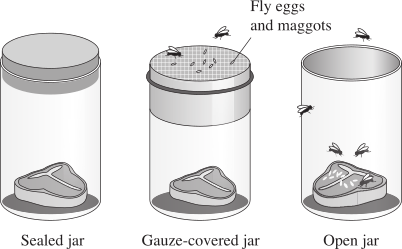
 

Which of the following is correct for this experimental set up?

  1. The sealed jar improves the validity of the experiment.
  2. The independent variable is whether the meat spoils or not.
  3. The use of three jars improves the reliability of the experiment.
  4. The dependent variable is the use of different covers for the jars.
Show Answers Only

\(A\)

Show Worked Solution
  • The sealed jar improves the validity of Redi’s experiment because it serves as a proper control that completely prevents flies from reaching the meat.
  • This allows Redi to conclusively demonstrate that maggots come from flies laying eggs rather than spontaneous generation.

\(\Rightarrow A\)

Mean mark 58%.

Filed Under: Causes of Infectious Disease Tagged With: Band 4, smc-3655-20-Transmission, smc-3655-30-Vectors

BIOLOGY, M7 2024 HSC 8 MC

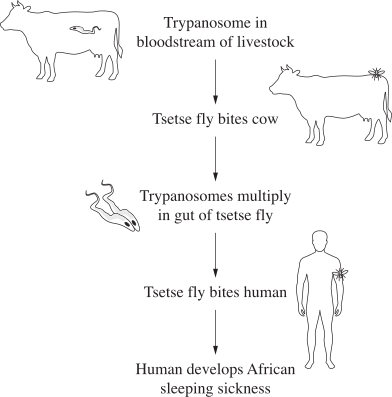
Trypanosomes (Trypanosoma brucei) are protozoans that cause African sleeping sickness in humans. The diagram shows the way that the disease is transmitted to humans.
 

Which row of the table identifies the pathogen, vector and method of disease transmission to humans?

\begin{align*}
\begin{array}{l}
\rule{0pt}{2.5ex}\ & \\
\ & \rule[-1ex]{0pt}{0pt} \\ 
\rule{0pt}{2.5ex} \textbf{A.}\rule[-1ex]{0pt}{0pt}\\
\rule{0pt}{2.5ex} \textbf{B.}\rule[-1ex]{0pt}{0pt}\\
\rule{0pt}{2.5ex} \textbf{C.}\rule[-1ex]{0pt}{0pt}\\
\rule{0pt}{2.5ex} \textbf{D.}\rule[-1ex]{0pt}{0pt}\\
\end{array}
\begin{array}{|l|l|l|}
\hline
\rule{0pt}{2.5ex} \quad \textit{Pathogen} & \ \ \textit{Vector} & \ \ \textit{Method of disease} \\
\textit{} \rule[-1ex]{0pt}{0pt} & \textit{} & \ \ \textit{transmission} \\
\hline
\rule{0pt}{2.5ex}\text{Trypanosomes} \rule[-1ex]{0pt}{0pt}&  \text{Tsetse fly}& \text{Direct} \\
\hline
\rule{0pt}{2.5ex}\text{Tsetse fly} \rule[-1ex]{0pt}{0pt}& \text{Cow} & \text{Direct} \\
\hline
\rule{0pt}{2.5ex}\text{Trypanosomes} \rule[-1ex]{0pt}{0pt}& \text{Tsetse fly} & \text{Indirect}\\
\hline
\rule{0pt}{2.5ex}\text{Tsetse fly} \rule[-1ex]{0pt}{0pt}&  \text{Cow} & \text{Indirect}\\
\hline
\end{array}
\end{align*}

Show Answers Only

\(C\)

Show Worked Solution
  • African sleeping sickness is caused by trypanosome parasites (pathogen).
  • The pathogens are transmitted indirectly to humans through the bite of tsetse flies (vector).

\(\Rightarrow C\)

♦ Mean mark 48%.

Filed Under: Causes of Infectious Disease Tagged With: Band 5, smc-3655-10-Classifying Pathogens, smc-3655-20-Transmission, smc-3655-30-Vectors

BIOLOGY, M7 EQ-Bank 7 MC

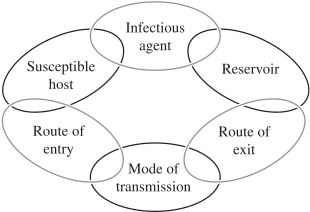
The diagram shows a model of disease transmission.
 

An epidemiologist suspected that bats were acting as a reservoir for an infectious disease in humans.

Which condition would need to be met to confirm the epidemiologist's suspicion?

  1. The infectious agent would need to have a mode of entry into humans.
  2. The infectious agent would need a mode of transmission from bats to humans.
  3. The bats would have to be able to transmit the infectious agent between each other.
  4. The susceptible human host must be able to transmit the infectious agent to the reservoir of bats.
Show Answers Only

`B`

Show Worked Solution
  • For the assumption to be true, the pathogen would need to have developed an adaptation allowing it to transfer from bats to humans.

`=>B`

Filed Under: Causes of Infectious Disease Tagged With: Band 5, smc-3655-20-Transmission, smc-3655-40-Pathogen Adaptations

BIOLOGY, M7 EQ-Bank 3 MC

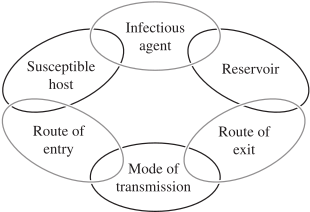
The diagram shows a model of disease transmission.
 

A pathogen was identified as being unadapted to dry conditions and as having the gastrointestinal tract as the 'route of entry' and the 'route of exit'.

Using this information, what is the most likely mode of transmission?

  1. Skin to skin contact
  2. Coughing or sneezing
  3. Contaminated water supplies
  4. Transmission of infected blood products
Show Answers Only

`C`

Show Worked Solution
  • The pathogen is most likely to have adapted to be transmitted through conditions which are moist and can be more effective at entering through the gastrointestinal tract.

`=>C`

Filed Under: Causes of Infectious Disease Tagged With: Band 4, smc-3655-20-Transmission, smc-3655-40-Pathogen Adaptations

BIOLOGY, M7 2020 HSC 32a

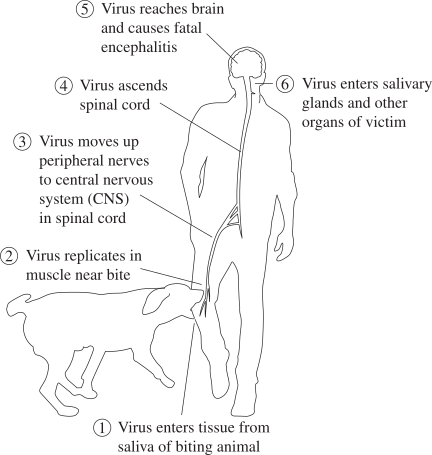
Rabies is a disease that can affect all mammals and is caused by the rabies virus. It is transmitted by the bite of an infected animal. Without treatment it almost always results in death.


Use the information provided to identify TWO features of the rabies infection that facilitate transmission of the pathogen to a new host.   (2 marks) 

Show Answers Only

Successful answers should include two of the following:

  • The rabies virus can travel through the nervous system which allows it to reach the salivary glands.
  • The virus can then be directly transmitted to another host with a bite from the infected host.
  • The virus can replicate in muscle after an infected bite.
Show Worked Solution

Successful answers should include two of the following:

  • The rabies virus can travel through the nervous system which allows it to reach the salivary glands.
  • The virus can then be directly transmitted to another host with a bite from the infected host.
  • The virus can replicate in muscle after an infected bite.

Mean mark 51%.

Filed Under: Causes of Infectious Disease Tagged With: Band 5, smc-3655-20-Transmission, smc-3655-40-Pathogen Adaptations

BIOLOGY, M7 2019 HSC 31

  1. Outline ONE adaptation of a specific pathogen that facilitates its entry into a host.   (2 marks)

    --- 4 WORK AREA LINES (style=lined) ---

  2. Explain how the mode of transmission of pathogens influences the spread of diseases.   (3 marks)

    --- 6 WORK AREA LINES (style=lined) ---

Show Answers Only

a.    Helicobacter pylori is a bacteria that causes stomach ulcers.

  • It has flagellum which allows it to move in the stomach and penetrate the stomach wall. 

Other answers could include:

  • Salmonella and its ability to adapt to host blood temperature. 

b.    Diseases will be able to spread faster and easier with certain modes of transmission.

  • Airborne disease such as influenza are able to spread faster as the virus can be passed through droplets of air by infected individuals sneezing/coughing.
  • Diseases that can only spread via direct contact will have lower infection rates as there is a less effective mode of transmission. 

Other answers could include the effectiveness of modes such as 

  • Vectors and their presence in an area influencing infection rate.
  • Foodborne/waterborne diseases.
  • Zoonotic diseases.
Show Worked Solution

a.    Helicobacter pylori is a bacteria that causes stomach ulcers.

  • It has flagellum which allows it to move in the stomach and penetrate the stomach wall. 

Other answers could include:

  • Salmonella and its ability to adapt to host blood temperature. 

♦♦ Mean mark (a) 36%.

b.    Diseases will be able to spread faster and easier with certain modes of transmission.

  • Airborne disease such as influenza are able to spread faster as the virus can be passed through droplets of air by infected individuals sneezing/coughing.
  • Diseases that can only spread via direct contact will have lower infection rates as there is a less effective mode of transmission. 

Other answers could include the effectiveness of modes such as 

  • Vectors and their presence in an area influencing infection rate.
  • Foodborne/waterborne diseases.
  • Zoonotic diseases.

Filed Under: Causes of Infectious Disease Tagged With: Band 4, Band 5, smc-3655-20-Transmission, smc-3655-30-Vectors, smc-3655-40-Pathogen Adaptations

BIOLOGY, M7 2022 HSC 21a

Outline ONE way that a pathogen can pass from person to person.  (2 marks)

--- 4 WORK AREA LINES (style=lined) ---

Show Answers Only
  • A pathogen such as a bacteria, protozoa or fungus can be passed from person to person by direct transmission
  • This involves skin to skin contact, such as sexual intercourse or shaking hands. 

Other modes of transmission include:

  • Object contamination.
  • Waterborne, foodborne or airborne.
  • Animal faeces or nasal secretions.
  • Bodily fluids/respiratory droplets.
Show Worked Solution
  • A pathogen such as a bacteria, protozoa or fungus can be passed from person to person by direct transmission
  • This involves skin to skin contact, such as sexual intercourse or shaking hands. 

Other modes of transmission include:

  • Object contamination.
  • Waterborne, foodborne or airborne.
  • Animal faeces or nasal secretions.
  • Bodily fluids/respiratory droplets.

Filed Under: Causes of Infectious Disease Tagged With: Band 2, smc-3655-20-Transmission, smc-3655-30-Vectors

Copyright © 2014–2025 SmarterEd.com.au · Log in