SmarterEd

Aussie Maths & Science Teachers: Save your time with SmarterEd

  • Login
  • Get Help
  • About

BIOLOGY, M7 2024 HSC 12 MC

Robert Koch produced a set of criteria to establish whether a particular organism is the cause of a disease in an animal. The criteria are listed below but not in the correct order.
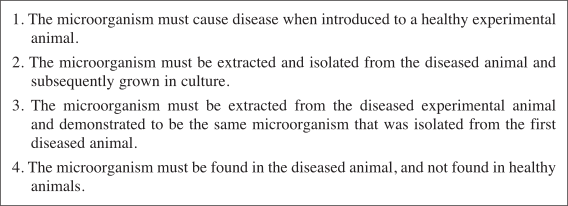
 

Which of the following correctly shows the order of steps required to determine the cause of a particular disease in an animal?

  1. 2, 3, 1, 4
  2. 2, 4, 1, 3
  3. 4, 2, 1, 3
  4. 4, 3, 2, 1
Show Answers Only

\(C\)

Show Worked Solution
  • Koch’s postulates follow a logical sequence of first identifying the microorganism in sick but not healthy animals (4).
  • Second step is isolating and culturing it (2), using it to infect a healthy animal to prove it causes disease (1), and finally re-isolating the same organism from the newly infected animal (3) to conclusively prove causation.

\(\Rightarrow C\)

Filed Under: Causes of Infectious Disease Tagged With: Band 4, smc-3655-70-Robert Koch

BIOLOGY, M7 EQ-Bank 8 MC

Eight sick animals had the same symptoms. Blood tests showed that they were infected with the same type of bacterium.

Which of the following would be the best course of action to determine if this particular type of bacterium is the cause of the symptoms?

  1. Treat all eight animals with the antibiotic known to kill this type of bacterium. Check if they recover.
  2. Find other animals with the same symptoms. Attempt to isolate the same type of bacterium from their blood.
  3. Inject blood from animals with the symptoms into suitable host individuals. Check if they develop the same symptoms.
  4. Use bacteria from the blood of affected animals to inoculate healthy animals. If these healthy animals develop the symptoms, attempt to isolate the same bacterium from their blood.
Show Answers Only

`D`

Show Worked Solution
  • The blood from an affected animal will contain bacteria that is presumed to be responsible for the disease.
  • If it is injected into healthy organisms that subsequently develop the same symptoms, and their blood is isolated and observed to have the same bacteria, then it is certain that the bacteria is responsible for the disease.
  • This follows Koch’s postulates.

`=>D`

Filed Under: Causes of Infectious Disease Tagged With: Band 5, smc-3655-70-Robert Koch

BIOLOGY, M8 2018 HSC 30

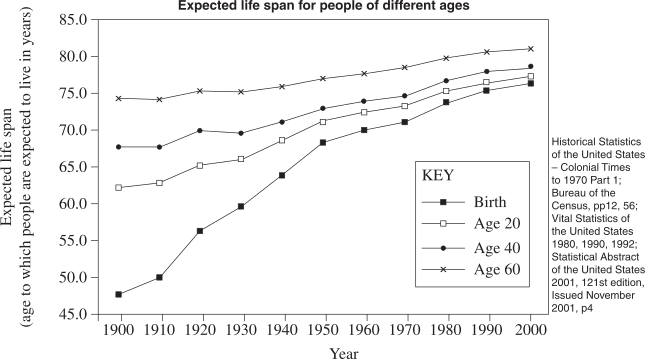
The graph shows the expected life span (the age to which people are expected to live in years) for people of different ages during the 20th century in one country.
 

There have been many biological developments that have contributed to our understanding of the identification, treatment and prevention of disease.

Evaluate the impact of these developments on the expected life span. In your answer, include reference to trends in the data provided.  (8 marks)

--- 18 WORK AREA LINES (style=lined) ---

Show Answers Only
  • For all ages listed in the graph, life expectancy increased during the 20th century.
  • The lifespan from birth has increased more significantly than other ages ~ 48 to 74 years.
  • The smallest increase being for 60 year olds at ~ 5 years.
  • The ability to understand pathogens and the causes of infectious disease (Koch and Pasteur) has led to early identification and treatment of childhood illnesses such as rubella, polio and whooping cough.
  • Koch and Pasteur established germ theory, culture techniques and a set of postulates to follow in order to create the link between a particular pathogen and disease.
  • Vaccines to combat childhood illnesses were developed through a knowledge of germ theory.
  • The infant/childhood mortality rate has improved significantly, and hence life expectancy, due to the immunity provided by vaccines.
  • An understanding of inherited disorders has also improved lifespans with early diagnosis and prenatal genetic screening for genetic disorders and illnesses.
  • Antibiotic remedies were developed to combat bacterial diseases such as Staphylococcus aureus, due to an understanding of the difference between prokaryotic and eukaryotic cells.
  • With the use of antibiotics many diseases were then no longer life threatening, leading to improved mortality rates across all ages.
  • However, bacterial resistance has resulted with the overuse of antibiotics, so some diseases are now unresponsive to antibiotic treatment.
  • Epidemiology studies involving intricate planning and design, control groups and large scale analysis of data have lead to improvements in the treatment of non-infectious diseases such as cancer.
  • For example the discovery of links between smoking and lung cancer, sun exposure and melanoma, obesity and type II diabetes, has lead to widespread public health campaigns to inform people of the health risks and lowered the associated mortality rates.
  • Improved hygiene, food storage and preservation, and water filtration also occurred in the 20th century leading to fewer preventable diseases and hence increased life spans for all age groups.
  • Improved quarantine requirements have helped prevent the spread of plant, animal and human diseases via international travel.
  • In conclusion, developments in biology have lead to increased life expectancy across all age groups, with the biggest improvements for babies and children.
  • These benefits are not necessarily a worldwide phenomenon as poor living conditions and access to medical treatment is not available in many poor socioeconomic communities.
Show Worked Solution
  • For all ages listed in the graph, life expectancy increased during the 20th century.
  • The lifespan from birth has increased more significantly than other ages ~ 48 to 74 years.
  • The smallest increase being for 60 year olds at ~ 5 years.
  • The ability to understand pathogens and the causes of infectious disease (Koch and Pasteur) has led to early identification and treatment of childhood illnesses such as rubella, polio and whooping cough.
  • Koch and Pasteur established germ theory, culture techniques and a set of postulates to follow in order to create the link between a particular pathogen and disease.
  • Vaccines to combat childhood illnesses were developed through a knowledge of germ theory.
  • The infant/childhood mortality rate has improved significantly, and hence life expectancy, due to the immunity provided by vaccines.
  • An understanding of inherited disorders has also improved lifespans with early diagnosis and prenatal genetic screening for genetic disorders and illnesses.
  • Antibiotic remedies were developed to combat bacterial diseases such as Staphylococcus aureus, due to an understanding of the difference between prokaryotic and eukaryotic cells.
  • With the use of antibiotics many diseases were then no longer life threatening, leading to improved mortality rates across all ages.
  • However, bacterial resistance has resulted with the overuse of antibiotics, so some diseases are now unresponsive to antibiotic treatment.
  • Epidemiology studies involving intricate planning and design, control groups and large scale analysis of data have lead to improvements in the treatment of non-infectious diseases such as cancer.
  • For example the discovery of links between smoking and lung cancer, sun exposure and melanoma, obesity and type II diabetes, has lead to widespread public health campaigns to inform people of the health risks and lowered the associated mortality rates.
  • Improved hygiene, food storage and preservation, and water filtration also occurred in the 20th century leading to fewer preventable diseases and hence increased life spans for all age groups.
  • Improved quarantine requirements have helped prevent the spread of plant, animal and human diseases via international travel.
  • In conclusion, developments in biology have lead to increased life expectancy across all age groups, with the biggest improvements for babies and children.
  • These benefits are not necessarily

♦♦ Mean mark 35%.

Filed Under: Causes of Infectious Disease, Epidemiology, Prevention, Treatment and Control Tagged With: Band 5, Band 6, smc-3655-60-Louis Pasteur, smc-3655-70-Robert Koch, smc-3658-11-Pharmaceuticals, smc-3658-20-Vaccines, smc-3658-30-Procedures to Prevent Spread, smc-3661-10-Analysing Results

BIOLOGY, M7 2018 HSC 22b

Describe the contribution of Robert Koch to our understanding of disease.  (3 marks)

--- 6 WORK AREA LINES (style=lined) ---

Show Answers Only
  • Robert Koch demonstrated a relationship between microbes and infectious disease.
  • Koch revealed that specific infectious diseases were caused by specific microbes.
  • He developed Koch’s postulates which allow for the identification of specific diseases.
Show Worked Solution
  • Robert Koch demonstrated a relationship between microbes and infectious disease.
  • Koch revealed that specific infectious diseases were caused by specific microbes.
  • He developed Koch’s postulates which allow for the identification of specific diseases.

Mean mark 58%.

Filed Under: Causes of Infectious Disease Tagged With: Band 4, smc-3655-70-Robert Koch

BIOLOGY, M7 2021 HSC 21

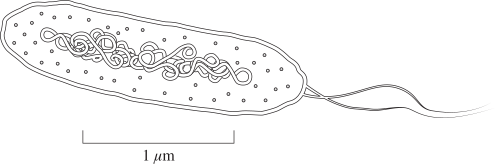
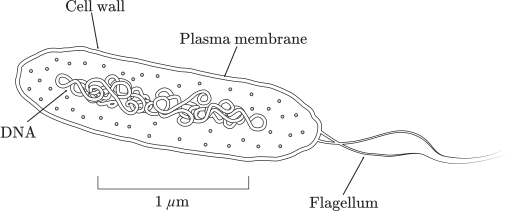
  1. Label TWO features on the diagram below that would help to classify this pathogen as a bacterium.   (2 marks)


  2. A scientist followed Koch's postulates to confirm that this bacterium was causing diarrhoea in pigs on a local farm. 
  3. Complete the boxes in the flowchart provided to show the steps taken by the scientist.    (2 marks)


  4.  
  5. Two pig farmers on neighbouring farms noticed that their pigs were suffering from diarrhoea and gradually losing weight. The farmers each adopted a different strategy to deal with this disease, as shown in the table.  

\begin{array} {|c|l|l|}
\hline
\rule{0pt}{2.5ex} \quad \textit{Farm} \quad \rule[-1ex]{0pt}{0pt} & \quad\quad\quad \quad \textit{Strategy} & \quad\quad\quad \quad \textit{Result}\\
\hline
\rule{0pt}{2.5ex} 1  & \text{Treatment with antibiotics} & \text{All pigs recovered after two}\\
\rule[-1ex]{0pt}{0pt} & \text{} & \text{weeks}\\
\hline
\rule{0pt}{2.5ex} 2  & \text{Elimination of rats and mice} & \text{Decrease in number of sick}\\
& \text{from pig sheds to improve} & \text{animals over three months}\\
\rule[-1ex]{0pt}{0pt} & \text{hygiene} & \\
\hline
\end{array}

Outline ONE benefit and ONE limitation of the strategies used on each farm.   (3 marks)

--- 6 WORK AREA LINES (style=lined) ---

Show Answers Only

a.    Include two of the following labels:


b.    Box 2: Bacteria grown in pure culture and identified.

Box 4: Healthy pig became ill with diarrhoea. 

c.   Benefits and Limitations of the strategies used on each farm.

  • The use of antibiotics on farm 1 has resulted in a rapid elimination of diarrhoea cases, however may induce antibiotic resistance in the
    future, rendering the strategy less effective.
  • The removal of rats and mice from pig sheds to increase hygiene on farm 2 is slow to eliminate diarrhoea cases, however provides reassurance to prevent future outbreaks. 

Other correct answers:

  • Proper hygiene practices can reduce incidence of other diseases, not just diarrhoea.
Show Worked Solution

a.    Include two of the following labels:


b.    Box 2: Bacteria grown in pure culture and identified.

Box 4: Healthy pig became ill with diarrhoea. 
 

c.   Benefits and Limitations of the strategies used on each farm.

  • The use of antibiotics on farm 1 has resulted in a rapid elimination of diarrhoea cases, however may induce antibiotic resistance in the
    future, rendering the strategy less effective.
  • The removal of rats and mice from pig sheds to increase hygiene on farm 2 is slow to eliminate diarrhoea cases, however provides reassurance to prevent future outbreaks. 

Other correct answers:

  • Proper hygiene practices can reduce incidence of other diseases, not just diarrhoea.

Filed Under: Causes of Infectious Disease, Prevention, Treatment and Control Tagged With: Band 3, Band 4, smc-3655-10-Classifying Pathogens, smc-3655-70-Robert Koch, smc-3658-30-Procedures to Prevent Spread

Copyright © 2014–2025 SmarterEd.com.au · Log in