SmarterEd

Aussie Maths & Science Teachers: Save your time with SmarterEd

  • Login
  • Get Help
  • About

BIOLOGY, M8 2023 HSC 12 MC

The following diagram shows the regulation of blood calcium \(\ce{(Ca^{2+})}\) levels in the body.
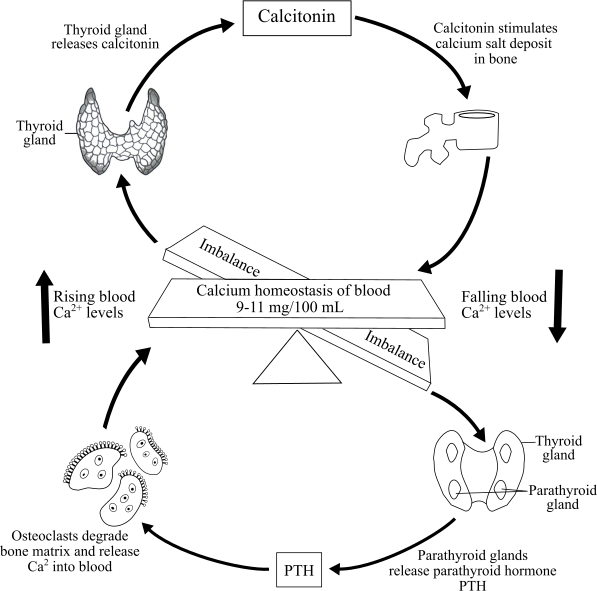


A blood test shows a person has a blood calcium level of 6 mg/100 mL.

What will occur in the body to restore homeostasis?

  1. Calcium will be deposited in the bones.
  2. Calcium will be removed from the bone matrix.
  3. The thyroid gland will release the hormone thyroxine.
  4. The thyroid gland will release the hormone calcitonin.
Show Answers Only

\(B\)

Show Worked Solution
  • 6 mg/100 mL is lower than the homeostasis concentration range.
  • This means that the parathyroid gland will release PTH causing \(\ce{Ca^{2+}}\) ions to be removed from the bone matrix.

\(\Rightarrow B\)

Mean mark 58%.

Filed Under: Homeostasis Tagged With: Band 4, smc-3659-12-Negative Feedback Loops

BIOLOGY, M8 2017 HSC 1 MC

What is the name of the process that enables organisms to maintain a relatively stable internal environment?

  1. Osmosis
  2. Adaptation
  3. Homeostasis
  4. Active transport
Show Answers Only

`C`

Show Worked Solution
  • Homeostasis is the process of keeping a fairly stable internal environment in response to change.

`=>C`

Filed Under: Homeostasis Tagged With: Band 2, smc-3659-12-Negative Feedback Loops

BIOLOGY, M8 2015 HSC 7-8 MC

Refer to the following information to answer Questions 7 and 8 .

The diagram shows a homeostatic mechanism in a mammal.
 

Question 7

What does `text{X}` represent in the diagram?

  1. The heart
  2. The brain
  3. A thermoreceptor in the skin
  4. A pressure receptor in a blood vessel

 
Question 8

Which of the following describes what happens to the muscles and the arteriole walls in the skin when the core body temperature is below normal?
 

Show Answers Only

Q7.  `B`
Q8.  `B`

Show Worked Solution

Q7.   `text{X}` = the brain

  • Messages are sent by the brain to the effectors.
  • This promotes a stimulus response.

`=>B`


♦♦ Mean mark (Q7) 38%.

Q8.   When body temperature is below normal:

  • Hairs stand on end and arteriole walls of skin contract to prevent the loss of heat.

`=>B`

Filed Under: Homeostasis Tagged With: Band 3, Band 5, smc-3659-12-Negative Feedback Loops, smc-3659-15-Temperature

BIOLOGY, M8 2019 HSC 21

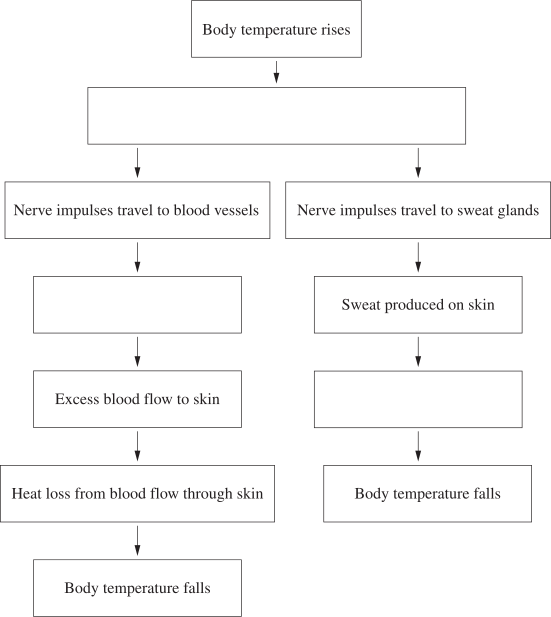
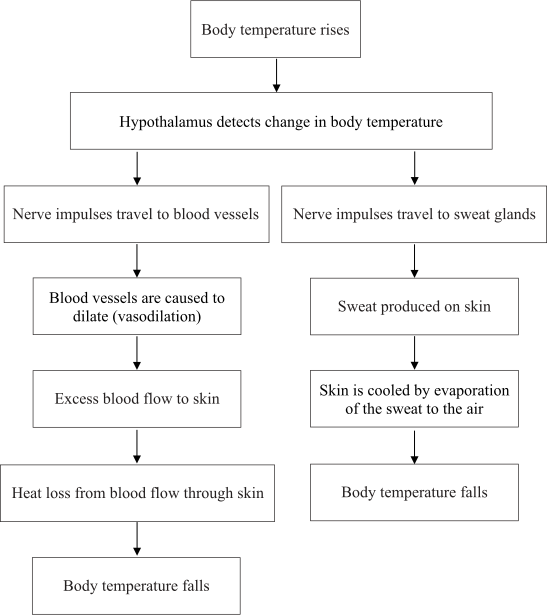
The diagram shows a flow chart of the reaction of a human body to an increase in temperature.

Fill in the three blank steps on the flow chart.   (3 marks)
 

--- 0 WORK AREA LINES (style=lined) ---

Show Answers Only

Show Worked Solution


Mean mark 53%.

Filed Under: Homeostasis Tagged With: Band 4, smc-3659-12-Negative Feedback Loops, smc-3659-15-Temperature

BIOLOGY, M5 2019 HSC 18 MC

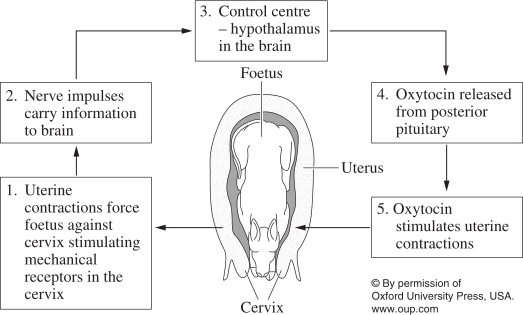
The diagram shows the effect of the hormone oxytocin on the uterus during the birth of a mammal.
 

 Which of the following best identifies and explains the feedback loop demonstrated in the diagram?
 
\begin{align*}
\begin{array}{l}
\ & \\
\rule{0pt}{3.5 ex}\textbf{A.}\\
\\
\textbf{B.}\\
\\
\textbf{C.}\\
\\
\textbf{D.}\\
\\
\end{array}
\begin{array}{|l|l|}
\hline
\rule{0pt}{2.5ex}\textit{Feedback loop} \rule[-1ex]{0pt}{0pt} & \quad \quad \quad \quad \quad \quad \quad \quad \quad \quad \textit{Explanation} \\
\hline
\text{Negative} & \text{The production of oxytocin results in the production of more} \\
\text{} & \text{oxytocin.} \\
\hline
\text{Positive} & \text{The production of oxytocin results in the production of more} \\
\text{} & \text{oxytocin.} \\
\hline
\text{Negative} & \text{The production of oxytocin results in the detection of the} \\
\text{} & \text{contraction by receptors in the cervix.} \\
\hline
\text{Positive} & \text{The production of oxytocin results in the detection of the} \\
\text{} & \text{contraction by receptors in the cervix.} \\
\hline
\end{array}
\end{align*}

Show Answers Only

\(B\)

Show Worked Solution
  • Oxytocin is a chemical which maintains cervical contractions by releasing more oxytocin when the cervix is contracted, a property of a positive feedback mechanism.

\(\Rightarrow B\)


♦♦ Mean mark 31%.

Filed Under: Homeostasis, Reproduction Tagged With: Band 5, smc-3647-05-Human/Mammal, smc-3647-50-Hormones, smc-3659-12-Negative Feedback Loops

BIOLOGY, M8 2019 HSC 12 MC

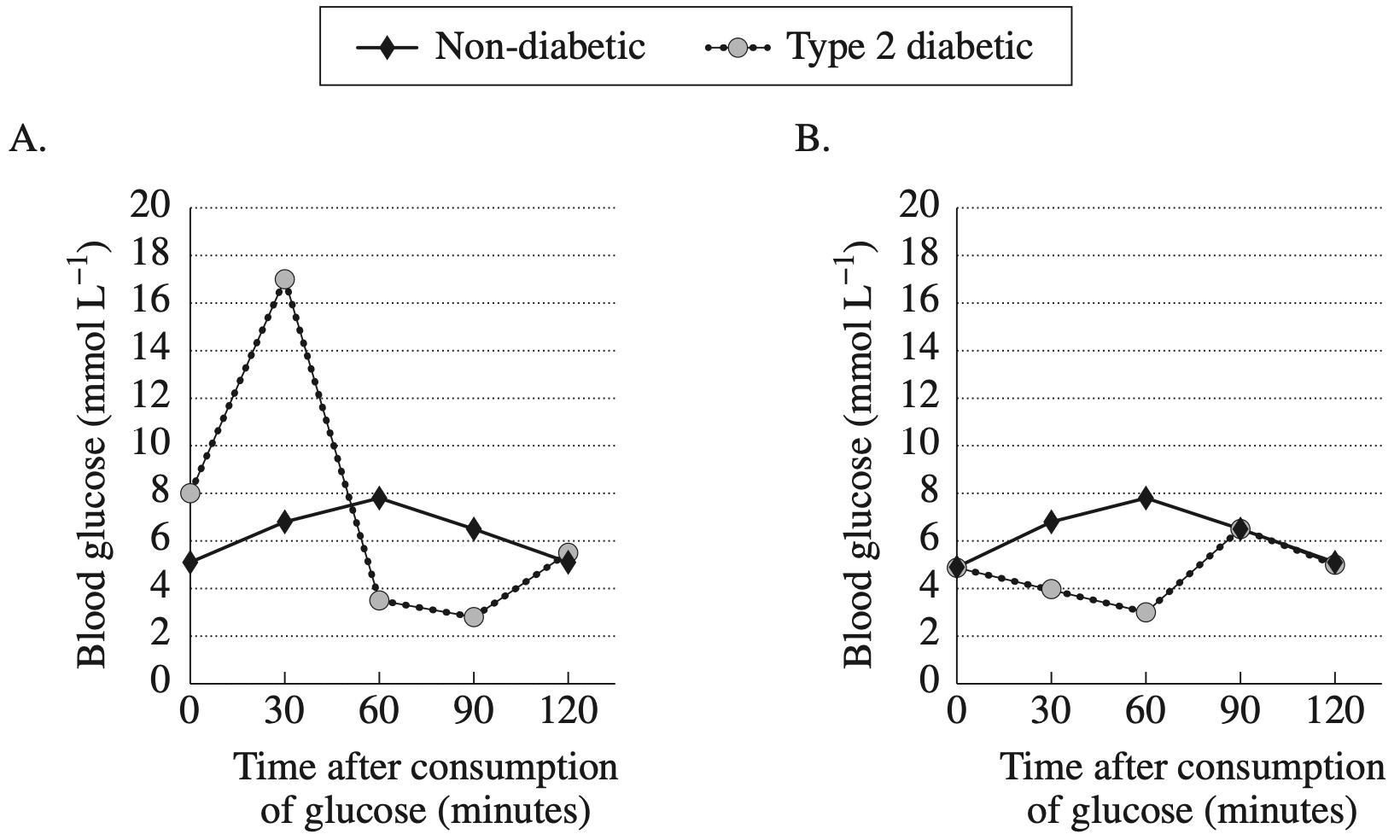
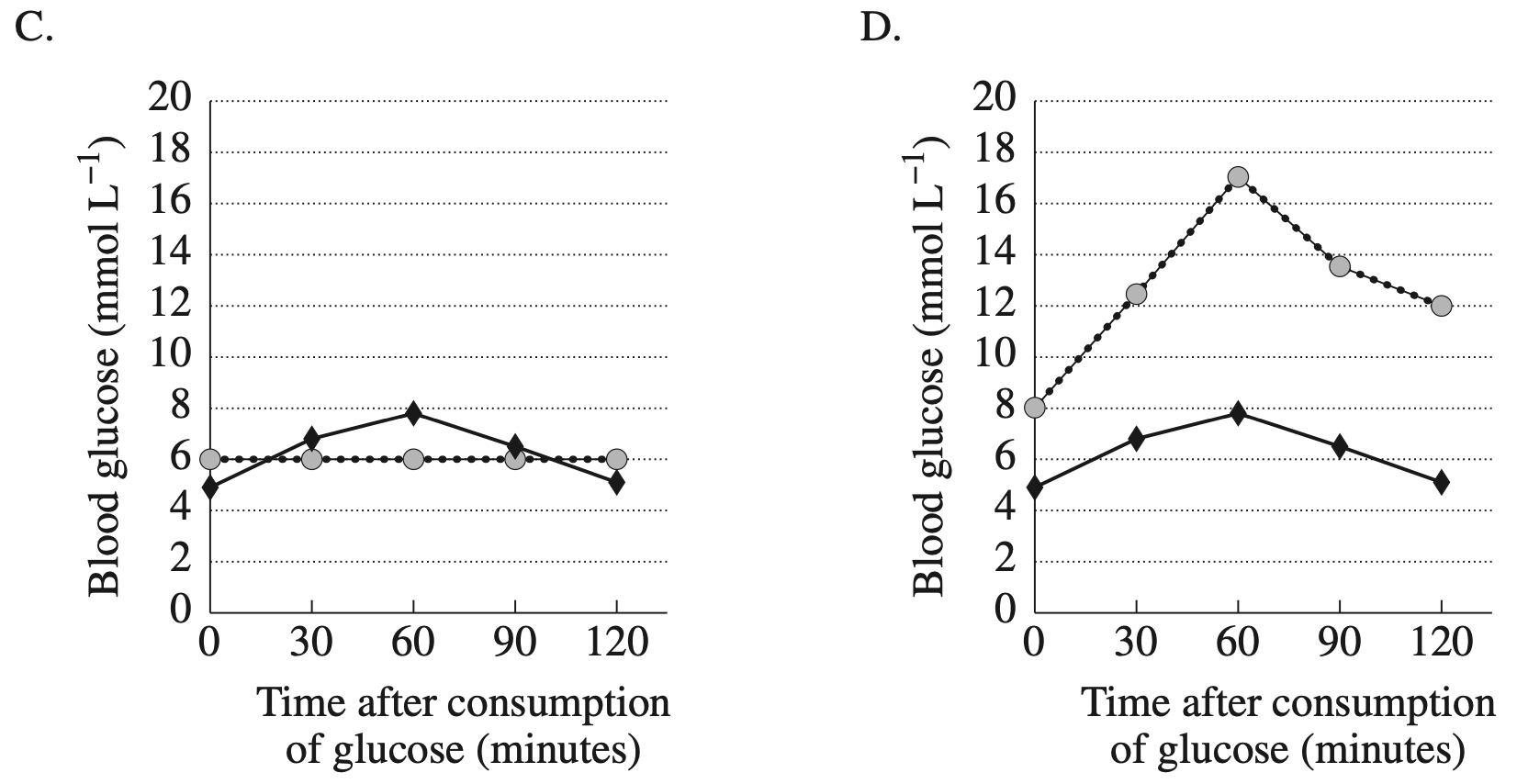
The glucose tolerance test is used to investigate the control of glucose in the human body. Patients consume 75 g of glucose and their blood glucose is monitored.

Type 2 diabetes is a condition where the cells of the body do not respond adequately to insulin.

Which graph could represent the results of glucose tolerance tests in a non-diabetic person and a person with untreated Type 2 diabetes?
  

Show Answers Only

`D`

Show Worked Solution
  • In a type 2 diabetic, glucose cannot be actively stored as glycogen as fast as a person with a functioning pancreases, leading to a build up of glucose in the bloodstream.
  • Graph D is the only graph that shows a type 2 diabetics BGL above that of a non-diabetic. 

`=>D`


Mean mark 55%.

Filed Under: Homeostasis Tagged With: Band 4, smc-3659-12-Negative Feedback Loops, smc-3659-25-BGL/Diabetes

BIOLOGY, M8 2020 HSC 31

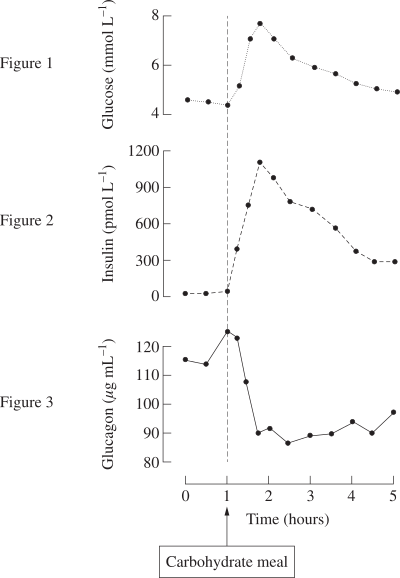
  1. The levels of glucose, insulin and glucagon were measured in the plasma of 24 healthy adults at intervals over a 5-hour period. After 1 hour at rest the patients ate a large carbohydrate meal. The results are shown.

  2. Use the data provided to explain how blood glucose is controlled in the body.   (6 marks)

    --- 12 WORK AREA LINES (style=lined) ---

  3. Outline how in humans, maintenance of temperature is different to the way that glucose is controlled.   (3 marks)

    --- 6 WORK AREA LINES (style=lined) ---

Show Answers Only

a.   Glucose Levels

  • Plasma levels within the first 60 minutes represent the resting glucose levels of the individuals.
  • After the 1 hour mark, the rise in glucose is a result of the absorption of glucose into the bloodstream from the gut after eating the carb rich meal.

Insulin Levels

  • Insulin is a hormone secreted by beta cells in the pancreas. It causes excess glucose in the bloodstream to be taken by the liver and stored as glycogen.
  • This can be seen when the insulin levels directly correlate to the amount of glucose in the body; glucose absorbed in the meal stimulates release of insulin.
  • The reduction in glucose by the insulin then causes insulin to also fall.

Glucagon Levels

  • Glucagon is a hormone secreted by alpha cells in the pancreas. It can almost be seen as the opposite of insulin, and forms the negative feedback loop responsible for controlling blood glucose. 
  • It causes glycogen stores in the liver to decompose into glucose and be absorbed by the bloodstream when blood glucose levels drop too low.
  • When glucose levels rise between the 1-2 hour mark, glucagon levels drop significantly, as the build up of glucose from the meal has meant that glycogen stores are not needed.
  • Gradually, as glucose levels drop, glucagon levels will increase as the glucose from the meal is depleted.

b.  Differences in temperature vs glucose maintenance

  • Temperature changes are detected by the hypothalamus and sensory neurons, but changes in blood glucose levels (BGL) are detected by the pancreas.
  • Responses are carried out by the nervous system when temperature changes are detected, but carried out by hormones when changes in BGL are detected.
Show Worked Solution

a.   Glucose Levels

  • Plasma levels within the first 60 minutes represent the resting glucose levels of the individuals.
  • After the 1 hour mark, the rise in glucose is a result of the absorption of glucose into the bloodstream from the gut after eating the carb rich meal.

Insulin Levels

  • Insulin is a hormone secreted by beta cells in the pancreas. It causes excess glucose in the bloodstream to be taken by the liver and stored as glycogen.
  • This can be seen when the insulin levels directly correlate to the amount of glucose in the body; glucose absorbed in the meal stimulates release of insulin.
  • The reduction in glucose by the insulin then causes insulin to also fall.

Glucagon Levels

  • Glucagon is a hormone secreted by alpha cells in the pancreas. It can almost be seen as the opposite of insulin, and forms the negative feedback loop responsible for controlling blood glucose. 
  • It causes glycogen stores in the liver to decompose into glucose and be absorbed by the bloodstream when blood glucose levels drop too low.
  • When glucose levels rise between the 1-2 hour mark, glucagon levels drop significantly, as the build up of glucose from the meal has meant that glycogen stores are not needed.
  • Gradually, as glucose levels drop, glucagon levels will increase as the glucose from the meal is depleted.

♦ Mean mark (a) 48%.

b.  Differences in temperature vs glucose maintenance

  • Temperature changes are detected by the hypothalamus and sensory neurons, but changes in blood glucose levels (BGL) are detected by the pancreas.
  • Responses are carried out by the nervous system when temperature changes are detected, but carried out by hormones when changes in BGL are detected.

♦♦ Mean mark (b) 36%.

Filed Under: Homeostasis Tagged With: Band 5, Band 6, smc-3659-12-Negative Feedback Loops, smc-3659-25-BGL/Diabetes

BIOLOGY, M8 2021 HSC 32

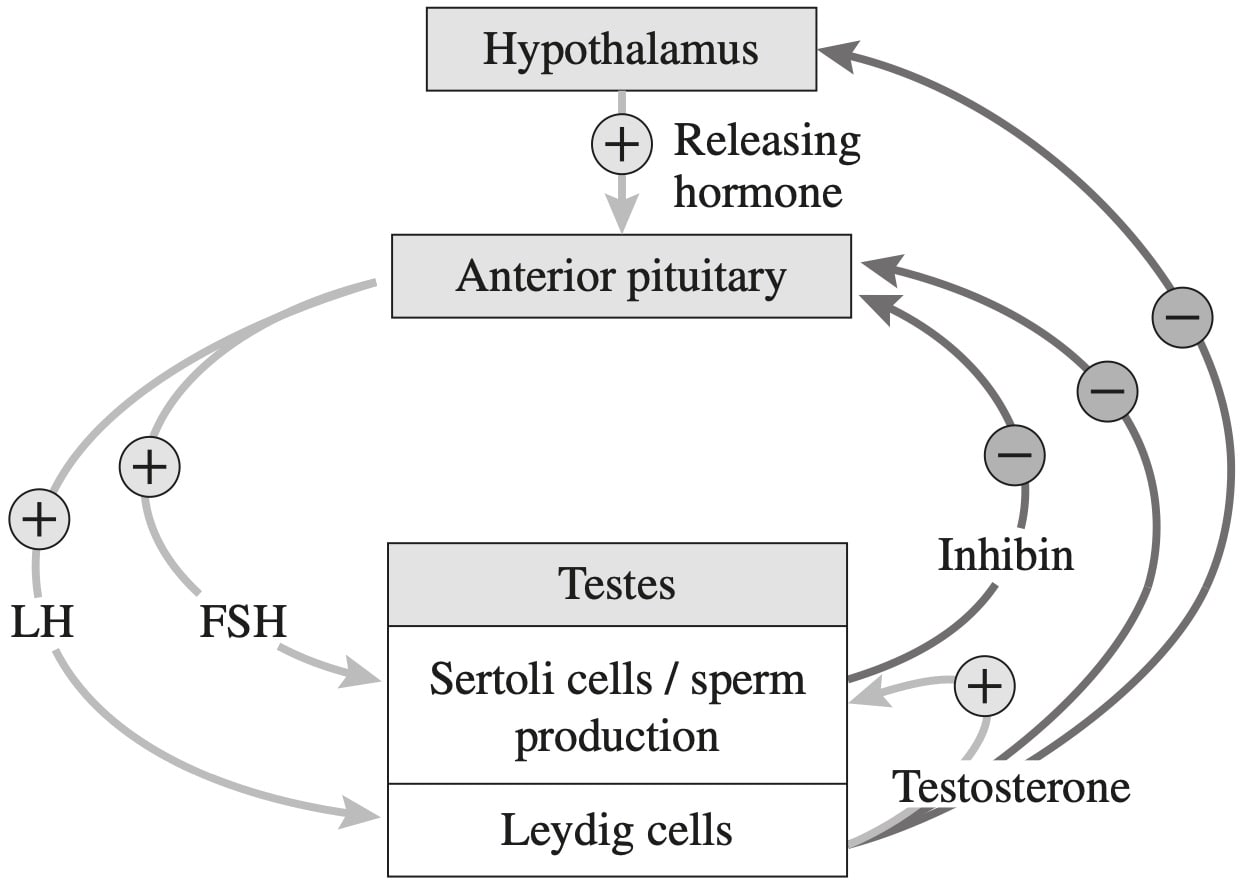
The flow chart shows negative feedback by the hormones testosterone and inhibin in a human male.


Some athletes take anabolic steroids to increase their muscle mass and strength. These steroids may be testosterone or a synthetic modification of testosterone.

Explain the changes that would occur in the testes of a male athlete continuously taking anabolic steroids. Support your answer with reference to the flow chart.   (5 marks)

Show Answers Only
  • Naturally, as shown in the diagram above, males produce Releasing Hormone via the hypothalamus, which stimulates the anterior pituitary gland to produce hormones which further stimulate the testes to produce hormones inhibin and testosterone as well as sperm (via testosterone).
  • A male taking anabolic steroids similar to testosterone will see an initial increase in sperm and inhibin.
  • However, it will also impact the negative feedback on both the hypothalamus and anterior pituitary, reducing their release of respective stimulatory hormones, reducing sperm, testosterone and inhibin.
  • Although less inhibin would mean a smaller negative feedback on the anterior pituitary caused by this hormone, the ongoing dose of testosterone would ensure a large overall negative feedback effect. 
  • Over time, with repetitive and excessive use of anabolic steroids, males will produce less sperm, testosterone and inhibin, and the testes will lose their normal function.
Show Worked Solution
  • Naturally, as shown in the diagram above, males produce Releasing Hormone via the hypothalamus, which stimulates the anterior pituitary gland to produce hormones which further stimulate the testes to produce hormones inhibin and testosterone as well as sperm (via testosterone).
  • A male taking anabolic steroids similar to testosterone will see an initial increase in sperm and inhibin.
  • However, it will also impact the negative feedback on both the hypothalamus and anterior pituitary, reducing their release of respective stimulatory hormones, reducing sperm, testosterone and inhibin.
  • Although less inhibin would mean a smaller negative feedback on the anterior pituitary caused by this hormone, the ongoing dose of testosterone would ensure a large overall negative feedback effect. 
  • Over time, with repetitive and excessive use of anabolic steroids, males will produce less sperm, testosterone and inhibin, and the testes will lose their normal function.
♦ Mean mark 50%.

Filed Under: Homeostasis Tagged With: Band 4, Band 5, smc-3659-12-Negative Feedback Loops

Copyright © 2014–2025 SmarterEd.com.au · Log in