SmarterEd

Aussie Maths & Science Teachers: Save your time with SmarterEd

  • Login
  • Get Help
  • About

BIOLOGY, M8 2025 HSC 24

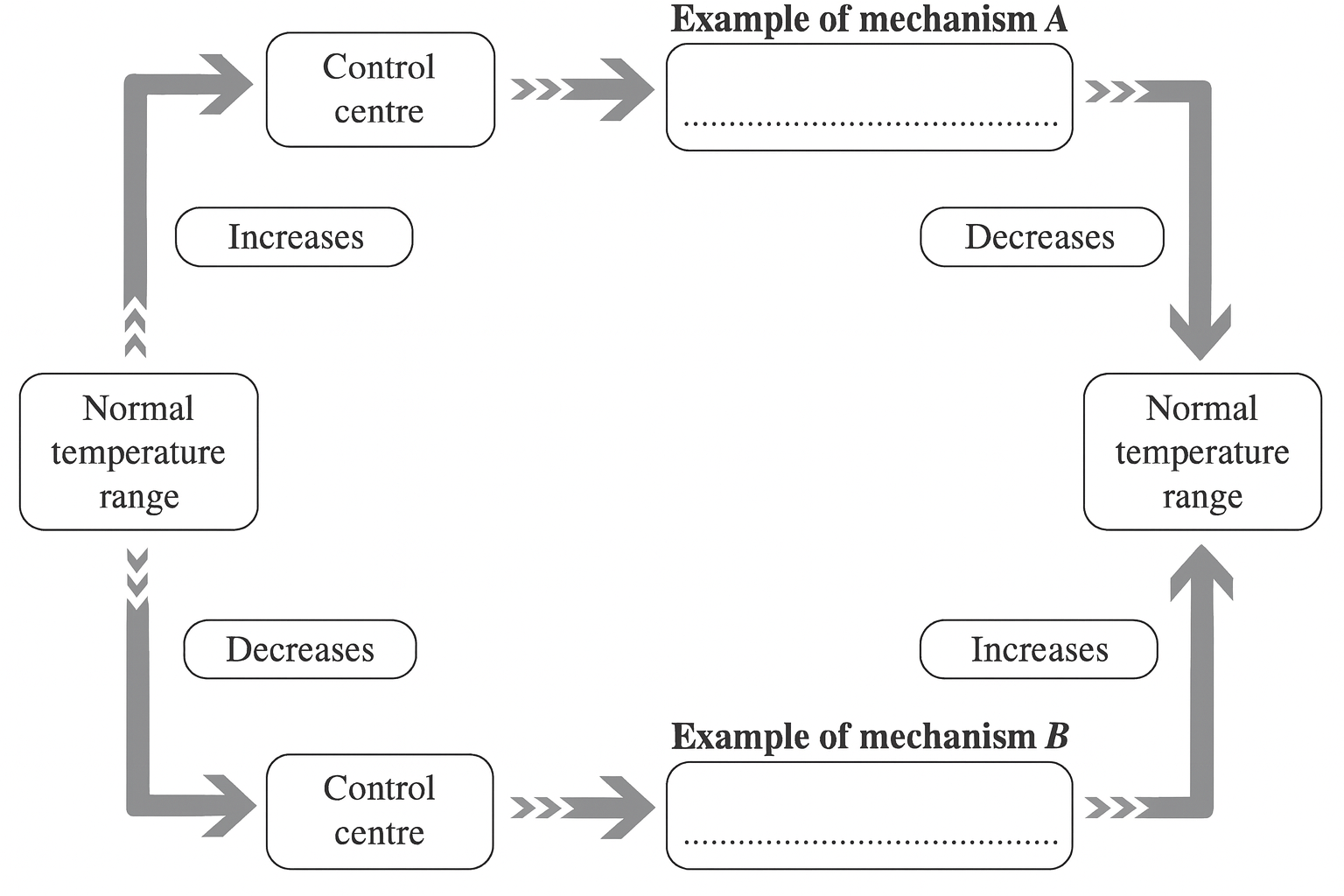
The following flow chart represents the control of body temperature in humans.
 

  1. Complete the flow chart to give an example of mechanism A and an example of mechanism B.   (2 marks)

    --- 0 WORK AREA LINES (style=lined) ---

  2. Outline how mechanism B maintains homeostasis.   (2 marks)

    --- 4 WORK AREA LINES (style=lined) ---
Show Answers Only

a.    Mechanism A (Decreases temperature):

  • Sweating/perspiration → Vasodilation

Mechanism B (Increases temperature):

  • Shivering → Vasoconstriction

b.    Maintaining homeostasis

  • When body temperature drops below normal range, thermoreceptors detect the change.
  • The hypothalamus (control centre) activates mechanism B responses like shivering and vasoconstriction.
  • Shivering generates heat through muscle contractions whilst vasoconstriction reduces heat loss.
  • Body temperature increases back to normal range, restoring homeostasis.

Show Worked Solution

a.   Mechanism A (Decreases temperature):

  • Sweating/perspiration → Vasodilation

Mechanism B (Increases temperature):

  • Shivering → Vasoconstriction

b.    Maintaining homeostasis

  • When body temperature drops below normal range, thermoreceptors detect the change.
  • The hypothalamus (control centre) activates mechanism B responses like shivering and vasoconstriction.
  • Shivering generates heat through muscle contractions whilst vasoconstriction reduces heat loss.
  • Body temperature increases back to normal range, restoring homeostasis.

Filed Under: Homeostasis Tagged With: Band 4, Band 5, smc-3659-15-Temperature

BIOLOGY, M8 2025 HSC 7 MC

An animal's body temperature and the air temperature of the animal's environment were measured every 4 hours, and the following data were recorded.

\begin{array} {|c|c|c|}
\hline
\rule{0pt}{2.5ex} \ \ \ \ \ \  \ \ \  {Time} \ \ \ \ \ \  \ \ \  \rule[-1ex]{0pt}{0pt} & {Body \ temperature} \rule[-1ex]{0pt}{0pt} & {Air  \  temperature} \\
{} & \text{(°C)} & \text{(°C)} \\
\hline
\rule{0pt}{2.5ex} \text{4 am} \rule[-1ex]{0pt}{0pt} & \text{41.3} \rule[-1ex]{0pt}{0pt} & \text{19.2}\\
\hline
\rule{0pt}{2.5ex} \text{8 am} \rule[-1ex]{0pt}{0pt} & \text{41.1} \rule[-1ex]{0pt}{0pt} & \text{18.8}\\
\hline
\rule{0pt}{2.5ex} \text{12 pm} \rule[-1ex]{0pt}{0pt} & \text{40.8} \rule[-1ex]{0pt}{0pt} & \text{21.5}\\
\hline
\rule{0pt}{2.5ex} \text{4 pm} \rule[-1ex]{0pt}{0pt} & \text{41.4} \rule[-1ex]{0pt}{0pt} & \text{26.4}\\
\hline
\rule{0pt}{2.5ex} \text{8 pm} \rule[-1ex]{0pt}{0pt} & \text{41.2} \rule[-1ex]{0pt}{0pt} & \text{27.5}\\
\hline
\rule{0pt}{2.5ex} \text{12 am} \rule[-1ex]{0pt}{0pt} & \text{41.5} \rule[-1ex]{0pt}{0pt} & \text{23.0}\\
\hline
\end{array}

Based on this data, which row of the table indicates what type of animal it is and why?

\begin{align*}
\begin{array}{l}
\rule{0pt}{2.5ex} \ \rule[-1ex]{0pt}{0pt}& \\
\rule{0pt}{2.5ex}\textbf{A.}\rule[-1ex]{0pt}{0pt}\\ & \\
\rule{0pt}{2.5ex}\textbf{B.}\rule[-1ex]{0pt}{0pt}\\ & \\
\rule{0pt}{2.5ex}\textbf{C.}\rule[-1ex]{0pt}{0pt}\\ & \\
\rule{0pt}{2.5ex}\textbf{D.}\rule[-1ex]{0pt}{0pt}\\ & \\
\end{array}
\begin{array}{|l|l|}
\hline
\rule{0pt}{2.5ex} {Type \ of \ animal}\rule[-1ex]{0pt}{0pt}& {Reason } \\
\hline
\rule{0pt}{2.5ex}\text{Ectotherm}\rule[-1ex]{0pt}{0pt}&\text{Body temperature is around 41°C and varies} \\ & \text{with the air temperature. }\\
\hline
\rule{0pt}{2.5ex}\text{Ectotherm}\rule[-1ex]{0pt}{0pt}& \text{Body temperature is around 41°C and is} \\ & \text{always above the air temperature. }\\
\hline
\rule{0pt}{2.5ex}\text{Endotherm }\rule[-1ex]{0pt}{0pt}& \text{Body temperature is relatively constant} \\ & \text{despite changes in air temperature. } \\
\hline
\rule{0pt}{2.5ex}\text{Endotherm}\rule[-1ex]{0pt}{0pt}& \text{Body temperature is relatively constant, and} \\ & \text{air temperature is relatively constant. } \\
\hline
\end{array}
\end{align*}

Show Answers Only

\(C\)

Show Worked Solution
  • C is correct: Body temperature remains constant around 41°C despite air temperature fluctuations.

Other Options:

  • A is incorrect: Body temperature doesn’t vary with air temperature; remains constant.
  • B is incorrect: Ectotherms cannot maintain constant body temperature above air temperature.
  • D is incorrect: Air temperature varies significantly from 18.8°C to 27.5°C.

Filed Under: Homeostasis Tagged With: Band 5, smc-3659-15-Temperature, smc-3659-20-Adaptations/Endotherms

BIOLOGY, M8 2024 HSC 31

A study monitored the changes in the body temperature of a kookaburra (an Australian bird) and a human over a 24-hour period. The results of the study are shown in the graph.
 

  1. At what time was the kookaburra's body temperature the lowest?   (1 mark)

--- 2 WORK AREA LINES (style=lined) ---

  1. Some endothermic organisms can display torpor (a significant decrease in physiological activity).

    With reference to the graph, explain whether the human or the kookaburra was displaying torpor and if so, state the time this occurred.   (3 marks)

--- 7 WORK AREA LINES (style=lined) ---

  1. Outline an adaptation that may lead to an increase in the kookaburra's body temperature during the inactive period.   (2 marks)

--- 4 WORK AREA LINES (style=lined) ---

Show Answers Only

a.   4 am

b.   Signs of torpor:

  • The human maintained a steady body temperature throughout the observed period, showing no signs of torpor or reduced physiological activity
  • In contrast, the kookaburra exhibited classic torpor behaviour.
  • Its body temperature dropped significantly between 5 pm and 4 am, demonstrating the characteristic reduction in physiological functions during this period.

c.   Kookaburra adaptation:

  • Kookaburras have an effective insulation mechanism where they puff out their feathers, creating space between them.
  • This fluffing action traps a layer of warm air between the feathers and the bird’s body, forming an insulating barrier
  • The trapped air pocket acts like natural insulation, minimising heat loss and helping the kookaburra maintain its body temperature efficiently.

Show Worked Solution

a.   4 am

b.   Signs of torpor:

  • The human maintained a steady body temperature throughout the observed period, showing no signs of torpor or reduced physiological activity
  • In contrast, the kookaburra exhibited classic torpor behaviour.
  • Its body temperature dropped significantly between 5 pm and 4 am, demonstrating the characteristic reduction in physiological functions during this period.
Mean mark (b) 56%.

c.   Kookaburra adaptation:

  • Kookaburras have an effective insulation mechanism where they puff out their feathers, creating space between them.
  • This fluffing action traps a layer of warm air between the feathers and the bird’s body, forming an insulating barrier
  • The trapped air pocket acts like natural insulation, minimising heat loss and helping the kookaburra maintain its body temperature efficiently.
♦ Mean mark (c) 47%.

Filed Under: Homeostasis Tagged With: Band 2, Band 4, Band 5, smc-3659-15-Temperature, smc-3659-20-Adaptations/Endotherms

BIOLOGY, M8 2023 HSC 29b

Organisms use various mechanisms to maintain their internal environment within tolerance limits.

Explain TWO adaptations in plants that help to maintain water balance.  (4 marks)

--- 8 WORK AREA LINES (style=lined) ---

Show Answers Only

Answers could include two of the following:

  • Leaves are covered in a waxy cuticle on their surface which reduces water loss. Plants that live in hotter and/or dryer areas will have thicker waxy cuticles.
  • Stomata are holes on the underside of the leaf which allow water to leave the plant via the process of transpiration. Stomata are able to close when the plant is exposed to higher temperatures which reduces transpiration.
  • Many plants also have sunken stomata which reduces transpiration.
  • A plant’s roots are able to absorb water from the ground, however the depths of these roots is dependant on the plant’s environment. Some plants such as cacti will have a shallow root system to absorb overnight condensation, while other plants have deeper root systems which allow them to reach the lower water table.

Show Worked Solution

Answers could include two of the following:

  • Leaves are covered in a waxy cuticle on their surface which reduces water loss. Plants that live in hotter and/or dryer areas will have thicker waxy cuticles.
  • Stomata are holes on the underside of the leaf which allow water to leave the plant via the process of transpiration. Stomata are able to close when the plant is exposed to higher temperatures which reduces transpiration.
  • Many plants also have sunken stomata which reduces transpiration.
  • A plant’s roots are able to absorb water from the ground, however the depths of these roots is dependant on the plant’s environment. Some plants such as cacti will have a shallow root system to absorb overnight condensation, while other plants have deeper root systems which allow them to reach the lower water table.

Filed Under: Homeostasis Tagged With: Band 4, smc-3659-15-Temperature, smc-3659-30-Water Balance in Plants

BIOLOGY, M8 2023 HSC 29a

Organisms use various mechanisms to maintain their internal environment within tolerance limits.

Outline a physiological adaptation in endotherms which assists in maintaining their internal environment.   (2 marks)

Show Answers Only

  • Endotherms have developed the ability to change the diameter of their blood vessels to be able to maintain a stable internal temperature.
  • If their internal temperature increases the blood vessels will dilate (vasodilation) which will cause warm blood to flush through and heat will radiate from the skin.
  • If their internal temperature drops the blood vessels will constrict (vasoconstriction) which will reduce the heat radiating from the skin and reduce heat loss.

Other answers could include

  • Sweating to maintain temperature.
  • Shivering/goosebumps to maintain temperature.

Show Worked Solution

  • Endotherms have developed the ability to change the diameter of their blood vessels to be able to maintain a stable internal temperature.
  • If their internal temperature increases the blood vessels will dilate (vasodilation) which will cause warm blood to flush through and heat will radiate from the skin.
  • If their internal temperature drops the blood vessels will constrict (vasoconstriction) which will reduce the heat radiating from the skin and reduce heat loss.

Other answers could include

  • Sweating to maintain temperature.
  • Shivering/goosebumps to maintain temperature.

Filed Under: Homeostasis Tagged With: Band 4, smc-3659-15-Temperature, smc-3659-20-Adaptations/Endotherms

BIOLOGY, M8 EQ-Bank 2 MC

The diagram shows a homeostatic mechanism in a mammal.
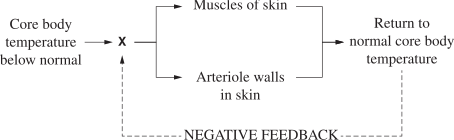
 

Which row of the table describes what happens to the muscles and the arteriole walls in the skin when the core body temperature is below normal?
 

Show Answers Only

`B`

Show Worked Solution

→ When the body is cold, it contracts to raise epidermal hairs (also known as goosebumps) which generates heat, closes skin pores and traps a layer of heat close to the skin.

→ The contraction of arteries (also known as vasoconstriction) helps conserve heat by minimising heat loss from the skin.

`=>B`

Filed Under: Uncategorized Tagged With: Band 3, smc-3659-15-Temperature

BIOLOGY, M8 EQ-Bank 1 MC

The diagram shows a homeostatic mechanism in a mammal.


What does X represent in the diagram?

  1. The brain
  2. The heart
  3. A thermoreceptor in the skin
  4. A pressure receptor in a blood vessel
Show Answers Only

`A`

Show Worked Solution
  • The brain (more specifically the hypothalamus) is the organ responsible for the detection of a change in body temperature.

`=>A`

Filed Under: Homeostasis Tagged With: Band 4, smc-3659-15-Temperature

BIOLOGY, M8 2018 HSC 21

  1. Identify TWO responses of a named endotherm to a decrease in body temperature.  (2 marks)

    --- 2 WORK AREA LINES (style=lined) ---

  2. Outline the role of the nervous system of an endotherm in maintaining homeostasis when its body temperature changes.  (2 marks)

    --- 5 WORK AREA LINES (style=lined) ---

Show Answers Only

a.   Vasoconstriction and shivering.

b.   Body temperature maintenance in endotherms:

  • This is achieved via negative feedback loops.
  • Temperature receptors in the brain and skin detect changes in body temperature.
  • The central nervous system receives a signal via the receptors.
  • Muscles or glands (effectors) then receive nerve signals sent from the central nervous system.
Show Worked Solution

a.   Vasoconstriction and shivering.

b.   Body temperature maintenance in endotherms:

  • This is achieved via negative feedback loops.
  • Temperature receptors in the brain and skin detect changes in body temperature.
  • The central nervous system receives a signal via the receptors.
  • Muscles or glands (effectors) then receive nerve signals sent from the central nervous system.

Filed Under: Homeostasis Tagged With: Band 3, Band 4, smc-3659-15-Temperature, smc-3659-60-Nervous System

BIOLOGY, M8 2018 HSC 12 MC

The graph shows four possible relationships between ambient temperature and body temperature.
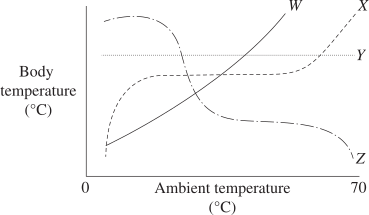
 

Which line on the graph represents the relationship between ambient temperature and body temperature for an endotherm in a terrestrial environment?

  1. `W`
  2. `X`
  3. `Y`
  4. `Z`
Show Answers Only

`B`

Show Worked Solution
  • Endotherms are animals which perform complex processes to maintain a constant internal body temperature over a variety of external temperatures.

`=>B`


♦♦♦ Mean mark 25%.

Filed Under: Homeostasis Tagged With: Band 6, smc-3659-15-Temperature, smc-3659-20-Adaptations/Endotherms

BIOLOGY, M8 2015 HSC 7-8 MC

Refer to the following information to answer Questions 7 and 8 .

The diagram shows a homeostatic mechanism in a mammal.
 

Question 7

What does `text{X}` represent in the diagram?

  1. The heart
  2. The brain
  3. A thermoreceptor in the skin
  4. A pressure receptor in a blood vessel

 
Question 8

Which of the following describes what happens to the muscles and the arteriole walls in the skin when the core body temperature is below normal?
 

Show Answers Only

Q7.  `B`
Q8.  `B`

Show Worked Solution

Q7.   `text{X}` = the brain

  • Messages are sent by the brain to the effectors.
  • This promotes a stimulus response.

`=>B`


♦♦ Mean mark (Q7) 38%.

Q8.   When body temperature is below normal:

  • Hairs stand on end and arteriole walls of skin contract to prevent the loss of heat.

`=>B`

Filed Under: Homeostasis Tagged With: Band 3, Band 5, smc-3659-12-Negative Feedback Loops, smc-3659-15-Temperature

BIOLOGY, M8 2019 HSC 21

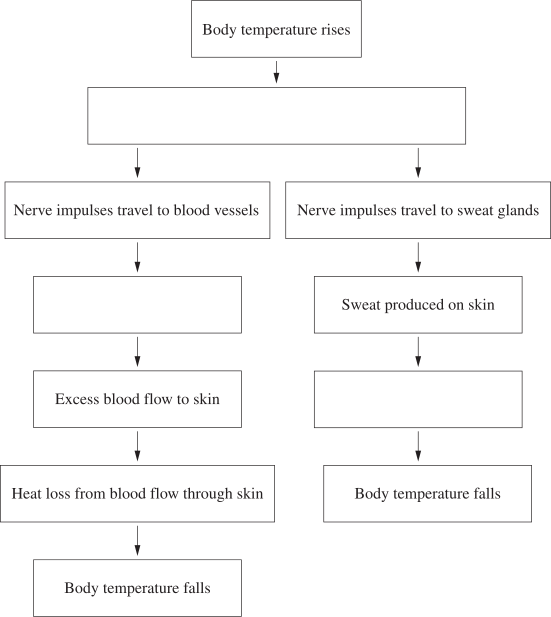
The diagram shows a flow chart of the reaction of a human body to an increase in temperature.

Fill in the three blank steps on the flow chart.   (3 marks)
 

--- 0 WORK AREA LINES (style=lined) ---

Show Answers Only
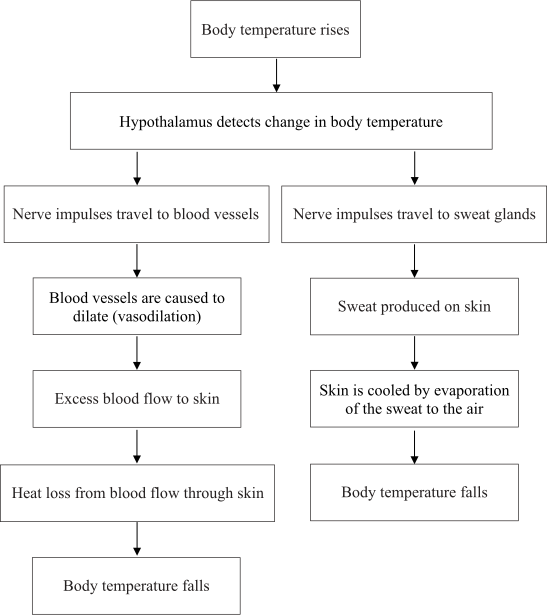
Show Worked Solution


Mean mark 53%.

Filed Under: Homeostasis Tagged With: Band 4, smc-3659-12-Negative Feedback Loops, smc-3659-15-Temperature

BIOLOGY, M8 2022 HSC 1 MC

A healthy person in a hot environment measures their body temperature to be 38.0°C.

Which of the following might occur in this person?

  1. Shivering
  2. Vasodilation
  3. Goosebumps
  4. Pale appearance
Show Answers Only

`B`

Show Worked Solution
  • Vasodilation is the widening of blood vessels, which brings heat to the skin’s surface where it is lost to the environment.

`=>B`

Filed Under: Homeostasis Tagged With: Band 3, smc-3659-15-Temperature, smc-3659-20-Adaptations/Endotherms

Copyright © 2014–2025 SmarterEd.com.au · Log in