SmarterEd

Aussie Maths & Science Teachers: Save your time with SmarterEd

  • Login
  • Get Help
  • About

BIOLOGY, M8 2025 HSC 7 MC

An animal's body temperature and the air temperature of the animal's environment were measured every 4 hours, and the following data were recorded.

\begin{array} {|c|c|c|}
\hline
\rule{0pt}{2.5ex} \ \ \ \ \ \  \ \ \  {Time} \ \ \ \ \ \  \ \ \  \rule[-1ex]{0pt}{0pt} & {Body \ temperature} \rule[-1ex]{0pt}{0pt} & {Air  \  temperature} \\
{} & \text{(°C)} & \text{(°C)} \\
\hline
\rule{0pt}{2.5ex} \text{4 am} \rule[-1ex]{0pt}{0pt} & \text{41.3} \rule[-1ex]{0pt}{0pt} & \text{19.2}\\
\hline
\rule{0pt}{2.5ex} \text{8 am} \rule[-1ex]{0pt}{0pt} & \text{41.1} \rule[-1ex]{0pt}{0pt} & \text{18.8}\\
\hline
\rule{0pt}{2.5ex} \text{12 pm} \rule[-1ex]{0pt}{0pt} & \text{40.8} \rule[-1ex]{0pt}{0pt} & \text{21.5}\\
\hline
\rule{0pt}{2.5ex} \text{4 pm} \rule[-1ex]{0pt}{0pt} & \text{41.4} \rule[-1ex]{0pt}{0pt} & \text{26.4}\\
\hline
\rule{0pt}{2.5ex} \text{8 pm} \rule[-1ex]{0pt}{0pt} & \text{41.2} \rule[-1ex]{0pt}{0pt} & \text{27.5}\\
\hline
\rule{0pt}{2.5ex} \text{12 am} \rule[-1ex]{0pt}{0pt} & \text{41.5} \rule[-1ex]{0pt}{0pt} & \text{23.0}\\
\hline
\end{array}

Based on this data, which row of the table indicates what type of animal it is and why?

\begin{align*}
\begin{array}{l}
\rule{0pt}{2.5ex} \ \rule[-1ex]{0pt}{0pt}& \\
\rule{0pt}{2.5ex}\textbf{A.}\rule[-1ex]{0pt}{0pt}\\ & \\
\rule{0pt}{2.5ex}\textbf{B.}\rule[-1ex]{0pt}{0pt}\\ & \\
\rule{0pt}{2.5ex}\textbf{C.}\rule[-1ex]{0pt}{0pt}\\ & \\
\rule{0pt}{2.5ex}\textbf{D.}\rule[-1ex]{0pt}{0pt}\\ & \\
\end{array}
\begin{array}{|l|l|}
\hline
\rule{0pt}{2.5ex} {Type \ of \ animal}\rule[-1ex]{0pt}{0pt}& {Reason } \\
\hline
\rule{0pt}{2.5ex}\text{Ectotherm}\rule[-1ex]{0pt}{0pt}&\text{Body temperature is around 41°C and varies} \\ & \text{with the air temperature. }\\
\hline
\rule{0pt}{2.5ex}\text{Ectotherm}\rule[-1ex]{0pt}{0pt}& \text{Body temperature is around 41°C and is} \\ & \text{always above the air temperature. }\\
\hline
\rule{0pt}{2.5ex}\text{Endotherm }\rule[-1ex]{0pt}{0pt}& \text{Body temperature is relatively constant} \\ & \text{despite changes in air temperature. } \\
\hline
\rule{0pt}{2.5ex}\text{Endotherm}\rule[-1ex]{0pt}{0pt}& \text{Body temperature is relatively constant, and} \\ & \text{air temperature is relatively constant. } \\
\hline
\end{array}
\end{align*}
Show Answers Only

\(C\)

Show Worked Solution
  • C is correct: Body temperature remains constant around 41°C despite air temperature fluctuations.

Other Options:

  • A is incorrect: Body temperature doesn’t vary with air temperature; remains constant.
  • B is incorrect: Ectotherms cannot maintain constant body temperature above air temperature.
  • D is incorrect: Air temperature varies significantly from 18.8°C to 27.5°C.

Filed Under: Homeostasis Tagged With: Band 5, smc-3659-15-Temperature, smc-3659-20-Adaptations/Endotherms

BIOLOGY, M8 2024 HSC 31

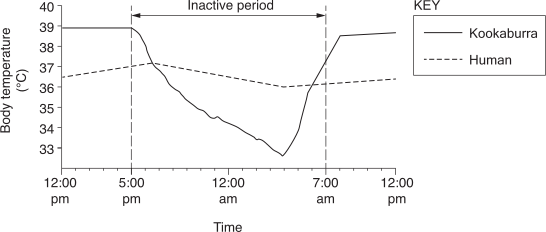
A study monitored the changes in the body temperature of a kookaburra (an Australian bird) and a human over a 24-hour period. The results of the study are shown in the graph.
 

  1. At what time was the kookaburra's body temperature the lowest?   (1 mark)

--- 2 WORK AREA LINES (style=lined) ---

  1. Some endothermic organisms can display torpor (a significant decrease in physiological activity).

    With reference to the graph, explain whether the human or the kookaburra was displaying torpor and if so, state the time this occurred.   (3 marks)

--- 7 WORK AREA LINES (style=lined) ---

  1. Outline an adaptation that may lead to an increase in the kookaburra's body temperature during the inactive period.   (2 marks)

--- 4 WORK AREA LINES (style=lined) ---

Show Answers Only

a.   4 am

b.   Signs of torpor:

  • The human maintained a steady body temperature throughout the observed period, showing no signs of torpor or reduced physiological activity
  • In contrast, the kookaburra exhibited classic torpor behaviour.
  • Its body temperature dropped significantly between 5 pm and 4 am, demonstrating the characteristic reduction in physiological functions during this period.

c.   Kookaburra adaptation:

  • Kookaburras have an effective insulation mechanism where they puff out their feathers, creating space between them.
  • This fluffing action traps a layer of warm air between the feathers and the bird’s body, forming an insulating barrier
  • The trapped air pocket acts like natural insulation, minimising heat loss and helping the kookaburra maintain its body temperature efficiently.

Show Worked Solution

a.   4 am

b.   Signs of torpor:

  • The human maintained a steady body temperature throughout the observed period, showing no signs of torpor or reduced physiological activity
  • In contrast, the kookaburra exhibited classic torpor behaviour.
  • Its body temperature dropped significantly between 5 pm and 4 am, demonstrating the characteristic reduction in physiological functions during this period.
Mean mark (b) 56%.

c.   Kookaburra adaptation:

  • Kookaburras have an effective insulation mechanism where they puff out their feathers, creating space between them.
  • This fluffing action traps a layer of warm air between the feathers and the bird’s body, forming an insulating barrier
  • The trapped air pocket acts like natural insulation, minimising heat loss and helping the kookaburra maintain its body temperature efficiently.
♦ Mean mark (c) 47%.

Filed Under: Homeostasis Tagged With: Band 2, Band 4, Band 5, smc-3659-15-Temperature, smc-3659-20-Adaptations/Endotherms

BIOLOGY, M8 2023 HSC 29a

Organisms use various mechanisms to maintain their internal environment within tolerance limits.

Outline a physiological adaptation in endotherms which assists in maintaining their internal environment.   (2 marks)

Show Answers Only

  • Endotherms have developed the ability to change the diameter of their blood vessels to be able to maintain a stable internal temperature.
  • If their internal temperature increases the blood vessels will dilate (vasodilation) which will cause warm blood to flush through and heat will radiate from the skin.
  • If their internal temperature drops the blood vessels will constrict (vasoconstriction) which will reduce the heat radiating from the skin and reduce heat loss.

Other answers could include

  • Sweating to maintain temperature.
  • Shivering/goosebumps to maintain temperature.

Show Worked Solution

  • Endotherms have developed the ability to change the diameter of their blood vessels to be able to maintain a stable internal temperature.
  • If their internal temperature increases the blood vessels will dilate (vasodilation) which will cause warm blood to flush through and heat will radiate from the skin.
  • If their internal temperature drops the blood vessels will constrict (vasoconstriction) which will reduce the heat radiating from the skin and reduce heat loss.

Other answers could include

  • Sweating to maintain temperature.
  • Shivering/goosebumps to maintain temperature.

Filed Under: Homeostasis Tagged With: Band 4, smc-3659-15-Temperature, smc-3659-20-Adaptations/Endotherms

BIOLOGY, M8 2018 HSC 12 MC

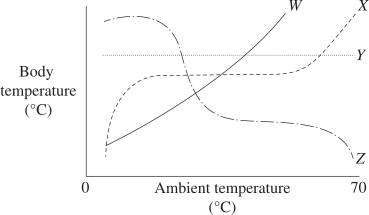
The graph shows four possible relationships between ambient temperature and body temperature.
 

Which line on the graph represents the relationship between ambient temperature and body temperature for an endotherm in a terrestrial environment?

  1. `W`
  2. `X`
  3. `Y`
  4. `Z`
Show Answers Only

`B`

Show Worked Solution
  • Endotherms are animals which perform complex processes to maintain a constant internal body temperature over a variety of external temperatures.

`=>B`


♦♦♦ Mean mark 25%.

Filed Under: Homeostasis Tagged With: Band 6, smc-3659-15-Temperature, smc-3659-20-Adaptations/Endotherms

BIOLOGY, M8 2022 HSC 2 MC

Some desert mammals can obtain their water from breaking down stored body fat.

What type of adaptation is this?

  1. Behavioural
  2. Environmental
  3. Physiological
  4. Structural
Show Answers Only

`C`

Show Worked Solution
  • The adaptation is an automatic response by the mammal.

`=>C`

Filed Under: Homeostasis Tagged With: Band 4, smc-3659-20-Adaptations/Endotherms

BIOLOGY, M8 2022 HSC 1 MC

A healthy person in a hot environment measures their body temperature to be 38.0°C.

Which of the following might occur in this person?

  1. Shivering
  2. Vasodilation
  3. Goosebumps
  4. Pale appearance
Show Answers Only

`B`

Show Worked Solution
  • Vasodilation is the widening of blood vessels, which brings heat to the skin’s surface where it is lost to the environment.

`=>B`

Filed Under: Homeostasis Tagged With: Band 3, smc-3659-15-Temperature, smc-3659-20-Adaptations/Endotherms

BIOLOGY, M8 2020 HSC 1 MC

In maintaining homeostasis, which of the following is a behavioural adaptation?

  1. Sweating to cool down
  2. Curling up in a ball to keep warm
  3. Speeding up or slowing down cell metabolism
  4. Skin going red as more blood flows to surface
Show Answers Only

`B`

Show Worked Solution
  • Curling into a ball to keep warm is a behavioural response of an organism that helps it maintain body temperature.

`=>B`

Filed Under: Homeostasis Tagged With: Band 3, smc-3659-20-Adaptations/Endotherms

BIOLOGY, M8 2021 HSC 29

The koala is a mammal that maintains a stable body temperature of close to 36.6°C.

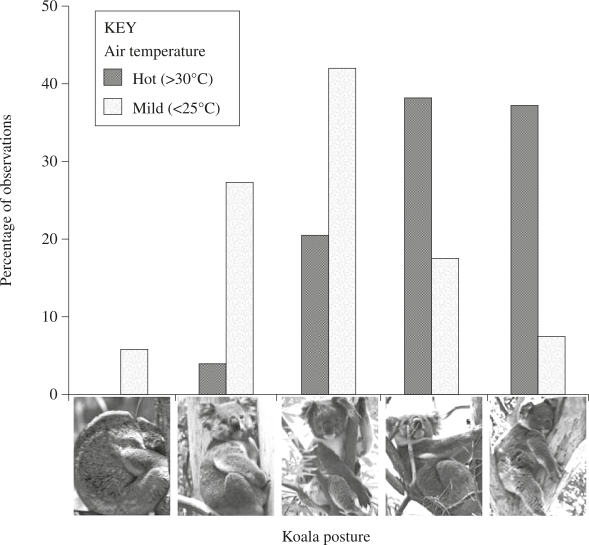
A study was conducted. Koalas were observed in natural forests in south-eastern Australia. Their posture in the tree and the ambient temperature were recorded. Ambient temperatures were divided into two categories, hot and mild.

The graph shows the posture of koalas observed.
 

Explain the adaptations used by the koalas in this study to maintain a stable body temperature. Make reference to the stimulus provided.   (4 marks)

Show Answers Only
  • Posture is a behavioural adaptation that changes the surface area of skin exposed to the air or tree trunk. Posture is often seen associated with hot or mild air temperatures. 
  • In mild conditions, koalas were often seen curling up, minimising heat loss by reducing surface area exposed to air, a behaviour that was never observed during hot conditions.
  • In hotter conditions, the koalas were seen leaning against, and hugging trees much more often than during milder conditions. Since the trees were shown to have lower temperatures, this exposes their ventral surface to the cool trunk and acts as a heat sink.

Other answers could include:

  • Reference to the physiological adaptation of directing blood flow to the stomach region to increase cooling when this are is in contact with the tree.
Show Worked Solution
  • Posture is a behavioural adaptation that changes the surface area of skin exposed to the air or tree trunk. Posture is often seen associated with hot or mild air temperatures. 
  • In mild conditions, koalas were often seen curling up, minimising heat loss by reducing surface area exposed to air, a behaviour that was never observed during hot conditions.
  • In hotter conditions, the koalas were seen leaning against, and hugging trees much more often than during milder conditions. Since the trees were shown to have lower temperatures, this exposes their ventral surface to the cool trunk and acts as a heat sink.

Other answers could include:

  • Reference to the physiological adaptation of directing blood flow to the stomach region to increase cooling when this are is in contact with the tree.

Filed Under: Homeostasis Tagged With: Band 4, smc-3659-20-Adaptations/Endotherms

Copyright © 2014–2025 SmarterEd.com.au · Log in