SmarterEd

Aussie Maths & Science Teachers: Save your time with SmarterEd

  • Login
  • Get Help
  • About

BIOLOGY, M8 2025 HSC 32

A population lives across three regions, \(A,\ B\) and \(C\).
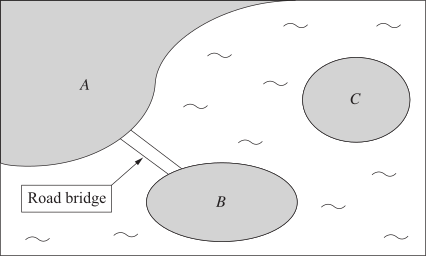
  

People in community \(B\) developed an environmental disease. An epidemiological study was carried out to determine the risk of developing the disease due to age at exposure. The results of this study are shown in the graph.
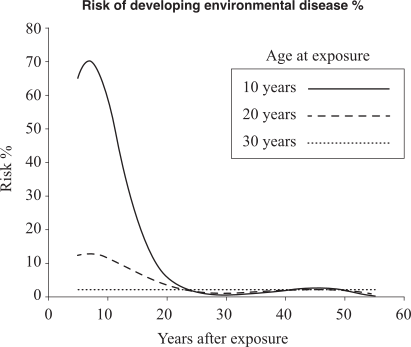
  

Design an epidemiological study that could be used to produce the results shown in the graph. Justify the features of your design.   (7 marks)

--- 22 WORK AREA LINES (style=lined) ---

Show Answers Only

Study Type: A prospective cohort study would be used. This is justified because it follows participants over extended time periods (up to 60 years) to observe disease development naturally.

Participants: Recruit individuals from community B across three age groups: 10-year-olds, 20-year-olds and 30-year-olds at the time of exposure to the environmental factor. This is justified because the graph displays separate curves for exposure at these three ages.

Baseline Data: Record each participant’s exact age at first exposure. This is justified because age at exposure is the independent variable being tested.

Longitudinal Follow-up: Monitor all participants annually for disease development over 60 years. This is justified because the graph tracks disease risk across this timeframe and shows when risk peaks and declines.

Data Collection: Document whether each participant develops the disease and calculate the percentage of each age cohort affected at yearly intervals. This is justified because the y-axis shows risk as a percentage.

Control Variables: Ensure all participants experience similar levels of environmental exposure in community B. This is justified because the study isolates age at exposure as the only variable affecting disease risk.

Statistical Analysis: Calculate risk percentages for each time point after exposure for each age group. This is justified because it produces the three distinct curves showing risk declining differently based on initial exposure age.
Show Worked Solution

Study Type: A prospective cohort study would be used. This is justified because it follows participants over extended time periods (up to 60 years) to observe disease development naturally.

Participants: Recruit individuals from community B across three age groups: 10-year-olds, 20-year-olds and 30-year-olds at the time of exposure to the environmental factor. This is justified because the graph displays separate curves for exposure at these three ages.

Baseline Data: Record each participant’s exact age at first exposure. This is justified because age at exposure is the independent variable being tested.

Longitudinal Follow-up: Monitor all participants annually for disease development over 60 years. This is justified because the graph tracks disease risk across this timeframe and shows when risk peaks and declines.

Data Collection: Document whether each participant develops the disease and calculate the percentage of each age cohort affected at yearly intervals. This is justified because the y-axis shows risk as a percentage.

Control Variables: Ensure all participants experience similar levels of environmental exposure in community B. This is justified because the study isolates age at exposure as the only variable affecting disease risk.

Statistical Analysis: Calculate risk percentages for each time point after exposure for each age group. This is justified because it produces the three distinct curves showing risk declining differently based on initial exposure age.

Filed Under: Causes and Effects, Epidemiology Tagged With: Band 5, Band 6, smc-3660-11-Environmental/Nutritional, smc-3661-20-Evaluating the Method

BIOLOGY, M8 2023 HSC 27

Air pollution has been linked to a variety of non-infectious neurological (brain) disorders. Some of the symptoms include memory loss, cognitive decline and impaired movement and coordination.

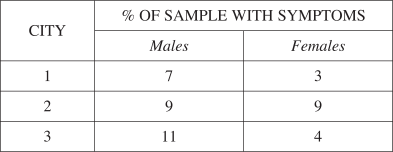
500 people from each of three major cities were surveyed and were monitored and tested for a period of 12 months. Each group included males and females aged between 20 and 50 years of age.

The results after 12 months were as follows:
 

Evaluate the method used in this epidemiological study in determining a link between air pollution and the symptoms.  (7 marks)

--- 16 WORK AREA LINES (style=lined) ---

Show Answers Only

  • This study is not an effective study for validating a link between air pollution and cognitive disorders due to a variety of issues with the study’s reliability, validity and accuracy.
  • While the study does have a reasonable sample size and uses 3 different cities, numerous important factors are not specified. These include risk factors such as age, sex, ethnicity and occupation of the participants in each city.
  • The 12 month timeframe of the study may not be long enough for symptoms to develop.
  • The study also does not signify the type and degree of symptoms that were experienced.
  • A non-city comparison where air pollution is low would provide good baseline data against which the data from city participants could be compared.
  • The study does also not take into account other important demographic factors, such as socioeconomic status and geography within a city. The proximity to industry of an individual’s workplace or residence would be a particularly important risk factor to consider.
  • Cities should be chosen that have different levels of air pollution in order to look for general trends in the data, such as more exposure to air pollution corresponds to a greater number of symptoms. There is no evidence that this is part of the study design.
  • This is not a valid nor reliable test in determining a link between air pollution and neurological disorders. Adding prior medical/family history and data relating to the testing centres/cities as well as controlling more variables will lead to a fairer test.

Show Worked Solution

  • This study is not an effective study for validating a link between air pollution and cognitive disorders due to a variety of issues with the study’s reliability, validity and accuracy.
  • While the study does have a reasonable sample size and uses 3 different cities, numerous important factors are not specified. These include risk factors such as age, sex, ethnicity and occupation of the participants in each city.
  • The 12 month timeframe of the study may not be long enough for symptoms to develop.
  • The study also does not signify the type and degree of symptoms that were experienced.
  • A non-city comparison where air pollution is low would provide good baseline data against which the data from city participants could be compared.
  • The study does also not take into account other important demographic factors, such as socioeconomic status and geography within a city. The proximity to industry of an individual’s workplace or residence would be a particularly important risk factor to consider.
  • Cities should be chosen that have different levels of air pollution in order to look for general trends in the data, such as more exposure to air pollution corresponds to a greater number of symptoms. There is no evidence that this is part of the study design.
  • This is not a valid nor reliable test in determining a link between air pollution and neurological disorders. Adding prior medical/family history and data relating to the testing centres/cities as well as controlling more variables will lead to a fairer test.
Mean mark 57%.

Filed Under: Epidemiology Tagged With: Band 4, Band 5, smc-3661-20-Evaluating the Method

BIOLOGY, M8 EQ-Bank 15

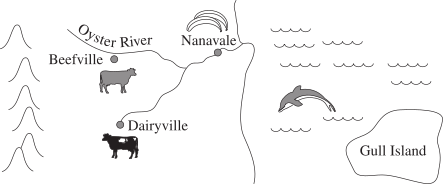
The diagram shows a rural coastal area and the towns, rivers and associated industry for each of the townships.
 

An epidemic of a disease has broken out in Nanavale. The symptoms are stomach ache, vomiting and tiredness. Many families in Nanavale have only one member with the disease, therefore it appears to be non-infectious. The symptoms are worse in infants than in adults.

Isolated cases of this disease have occurred in the nearby towns of Dairyville and Beefville. No cases have been reported on Gull Island.

Design an epidemiological study to investigate the origin of the disease. Refer to features of validity and reliability in your answer.   (7 marks)

--- 16 WORK AREA LINES (style=lined) ---

Show Answers Only
  • When planning an epidemiological study it is important to first analyse all the initial evidence to better construct an effective study.
  • The disease is most likely infectious as an outbreak that affects many people is very unlikely to be due to a previously masked non-infectious disease.
  • The fact that the disease is not present on gull island also supports this and may indicate that the disease is not waterborne and may spread through physical touch, close proximity, food or radioactive toxic elements.
  • The disease also affects children more severely. This fact must be addressed in the study and measures taken to protect and monitor this vulnerable group.
  • The study should survey affected families to try to pinpoint the transmission of the disease.
  • Appropriate fact finding questions should include
    • Where have you travelled to?
    • What have you eaten/drunk and where did you get it from?
    • Who else have you been in contact with and where are they from?
  • These results should be analysed for common factors and then compared to results from the same set of questions asked of unaffected families, thus increasing the study’s validity.
  • The more people that can be reached and questioned, the more accurate the findings of the study will be.
  • Geiger readings, screening and soil extraction may pinpoint whether the disease is caused by a carcinogen on the coastal area.
  • Common factors found in the study may also reveal an antidote or treatment for affected individuals.
Show Worked Solution
  • When planning an epidemiological study it is important to first analyse all the initial evidence to better construct an effective study.
  • The disease is most likely infectious as an outbreak that affects many people is very unlikely to be due to a previously masked non-infectious disease.
  • The fact that the disease is not present on gull island also supports this and may indicate that the disease is not waterborne and may spread through physical touch, close proximity, food or radioactive toxic elements.
  • The disease also affects children more severely. This fact must be addressed in the study and measures taken to protect and monitor this vulnerable group.
  • The study should survey affected families to try to pinpoint the transmission of the disease.
  • Appropriate fact finding questions should include
    • Where have you travelled to?
    • What have you eaten/drunk and where did you get it from?
    • Who else have you been in contact with and where are they from?
  • These results should be analysed for common factors and then compared to results from the same set of questions asked of unaffected families, thus increasing the study’s validity.
  • The more people that can be reached and questioned, the more accurate the findings of the study will be.
  • Geiger readings, screening and soil extraction may pinpoint whether the disease is caused by a carcinogen on the coastal area.
  • Common factors found in the study may also reveal an antidote or treatment for affected individuals.

Filed Under: Epidemiology Tagged With: Band 4, Band 5, Band 6, smc-3661-20-Evaluating the Method, smc-3661-30-Benefits

BIOLOGY, M8 EQ-Bank 13

A scientist performed an epidemiological study to investigate the cause and effect relationship of smoking and lung cancer as follows:

    1. Handed out a scientifically valid questionnaire to all employees at her daughter's high school (n=96)
    2. Checked that there were an equal number of male and female respondents
    3. Discovered that there were more non-smoking respondents than smoking respondents. Removed some of the non-smokers until both groups had equal numbers
    4. Required all respondents to have a general check up from their doctor before participating 
    5. Analysed data, wrote the paper and published it in a scientific blog

From the information provided, assess the suitability of the methodology for this investigation.   (5 marks)

--- 10 WORK AREA LINES (style=lined) ---

Show Answers Only
  • This study cannot be referred to as a suitable comparison between smoking and lung cancer due to several flaws in its methodology.
  • The sample size of the study is too small and confined to one workplace.
  • The participants should represent a number of equal categories such as age and ethnicity, not just equal representation of males and females.
  • The fact that participants were removed in order to create equal smoking/non-smoking categories reduces the validity of the findings.
  • The medical check ups should not be general and instead be in relation to the study such as cancer and lung checks.
  • The study will also benefit from peer review.
Show Worked Solution
  • This study cannot be referred to as a suitable comparison between smoking and lung cancer due to several flaws in its methodology.
  • The sample size of the study is too small and confined to one workplace.
  • The participants should represent a number of equal categories such as age and ethnicity, not just equal representation of males and females.
  • The fact that participants were removed in order to create equal smoking/non-smoking categories reduces the validity of the findings.
  • The medical check ups should not be general and instead be in relation to the study such as cancer and lung checks.
  • The study will also benefit from peer review.

Filed Under: Epidemiology Tagged With: Band 4, Band 5, smc-3661-20-Evaluating the Method

BIOLOGY, M8 EQ-Bank 4 MC

An investigation was undertaken to examine the cause of lactose intolerance, a non-infectious condition found in some humans who cannot digest milk. The investigation found variation in the occurrence of lactose intolerance in human populations from different parts of the world.

What is this investigation an example of?

  1. A study of ecosystems
  2. A microbiological study
  3. An epidemiological study
  4. A study of the human immune system
Show Answers Only

`=>C`

Show Worked Solution
  • An epidemiological study is one which studies diseases which affect many people by gathering and analysing a large collection of data related to incidence and mortality, while comparing it to varying factors, such as location and age.

`=>C` 

Filed Under: Epidemiology Tagged With: Band 3, smc-3661-20-Evaluating the Method

BIOLOGY, M8 2022 HSC 31a

Studies have shown that lung cancer can be linked to environmental causes.

In one historical study across 29 health districts in Japan, non-smoking married women aged 40 and above were followed up for 14 years (1966-79) and annual mortality rates for lung cancer were assessed according to the smoking habits of their husbands. They were compared to women who smoked.

The results are shown.

  1. Evaluate the method used in this epidemiological study.   (4 marks)

    --- 8 WORK AREA LINES (style=lined) ---

  2. Justify conclusions that could be drawn from the results of the study.   (3 marks)

    --- 6 WORK AREA LINES (style=lined) ---

Show Answers Only

i.    Sample size:

  • Large sample (36 302 average amount per group).
  • Widespread (29 different health districts) which means results will be more accurate.

Other factors to consider:

  • The study was conducted over an extended period of 14 years, which will again lead to more accurate results.
  • The study also has a control group (non-smokers with non-smoker husbands) which provides a base for the study.
  • Overall, it can be concluded that this study is a valid way of showing the relationship between first and second hand smoking and mortality in women.

ii.   Conclusions of study:

  • The control group (non-smoker women with non-smoker husbands) shows that 8.7 women per 100 000 have died to lung cancer.
  • This could be due to friends or other family members who smoke or exposure to smoke in the workplace.
  • Other possible contributing factors in Japan, such as poor air quality can have an effect but be outside the scope of the study.
  • The study also shows that non-smoker women who have smoker husbands have almost double the mortality of women in the control group, and women who smoke themselves with smoker husbands have triple the mortality rate.
  • With this information, it can be concluded that both smoking and exposure to second hand smoke, increases a woman’s chance of death by lung cancer.
Show Worked Solution

i.    Sample size:

  • Large sample (36 302 average amount per group).
  • Widespread (29 different health districts) which means results will be more accurate.

Other factors to consider:

  • The study was conducted over an extended period of 14 years, which will again lead to more accurate results.
  • The study also has a control group (non-smokers with non-smoker husbands) which provides a base for the study.
  • Overall, it can be concluded that this study is a valid way of showing the relationship between first and second hand smoking and mortality in women.

♦ Mean mark (i) 44%.
ii.   Conclusions of study:

  • The control group (non-smoker women with non-smoker husbands) shows that 8.7 women per 100 000 have died to lung cancer.
  • This could be due to friends or other family members who smoke or exposure to smoke in the workplace.
  • Other possible contributing factors in Japan, such as poor air quality can have an effect but be outside the scope of the study.
  • The study also shows that non-smoker women who have smoker husbands have almost double the mortality of women in the control group, and women who smoke themselves with smoker husbands have triple the mortality rate.
  • With this information, it can be concluded that both smoking and exposure to second hand smoke, increases a woman’s chance of death by lung cancer.

Filed Under: Epidemiology Tagged With: Band 4, Band 5, smc-3661-10-Analysing Results, smc-3661-20-Evaluating the Method

BIOLOGY, M8 2020 HSC 9 MC

A public education campaign was developed with the aim of lowering the incidence of skin cancer in the population.

The campaign was adopted Australia wide and is illustrated in the poster.
 

Which is the best method to measure the effectiveness of the campaign?

  1. By measuring exposure to the sun and skin cancer incidence
  2. By surveying beachgoers, asking if they remember the campaign
  3. By comparing skin cancer incidence before and after the campaign
  4. By counting the number of people on the beach wearing hats and sunglasses
Show Answers Only

`C`

Show Worked Solution
  • A direct measurement of any reduction in cancer incidence would prove campaign effectiveness.

`=>C`

Filed Under: Epidemiology Tagged With: Band 2, smc-3661-20-Evaluating the Method

BIOLOGY, M8 2021 HSC 31

Millions of people around the world take drugs known as statins, which have been shown to reduce the incidence of heart attacks and strokes in vulnerable patients. However, up to 20% of people stop taking statins due to side-effects such as muscle aches, fatigue, feeling sick and joint pain.

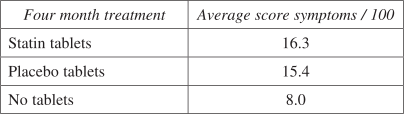
A recent study at a public hospital focused on 60 patients who had all stopped taking statins in the past due to severe side-effects. Patients took statin tablets for four months, placebo tablets for four months and no tablets for four months.

Every day for the year the patients scored, from zero to 100, how bad their symptoms were. The results are shown.
 

Evaluate this study and its results.   (6 marks)

--- 12 WORK AREA LINES (style=lined) ---

Show Answers Only
  • The data shows that when no tablets were taken, patients still displayed symptoms of the side effects (score 8.0). Taking the statin tablets doubled the severity of the side effects (score 16.3), however, placebo tablets with no active ingredients still produced similar results (score 15.4).
  • This seems to indicate that the side effects may arise as a result of other factors.
  • However, this study cannot be regarded as valid. Only 60 patients were involved in comparison to the millions that take statin tablets.
  • The results were also taken in a qualitative way and cannot be regarded as reliable.
  • The study should also have included a control group of people who have never taken statins to be used for a comparison to improve validity.
  • While the raw data provides data which is valuable and should be followed up with a large, randomised control trial, the study itself cannot be regarded as valid.
Show Worked Solution
  • The data shows that when no tablets were taken, patients still displayed symptoms of the side effects (score 8.0). Taking the statin tablets doubled the severity of the side effects (score 16.3), however, placebo tablets with no active ingredients still produced similar results (score 15.4).
  • This seems to indicate that the side effects may arise as a result of other factors.
  • However, this study cannot be regarded as valid. Only 60 patients were involved in comparison to the millions that take statin tablets.
  • The results were also taken in a qualitative way and cannot be regarded as reliable.
  • The study should also have included a control group of people who have never taken statins to be used for a comparison to improve validity.
  • While the raw data provides data which is valuable and should be followed up with a large, randomised control trial, the study itself cannot be regarded as valid.
♦♦ Mean mark 38%.

Filed Under: Epidemiology Tagged With: Band 5, Band 6, smc-3661-10-Analysing Results, smc-3661-20-Evaluating the Method

Copyright © 2014–2025 SmarterEd.com.au · Log in