SmarterEd

Aussie Maths & Science Teachers: Save your time with SmarterEd

  • Login
  • Get Help
  • About

CHEMISTRY, M5 2025 HSC 14 MC

The equation for the decomposition of hydrogen iodide is shown.

\(\ce{2HI(g)\rightleftharpoons I2(g) + H2(g)} \quad \quad \Delta H=+52 \ \text{kJ mol}^{-1}\)

The equilibrium formed during this reaction was investigated in two experiments carried out at different temperatures. The initial and equilibrium concentrations for both experiments are shown in the table, with only the \(K_{e q}\) for Experiment 1 shown.
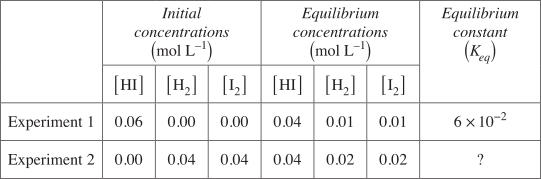
 

Which row in the table correctly compares features of the two experiments?

\begin{align*}
\begin{array}{l}
\rule{0pt}{2.5ex} \ \rule[-1ex]{0pt}{0pt}& \\
 \ \rule[-1ex]{0pt}{0pt}& \\
\rule{0pt}{2.5ex}\textbf{A.}\rule[-1ex]{0pt}{0pt}\\
\rule{0pt}{2.5ex}\textbf{B.}\rule[-1ex]{0pt}{0pt}\\
\rule{0pt}{2.5ex}\textbf{C.}\rule[-1ex]{0pt}{0pt}\\
\rule{0pt}{2.5ex}\textbf{D.}\rule[-1ex]{0pt}{0pt}\\
\end{array}
\begin{array}{|c|c|}
\hline
\rule{0pt}{2.5ex}\quad \quad \quad K_{e q}\quad \quad\quad& \ \ \text{Temperature of}\ \  \\
\ \rule[-1ex]{0pt}{0pt}& \textit{experiment} \\
\hline
\rule{0pt}{2.5ex}\text{Lower in 1}\rule[-1ex]{0pt}{0pt}&\text{Lower in 2}\\
\hline
\rule{0pt}{2.5ex}\text{Lower in 1}\rule[-1ex]{0pt}{0pt}& \text{Higher in 2}\\
\hline
\rule{0pt}{2.5ex}\text{Higher in 1}\rule[-1ex]{0pt}{0pt}& \text{Lower in 2} \\
\hline
\rule{0pt}{2.5ex}\text{Higher in 1}\rule[-1ex]{0pt}{0pt}& \text{Higher in 2} \\
\hline
\end{array}
\end{align*}

Show Answers Only

\(B\)

Show Worked Solution
  • The equilibrium constant for experiment two:
  •    \(K_{eq} = \dfrac{\ce{[H2][I2]}}{\ce{[HI]^2}} = \dfrac{0.02 \times 0.02}{0.04^2} = 0.25\)
  • Therefore the \(K_{eq}\) for experiment 1 is lower than the \(K_{eq}\) for experiment 2.
  • For an endothermic reaction (thinking of heat as a reactant), increasing the temperature of the reaction will shift the equilibrium to the products and increase \(K_{eq}\) which is what occured in experiment 2. 
  • Hence, the temperature of the experiment is higher in 2.

\(\Rightarrow B\)

Filed Under: Equilibrium Constant, Factors that Affect Equilibrium Tagged With: Band 5, smc-3670-10-Temperature, smc-3671-10-Find K(eq)

CHEMISTRY, M5 2025 HSC 12 MC

Consider the following reaction.

\(\ce{3AgNO3(aq) + FeCl3(aq) \rightleftharpoons 3AgCl(s) + Fe(NO3)3(aq)}\)

What is the correct equilibrium expression for this reaction?

  1. \(\dfrac{\left[\ce{Fe(NO3)3}\right]}{\left[\ce{AgNO3}\right]\left[\ce{FeCl3}\right]}\)
  2. \(\dfrac{\left[\ce{Fe(NO3)3}\right]}{\left[\ce{AgNO3}\right]^3\left[\ce{FeCl3}\right]}\)
  3. \(\dfrac{\left[\ce{AgNO3}\right]^3 \left[\ce{FeCl3}\right]}{\ce{[AgCl]^3}\left[ \ce{Fe}\ce{(NO3)_3}\right]}\)
  4. \(\dfrac{\ce{[AgCl]^3}\left[ \ce{Fe}\ce{(NO3)_3}\right]}{\left[\ce{AgNO3}\right]^3\left[\ce{FeCl3}\right]}\)
Show Answers Only

\(B\)

Show Worked Solution
  • The equilibrium expression does not include reactants or products that are in the solid or liquid state, hence \(\ce{3AgCl(s)}\) is not included in the equilibrium expression.
  • \(\therefore K_{eq} = \dfrac{\ce{[Fe(NO3)3]}}{\ce{[AgNO3]^3[FeCl3]}}\)

\(\Rightarrow B\)

Filed Under: Equilibrium Constant Tagged With: Band 4, smc-3671-10-Find K(eq)

CHEMISTRY, M5 2024 HSC 39

Water and octan-1-ol do not mix. When an aqueous solution of bromoacetic acid \(\left(\ce{BrCH2COOH}\right)\) is shaken with octan-1-ol, an equilibrium system is established between bromoacetic acid dissolved in the octan-1-ol and in the water.

\(\ce{BrCH2COOH(aq) \rightleftharpoons BrCH2COOH}\textit{(octan-l-ol)}\)

The equilibrium constant expression for this system is

\(K_{e q}=\dfrac{\left[\ce{BrCH2COOH}\textit{(octan-l-ol)}\right]}{\left[\ce{BrCH2COOH}\textit{(aq)}\right]}\).

An aqueous solution of bromoacetic acid with an initial concentration of 0.1000 mol L \(^{-1}\) is shaken with an equal volume of octan-1-ol. Bromoacetic acid does not dissociate in octan-1-ol but does dissociate in water, with \(K_a=1.29 \times 10^{-3}\). When the system has reached equilibrium, the \(\left[\ce{H+}\right]\) is \(9.18 \times 10^{-3} \text{ mol L}^{-1}\).

Calculate the equilibrium concentration of aqueous bromoacetic acid and hence, or otherwise, calculate the \(K_{eq}\) for the octan-1-ol and water system.   (4 marks)

--- 10 WORK AREA LINES (style=lined) ---

Show Answers Only

\(0.390\) 

Show Worked Solution

  • The ionisation of bromoacetic acid in water is:
  •    \(\ce{BrCH2COOH(aq) \rightleftharpoons BrCH2COO^-(aq) + H^+(aq)}\)
  • At equilibrium \(\ce{[BrCH2COO^-(aq)] = [H^+(aq)]} = 9.18 \times 10^{-3}\ \text{mol L}^{-1}\) as the are formed in a \(1:1\).
\(K_{a}\) \(=\dfrac{\ce{[H^+][BrCH2COO^-]}}{\ce{[BrCH2COOH]_{eq}}}\)  
\(\ce{[BrCH2COOH]_{eq}}\) \(=\dfrac{\ce{[H^+][BrCH2COO^-]}}{K_a}\)  
  \(=\dfrac{(9.18 \times 10^{-3})^2}{1.29 \times 10^{-3}}\)  
  \(=0.06533\ \text{mol L}^{-1}\)  


\(\ce{[BrCH2COOH]_{\text{total}}}=\ce{[BrCH2COOH(aq)]_{eq} + [BrCH2COO^-(aq)]}\)

\(\ce{+ [BrCH2COOH(octan-1-ol)]_{eq}}\)

\(\ce{[BrCH2COOH(octan-1-ol)]_{eq}}\) \(=0.1000-0.06533-9.18 \times 10^{-3}\)  
  \(=0.02549\ \text{mol L}^{-1}\)    
     
  • Since the volume of the aqueous solution of bromoacetic acid and octane is the same, the concentration values between the water and octane solutions can be added/subtracted in one equation and mole calculations are not required.
  •    \(K_{eq} = \dfrac{\ce{[BrCH2COOH(octan-1-ol)]_{eq}}}{\ce{[BrCH2COOH(aq)]_{eq}}}= \dfrac{0.02549}{0.06533}=0.390\ \text{(3 sig. fig.)}\)
♦♦ Mean mark 27%.
COMMENT: Students who identified the acid conc in the organic solvent often succeeded in this question.

Filed Under: Equilibrium Constant, Quantitative Analysis Tagged With: Band 5, Band 6, smc-3671-10-Find K(eq), smc-3675-30-Ka/Kb

CHEMISTRY, M5 2024 HSC 23

Consider the following equilibrium system.

\(\ce{\left[Co \left(H_2O\right)_6\right]^{2+}(aq) + 4Cl^{-} (aq) \rightleftharpoons\left[CoCl_4\right]^{2-}(aq) +6H_2O (l)}\)

\(\ce{\left[Co\left(H_2O\right)_6\right]^{2+}(aq)}\)  is pink and  \(\ce{\left[CoCl_4\right]^{2-}(aq)}\)  is blue. When a solution of these ions and chloride ions is heated, the mixture becomes more blue.

Relate the observed colour change to the change in \(K_{e q}\).   (3 marks)

--- 10 WORK AREA LINES (style=lined) ---

Show Answers Only
  • When the solution is heated and the mixture becomes more blue, it suggests that the concentration of \(\ce{\left[CoCl_4\right]^{2-}(aq)}\) is increasing.
  • The increase in temperature favoured the forward endothermic reaction and shifts the equilibrium position to the products.
  • Therefore the concentrations of \(\ce{\left[Co\left(H_2O\right)_6\right]^{2+}(aq)}\) and \(\ce{Cl^-(aq)}\) will decrease.
  • As  \(K_{eq}=\dfrac{\ce{\left[\left[CoCl4\right]^{2-}\right]}}{\ce{\bigl[\left[Co\left(H2O\right)6\right]^{2+}\bigr]\left[Cl^{-}\right]^4}}\),  \(K_{eq}\) will increase.
Show Worked Solution
  • When the solution is heated and the mixture becomes more blue, it suggests that the concentration of \(\ce{\left[CoCl_4\right]^{2-}(aq)}\) is increasing.
  • The increase in temperature favoured the forward endothermic reaction and shifts the equilibrium position to the products.
  • Therefore the concentrations of \(\ce{\left[Co\left(H_2O\right)_6\right]^{2+}(aq)}\) and \(\ce{Cl^-(aq)}\) will decrease.
  • As  \(K_{eq}=\dfrac{\ce{\left[\left[CoCl4\right]^{2-}\right]}}{\ce{\bigl[\left[Co\left(H2O\right)6\right]^{2+}\bigr]\left[Cl^{-}\right]^4}}\),  \(K_{eq}\) will increase.

Filed Under: Equilibrium Constant Tagged With: Band 4, smc-3671-10-Find K(eq), smc-3671-35-Chemical equation given

CHEMISTRY, M5 2024 HSC 15 MC

The thermal decomposition of lithium peroxide \(\ce{(Li_2O_2)}\) is given by the equation shown.

\(\ce{2Li_2O_2(s)\rightleftharpoons 2 Li_2 O(s) + O_2(g)}\)

Mixtures of \(\ce{Li_2O_2}\), \(\ce{Li_2O}\) and \(\ce{O_2}\) were allowed to reach equilibrium in two identical, closed containers, \(\text{P}\) and \(\text{Q}\), at the same temperature. The amount of \(\ce{Li_2O_2(s)}\) in container \(\text{P}\) is double that in container \(\text{Q}\) . The amount of \(\ce{Li_2O(s)}\) is the same in each container.

What is the ratio of \(\left[ \ce{O_2(g)}\right]\) in container \(\text{P}\) to \(\left[\ce{O_2(g)}\right]\) in container \(\text{Q}\)?

  1. \(1: 1\)
  2. \(2: 1\)
  3. \(3: 2\)
  4. \(5: 4\)
Show Answers Only

\(A\)

Show Worked Solution
  • When calculating the \(K_{eq}\) of a system, substances in solid states are all given a value of \(1\).
  • The equilibrium constant of the above reaction is \(K_{eq} = \ce{[O_2(g)]}\).
  • As both mixtures reached equilibrium, the \(K_{eq}\) values for each mixture is the same, hence the ratio of \(\ce{[O2(g)]}\) in each container is \(1:1\).

\(\Rightarrow A\)

♦♦ Mean mark 39%.

Filed Under: Equilibrium Constant Tagged With: Band 5, smc-3671-10-Find K(eq), smc-3671-20-Calcs given K(eq)

CHEMISTRY, M5 2023 HSC 31

Copper(\(\text{II}\)) ions \( \ce{(Cu^{2+})} \) form a complex with lactic acid \( \ce{(C3H6O3)} \), as shown in the equation.

\( \ce{Cu^{2+}(aq)} + \ce{2C3H6O3(aq)} \rightleftharpoons \Bigl[\ce{Cu(C3H6O3)2\Bigr]^{2+}(aq)} \)

This complex can be detected by measuring its absorbance at 730 nm. A series of solutions containing known concentrations of \( \Bigl[\ce{Cu(C3H6O3)_2\Big]^{2+}} \) were prepared, and their absorbances measured.
 

\( Concentration \ of \Bigl[\ce{Cu(C3H6O3)_2\Bigr]^{2+}} \) \( \text{(mol L}^{-1}) \) \( Absorbance \)
0.000 0.00
0.010 0.13
0.020 0.28
0.030 0.43
0.040 0.57
0.050 0.72
 
Two solutions containing \( \ce{Cu^{2+}} \ \text{and} \ \ce{C3H6O3} \) were mixed. The initial concentrations of each in the resulting solution are shown in the table.
 
\( Species \) \( Initial \ Concentration\)
\( (\text{mol L}^{-1}) \)
\( \ce{Cu^{2+}} \) 0.056
\( \ce{C3H6O3} \) 0.111

 
When the solution reached equilibrium, its absorbance at 730 nm was 0.66.

You may assume that under the conditions of this experiment, the only species present in the solution are those present in the equation above, and that \( \Bigl[ \ce{Cu(C3H6O3)_2\Bigr]^{2+}} \) is the only species that absorbs at 730 nm.

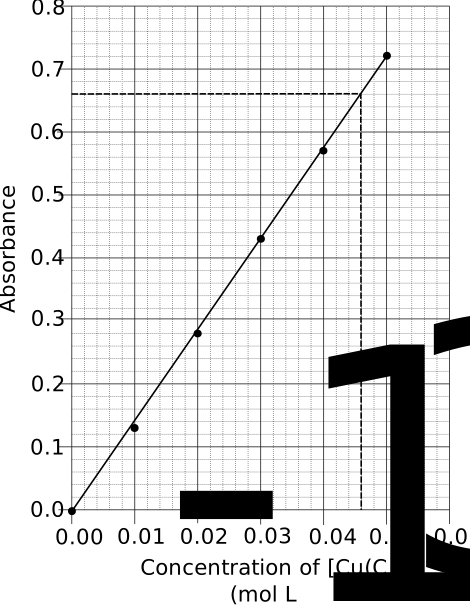
With the support of a line graph, calculate the equilibrium constant for the reaction.   (7 marks)
 

--- 14 WORK AREA LINES (style=lined) ---

Show Answers Only

\(K_{eq}=1.3 \times 10^4\)

Show Worked Solution

\(\text{From graph:}\)

\(\text{0.66 absorbance}\  \Rightarrow\ \ \Big[\bigl[\ce{Cu(C3H6O3)2\bigr]^{2+}\Big]} = 0.046\ \text{mol L}^{-1} \)

\begin{array} {|l|c|c|c|}
\hline  & \ce{Cu^{2+}} & \ce{2C3H6O3(aq)} & \ce{\big[Cu(C3H6O3)2\big]^{2+}(aq)} \\
\hline \text{Initial} & \ \ \ \ 0.056 & \ \ \ \ 0.111 & 0 \\
\hline \text{Change} & -0.046 & -0.092 & \ \ \ +0.046 \\
\hline \text{Equilibrium} & \ \ \ \ 0.010 & \ \ \ \ 0.019 & \ \ \ \ \ \ 0.046 \\
\hline \end{array}

\(K_{eq}=\dfrac{\ce{\Big[\big[Cu(C3H6O3)2\big]^{2+}\Big]}}{\ce{\big[Cu^{2+}\big]\big[C3H6O3\big]^2}}=\dfrac{0.046}{0.010 \times 0.019^2}=1.3 \times 10^4\)

Filed Under: Equilibrium Constant Tagged With: Band 4, Band 5, smc-3671-10-Find K(eq), smc-3671-60-Ionic solutions

CHEMISTRY, M5 EQ-Bank 13 MC

0.20 moles of phosphorus pentachloride were heated to 200°C in a 2 L container in the presence of a vanadium catalyst according to the following reaction.

\( \ce{PCl5(g) \rightleftharpoons  PCl3(g) + Cl2(g)}\)

At equilibrium, the mixture was found to contain 0.16 moles of chlorine.

Which of the following is the equilibrium constant for this reaction at this temperature?

  1. 0.32
  2. 0.64
  3. 1.56
  4. 3.13
Show Answers Only

`A`

Show Worked Solution

\(\ce{PCl5(g) \rightleftharpoons PCl3(g) + Cl2(g)}\)

\[\ce{[PCl5]_{init} = \frac{n}{V} = \frac{0.20}{2} = 0.10 mol L^{-1}}\]

\begin{array} {|l|c|c|c|}
\hline  & \ce{[PCl5]} & \ce{[PCl3]}  & \ce{[Cl2]} \\
\hline \text{Initial} & 0.10 & 0  & 0 \\
\hline \text{Change} & -0.08 & +0.08  & +0.08 \\
\hline \text{Equilibrium} & 0.02  & 0.08 & 0.08 \\
\hline \end{array}

 
\[\ce{$K_{eq}$ = \frac{[PCl3][Cl2]}{[PCl5]} = \frac{0.08^2}{0.02} = 0.32}\]

`=>A`

Filed Under: Equilibrium Constant Tagged With: Band 5, smc-3671-10-Find K(eq)

CHEMISTRY, M5 EQ-Bank 22

Hydrogen gas reacts with iodine gas to form hydrogen iodide according to the following equation.

\( \ce{H2(g) + I2(g) \rightleftharpoons 2HI(g)}\) at 700 k

At equilibrium, the concentrations for \(\ce{H2, I2}\) and \(\ce{HI}\) are as follows:  0.326 mol L–1, 0.326 mol L–1 and 2.39 mol L–1 respectively.

What is the value of the equilibrium constant for this reaction?  (2 marks)

--- 6 WORK AREA LINES (style=lined) ---

Show Answers Only

53.7

Show Worked Solution

\[\ce{$K_{eq}$ = \frac{[HI]^2}{[H2][I2]} = \frac{2.39^2}{[0.326][0.326]} = 53.7}\]

Filed Under: Equilibrium Constant Tagged With: Band 3, smc-3671-10-Find K(eq), smc-3671-35-Chemical equation given

CHEMISTRY, M5 EQ-Bank 3 MC

Consider the following reaction.

\( \ce{2NOCl(g) \rightleftharpoons 2NO(g) + Cl2(g)}\).

What is the equilibrium expression for this reaction?

  1. \(\dfrac{\ce{2[NO][Cl2]}}{\ce{2[NOCl]}}\)
  2. \(\dfrac{\ce{[NO]^2[Cl2]}}{\ce{[NOCl]^2}}\)
  3. \(\dfrac{\ce{2[NOCl]}}{\ce{2[NO][Cl2]}}\)
  4. \(\dfrac{\ce{[NOCl]^2}}{\ce{2[NO]^2[Cl2]}} \)
Show Answers Only

`B`

Show Worked Solution
  • All elements in the reaction are included in the \(\ce{$K_{eq}$}\) expression (i.e. no solids or pure liquids are present which would be omitted).
  •    \(\ce{$K_{eq}$} = \dfrac{\ce{[NO]^2[Cl2]}}{\ce{[NOCl]^2}}\)

\(\Rightarrow B\)

Filed Under: Equilibrium Constant Tagged With: Band 3, smc-3671-10-Find K(eq), smc-3671-35-Chemical equation given

CHEMISTRY, M6 2019 HSC 27

The relationship between the acid dissociation constant, `K_a`, and the corresponding conjugate base dissociation constant, `K_b`, is given by:

`K_(a)xxK_(b)=K_(w)`

Assume that the temperature for part (a) and part (b) is 25°C.

  1. The `K_a` of hypochlorous acid `text{(HOCl)}` is  `3.0 xx10^(-8)`.
  2. Show that the `K_b` of the hypochlorite ion, `text{OCl}^-`, is  `3.3 xx10^(-7)`.   (1 mark)

    --- 3 WORK AREA LINES (style=lined) ---

  3. The conjugate base dissociation constant, `K_b`, is the equilibrium constant for the following equation:
  4.      `text{OCl}^(-)(aq)+ text{H}_(2) text{O}(l) ⇌ text{HOCl}(aq)+ text{OH}^(-)(aq)`
  5. Calculate the pH of a 0.20 mol L¯1 solution of sodium hypochlorite `(text{NaOCl})`.   (4 mark)

    --- 14 WORK AREA LINES (style=lined) ---

Show Answers Only
  1. `K_b=3.3 xx 10^{-7}`
  2. \(\ce{pH = 14-3.59 = 10.41}\)
Show Worked Solution

a.   `K_(a)xxK_(b)=K_(w)\ \ =>\ \ K_b=(K_(w))/(K_(a))`

`K_b=(1.0 xx 10^{-14})/(3.0 xx 10^{-8}=3.3 xx 10^{-7}`
 

b.   \(\ce{OCl-(aq) + H2O(l) \rightleftharpoons HOCl(aq) + OH-(aq)}\)
 

\begin{array} {|l|c|c|c|}
\hline  & \ce{OCl-} & \ce{HOCl} & \ce{OH–} \\
\hline \text{Initial} & 0.20 & 0 & 0 \\
\hline \text{Change} & -x & +x & +x \\
\hline \text{Equilibrium} & 0.20-x & x & x \\
\hline \end{array}

 
\[ K_b = \ce{\frac{[HOCl][OH– ]}{[OCl-]}} = \frac{x^2}{(0.20-x)} \]

Assume  `0.20-x~~0.20`  because `x` is negligible:

`3.3 xx 10^(-7)` `= x^2 / (0.20-x)`  
`x` `=sqrt(3.3 xx 10^(−7) xx 0.20)`  
  `= 2.5690 xx 10^{-4}\ text{mol L}^(–1)`  

 
\(\ce{[OH-] = 2.5690 \times 10^{-4} mol L^{-1}}\)

\(\ce{pOH = -log10[OH-] = -log10(2.5690 \times 10^{-4}) = 3.59}\)

\(\therefore \ce{pH = 14-3.59 = 10.41}\)


♦ Mean mark (b) 45%.

Filed Under: Bronsted-Lowry Theory, Equilibrium Constant, Quantitative Analysis Tagged With: Band 4, Band 5, smc-3671-10-Find K(eq), smc-3671-35-Chemical equation given, smc-3671-40-K(eq) and pH, smc-3671-50-Acids and bases, smc-3674-10-Calculations Involving pH, smc-3675-30-Ka/Kb

CHEMISTRY, M5 2019 HSC 16 MC

At equilibrium, a 1.00 L vessel contains 0.0430 mol of \(\ce{H2}\), 0.0620 mol of \(\ce{I2}\), and 0.358 mole of \(\ce{HI}\). The system is represented by the following equation:

\(\ce{H2(g) + I2(g) \rightleftharpoons 2HI(g)}\)

Which of the following is closest to the value of the equilibrium constant, \(K_{eq}\), for this reaction?

  1. 0.0208
  2. 48.1
  3. 134
  4. 269
Show Answers Only

\(B\)

Show Worked Solution
\(K_{eq}\) \(= \dfrac{\ce{[HI]^2}}{\ce{[H_2][I_2]}} \)  
  \(=\dfrac{0.358^2}{(0.0430)(0.0620)}\)  
  \(=48.1\)  

 
\(\Rightarrow B\)

Filed Under: Equilibrium Constant Tagged With: Band 3, smc-3671-10-Find K(eq), smc-3671-35-Chemical equation given

CHEMISTRY, M5 2020 HSC 35

In aqueous solution, iodide ions `(text{I}^-)`react rapidly with iodine `(text{I}_2)` to form triiodide ions `text{I}_(3)^(\ -)`, making the equilibrium system shown in the chemical equation:

`text{I}^(-)(aq)+ text{I}_(2)(aq) ⇌ text{I}_(3)^(\ -)(aq)`

The following relationships can be derived from the reaction mechanism:

`[text{I}^(-)]_(eq)=2[text{I}_(2)]_(eq)`

`[text{I}^(-)]_(i nitial)=4[text{I}_(2)]_(eq)+3[text{I}_(3)^(\ -)]_(eq)`

where 'initial' designates the initial concentration and 'eq' designates the equilibrium concentration.

The absorbance of the solution in the UV-Vis spectrum is given by:

`A=[text{I}_(3)^(\ -)]xx2.76 xx10^(4)`

Determine the value of the equilibrium constant, given that  `A = 0.745`  at equilibrium and  `[text{I}^(-)]_(i nitial )=7.00 xx10^(-4)\ text{mol L}^(-1)`.   (4 marks)

--- 14 WORK AREA LINES (style=lined) ---

Show Answers Only

`K_text{eq}= 564`

Show Worked Solution
`text{A}` \(\ce{= [I3–]_{eq} \times 2.76 × 10^4}\)
`0.745` \(\ce{= [I3–]_{eq} \times 2.76 × 10^4}\)
\(\ce{[I3–]_{eq}}\) `= 2.70 \times 10^(−5)\ text{mol L}^(–1)`


\(\ce{[I– ]_{initial}}\) \(\ce{= 4[I2 ]_{eq} + 3 [I3– ]_{eq}}\)
`7.00 xx 10^(−4)` `= 4 [text{I}_2 ]_text{eq} + (3 xx 2.70 xx 10^(−5))`
\(\ce{[I2 ]_{eq}}\) `=(7.00 xx 10^(−4)-(3 xx 2.70 xx 10^(−5)))/4`
  `= 1.55 xx 10^(−4)\ text{mol L}^(–1)`


`[text{I}^– ]_text(eq) = 2 [text{I}_2 ]_text(eq) = 2 xx (1.55 xx 10^(−4)) = 3.10 xx 10^(−4)\ text{mol L}^(–1)`


`K_text{eq}` `=[text{I}_3\^(\ -)]_text(eq) /[[text{I}^–]_text(eq) xx [text{I}_2]_text(eq)]`
  `= [2.70 xx 10^(−5)] / [3.10 xx 10^(−4) xx 1.55 xx 10^(−4)]`
  `= 564`

Mean mark 55%.

Filed Under: Equilibrium Constant, Solution Equilibria Tagged With: Band 5, smc-3671-10-Find K(eq), smc-3671-35-Chemical equation given, smc-3671-60-Ionic solutions, smc-3672-10-Mixed ionic solutions

CHEMISTRY, M6 2020 HSC 33

Excess solid calcium hydroxide is added to a beaker containing 0.100 L of 2.00 mol L¯1 hydrochloric acid and the mixture is allowed to come to equilibrium.

  1. Show that the amount (in mol) of calcium hydroxide that reacts with the hydrochloric acid is 0.100 mol.   (2 marks)

    --- 4 WORK AREA LINES (style=lined) ---

  2. It is valid in this instance to make the simplifying assumption that the amount of calcium ions present at equilibrium is equal to the amount generated in the reaction in part (a).
  3. Calculate the pH of the resulting solution.   (4 marks)

    --- 10 WORK AREA LINES (style=lined) ---

Show Answers Only

a.   \(\ce{Ca(OH)2 (s) + 2 HCl (aq) -> CaCl2 (aq) + 2 H2O (l)}\)

`text{n(HCl)} = text{c} xx text{V} = 2.00 xx 0.100  = 0.200\ text{mol}`

\[\ce{n(Ca(OH)2) = \frac{n(HCL)}{2} = \frac{0.200}{2}= 0.100 mol}\]  

b.   `text{pH} = 11.35`

Show Worked Solution

a.   \(\ce{Ca(OH)2 (s) + 2 HCl (aq) -> CaCl2 (aq) + 2 H2O (l)}\)

`text{n(HCl)} = text{c} xx text{V} = 2.00 xx 0.100  = 0.200\ text{mol}`

\[\ce{n(Ca(OH)2) = \frac{n(HCL)}{2} = \frac{0.200}{2}= 0.100 mol}\]  

b.   \(\ce{Ca(OH)2(s) \rightleftharpoons Ca^2+ (aq) + 2 OH– (aq)}\)

`[text{Ca}^(2+)] = text{n} / text{V} = 0.100 / 0.100 = 1.00\ text{mol L}^-1`
 

\(\ce{K_{sp}}\) \( \ce{= [Ca^2+][OH– ]^2}\)  
`5.02 xx 10^(-6)` `= 1.00 xx [text{OH}^– ]^2`  
`[text{OH}^– ]` `=sqrt{5.02 xx 10^(-6)}=2.24 xx 10^(−3)\ text{mol L}^(-1)`  
`text{pOH }` `= −log_10(2.24 xx 10^(-3))= 2.650`  

 
`:.\ text{pH} = 14-2.650 = 11.35`


♦♦♦ Mean mark (b) 20%.

Filed Under: Bronsted-Lowry Theory, Equilibrium Constant Tagged With: Band 3, Band 6, smc-3671-10-Find K(eq), smc-3671-30-Deduce chemical equation, smc-3671-40-K(eq) and pH, smc-3671-50-Acids and bases, smc-3674-10-Calculations Involving pH

CHEMISTRY, M5 2022 HSC 8 MC

A system is described as follows.

\(\ce{2NaHCO3(s)  \rightleftharpoons Na2CO3(s) + CO2(g) + H2O(g)}\)

What is the equilibrium expression for this system?

  1. `K_{eq}=[\text{CO}_2]`
  2. `K_{eq}=[\text{CO}_2][\text{H}_2\text{O}]`
  3. `K_{eq}=(1)/([\text{CO}_2][\text{H}_2\text{O}])`
  4. `K_{eq}=([\text{Na}_2\text{CO}_3][\text{CO}_2][\text{H}_2\text{O}])/[\text{NaHCO}_3]^(2)`
Show Answers Only

`B`

Show Worked Solution
  • The concentrations of solids and pure liquids are omitted from the equilibrium expression because they have a constant concentration.
  • Thus, the equilibrium expression is:
  •    `K_(eq) = [text{CO}_2] [text{H}_2 text{O}]`

`=> B`

Filed Under: Equilibrium Constant Tagged With: Band 4, smc-3671-10-Find K(eq), smc-3671-35-Chemical equation given

Copyright © 2014–2025 SmarterEd.com.au · Log in