SmarterEd

Aussie Maths & Science Teachers: Save your time with SmarterEd

  • Login
  • Get Help
  • About

CHEMISTRY, M5 EQ-Bank 26

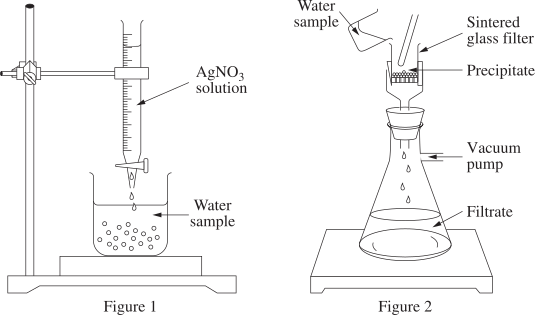
The diagrams represent equipment used in an investigation to determine the chloride ion concentration in a water sample.
 

Describe how the chloride ion concentration in a water sample can be determined using the equipment in the diagrams. Include a relevant chemical equation.   (3 marks)

Show Answers Only
  • When the silver nitrate solution is added, chloride ions present in the water sample will precipitate with the added silver ions described by the following equation:
  •    \(\ce{Ag+(aq) +Cl^-(aq) \rightleftharpoons AgCl(s)}\)
  • Adding excess silver nitrate ensures all chloride ions precipitate out.
  • The filtering apparatus is used to filter solid silver chloride. This solid is then dried to constant mass and weighed.
  • Using the molar mass of silver chloride, the number of moles of solid silver chloride produced is calculated. Silver chloride contains silver ions and chloride ions in a 1:1 molar ratio and using this ratio, the moles of chloride present is calculated.
  • The result represents the same number of moles of chloride in the original water sample. Using the volume of the water sample, its chloride ion concentration is calculated.
Show Worked Solution
  • When the silver nitrate solution is added, chloride ions present in the water sample will precipitate with the added silver ions described by the following equation:
  •    \(\ce{Ag+(aq) +Cl^-(aq) \rightleftharpoons AgCl(s)}\)
  • Adding excess silver nitrate ensures all chloride ions precipitate out.
  • The filtering apparatus is used to filter solid silver chloride. This solid is then dried to constant mass and weighed.
  • Using the molar mass of silver chloride, the number of moles of solid silver chloride produced is calculated. Silver chloride contains silver ions and chloride ions in a 1:1 molar ratio and using this ratio, the moles of chloride present is calculated.
  • The result represents the same number of moles of chloride in the original water sample. Using the volume of the water sample, its chloride ion concentration is calculated.

Filed Under: Inorganic Substances, Solution Equilibria Tagged With: Band 4, smc-3672-70-Precipitate

CHEMISTRY, M5 EQ-Bank 15 MC

What will happen when sulfuric acid is added to a saturated solution of sparingly soluble calcium sulfate?

  1. The concentration of calcium and sulfate ions will increase over time due to the presence of \(\ce{H^{+}}\) ions.
  2. The concentration of calcium and sulfate ions will decrease over time due to the presence of \(\ce{H^{+}}\) ions.
  3. The concentration of calcium and sulfate ions will increase over time due to the presence of \(\ce{SO4^{2-}}\) ions.
  4. The concentration of calcium and sulfate ions will decrease over time due to the presence of \(\ce{SO4^{2-}}\) ions.
Show Answers Only

`D`

Show Worked Solution
  • The saturated solution of calcium sulfate is originally at equilibrium
  •    \(\ce{CaSO4(s) \rightleftharpoons Ca^2+(aq) + SO4^2-(aq)}\)
  • The addition of sulfuric acid increases the concentration of \(\ce{SO4^{2-}}\) (sulfate) ions in solution.
  • By Le Chatelier’s principle, the above equilibrium will shift left to counteract this, decreasing the concentration of calcium and sulfate ions over time.

`=>D`

Filed Under: Solution Equilibria Tagged With: Band 5, smc-3672-70-Precipitate

CHEMISTRY, M8 2019 HSC 29

Stormwater from a mine site has been found to be contaminated with copper\(\text{(II)}\) and lead\(\text{(II)}\) ions. The required discharge limit is 1.0 mg L¯1 for each metal ion. Treatment of the stormwater with \(\ce{Ca(OH)2}\) solid to remove the metal ions is recommended.

  1. Explain the recommended treatment with reference to solubility. Include a relevant chemical equation.   (2 marks)

    --- 5 WORK AREA LINES (style=lined) ---

  2. Explain why atomic absorption spectroscopy can be used to determine the concentrations of \(\ce{Cu^2+}\) and \(\ce{Pb^2+}\) ions in a solution containing both species.   (2 marks)

    --- 6 WORK AREA LINES (style=lined) ---

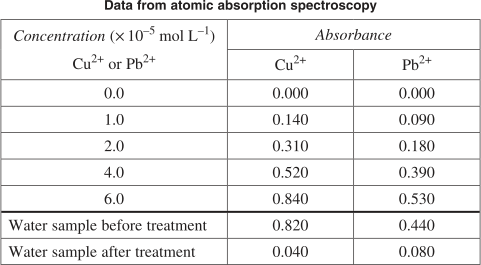
  3. The data below were obtained after treatment of the stormwater.


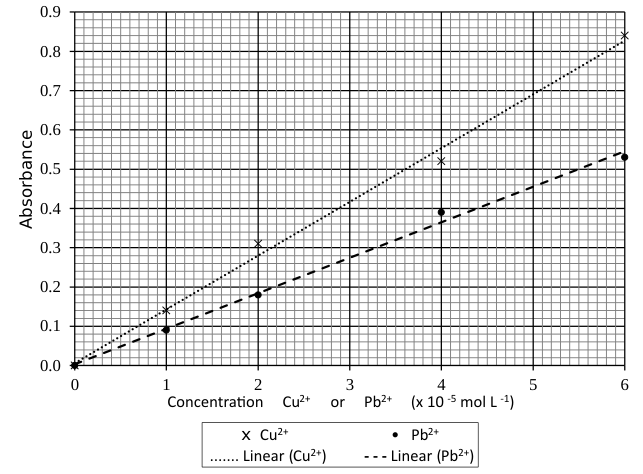
    To what extent is the treatment effective in meeting the required discharge limit of 1.0 mg L¯1 for each metal ion? Support your conclusion with calibration curves and calculations.   (7 marks)


    --- 7 WORK AREA LINES (style=lined) ---

Show Answers Only

a.   Recommended Treatment:

  • Calcium hydroxide is a slightly soluble compound, while copper\(\text{(II)}\) hydroxide and lead\(\text{(II)}\) hydroxide are very insoluble in water.
  • When these compounds are added to water, the metal ions tend to precipitate out of solution.
  • For example, the addition of solid calcium hydroxide to water produces calcium ions \(\ce{Ca^2+}\) and hydroxide ions \(\ce{OH-}\), which can then react with lead\(\text{(II)}\) ions (\(\ce{Pb^2+})\) and copper\(\text{(II)}\) ions \(\ce{Cu^2+}\) to form precipitates of lead\(\text{(II}\) hydroxide and copper\(\text{(II)}\) hydroxide, respectively.
  • These reactions are represented by the equations:
  •    \(\ce{Pb^2+ + 2OH- -> Pb(OH)2, \ \ Cu^2+ + 2OH- -> Cu(OH)2}\) 

b.   Atomic absorption spectroscopy (AAS):

  • Can be used for determining the concentration of metal ions in a sample by measuring the absorbance of light at specific wavelengths that are characteristic of each metal.
  • AAS uses light wavelengths that correspond to atomic absorption by the element of interest, and since each element has unique wavelengths that are absorbed, the concentration of that element can be selectively measured in the presence of other species.
  • As a result, AAS can be used to independently measure the concentrations of different metal ions, such as lead\(\text{(II)}\) ions and copper\(\text{(II)}\) ions in a sample containing both types. 

c.   Concentrations of ions:

\begin{array} {|l|c|c|c|}
\hline  \text{Sample }& \ce{Cu^2+ \times 10^{-5} mol L^{-1}} & \ce{Pb^2+ \times 10^{-5} mol L^{-1}} \\
\hline \text{Water (pre-treatment)} & 5.95 & 4.75 \\
\hline \text{Water (post-treatment)} & 0.25 & 0.85 \\
\hline \end{array}

  • Concentrations of copper and lead have been significantly reduced.
  • Convert concentrations to compare with standard:

\begin{array} {ccc}
\ce{Cu^2+}: & 5.95 \times 10^{-5} \times 63.55 \times 1000 = 3.78\ \text{mg L}^{-1} \\
 & 0.25 \times 10^{-5} \times 63.55 \times 1000 = 0.16\ \text{mg L}^{-1} \\
& \\
\ce{Pb^2+}: & 4.75 \times 10^{-5} \times 207.2 \times 1000 = 9.84\ \text{mg L}^{-1} \\
& 0.85 \times 10^{-5} \times 207.2 \times 1000 = 1.76\ \text{mg L}^{-1} \end{array}


Conclusion:

  • The concentration of copper ions has been reduced to a level that is lower than the discharge limit (0.16 < 1.0) but the lead ion concentration has not (1.76 > 1.0).
  • The treatment has only been partially successful.
Show Worked Solution

a.   Recommended Treatment:

  • Calcium hydroxide is a slightly soluble compound, while copper\(\text{(II)}\) hydroxide and lead\(\text{(II)}\) hydroxide are very insoluble in water.
  • When these compounds are added to water, the metal ions tend to precipitate out of solution.
  • For example, the addition of solid calcium hydroxide to water produces calcium ions \(\ce{Ca^2+}\) and hydroxide ions \(\ce{OH-}\), which can then react with lead\(\text{(II)}\) ions (\(\ce{Pb^2+})\) and copper\(\text{(II)}\) ions \(\ce{Cu^2+}\) to form precipitates of lead\(\text{(II}\) hydroxide and copper\(\text{(II)}\) hydroxide, respectively.
  • These reactions are represented by the equations:
  •    \(\ce{Pb^2+ + 2OH- -> Pb(OH)2, \ \ Cu^2+ + 2OH- -> Cu(OH)2}\) 

♦ Mean mark (a) 46%.

b.   Atomic absorption spectroscopy (AAS):

  • Can be used for determining the concentration of metal ions in a sample by measuring the absorbance of light at specific wavelengths that are characteristic of each metal.
  • AAS uses light wavelengths that correspond to atomic absorption by the element of interest, and since each element has unique wavelengths that are absorbed, the concentration of that element can be selectively measured in the presence of other species.
  • As a result, AAS can be used to independently measure the concentrations of different metal ions, such as lead\(\text{(II)}\) ions and copper\(\text{(II)}\) ions in a sample containing both types. 

c.   Concentrations of ions:

\begin{array} {|l|c|c|c|}
\hline  \text{Sample }& \ce{Cu^2+ \times 10^{-5} mol L^{-1}} & \ce{Pb^2+ \times 10^{-5} mol L^{-1}} \\
\hline \text{Water (pre-treatment)} & 5.95 & 4.75 \\
\hline \text{Water (post-treatment)} & 0.25 & 0.85 \\
\hline \end{array}


♦♦ Mean mark (b) 32%.
  • Concentrations of copper and lead have been significantly reduced.
  • Convert concentrations to compare with standard:

\begin{array} {ccc}
\ce{Cu^2+}: & 5.95 \times 10^{-5} \times 63.55 \times 1000 = 3.78\ \text{mg L}^{-1} \\
 & 0.25 \times 10^{-5} \times 63.55 \times 1000 = 0.16\ \text{mg L}^{-1} \\
& \\
\ce{Pb^2+}: & 4.75 \times 10^{-5} \times 207.2 \times 1000 = 9.84\ \text{mg L}^{-1} \\
& 0.85 \times 10^{-5} \times 207.2 \times 1000 = 1.76\ \text{mg L}^{-1} \end{array}


Conclusion:

  • The concentration of copper ions has been reduced to a level that is lower than the discharge limit (0.16 < 1.0) but the lead ion concentration has not (1.76 > 1.0).
  • The treatment has only been partially successful.

♦ Mean mark (c) 53%.

Filed Under: Inorganic Substances, Solution Equilibria Tagged With: Band 5, Band 6, smc-3672-10-Mixed ionic solutions, smc-3672-60-Concentration graphs, smc-3672-70-Precipitate, smc-3682-60-Colourimetry UV-Vis and AAS

CHEMISTRY, M5 2020 HSC 17 MC

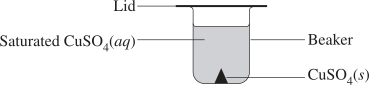
The following apparatus was set up in a temperature-controlled laboratory.


Excess solid sodium hydroxide is added to the beaker.

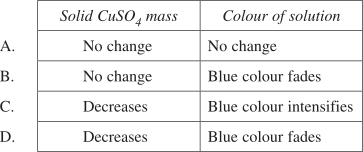
Which row of the table correctly identifies the change in the `text{CuSO}_(4)(s)` mass and the colour of the solution after several days?
 

Show Answers Only

`D`

Show Worked Solution

\(\ce{CuSO4(s) \rightleftharpoons Cu^2+ (aq) + SO4^2– (aq)}\)

  • The addition of \(\ce{NaOH}\) to the solution would result in a precipitate \(\ce{Cu(OH)2}\) and thus decreases the amount of \(\ce{Cu^2+}\) ions.
  • According to Le Chatlelier’s Principle, the system would shift right in an attempt to counteract the change and increase \(\ce{[Cu^2+]}\), thereby decreasing the mass of the precipitate.
  • The blue colour will fade since the \(\ce{[Cu^2+]}\) in the final solution is less.

`=>D`


♦♦ Mean mark 35%.

Filed Under: Solution Equilibria Tagged With: Band 5, smc-3672-10-Mixed ionic solutions, smc-3672-70-Precipitate

CHEMISTRY, M5 2022 HSC 35

A precipitate of strontium hydroxide `\text{Sr}(\text{OH})_2`, (`MM` = 121.63 g mol ¯1) was produced when 80.0 mL of 1.50 mol L ¯1 strontium nitrate solution was mixed with 80.0 mL of 0.855 mol L ¯1 sodium hydroxide solution. The mass of the dried precipitate was 3.93 g.

What is the `K_{sp}` of strontium hydroxide?   (5 marks)

--- 15 WORK AREA LINES (style=lined) ---

Show Answers Only

`3.06 × 10^(−4)`

Show Worked Solution

\( \ce{Sr(NO3)2(aq) + 2NaOH(aq) -> Sr(OH)2(s) + 2NaNO3(aq)} \)

\( \ce{n(Sr(NO3)2) = c \times V = 1.50 \times 0.0800= 0.120\ mol}\)

\( \ce{n(NaOH) = 0.855 \times 0.0800 = 0.0684  \text{mol} }\)

`text{NaOH = limiting reagent}, \ \ \ text{Sr(NO}_3)_2 = text{excess reagent}`

`text{n(Sr(OH)}_2text{) produced}\ = 1 / 2 xx 0.0684= 0.0342  text{mol}`

`text{Thus, 0.0342 moles of Sr(OH)}_2  text{can be produced in solution.}`

`text{n(Sr(OH)}_2\text{)} \ text{precipitate}= text{m} / text{MM}=3.93/121.63=0.0323111  text{mol}`
 

`text{n(Sr(OH)}_2)\ text{in solution}` `=text{n(Sr(OH)}_2)\ text{produced}  –  text{n(Sr(OH)}_2)\ text{precipitate}`
  `=0.0342-0.0323111`
  `= 0.0018889  text{mol}`

 
\( \ce{Sr(OH)2(s) \rightleftharpoons Sr^2+(aq) + 2OH-(aq)} \)

\( \ce{n(Sr(NO3)2)_{init} = 0.120 – \dfrac{1}{2} \times 0.0684 = 0.0858\ \text{mol}} \) 

\begin{array} {|l|c|c|}
\hline  & \text{Sr}^{2+} & \text{OH}^– \\
\hline \text{Initial} & 0.0858 & 0 \\
\hline \text{Change} & +0.0018889 & +2 \times 0.0018889 \\
\hline \text{Equilibrium} & 0.0877 & 0.00378 \\
\hline \end{array}

 
`text{V (total)} = 0.08 + 0.08= 0.16\ text{L}`

`[text{Sr}^(2+)]= text{n} / text{V} = 0.0877 / 0.16 = 0.548  text{mol L}^(–1)`

`[text{OH}^–]=0.00378 / 0.16= 0.0236  text{mol L}^–1`

`K_(sp)= [text{Sr}^(2+)][text{OH}^–]^2= 0.548 xx (0.02362)^2= 3.06 xx 10^(−4)`


♦ Mean mark 43%

Filed Under: Solution Equilibria Tagged With: Band 5, smc-3672-10-Mixed ionic solutions, smc-3672-15-Find K(sp), smc-3672-70-Precipitate

CHEMISTRY, M5 2020 HSC 11 MC

Equal volumes of two 0.04 mol L ¯1 solutions were mixed together.

Which pair of solutions would give the greatest mass of precipitate?

  1. `text{Ba(OH)}_(2) \ text{and} \ text{MgCl}_(2)`
  2. `text{Ba(OH)}_(2) \ text{and} \ text{MgSO}_(4)`
  3. `text{Ba(OH)}_(2) \ text{and} \ text{NaCl}`
  4. `text{Ba(OH)}_(2) \ text{and} \ text{Na}_(2) text{SO}_(4)`
Show Answers Only

`B`

Show Worked Solution

\(\ce{Ba(OH)2(aq) + MgSO4(aq) → BaSO4(s) + Mg(OH)2(s)}\)

  • Reaction B produces 2 molecules of precipitate
  • Reactions A and D produce 1 molecule of precipitate each
  • Reaction C does not produce a precipitate.

`=> B`

Filed Under: Solution Equilibria Tagged With: Band 4, smc-3672-10-Mixed ionic solutions, smc-3672-25-Solubility rules, smc-3672-70-Precipitate

Copyright © 2014–2025 SmarterEd.com.au · Log in