SmarterEd

Aussie Maths & Science Teachers: Save your time with SmarterEd

  • Login
  • Get Help
  • About

PHYSICS, M5 2025 HSC 5 MC

A planet orbits a star in an elliptical orbit as shown.
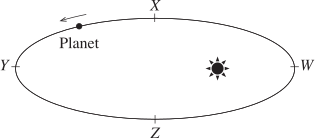
 

At which point in its orbit is the planet's kinetic energy increasing?

  1. \(W\)
  2. \(X\)
  3. \(Y\)
  4. \(Z\)
Show Answers Only

\(D\)

Show Worked Solution
  • As the planet gets closer to the sun in its orbit, its gravitational potential energy decreases.
  • The Law of Conservation of Energy means that as the planet’s potential energy decreases, its kinetic energy increases.
  • This occurs at point \(Z\), noting that the planet is moving perpendicular to the sun at \(W\) and \(Y\).

\(\Rightarrow D\)

Filed Under: Motion in Gravitational Fields Tagged With: Band 4, smc-3692-20-Energy Changes

PHYSICS, M5 2024 HSC 31

In a thought experiment, a projectile is launched vertically from Earth's surface. Its initial velocity is less than the escape velocity.

The behaviour of the projectile can be analysed by using two different models, Model \(A\) and Model \(B\) as shown.
  

The effects of Earth's atmosphere and Earth's rotational and orbital motions can be ignored.

Compare the maximum height reached by the projectile, using each model. In your answer, describe the energy changes of the projectile.   (4 marks)

--- 8 WORK AREA LINES (style=lined) ---

Show Answers Only

  • Both models start with identical kinetic energy, which completely transforms into gravitational potential energy when the object reaches its highest point.
  • In Model \(A\), a consistent amount of kinetic energy converts to gravitational potential energy for each meter of upward movement.
  • In Model \(B\), the gravitational field gets weaker at higher altitudes. As a result, less kinetic energy is converted to gravitational potential energy per meter as the object goes up.
  • The object in Model \(B\) will therefore climb higher than the object in Model \(A\) before all its kinetic energy is converted to potential energy.

Show Worked Solution

  • Both models start with identical kinetic energy, which completely transforms into gravitational potential energy when the object reaches its highest point.
  • In Model \(A\), a consistent amount of kinetic energy converts to gravitational potential energy for each meter of upward movement.
  • In Model \(B\), the gravitational field gets weaker at higher altitudes. As a result, less kinetic energy is converted to gravitational potential energy per meter as the object goes up.
  • The object in Model \(B\) will therefore climb higher than the object in Model \(A\) before all its kinetic energy is converted to potential energy.
♦ Mean mark 47%.

Filed Under: Motion in Gravitational Fields Tagged With: Band 5, smc-3692-15-Gravitational field strength, smc-3692-20-Energy Changes, smc-3692-70-Escape Velocity

PHYSICS, M5 2024 HSC 13 MC

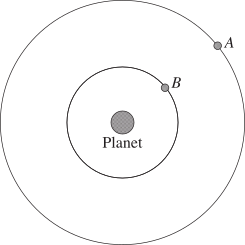
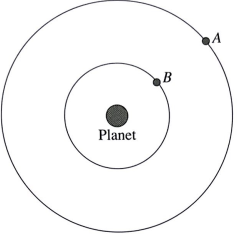
The diagram shows two identical satellites, \(A\) and \(B\), orbiting a planet.
 

Which row in the table correctly compares the potential energy, \(U\), and kinetic energy, \(K\), of the satellites?

\begin{align*}
\begin{array}{l}
\ \rule{0pt}{2.5ex}  \textbf{} \rule[-1.5ex]{0pt}{0pt}  & \\
\rule{0pt}{2.5ex}  \textbf{A.} \rule[-1ex]{0pt}{0pt} \\
\rule{0pt}{2.5ex}  \textbf{B.} \rule[-1ex]{0pt}{0pt} \\
\rule{0pt}{2.5ex}  \textbf{C.} \rule[-1ex]{0pt}{0pt} \\
\rule{0pt}{2.5ex}  \textbf{D.} \rule[-1ex]{0pt}{0pt} \\
\end{array}
\begin{array}{|c|c|}
\hline
\rule{0pt}{2.5ex} \textit{Potential energy} \rule[-1ex]{0pt}{0pt} & \textit{Kinetic energy} \\
\hline
\rule{0pt}{2.5ex} U_\text{A} > U_\text{B} \rule[-1ex]{0pt}{0pt} & K_\text{A} < K_\text{B} \\
\hline
\rule{0pt}{2.5ex} U_\text{A} < U_\text{B} \rule[-1ex]{0pt}{0pt} & K_\text{A} > K_\text{B} \\
\hline
\rule{0pt}{2.5ex} U_\text{A} > U_\text{B} \rule[-1ex]{0pt}{0pt} & K_\text{A} > K_\text{B} \\
\hline
\rule{0pt}{2.5ex} U_\text{A} < U_\text{B} \rule[-1ex]{0pt}{0pt} & K_\text{A} < K_\text{B} \\
\hline
\end{array}
\end{align*}

Show Answers Only

\(A\)

Show Worked Solution
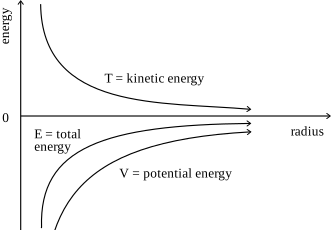
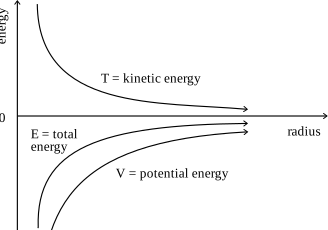
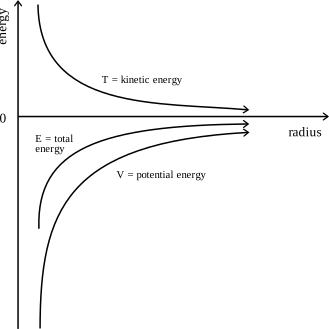
  • As shown in the graph below, as the radius of a satellite increases the kinetic energy decreases and the gravitational potential energy increases.
      

  • This can also be concluded using the energy formulas for kinetic energy and gravitational potential energy:
  •    \(K=\dfrac{GMm}{2r}\)  and  \(U=\dfrac{GMm}{r}\)

\(\Rightarrow A\)

Filed Under: Motion in Gravitational Fields Tagged With: Band 4, smc-3692-20-Energy Changes, smc-3692-40-Satellites

PHYSICS, M5 2020 VCE 11 MC

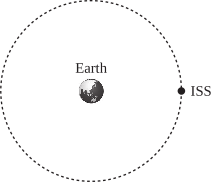
The International Space Station (ISS) is travelling around Earth in a stable circular orbit, as shown in the diagram below.
 

Which one of the following statements concerning the momentum and the kinetic energy of the ISS is correct?

  1. Both the momentum and the kinetic energy vary along the orbital path.
  2. Both the momentum and the kinetic energy are constant along the orbital path.
  3. The momentum is constant, but the kinetic energy changes throughout the orbital path.
  4. The momentum changes, but the kinetic energy remains constant throughout the orbital path.
Show Answers Only

\(D\)

Show Worked Solution
  • The magnitude of both the kinetic energy and momentum of the ISS remains constant.
  • However, momentum is a vector and as the direction of the ISS is continually changing so is the direction of the momentum of the ISS.

\(\Rightarrow D\)

♦♦ Mean mark 31%.
COMMENT: Students need to ensure they consider the direction of vector quantities as well as the magnitudes.

Filed Under: Motion in Gravitational Fields Tagged With: Band 5, smc-3692-20-Energy Changes, smc-3692-40-Satellites

PHYSICS, M5 2023 HSC 34

A 400 kg satellite is travelling in a circular orbit of radius 6.700 × 10\(^6\) m around Earth. Its potential energy is –2.389 × 10\(^{10}\ \text{J}\) and its total energy is –1.195 × 10\(^{10}\ \text{J}\).
 

At point \(P\), the satellite's engines are fired, increasing the satellite's velocity in the direction of travel and causing its kinetic energy to increase by 5.232 × 10\(^8\ \text{J}\). Assume that this happens instantaneously and that the engine is then shut down.

The satellite follows the trajectory shown, which passes through \(Q\), 6.850 × 10\(^6\) m from Earth's centre.

  1. Analyse qualitatively the energy changes as the satellite moves from \(P\) to \(Q\).   (2 marks)

    --- 5 WORK AREA LINES (style=lined) ---
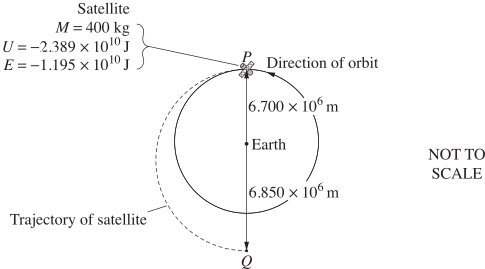
  1. Show that the kinetic energy of the satellite at \(Q\) is 1.194 × 10\(^{10}\ \text{J}\).   (4 marks)

    --- 5 WORK AREA LINES (style=lined) ---

  1. Explain the motion of the satellite after it passes through \(Q\).   (3 marks)

    --- 5 WORK AREA LINES (style=lined) ---

Show Answers Only

a.   Energy changes from \(P\) to \(Q\):

  • Due to the engine shutting down immediately after increasing the kinetic energy, the total energy of the system will remain the same.
  • As a result of the Law of Conservation of Energy, as the distance of the satellite from the Earth increases, the gravitational potential energy of the satellite increases and the kinetic energy of the satellite decreases.

b.   Using the Law of Conservation of Energy:

\(E_Q\) \(=U_Q+K_Q\) \(=E_P+K_{\text{engine}}\)
 
\(U_Q\) \(=-\dfrac{GMm}{r}\)  
  \(=-\dfrac{6.67 \times 10^{-11} \times 6 \times 10^{24} \times 400}{6.85 \times 10^6}\)  
  \(=-2.337 \times 10^{10}\) \(\text{J}\)  


\(K_Q\) \(=E_P+K_{\text{engine}}-U_Q\)  
  \(=-1.195 \times 10^{10} + 5.232 \times 10^8 -(-2.337 \times 10^{10})\)  
  \(=1.194 \times 10^{10}\) \(\text{J … as required}\)  


c.   The orbital velocity at \(Q\) is:

\(v\) \(=\sqrt{\dfrac{GM}{r}}\)  
  \(=\sqrt{\dfrac{6.67 \times 10^{-11} \times 6 \times 10^{24}}{6.85 \times 10^6}}\)  
  \(=7.644 \times 10^3\ \text{ms}^{-1}\)  


The velocity of the satellite at \(Q\) is:

\(K_Q\) \(=\dfrac{1}{2}mv_Q^2\)   
\(v_Q\) \(=\sqrt{\dfrac{2K_Q}{m}}\)  
  \(=\sqrt{\dfrac{2 \times 1.194 \times 10^{10}}{400}}\)  
  \(=7.727 \times 10^3\ \text{ms}^{-1}\)  


  • Since the velocity of the satellite at \(Q\) is greater than the orbital velocity at  \(r\) = 6.85 × 10\(^6\) m, the satellite will continue to move further away from the Earth.
  • Using the Law of Conservation of Energy, the kinetic energy of the satellite will decrease as the gravitational potential energy of the satellite increases. Hence the satellite will increase its distance from the Earth and slow down until the velocity of the satellite is equal to the orbital velocity at its new distance from the Earth.

Show Worked Solution

a.   Energy changes from \(P\) to \(Q\):

  • Due to the engine shutting down immediately after increasing the kinetic energy, the total energy of the system will remain the same.
  • As a result of the Law of Conservation of Energy, as the distance of the satellite from the Earth increases, the gravitational potential energy of the satellite increases and the kinetic energy of the satellite decreases.
♦ Mean mark (a) 47%.

b.   Using the Law of Conservation of Energy:

\(E_Q\) \(=U_Q+K_Q\) \(=E_P+K_{\text{engine}}\)
 
\(U_Q\) \(=-\dfrac{GMm}{r}\)  
  \(=-\dfrac{6.67 \times 10^{-11} \times 6 \times 10^{24} \times 400}{6.85 \times 10^6}\)  
  \(=-2.337 \times 10^{10}\) \(\text{J}\)  


\(K_Q\) \(=E_P+K_{\text{engine}}-U_Q\)  
  \(=-1.195 \times 10^{10} + 5.232 \times 10^8 -(-2.337 \times 10^{10})\)  
  \(=1.194 \times 10^{10}\) \(\text{J … as required}\)  
♦ Mean mark (b) 55%.

c.   The orbital velocity at \(Q\) is:

\(v\) \(=\sqrt{\dfrac{GM}{r}}\)  
  \(=\sqrt{\dfrac{6.67 \times 10^{-11} \times 6 \times 10^{24}}{6.85 \times 10^6}}\)  
  \(=7.644 \times 10^3\ \text{ms}^{-1}\)  


The velocity of the satellite at \(Q\) is:

\(K_Q\) \(=\dfrac{1}{2}mv_Q^2\)   
\(v_Q\) \(=\sqrt{\dfrac{2K_Q}{m}}\)  
  \(=\sqrt{\dfrac{2 \times 1.194 \times 10^{10}}{400}}\)  
  \(=7.727 \times 10^3\ \text{ms}^{-1}\)  

♦♦ Mean mark (c) 35%.
  • Since the velocity of the satellite at \(Q\) is greater than the orbital velocity at  \(r\) = 6.85 × 10\(^6\) m, the satellite will continue to move further away from the Earth.
  • Using the Law of Conservation of Energy, the kinetic energy of the satellite will decrease as the gravitational potential energy of the satellite increases. Hence the satellite will increase its distance from the Earth and slow down until the velocity of the satellite is equal to the orbital velocity at its new distance from the Earth.

Filed Under: Motion in Gravitational Fields Tagged With: Band 5, smc-3692-20-Energy Changes, smc-3692-40-Satellites

PHYSICS, M5 EQ-Bank 28

A bullet is fired vertically from the surface of Mars, at the escape velocity of Mars. Another bullet is fired vertically from the surface of Earth, at the escape velocity of Earth.

Neglecting air resistance, compare the energy transformations of the two bullets.   (5 marks)

Show Answers Only
  • The total energy of the bullet fired from the surface of Mars will remain constant. Its kinetic energy will transform into potential energy as it gains altitude. 
  • As the bullet fired from Mars reaches an ‘infinite’ distance away, it escapes Mars’ gravitational attraction. Here, the kinetic energy of the bullet is zero as it has expended all of its initial kinetic energy.
  • The potential energy (`U`) of the bullet has also decreased to zero as  `U=-(GMm)/(r)`.
  • A similar process occurs for the bullet fired from the surface of Earth at its escape velocity. As the mass and radius of Earth are different to that of Mars, the actual escape velocity, `v_(esc)=sqrt((2GM)/(r))` will be different.
  • The initial values of kinetic and potential energy, `U=-(GMm)/(r)` will also be different.
Show Worked Solution
  • The total energy of the bullet fired from the surface of Mars will remain constant. Its kinetic energy will transform into potential energy as it gains altitude. 
  • As the bullet fired from Mars reaches an ‘infinite’ distance away, it escapes Mars’ gravitational attraction. Here, the kinetic energy of the bullet is zero as it has expended all of its initial kinetic energy.
  • The potential energy (`U`) of the bullet has also decreased to zero as  `U=-(GMm)/(r)`.
  • A similar process occurs for the bullet fired from the surface of Earth at its escape velocity. As the mass and radius of Earth are different to that of Mars, the actual escape velocity, `v_(esc)=sqrt((2GM)/(r))` will be different.
  • The initial values of kinetic and potential energy, `U=-(GMm)/(r)` will also be different.

Filed Under: Motion in Gravitational Fields Tagged With: Band 4, Band 5, smc-3692-20-Energy Changes, smc-3692-70-Escape Velocity

PHYSICS, M5 EQ-Bank 23

A rocket carrying a satellite is launched from Earth. Once the rocket engine is switched off the satellite continues in an elliptical orbit.

Explain the satellite's changes in energy during this journey.   (3 marks)

Show Answers Only
  • During the rocket’s launch, its fuel is used up and its chemical potential energy decreases as its potential and kinetic energy both increase. In this stage the total mechanical energy of the rocket increases.
  • Once the satellite is in orbit, its total mechanical energy is constant.
  • As the satellite moves along its orbit away from Earth and gains altitude, its kinetic energy is converted into potential energy.
  • Once the satellite reaches its maximum distance from Earth within its elliptical orbit, its altitude will then begin to decrease. At this stage, its potential energy will be converted into kinetic energy with total energy remaining constant.
Show Worked Solution
  • During the rocket’s launch, its fuel is used up and its chemical potential energy decreases as its potential and kinetic energy both increase. In this stage the total mechanical energy of the rocket increases.
  • Once the satellite is in orbit, its total mechanical energy is constant.
  • As the satellite moves along its orbit away from Earth and gains altitude, its kinetic energy is converted into potential energy.
  • Once the satellite reaches its maximum distance from Earth within its elliptical orbit, its altitude will then begin to decrease. At this stage, its potential energy will be converted into kinetic energy with total energy remaining constant.

Filed Under: Motion in Gravitational Fields Tagged With: Band 4, smc-3692-20-Energy Changes

PHYSICS, M6 2016 HSC 30

The following makeshift device was made to provide lighting for a stranded astronaut on Mars.

The mass of Mars is `6.39 ×10^(23) \ text {kg}`.
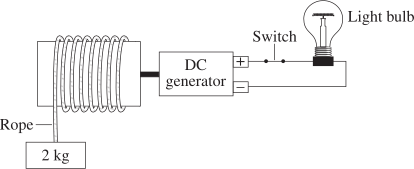
 

The 2 kg mass falls, turning the DC generator, which supplies energy to the light bulb. The mass falls from a point that is 3 376 204 m from the centre of Mars.

  1. Calculate the maximum possible energy released by the light bulb as the mass falls through a distance of one metre.   (3 marks)

--- 8 WORK AREA LINES (style=lined) ---

  1. Explain the difference in the behaviour of the falling mass when the switch is open.   (3 marks)

--- 8 WORK AREA LINES (style=lined) ---

Show Answers Only

a.   7.48 J

b.   When switch is opened:

  • There is no induced current opposing the downwards motion of the mass (Lenz’s Law).
  • Hence, the mass will fall more quickly.
Show Worked Solution

a.   `DeltaE=U_(f)-U_(i)`

`=((-Gm_(1)m_(2))/(r_(f)))-((-Gm_(1)m_(2))/(r_(i)))`

`=(-6.67 xx10^(-11)xx6.39 xx10^(23)xx2)/(3\ 376\ 203)-((-6.67 xx10^(-11)xx6.39 xx10^(23)xx2))/(3\ 376\ 204)`

`=-7.48\ text{J}`
 

  • 7.48 J is lost by the falling mass.
  • The light bulb released 7.48 J of energy.

♦ Mean mark (a) 52%.

b.   When switch is opened:

  • There is no induced current opposing the downwards motion of the mass (Lenz’s Law).
  • Hence, the mass will fall more quickly.

♦♦♦ Mean mark (b) 27%.

Filed Under: Electromagnetic Induction, Motion in Gravitational Fields Tagged With: Band 5, Band 6, smc-3692-20-Energy Changes, smc-3705-40-Lenz and Faraday

PHYSICS, M5 2017 HSC 24

The escape velocity from a planet is given by  `v = sqrt((2GM)/(r))`.

  1. The radius of Mars is  `3.39 xx 10^(6) \ text{m}`  and its mass is  `6.39 xx 10^(23) \ text{kg}`.
  2. Calculate the escape velocity from the surface of Mars.   (2 marks)

--- 4 WORK AREA LINES (style=lined) ---

  1. Using the law of conservation of energy, show that the escape velocity of an object is independent of its mass.   (3 marks)

--- 6 WORK AREA LINES (style=lined) ---

Show Answers Only

a.   `v=5010  text{m s}^(-1)`

b.   Applying the law of conservation of energy:

  • The object’s initial mechanical energy must equal its final mechanical energy.
  •    `KE_(i)+U_(i)=KE_(f)+U_(f)`
  • The escape velocity is the minimum velocity required for an object to escape from a central mass and never return.
  • As an object reaches an infinite distance away, `U_(f)=0`
  • When an object has just enough speed to escape, its final speed is zero, hence, `KE_(f)=0`.
  • It follows:
`KE_(i)+U_(i)` `=0`  
`(1)/(2)mv^(2)-(GMm)/(r)` `=0`  
`mv^(2)` `=(2GMm)/(r)`  
`∴ v_(esc)` `=sqrt((2GM)/(r))`  


  • Which is independent of the object’s mass.
Show Worked Solution
a.    `v` `=sqrt((2xx6.67 xx10^(-11)xx6.39 xx10^(23))/(3.39 xx10^(6)))`
    `=5014.5  text{m s}^(-1)`
    `=5015  text{m s}^(-1)\ \ text{(to 0 d.p.)}`


b.   Applying the law of conservation of energy:

  • The object’s initial mechanical energy must equal its final mechanical energy.
  •    `KE_(i)+U_(i)=KE_(f)+U_(f)`
  • The escape velocity is the minimum velocity required for an object to escape from a central mass and never return.
  • As an object reaches an infinite distance away, `U_(f)=0`
  • When an object has just enough speed to escape, its final speed is zero, hence, `KE_(f)=0`.
  • It follows:
`KE_(i)+U_(i)` `=0`  
`(1)/(2)mv^(2)-(GMm)/(r)` `=0`  
`mv^(2)` `=(2GMm)/(r)`  
`∴ v_(esc)` `=sqrt((2GM)/(r))`  


  • Which is independent of the object’s mass.

Mean mark (b) 53%.

Filed Under: Motion in Gravitational Fields Tagged With: Band 3, Band 5, smc-3692-20-Energy Changes, smc-3692-70-Escape Velocity

PHYSICS, M5 2017 HSC 12 MC

A satellite orbits Earth with an elliptical orbit that passes through positions `X` and `Y`.
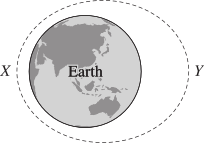
 

Which row of the table correctly identifies the position at which the satellite has greater kinetic energy and the position at which it has greater potential energy?
 

\begin{align*}
\begin{array}{l}
\rule{0pt}{2.5ex}\textit{} & \textit{} \\
\textit{}\rule[-1ex]{0pt}{0pt}& \textit{} \\
\rule{0pt}{2.5ex}\textbf{A.}\rule[-1ex]{0pt}{0pt}\\
\rule{0pt}{2.5ex}\textbf{B.}\rule[-1ex]{0pt}{0pt}\\
\rule{0pt}{2.5ex}\textbf{C.}\rule[-1ex]{0pt}{0pt}\\
\rule{0pt}{2.5ex}\textbf{D.}\rule[-1ex]{0pt}{0pt}\\
\end{array}
\begin{array}{|c|c|}
\hline
\rule{0pt}{2.5ex}\textit{Greater} & \textit{Greater} \\
\quad \textit{kinetic energy}\quad \rule[-1ex]{0pt}{0pt}& \quad \textit{potential energy} \quad \\
\hline
\rule{0pt}{2.5ex}X\rule[-1ex]{0pt}{0pt}&X\\
\hline
\rule{0pt}{2.5ex}X\rule[-1ex]{0pt}{0pt}& Y\\
\hline
\rule{0pt}{2.5ex}Y\rule[-1ex]{0pt}{0pt}& X \\
\hline
\rule{0pt}{2.5ex}Y\rule[-1ex]{0pt}{0pt}& Y \\
\hline
\end{array}
\end{align*}

Show Answers Only

`B`

Show Worked Solution
  • `Y`  is at a greater distance from the centre of Earth so it has a greater potential energy at `Y`.
  • As it moves towards `X` its potential energy is converted into kinetic energy, so it has a greater kinetic energy at `X`.

`=>B`

Filed Under: Motion in Gravitational Fields Tagged With: Band 3, smc-3692-20-Energy Changes

PHYSICS, M5 2018 HSC 28

The radius of the moon is 1740 km. The moon's mass is `7.35 × 10^(22)` kg. In this question, ignore the moon's rotational and orbital motion.

A 20 kg mass is launched vertically from the moon's surface at a velocity of `1200 \ text{m s}^(-1)`.

  1. Show that the change in potential energy of the mass in moving from the surface to an altitude of 500 km is `1.26 × 10^7 \ text{J}`.   (2 marks)

--- 5 WORK AREA LINES (style=lined) ---

  1. Calculate the velocity of the 20 kg mass at an altitude of 500 km.   (3 marks)

--- 10 WORK AREA LINES (style=lined) ---

Show Answers Only

a.   Proof (See Worked Solutions)

b.   `424  text{m s}^-1`

Show Worked Solution
a.       `U_(i)` `=-(GMm)/(r)`
    `=(-6.67 xx10^(-11)xx7.35 xx10^(22)xx20)/(1.74 xx10^(6))`
    `=-5.64 xx10^(7)\ text{J}`
  `U_(f)` `=(-6.67 xx10^(-11)xx7.35 xx10^(22)xx20)/(2.24 xx10^(6))`
    `=-4.38 xx10^(7)\ text{J}`

 
`:.Delta U=U_(f)-U_(i)=1.26 xx10^(7)\ text{J}`
 

b.  `KE_(i)=(1)/(2)m u^(2)=(1)/(2)xx20 xx1200^(2)=1.44 xx10^(7)  text{J}`

`KE_(f)=KE_(i)-DeltaE_(p)\ \ text{(by LCE)}=1.44 xx10^(7)-1.26 xx10^(7)=1.8 xx10^(6) text{J}`

`(1)/(2)mv^(2)` `=1.8 xx10^(6)`  
`v^2` `=(2xx1.8 xx10^(6))/(20)`  
`:.v` `=sqrt((2xx1.8 xx10^(6))/(20))= 424  text{m s}^-1`  

♦♦ Mean mark (b) 32%.

Filed Under: Motion in Gravitational Fields Tagged With: Band 3, Band 5, smc-3692-20-Energy Changes

PHYSICS, M5 2022 HSC 25

A rocket is launched vertically from a planet of mass \(M\). After it leaves the atmosphere, the rocket's engine is turned off and it continues to move away from the planet. From this time the rocket's mass is 200 kg. The rocket's speed, \(v\), at two different distances from the planet's centre, \(R\), is shown.

\begin{array}{|c|c|c|}
\hline \rule{0pt}{2.5ex} \text {Point } \rule[-1ex]{0pt}{0pt}& R\ \text{(m)} & \quad v\left(\text{m s}^{-1}\right) \quad \\
\hline \rule{0pt}{2.5ex} 1 \rule[-1ex]{0pt}{0pt}& \quad 4.3 \times 10^6 \quad & 5500 \\
\hline \rule{0pt}{2.5ex} 2 \rule[-1ex]{0pt}{0pt}& 2.5 \times 10^7 & 2900 \\
\hline
\end{array}

  1. Show that the magnitude of the change in kinetic energy from point 1 to point 2 is  \(2.2 \times 10^9 \ \text{J}\).  (2 marks)

--- 4 WORK AREA LINES (style=lined) ---

  1. Determine the mass \(M\) of the planet using the law of conservation of energy.  (3 marks)

--- 6 WORK AREA LINES (style=lined) ---

Show Answers Only

a.  \(\Delta K=K_f-K_i\)

\(K_f=\dfrac{1}{2} m v_2^2=\dfrac{1}{2} 200 \times 2900^2=8.41 \times 10^8 \ \text{J}\)

\(K_i=\dfrac{1}{2} m v_1^2=\dfrac{1}{2} 200 \times 5500^2=3.025 \times 10^9 \ \text{J}\)

  \(\therefore \Delta K\) \(=8.41 \times 10^8-3.025 \times 10^9\)
    \(=-2.2 \times 10^9 \ \text{J}\)

 
\(\therefore\) This change has a magnitude of \(2.2 \times 10^9 \ \text{J}\).
  

b.   Applying the law of conservation of energy:

  • The magnitude of kinetic energy lost is equal to the magnitude of potential energy gained by the rocket:
  •    \(\Delta U=U_f-U_i=-\dfrac{G M m}{r_f}-\left(-\dfrac{G M m}{r_i}\right)\)

\(\left(2.2 \times 10^9\right)=-\dfrac{\left(6.67 \times 10^{-11}\right)(200) M}{2.5 \times 10^7}+\dfrac{\left(6.67 \times 10^{-11}\right)(200) M}{4.3 \times 10^6}\)
 

\(\left(2.2 \times 10^9\right)\left(2.5 \times 10^7\right)\left(4.3 \times 10^6\right)\)

\(=\left(6.67 \times 10^{-11}\right) 200 M\left[\left(2.5 \times 10^7\right)-\left(4.3 \times 10^7\right)\right]\)
 

\(\therefore M\) \(=\dfrac{\left(2.2 \times 10^9\right)\left(2.5 \times 10^7\right)\left(4.3 \times 10^6\right)}{200\left(6.67 \times 10^{-11}\right)\left[\left(2.5 \times 10^7\right)-\left(4.3 \times 10^6\right)\right]}\)  
  \(=8.56 \times 10^{23} \ \text{kg}\)  
Show Worked Solution

a.  \(\Delta K=K_f-K_i\)

\(K_f=\dfrac{1}{2} m v_2^2=\dfrac{1}{2} 200 \times 2900^2=8.41 \times 10^8 \ \text{J}\)

\(K_i=\dfrac{1}{2} m v_1^2=\dfrac{1}{2} 200 \times 5500^2=3.025 \times 10^9 \ \text{J}\)

  \(\therefore \Delta K\) \(=8.41 \times 10^8-3.025 \times 10^9\)
    \(=-2.2 \times 10^9 \ \text{J}\)

 
\(\therefore\) This change has a magnitude of \(2.2 \times 10^9 \ \text{J}\).
 

b.   Applying the law of conservation of energy:

  • The magnitude of kinetic energy lost is equal to the magnitude of potential energy gained by the rocket:
  •    \(\Delta U=U_f-U_i=-\dfrac{G M m}{r_f}-\left(-\dfrac{G M m}{r_i}\right)\)

\(\left(2.2 \times 10^9\right)=-\dfrac{\left(6.67 \times 10^{-11}\right)(200) M}{2.5 \times 10^7}+\dfrac{\left(6.67 \times 10^{-11}\right)(200) M}{4.3 \times 10^6}\)
 

\(\left(2.2 \times 10^9\right)\left(2.5 \times 10^7\right)\left(4.3 \times 10^6\right)\)

\(=\left(6.67 \times 10^{-11}\right) 200 M\left[\left(2.5 \times 10^7\right)-\left(4.3 \times 10^7\right)\right]\)


\(\therefore M\) \(=\dfrac{\left(2.2 \times 10^9\right)\left(2.5 \times 10^7\right)\left(4.3 \times 10^6\right)}{200\left(6.67 \times 10^{-11}\right)\left[\left(2.5 \times 10^7\right)-\left(4.3 \times 10^6\right)\right]}\)  
  \(=8.56 \times 10^{23} \ \text{kg}\)

♦ Mean mark (b) 47%.

Filed Under: Motion in Gravitational Fields Tagged With: Band 3, Band 5, smc-3692-20-Energy Changes

PHYSICS M5 2022 HSC 6 MC

The elliptical orbit of a planet around a star is shown.
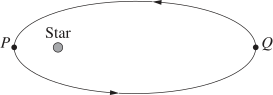


Which type of energy is greater at position `P` than at `Q` ?

  1. Kinetic
  2. Nuclear
  3. Potential
  4. Total
Show Answers Only

`A`

Show Worked Solution

As the planet moves from `Q`  to  `P` is converted to kinetic energy.

  • its kinetic energy must be greater at `P`.

`=>A`

Filed Under: Motion in Gravitational Fields Tagged With: Band 4, smc-3692-20-Energy Changes

PHYSICS, M5 2021 HSC 25

A satellite is launched from the surface of Mars into an orbit that keeps it directly above a position on the surface of Mars.

Mass of Mars = `6.39 xx 10^(23)` kg

Length of Martian day = 24 hours and 40 minutes

  1. Identify TWO energy changes as the satellite moves from the surface of Mars into orbit.   (2 marks)

    --- 3 WORK AREA LINES (style=lined) ---

  1. Calculate the orbital radius of the satellite.   (3 marks)

    --- 6 WORK AREA LINES (style=lined) ---

Show Answers Only

a.   The kinetic energy and gravitational potential energy of the satellite both increase as it moves into orbit.

b.   `2.0 xx10^(7)\ \text{m}`

Show Worked Solution

a.   The kinetic energy and gravitational potential energy of the satellite both increase as it moves into orbit.

b.   `(r^(3))/(T^(2))` `=(GM)/(4pi^(2))`  
`r^(3)` `=((6.67 xx10^(-11)xx6.39 xx10^(23))/(4pi^(2)))((24+(40)/(60))xx60 xx60)^(2)`  
`:. r` `=2.0 xx10^(7)\ \text{m}`  

Filed Under: Motion in Gravitational Fields Tagged With: Band 4, smc-3692-20-Energy Changes, smc-3692-30-Orbital Velocity/Period/Radius

PHYSICS, M5 2021 HSC 9 MC

A mass, `M`, is positioned at an equal distance from two identical stars as shown.

The mass is then moved to position `X`.
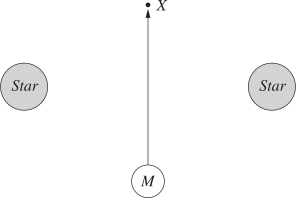
 

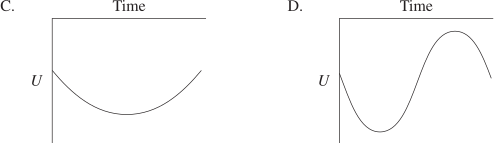
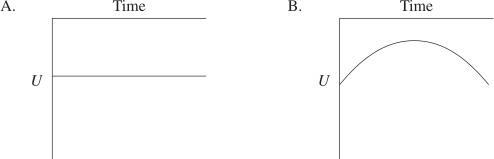
Which graph best represents the gravitational potential energy, `U`, of the mass during this movement?
 

Show Answers Only

`C`

Show Worked Solution

Potential energy decreases as the mass moves closer to the stars and then increases as it moves away from them.

`=>C`


♦ Mean mark 43%.

Filed Under: Motion in Gravitational Fields Tagged With: Band 5, smc-3692-20-Energy Changes

Copyright © 2014–2025 SmarterEd.com.au · Log in