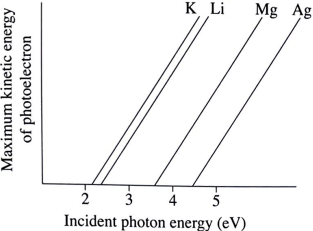
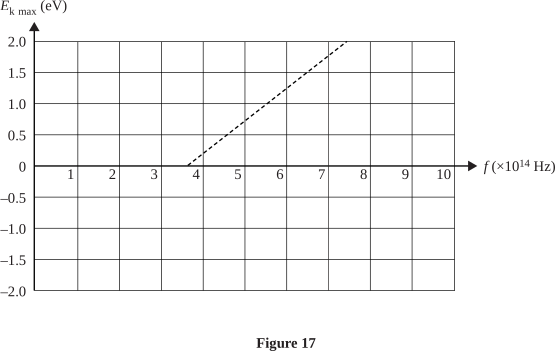
A student conducts an experiment to determine the work function of potassium.
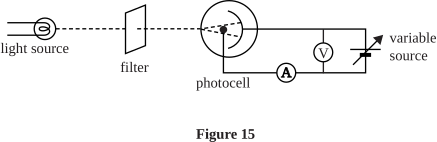
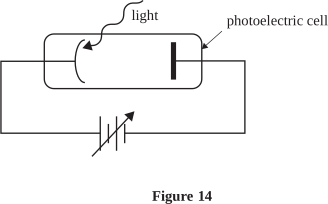
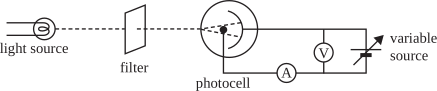
The following diagram depicts the experimental setup used, where light of varying frequency is incident on a potassium electrode inside an evacuated tube.
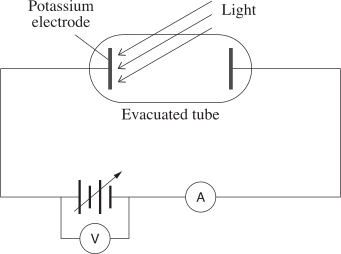
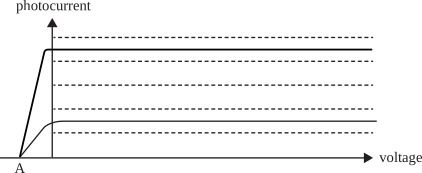
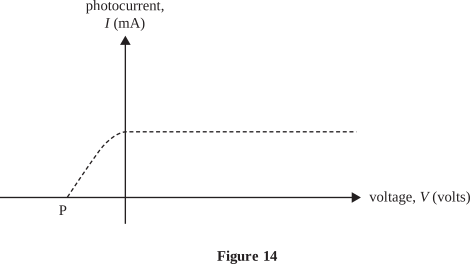
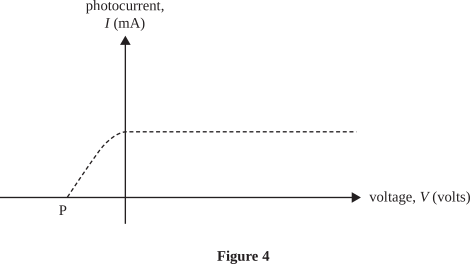
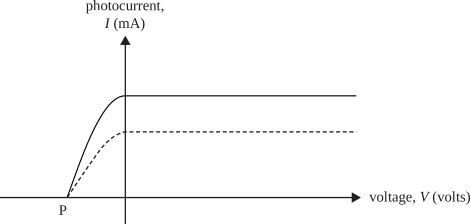
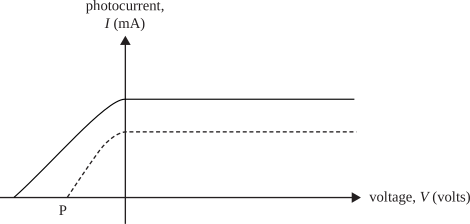
For each frequency of light tested, the voltage in the circuit is varied, and the minimum voltage (called the stopping voltage) required to bring the current in the circuit to zero is recorded.
\begin{array}{|c|c|}
\hline
\rule{0pt}{2.5ex}\ \ \textit{Frequency of incident light} \ \ & \quad \quad \quad \textit{Stopping voltage} \quad \quad \quad \\
\left(\times 10^{15} \ \text{Hz}\right) \rule[-1ex]{0pt}{0pt}& \text{(V)}\\
\hline
\rule{0pt}{2.5ex}0.9 \rule[-1ex]{0pt}{0pt}& 1.5 \\
\hline
\rule{0pt}{2.5ex}1.1 \rule[-1ex]{0pt}{0pt}& 2.0 \\
\hline
\rule{0pt}{2.5ex}1.2 \rule[-1ex]{0pt}{0pt}& 2.5 \\
\hline
\rule{0pt}{2.5ex}1.3 \rule[-1ex]{0pt}{0pt}& 3.0 \\
\hline
\rule{0pt}{2.5ex}1.4 \rule[-1ex]{0pt}{0pt}& 3.5 \\
\hline
\rule{0pt}{2.5ex}1.5 \rule[-1ex]{0pt}{0pt}& 4.0 \\
\hline
\end{array}
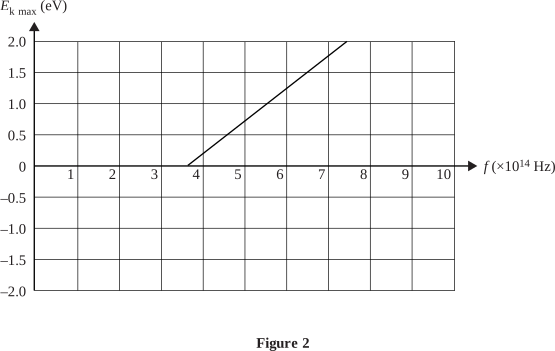
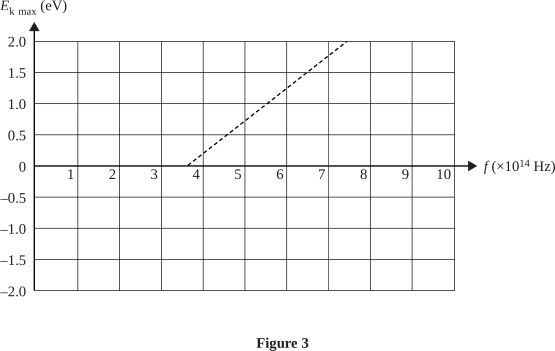
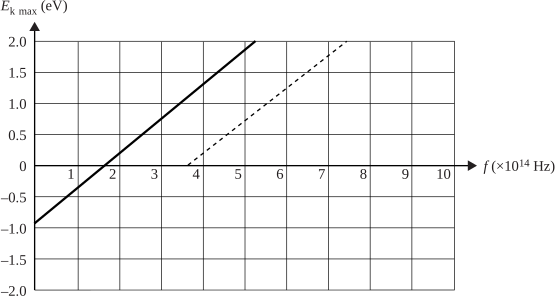
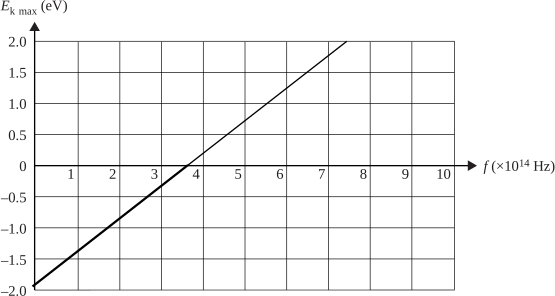
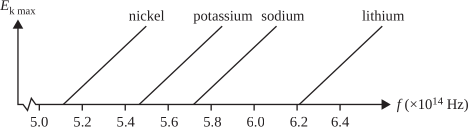
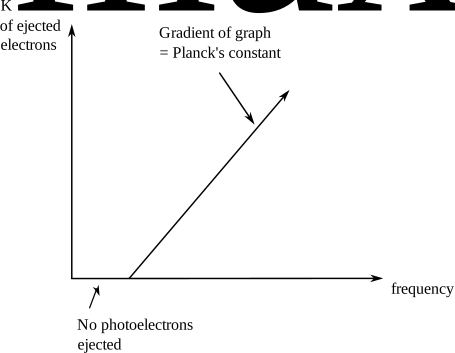
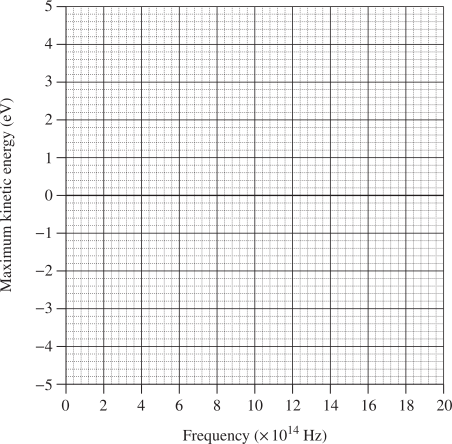
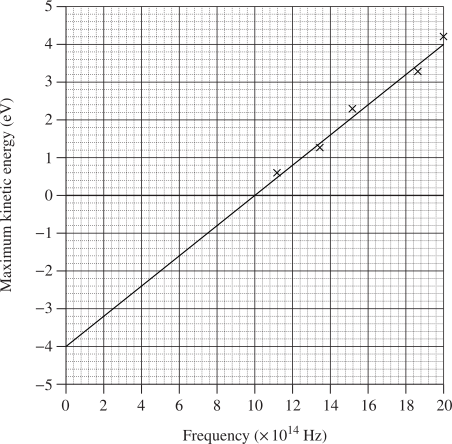
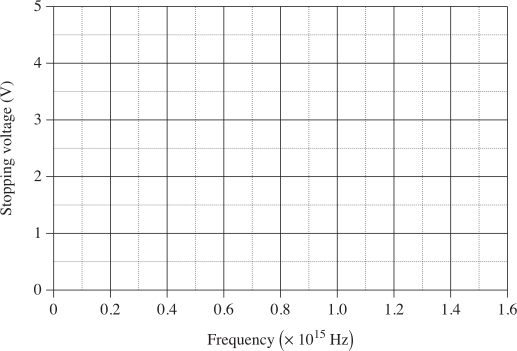
- Construct an appropriate graph using the data provided, and from this, determine the threshold frequency of potassium. (3 marks)
--- 0 WORK AREA LINES (style=lined) ---
- Using the particle model of light, explain the features shown in the experimental results. (3 marks)
--- 6 WORK AREA LINES (style=lined) ---
a.
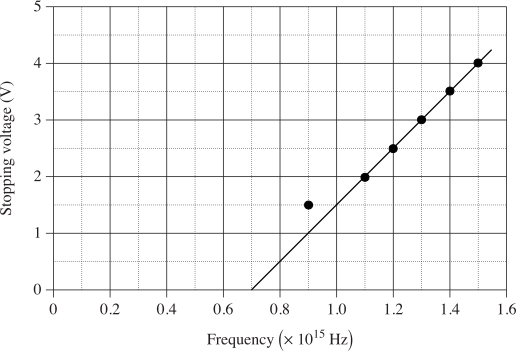
b. Features shown in experiment results:
- Light is made of discrete energy packets called photons.
- A photon’s energy is directly proportional to its frequency: \(E = hf\).
- When photons hit a metal surface, they transfer their energy to electrons.
- If the photon energy is greater than the metal’s work function \((\phi)\), the threshold frequency is exceeded and electrons are ejected with kinetic energy equal to the excess energy according to the equation \(KE = hf-\phi\).
- Increasing the frequency increases the photon energy which results in ejected electrons with greater kinetic energy.
- A larger stopping voltage is therefore needed to halt these more energetic electrons.
a.
b. Features shown in experiment results:
- Light is made of discrete energy packets called photons.
- A photon’s energy is directly proportional to its frequency: \(E = hf\).
- When photons hit a metal surface, they transfer their energy to electrons.
- If the photon energy is greater than the metal’s work function \((\phi)\), the threshold frequency is exceeded and electrons are ejected with kinetic energy equal to the excess energy according to the equation \(KE = hf-\phi\).
- Increasing the frequency increases the photon energy which results in ejected electrons with greater kinetic energy.
- A larger stopping voltage is therefore needed to halt these more energetic electrons.