SmarterEd

Aussie Maths & Science Teachers: Save your time with SmarterEd

  • Login
  • Get Help
  • About

PHYSICS, M7 2020 VCE 15 MC

\(\text{I}\) The energy of a light wave increases with increasing amplitude.
\(\text{II}\) The energy of a light wave increases with increasing frequency.
\(\text{III}\) The energy of a light wave increases with decreasing wavelength.

Which of the statements above about the energy of light waves is correct?

  1. \(\text{III}\) only
  2. \(\text{I}\) and \(\text{II}\) only
  3. \(\text{I}\) and \(\text{III}\) only
  4. all of the statements are correct
Show Answers Only

\(D\)

Show Worked Solution
  • Statement \(\text{I}\) is correct when considering the wave-model of light. The higher the amplitude, the further away the displacement of the wave from the origin which corresponds to higher energy.
  • Statements \(\text{II}\) and \(\text{III}\) are correct when considering the particle model of light.
  • The energy of a light photon, \(E=hf=\dfrac{hc}{\lambda}\). It follows that increasing the frequency or decreasing the wavelength both lead to an increase in energy.

\(\Rightarrow D\)

Filed Under: Light: Quantum Model Tagged With: Band 4, smc-3698-80-Wave/Particle models

PHYSICS, M7 2021 VCE 16

Light can be described by a wave model and also by a particle (or photon) model. The rapid emission of photoelectrons at very low light intensities supports one of these models but not the other.

Identify the model that is supported, giving a reason for your answer.   (2 marks)

--- 5 WORK AREA LINES (style=lined) ---

Show Answers Only

Model supported: Particle (photon) model

Reasons could include one of the following:

  • Each electron ejection corresponds to the absorption of a single photon.
  • The immediate ejection of a photoelectron corresponds to its direct interaction with the initial photon.
  • Contrary to the wave theory, which suggests that energy accumulates gradually, the emission of photoelectrons at very low light intensities demonstrates that energy is delivered in discrete quanta.
Show Worked Solution

Model supported: Particle (photon) model

Reasons could include one of the following:

  • Each electron ejection corresponds to the absorption of a single photon.
  • The immediate ejection of a photoelectron corresponds to its direct interaction with the initial photon.
  • Contrary to the wave theory, which suggests that energy accumulates gradually, the emission of photoelectrons at very low light intensities demonstrates that energy is delivered in discrete quanta.
♦ Mean mark 42%.

Filed Under: Light: Quantum Model Tagged With: Band 5, smc-3698-80-Wave/Particle models

PHYSICS, M7 2022 VCE 15 MC

Which one of the following best provides evidence of light behaving as a particle?

  1. photoelectric effect
  2. white light passing through a prism
  3. diffraction of light through a single slit
  4. interference of light passing through a double slit
Show Answers Only

\(A\)

Show Worked Solution
  • During the photoelectric effect, light transfers energy in small discrete ‘quanta’ which demonstrates light behaving as a particle.

\(\Rightarrow A\)

Filed Under: Light: Quantum Model Tagged With: Band 3, smc-3698-10-Photoelectric Effect, smc-3698-80-Wave/Particle models

PHYSICS, M8 EQ-Bank 27

Explain how the analysis of quantitative observations contributed to the development of the concept that certain matter and energy are quantised.   (9 marks)

--- 18 WORK AREA LINES (style=lined) ---

Show Answers Only

Experiments such as Millikan’s oil drop experiment and others testing the photoelectric effect have demonstrated that certain quantities of matter and energy are quantised which means they are multiples of some fundamental value.

Millikan’s Oil Drop Experiment

  • Millikan’s oil drop experiment was able to show that charge is quantised. 
  • Millikan levitated oil drops in an electric field by balancing the electric and gravitational forces on them. This allowed him to find the electric force acting on each oil drop, and using the mass of the oil drop he found its charge.
  • Analysing his results, he found that the charge on every oil drop was an integer multiple of `1.602 xx10^(-19) C`. This was determined to be the fundamental charge on an electron.
  • Further, with Thompson’s later discovery of the charge to mass ratio of an electron, its mass could be determined. 

Photoelectric Effect

  • Photoelectric effect experiments showed the quantum properties of light which seemingly contradicted the view of light as a wave.
  • It was found that there was a minimum frequency (energy) of light that would cause photoemission when it was incident upon a metal plate, and no photoemission occurred with light lower than this frequency, regardless of intensity.
  • As one photon would strike one electron on the metal surface, the electron would receive a discrete amount of energy from that photon determined by its frequency `E=hf`. If a photon didn’t have enough energy, an electron couldn’t be removed.
  • This experimental evidence changed the conceptual understanding of energy within physics and provided a basis for the quantisation of the energy of light. 

Other quantitative experiments that could be explored include:

  • Bohr’s analysis of emission spectra to demonstrate the existence of quantised energy levels in atoms.
  • Cathode ray experiments showing the particle nature of electrons.
  • Blackbody radiation experiments. 
Show Worked Solution

Experiments such as Millikan’s oil drop experiment and others testing the photoelectric effect have demonstrated that certain quantities of matter and energy are quantised which means they are multiples of some fundamental value.

Millikan’s Oil Drop Experiment

  • Millikan’s oil drop experiment was able to show that charge is quantised. 
  • Millikan levitated oil drops in an electric field by balancing the electric and gravitational forces on them. This allowed him to find the electric force acting on each oil drop, and using the mass of the oil drop he found its charge.
  • Analysing his results, he found that the charge on every oil drop was an integer multiple of `1.602 xx10^(-19) C`. This was determined to be the fundamental charge on an electron.
  • Further, with Thompson’s later discovery of the charge to mass ratio of an electron, its mass could be determined. 

Photoelectric Effect

  • Photoelectric effect experiments showed the quantum properties of light which seemingly contradicted the view of light as a wave.
  • It was found that there was a minimum frequency (energy) of light that would cause photoemission when it was incident upon a metal plate, and no photoemission occurred with light lower than this frequency, regardless of intensity.
  • As one photon would strike one electron on the metal surface, the electron would receive a discrete amount of energy from that photon determined by its frequency `E=hf`. If a photon didn’t have enough energy, an electron couldn’t be removed.
  • This experimental evidence changed the conceptual understanding of energy within physics and provided a basis for the quantisation of the energy of light. 

Other quantitative experiments that could be explored include:

  • Bohr’s analysis of emission spectra to demonstrate the existence of quantised energy levels in atoms.
  • Cathode ray experiments showing the particle nature of electrons.
  • Blackbody radiation experiments. 

Filed Under: Light: Quantum Model, Structure of the Atom Tagged With: Band 4, Band 5, Band 6, smc-3698-10-Photoelectric Effect, smc-3698-80-Wave/Particle models, smc-3701-20-Millikan

PHYSICS, M7 2020 HSC 26

  1. Describe the difference between the spectra of the light produced by a gas discharge tube and by an incandescent lamp.   (2 marks)

--- 4 WORK AREA LINES (style=lined) ---

  1. The graph shows the curves predicted by two different models, `X` and `Y`, for the electromagnetic radiation emitted by an object at a temperature of 5000 K.
     

    Identify an assumption of EACH model which determines the shape of its curve.   (2 marks)

--- 4 WORK AREA LINES (style=lined) ---

  1. The diagram shows the radiation curve for a black body radiator at a temperature of 5000 K.


    On the same diagram, sketch a curve for a black body radiator at a temperature of 4000 K and explain the differences between the curves.   (4 marks)

    --- 6 WORK AREA LINES (style=lined) ---

Show Answers Only

a.   The spectra of light produced by a gas discharge tube will consist of lines only at a few discrete wavelengths.

The spectra of light produced by an incandescent lamp will be a continuous spectrum.

b.   Model `X` black bodies absorb and emit energy continuously.

Model `Y` assumes that black bodies absorb and emit energy in discrete quantities.

c.

  • Using `lambda_(max)=(b)/(T)\ \ =>\ \ lambda prop (1)/(T)`
  • Therefore, the 4000 K curve will have a peak wavelength greater than the 5000 K curve.
  • The area under the curve and the intensity at all wavelengths will be less for the 4000 K curve, as the total power output of a black body decreases as its temperature decreases.
Show Worked Solution

a.    Differences:

  • The spectra of light produced by a gas discharge tube will consist of lines only at a few discrete wavelengths.
  • The spectra of light produced by an incandescent lamp will be a continuous spectrum.

♦ Mean mark (a) 39%.

b.    Assumptions of EACH model:

  • Model `X` black bodies absorb and emit energy continuously.
  • Model `Y` assumes that black bodies absorb and emit energy in discrete quantities.

♦ Mean mark (b) 44%.

c.

  • Using `lambda_(max)=(b)/(T)\ \ =>\ \ lambda prop (1)/(T)`
  • Therefore, the 4000 K curve will have a peak wavelength greater than the 5000 K curve.
  • The area under the curve and the intensity at all wavelengths will be less for the 4000 K curve, as the total power output of a black body decreases as its temperature decreases.

Filed Under: Electromagnetic Spectrum, Light: Quantum Model, Light: Wave Model, Origins of Elements Tagged With: Band 4, Band 5, smc-3696-10-Spectroscopy, smc-3698-50-Blackbodies, smc-3698-80-Wave/Particle models, smc-3700-20-Spectra

PHYSICS, M7 2021 HSC 33

Two experiments are performed with identical light sources having a wavelength of 400 nm.

In experiment \(A\), the light is incident on a pair of narrow slits  5.0 × 10\(^{-5}\) m  apart, producing a pattern on a screen located 3.0 m behind the slits.
 

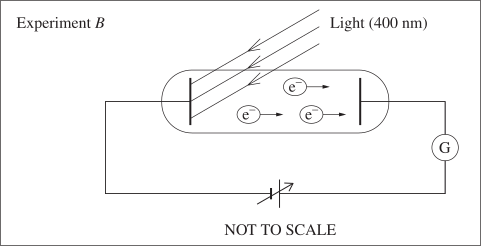
In experiment \(B\), the light is incident on different metal samples inside an evacuated tube as shown. The kinetic energy of any emitted photoelectrons can be measured.
 

Some results from experiment \(B\) are shown.
 

\begin{array}{|l|l|c|}
\hline
\rule{0pt}{1.5ex}\textit{Metal sample}\rule[-0.5ex]{0pt}{0pt}& \textit{Work function} \ \text{(J)} & \textit{Photoelectrons observed?} \\
\hline
\rule{0pt}{2.5ex}\text{Nickel}\rule[-1ex]{0pt}{0pt}&8.25 \times 10^{-19}&\text{No}\\
\hline
\rule{0pt}{2.5ex}\text{Calcium}\rule[-1ex]{0pt}{0pt}& 4.60 \times 10^{-19}&\text{Yes}\\
\hline
\end{array}

How do the results from Experiment \(A\) and Experiment \(B\) support TWO different models of light? In your answer, include a quantitative analysis of each experiment.   (9 marks)

--- 22 WORK AREA LINES (style=lined) ---

Show Answers Only
  • Experiment A supports the wave model of light as it demonstrates light undergoing diffraction as well as constructive and destructive interference, which are wave properties.
  • When light is incident upon the slits, it diffracts and causes the slit to act as a source of wavefronts. When light from the slits arrives at the screen, bright bands are produced when light waves arrive in phase and undergo constructive interference.
  • Dark bands are produced when light waves arrive at the screen out of phase and undergo destructive interference.
  • The spacing between adjacent bright bands can be calculated using  \(d \sin \theta=m \lambda\):
  •    \(5 \times 10^{-5} \sin \theta=1 \times 400 \times 10^{-9}\ \ \Rightarrow\ \ \theta=0.46^{\circ}\)
  •    \(s=3 \times \tan (0.46^{\circ})=0.024 \ \text{m}\)
  •  Experiment B supports Einstein’s particle, or photon model of light. This model can calculate the photon energy of incident light and explain why photons are emitted from calcium but not nickel:
  •    \(f=\dfrac{c}{\lambda}=\dfrac{3.00 \times 10^8}{400 \times 10^{-9}}=7.50 \times 10^{14} Hz\)
  •    \(E=h f=6.626 \times 10^{-34} \times 7.50 \times 10^{14}=4.97 \times 10^{-19} J\)
  • This energy is greater than the work function of calcium, explaining why one photon has enough energy to liberate a photoelectron from the calcium sample. However, this energy is less than the work function of nickel, explaining why no photoelectrons were observed from the nickel sample.
  • These observations support the particle model of light. Applying the particle model, the kinetic energy of photoelectrons emitted from calcium can be calculated:
  •    \(K_{\max }=h f-\phi=4.97 \times 10^{-19}-4.60 \times 10^{-19}=3.70 \times 10^{-20} \ \text{J}\)
Show Worked Solution
  • Experiment A supports the wave model of light as it demonstrates light undergoing diffraction as well as constructive and destructive interference, which are wave properties.
  • When light is incident upon the slits, it diffracts and causes the slit to act as a source of wavefronts. When light from the slits arrives at the screen, bright bands are produced when light waves arrive in phase and undergo constructive interference.
  • Dark bands are produced when light waves arrive at the screen out of phase and undergo destructive interference.
  • The spacing between adjacent bright bands can be calculated using  \(d \sin \theta=m \lambda\):
  •    \(5 \times 10^{-5} \sin \theta=1 \times 400 \times 10^{-9}\ \ \Rightarrow\ \ \theta=0.46^{\circ}\)
  •    \(s=3 \times \tan (0.46^{\circ})=0.024 \ \text{m}\)
  •  Experiment B supports Einstein’s particle, or photon model of light. This model can calculate the photon energy of incident light and explain why photons are emitted from calcium but not nickel:
  •    \(f=\dfrac{c}{\lambda}=\dfrac{3.00 \times 10^8}{400 \times 10^{-9}}=7.50 \times 10^{14} Hz\)
  •    \(E=h f=6.626 \times 10^{-34} \times 7.50 \times 10^{14}=4.97 \times 10^{-19} J\)
  • This energy is greater than the work function of calcium, explaining why one photon has enough energy to liberate a photoelectron from the calcium sample. However, this energy is less than the work function of nickel, explaining why no photoelectrons were observed from the nickel sample.
  • These observations support the particle model of light. Applying the particle model, the kinetic energy of photoelectrons emitted from calcium can be calculated:
  •    \(K_{\max }=h f-\phi=4.97 \times 10^{-19}-4.60 \times 10^{-19}=3.70 \times 10^{-20} \ \text{J}\)

♦ Mean mark 52%.

Filed Under: Light: Quantum Model, Light: Wave Model Tagged With: Band 4, Band 5, Band 6, smc-3697-20-Young, smc-3697-30-Double Slit Calcs, smc-3698-60-Experiments, smc-3698-80-Wave/Particle models

Copyright © 2014–2025 SmarterEd.com.au · Log in