SmarterEd

Aussie Maths & Science Teachers: Save your time with SmarterEd

  • Login
  • Get Help
  • About

Probability, SM-Bank 091

In an experiment, a 6-sided die is thrown a number of times and the results are listed below.
 

\(4, 1, 3, 2, 6, 5, 2, 2, 1, 4\)

\(3, 2, 1, 1, 2, 4, 2, 6, 1, 2\)
 

  1. What is the relative frequency of getting a 2? Give your answer as a decimal.  (1 mark)

    --- 2 WORK AREA LINES (style=lined) ---

  2. If this experiment was repeated 160 times, how many times would you expect to throw a 2?  (1 mark)

    --- 3 WORK AREA LINES (style=lined) ---
Show Answers Only

a.    \(0.35\)

b.    \(56\)

Show Worked Solution

a.    \(\text{Relative frequency}=\dfrac{\text{number of times event occurs}}{\text{total number of trials}}\)

\(P(2)\) \(=\dfrac{7}{20}\)
  \(=0.35\)


b.     \(\text{Number of 2’s}\) \(=160\times\dfrac{7}{20}\)
    \(=56\)

\(\therefore\ \text{You would expect to throw 56 2’s in 160 trials}\)

Filed Under: Probability Tagged With: num-title-ct-core, smc-4225-35-Relative frequency

Probability, SM-Bank 090

A coin is tossed and the results are as follows, where \(H=\)heads and \(T=\)Tails.

\(H, T, H, T, H, T, H, T, T, T, H, T, T, T\)

  1. What is the relative frequency of getting a Head?  (1 mark)

    --- 2 WORK AREA LINES (style=lined) ---

  2. If the trial was repeated 42 times, how many times would you expect to toss a head?  (1 mark)

    --- 3 WORK AREA LINES (style=lined) ---

Show Answers Only

a.    \(\dfrac{5}{14}\)

b.    \(15\)

Show Worked Solution

a.    \(\text{Relative frequency}=\dfrac{\text{number of times event occurs}}{\text{total number of trials}}\)

\(P(H)=\dfrac{5}{14}\)

b.     \(\text{Number of heads}\) \(=42\times\dfrac{5}{14}\)
    \(=15\)

\(\therefore\ \text{You would expect to toss 15 heads in 42 trials}\)

Filed Under: Probability Tagged With: num-title-ct-core, smc-4225-35-Relative frequency

Probability, SM-Bank 070

Tom has a dice and rolls it repeatedly 54 times, each time recording which side faces up.

How many times should he expect to see the side four coming up?  (2 marks)

--- 3 WORK AREA LINES (style=lined) ---

Show Answers Only

\(9\text{ times}\)

Show Worked Solution
\(\text{Number of times a 4}\) \(=P\text{(4 on die)}\times 54\)
  \(=\dfrac{1}{6}\times 54\)
  \(=9\)

 
\(\therefore\ \text{A 4 would be expected 9 times.}\)

Filed Under: Probability Tagged With: num-title-ct-core, smc-4225-35-Relative frequency

Probability, SM-Bank 068 MC

A biased die has 6 faces numbered from 1 to 6.

Jackson throws the die 60 times and records the results in the table below.
 

\begin{array} {|c|c|}
\hline
\rule{0pt}{2.5ex} \textbf{Number} \rule[-1ex]{0pt}{0pt} & \ \ 1\ \ & \ \ 2 \ \ & \ \ 3 \ \ & \ \ 4 \ \ & \ \ 5 \ \ & \ \ 6 \ \ \\
\hline
\rule{0pt}{2.5ex} \textbf{Times} \rule[-1ex]{0pt}{0pt} & \ \ 8\ \ & \ \ 14 \ \ & \ \ 9 \ \ & \ \ 13 \ \ & \ \ 7 \ \ & \ \ 9 \\
\hline
\end{array} 

Using the table, what is the probability that Jackson throws a 2 on his next throw?

  1. \(\dfrac{7}{30}\)
  2. \(\dfrac{14}{46}\)
  3. \(\dfrac{1}{5}\)
  4. \(\dfrac{1}{6}\)

Show Answers Only

\(A\)

Show Worked Solution
\(P(2)\) \(=\dfrac{\text{Number of 2’s}}{\text{Total number of throws}}\)
  \(=\dfrac{14}{60}\)
  \(=\dfrac{7}{30}\)

 
\(\Rightarrow A\)

Filed Under: Probability Tagged With: num-title-ct-core, smc-4225-35-Relative frequency

Probability, SM-Bank 061

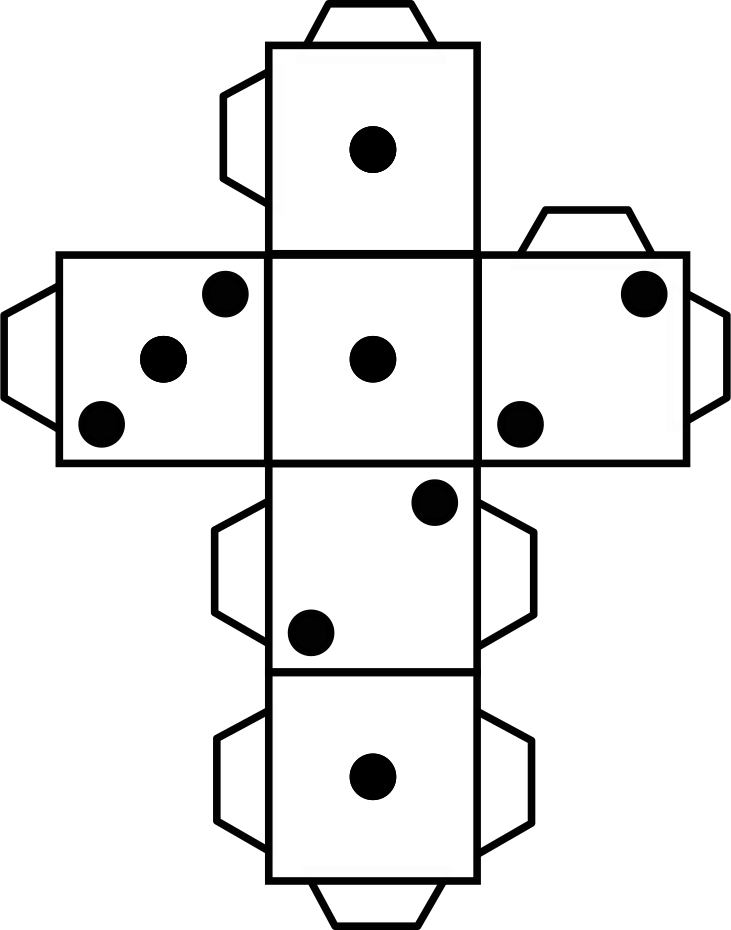
Chusi uses this net to make a dice.


  1. Chusi rolls the dice once. What is the chance that Chusi will roll a 2? (1 mark)

    --- 2 WORK AREA LINES (style=lined) ---

  2. Chusi makes up a game and to win the game you must roll a number larger than 2.
    What is the chance that Chusi will win the game on her next roll?  (1 mark)

    --- 2 WORK AREA LINES (style=lined) ---

  3. If Chusi rolls the dice 108 times, how many times could she expect to win the game?  (1 mark)

    --- 3 WORK AREA LINES (style=lined) ---
Show Answers Only

a.    \(\dfrac{1}{3}\)

b.    \(\dfrac{1}{6}\)

c.    \(18\ \text{times}\)

Show Worked Solution
a.    \(P(2)\) \(=\dfrac{\text{number of 2’s}}{\text{total possibilities}}\)
    \(=\dfrac{2}{6}\)
    \(=\dfrac{1}{3}\)


b.    \(P\text{(number>2)}\) \(=\dfrac{\text{number of 3’s}}{\text{total possibilities}}\)
    \(=\dfrac{1}{6}\)

\(\therefore\ \text{Chusi’s chance of winning on the next roll is }\dfrac{1}{6}.\)
 

c.    \(\text{Expected wins}\) \(=\text{number of rolls}\times \text{probability of winning}\)
    \(=108\times \dfrac{1}{6}\)
    \(=18\)

\(\therefore\ \text{Chusi could expect to win 18 times with 108 rolls.}\)

Filed Under: Probability Tagged With: num-title-ct-core, smc-4225-15-Single-stage events, smc-4225-35-Relative frequency

Probability, SM-Bank 057 MC

Blinky is blowing up balloons for a birthday party.

The number of blown up balloons of each colour is recorded in the table below.

\begin{array} {|l|c|}
\hline
\rule{0pt}{2.5ex} \textbf{Colour} \rule[-1ex]{0pt}{0pt} & \textbf{Number of Balloons} \\
\hline
\rule{0pt}{2.5ex} \text{white} \rule[-1ex]{0pt}{0pt} & 11 \\
\hline
\rule{0pt}{2.5ex} \text{purple} \rule[-1ex]{0pt}{0pt} & 7 \\
\hline
\rule{0pt}{2.5ex} \text{orange} \rule[-1ex]{0pt}{0pt} & 6 \\
\hline
\rule{0pt}{2.5ex} \text{yellow} \rule[-1ex]{0pt}{0pt} & 9 \\
\hline
\end{array}

Blinky picks one balloon without looking and gives it to the first person who arrives at the party.

What is the chance it is white?

  1. \(\dfrac{1}{11}\)
  2. \(\dfrac{1}{27}\)
  3. \(\dfrac{1}{2}\)
  4. \(\dfrac{1}{3}\)
Show Answers Only

\(D\)

Show Worked Solution
\(P\text{(white)}\) \(=\dfrac{\text{Number of white balloons}}{\text{Total number of balloons}}\)
  \(=\dfrac{11}{11+7+6+9}\)
  \(=\dfrac{11}{33}\)
  \(=\dfrac{1}{3}\)

\(\Rightarrow D\)

Filed Under: Probability Tagged With: num-title-ct-core, smc-4225-35-Relative frequency

Probability, SM-Bank 056

Marie has a bag containing various coloured balls.

Marie grabs a coloured ball from the bag and records the colour.

She then puts the ball back into the bag and repeats this process a number of times.

 
\begin{array} {|c|c|}
\hline
\rule{0pt}{2.5ex} \text{Orange} \rule[-1ex]{0pt}{0pt} & \ \ \text{Blue}\ \ \rule[-1ex]{0pt}{0pt} & \ \ \text{Red}\ \ \rule[-1ex]{0pt}{0pt} & \text{Green} \rule[-1ex]{0pt}{0pt} \ & \text{White} \rule[-1ex]{0pt}{0pt} & \text{Black} \rule[-1ex]{0pt}{0pt} & \text{Yellow} \rule[-1ex]{0pt}{0pt} \\
\hline
13 & 20 & 18 & 9 & 12 & 14 & 10\\
\hline
\end{array} 

Using the table, what is the probability that the next ball picked out by Marie will be yellow? (2 marks)

--- 3 WORK AREA LINES (style=lined) ---

Show Answers Only

\(\dfrac{1}{6}\)

Show Worked Solution
\(P \text{(white)}\) \(=\dfrac{\text{Number of white}}{\text{Total number of selections}}\)
  \(=\dfrac{12}{13 + 20 + 18 + 9 + 12 + 14 + 10}\)
  \(=\dfrac{12}{96}\)
  \(=\dfrac{1}{8}\)

Filed Under: Probability Tagged With: num-title-ct-core, smc-4225-35-Relative frequency

Probability, SM-Bank 055

Jackson spins a wheel with 5 different coloured sections and records which colour it lands on each time.

He repeats the process multiple times.

The table below shows the results.
 

\begin{array} {|c|c|}
\hline
\rule{0pt}{2.5ex} \text{White} \rule[-1ex]{0pt}{0pt} & \text{Yellow} \rule[-1ex]{0pt}{0pt} & \ \ \text{Red}\ \ \rule[-1ex]{0pt}{0pt} & \ \text{Blue} \rule[-1ex]{0pt}{0pt}\ \ & \text{Green} \rule[-1ex]{0pt}{0pt} \\
\hline
40 & 26 & 36 & 28 & 38\\
\hline
\end{array} 

Using the table, what is the probability that the next spin will be Blue?  (2 marks)

--- 3 WORK AREA LINES (style=lined) ---
Show Answers Only

\(\dfrac{1}{6}\)

Show Worked Solution
\(P \text{(Blue)}\) \(=\dfrac{\text{Number of blue}}{\text{Total number of throws}}\)
  \(=\dfrac{28}{40 + 26 + 36 + 28 + 38}\)
  \(=\dfrac{28}{168}\)
  \(=\dfrac{1}{6}\)

Filed Under: Probability Tagged With: num-title-ct-core, smc-4225-35-Relative frequency

Probability, SM-Bank 052

A random sample of people were asked what is their favourite winter sport.

The table below recorded the results.
 

\begin{array} {|l|c|}
\hline
\rule{0pt}{2.5ex} \textbf{Sport} \rule[-1ex]{0pt}{0pt} & \textbf{Number of People} \\
\hline
\rule{0pt}{2.5ex} \text{Netball} \rule[-1ex]{0pt}{0pt} & \text{49} \\
\hline
\rule{0pt}{2.5ex} \text{Aussie Rules} \rule[-1ex]{0pt}{0pt} & \text{19} \\
\hline
\rule{0pt}{2.5ex} \text{Rugby League} \rule[-1ex]{0pt}{0pt} & \text{135} \\
\hline
\rule{0pt}{2.5ex} \text{Ice Hockey} \rule[-1ex]{0pt}{0pt} & \text{13} \\
\hline
\end{array}

Using the data from the survey, predict how many people would choose rugby league if 2000 people were surveyed.  (2 marks)

--- 5 WORK AREA LINES (style=lined) ---

Show Answers Only

\(1250\)

Show Worked Solution

\(\text{Total people surveyed}\)

\(=49+19+135+13\)

\(=216\)

\(\therefore\ \text{Predicted number to choose rugby league}\)

\(=P\text{(Rugby League)}\times 2000\)

\(=\dfrac{135}{216}\times 2000\)

\(=1250\)

Filed Under: Probability Tagged With: num-title-ct-core, smc-4225-35-Relative frequency

Probability, SM-Bank 050

Mandy surveyed all year 7 students about their favourite flavour of milkshake.


Which flavour did 4 out of 10 year 7 students choose as their favourite?  (2 marks)

--- 5 WORK AREA LINES (style=lined) ---

Show Answers Only

\(\text{Vanilla}\)

Show Worked Solution
\(\text{Total students}\) \(=75+100+35+40\)
  \(=250\)

 
\(\text{If 4 out of 10 students chose a certain flavour,}\)

\(\text{Number of students}\)

\(=\dfrac{4}{10}\times 250\)

\(=100\)
 

\(\therefore\ \text{4 out of 10 students choose Vanilla.}\)

Filed Under: Probability Tagged With: num-title-ct-core, smc-4225-35-Relative frequency

Probability, SM-Bank 048

Rachel has a bag that contains 6 blue and 4 green balls.

She selects one ball at random and records its colour. The ball is then put back into the bag.

Rachel does this 50 times.

How many times should Rachel expect to select a green ball from the bag?  (2 marks)

Show Answers Only

\(20\)

Show Worked Solution

\(P\text{(picking green)}=\dfrac{4}{10}=\dfrac{2}{5}\)

\(\therefore\ \text{Expected green balls}\) \(=\dfrac{2}{5}\times 50\)
  \(=20\)

Filed Under: Probability Tagged With: num-title-ct-core, smc-4225-35-Relative frequency

Probability, SM-Bank 044

Ronald rolled a standard dice 80 times.

He recorded if an odd or even number was rolled, each time, and wrote the results in the table below.
 

\begin{array} {|l|c|}
\hline
\rule{0pt}{2.5ex} \text{} \rule[-1ex]{0pt}{0pt} & \textbf{Number of times} \\
\hline
\rule{0pt}{2.5ex} \textbf{Odd} \rule[-1ex]{0pt}{0pt} & \text{33} \\
\hline
\rule{0pt}{2.5ex} \textbf{Even} \rule[-1ex]{0pt}{0pt} & \text{47} \\
\hline
\end{array}

What is the difference between the expected number of odd rolls and the actual number recorded?  (2 marks)

--- 5 WORK AREA LINES (style=lined) ---

Show Answers Only

\(7\)

Show Worked Solution

\(\text{50% = the probability of an odd roll.}\)

\(\text{Expected odd rolls}\)

\(=50\%\times 80\)

\(=40\)
 

\(\therefore\ \text{Difference}\) \(=40-33\)
  \(=7\)

Filed Under: Probability Tagged With: num-title-ct-core, smc-4225-35-Relative frequency

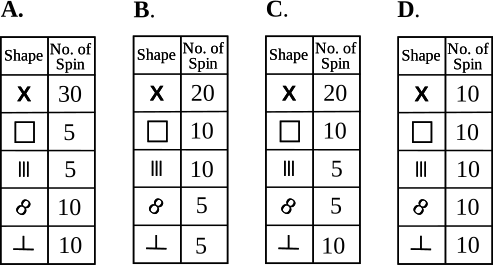
Probability, SM-Bank 039 MC

Nev spins the arrow 50 times.


Which table is most likely to show his result?

Show Answers Only

\(B\)

Show Worked Solution

\(\text{One strategy:}\)

\(\text{X should be worth }\dfrac{2}{5}\ \text{(20 spins),}\)

\(\rightarrow\ \text{Eliminate the first and last options.}\)

\(\text{The other relative sizes require the answer to be:}\)

\(\Rightarrow B\)

Filed Under: Probability Tagged With: num-title-ct-core, smc-4225-35-Relative frequency

Probability, SM-Bank 036 MC

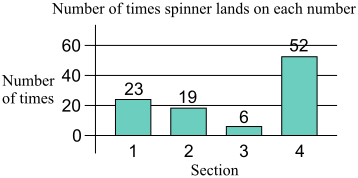
A spinner can land in any of 4 sections, labelled 1 to 4.

The spinner is spun 100 times and the results are recorded in the bar chart below.


Which of these spinners is most likely to give results shown in the graph?

A. B. C. D.
Show Answers Only

\(D\)

Show Worked Solution

\(\text{Landing on 1 should be about 23% (slightly less than one quarter).}\)

\(\text{Landing on 4 should be about 52% (just over half).}\)

\(\text{Landing on 2 and 3 (combined) should be 25%.}\)
 

\(\Rightarrow D\)

Filed Under: Probability Tagged With: num-title-ct-core, smc-4225-35-Relative frequency

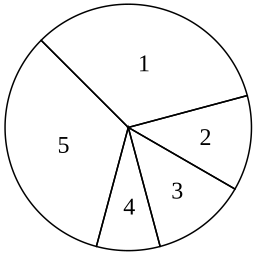
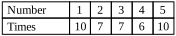
Probability, SM-Bank 029 MC

Spiro spins the arrow of this spinner 40 times.

He records the number of times the arrow lands on each number.


Which table records the most likely results?

A.
B.
C.
D.
Show Answers Only

\(D\)

Show Worked Solution

\(\text{Landing on 1 or 5 is approximately one-third chance}\)

\(\text{which is approximately 13 times.}\)

\(\text{Landing on 4 is expected to occur slightly less often}\)

\(\text{than landing on 2 or 3.}\)

 \(\Rightarrow D\)

Filed Under: Probability Tagged With: num-title-ct-core, smc-4225-35-Relative frequency

Probability, STD1 S2 2019 HSC 24

The faces on a biased six-sided die are labelled 1, 2, 3, 4, 5 and 6. The die was rolled twenty times. The relative frequency of rolling a 6 was 30% and the relative frequency of rolling a 2 was 15%. The number 3 was the only other number rolled in the twenty rolls.

How many times was the number 3 rolled in the twenty rolls of the die?  (3 marks)

--- 4 WORK AREA LINES (style=lined) ---

 
Show Answers Only

`11`

Show Worked Solution

`text(Number of 6’s) = 30/100 xx 20 = 6`

`text(Number of 2’s) = 15/100 xx 20 = 3`

`:.\ text(Number of 3’s)` `= 20 – (6 + 3)`
  `= 11`

Filed Under: Probability, Relative Frequency (Std 1) Tagged With: Band 4, num-title-ct-core, num-title-qs-hsc, smc-1133-30-Expected Frequency (np), smc-4225-35-Relative frequency

Probability, STD2 S2 2019 HSC 20

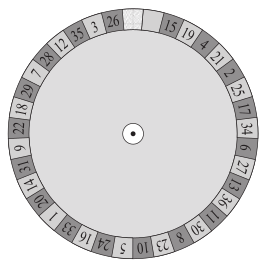
A roulette wheel has the numbers 0, 1, 2, …, 36 where each of the 37 numbers is equally likely to be spun.


If the wheel is spun 18 500 times, calculate the expected frequency of spinning the number 8.  (2 marks)

--- 4 WORK AREA LINES (style=lined) ---
Show Answers Only

`500`

Show Worked Solution

`P(8) = 1/37`

`:.\ text(Expected Frequency (8))`

`= 1/37 xx 18\ 500`

`= 500`

Filed Under: Probability, Relative Frequency (Std 1), Relative Frequency (Std 2), Relative Frequency (Y11) Tagged With: Band 4, common-content, num-title-ct-core, num-title-qs-hsc, smc-1133-20-Games of Chance, smc-4225-35-Relative frequency, smc-827-20-Games of Chance, smc-827-40-Expected Frequency (np), smc-990-20-Games of Chance, smc-990-40-Expected Frequency (np)

Probability, STD2 S2 2018 HSC 26a

Jeremy rolled a biased 6-sided die a number of times. He recorded the results in a table.
  

\begin{array} {|l|c|c|c|c|c|c|}
\hline
\rule{0pt}{2.5ex} \text{Number} \rule[-1ex]{0pt}{0pt} & \ \ 1 \ \ & \ \ 2 \ \  & \ \ 3 \ \  & \ \ 4 \ \  & \ \ 5 \ \  & \ \ 6 \ \ \\
\hline
\rule{0pt}{2.5ex} \text{Frequency} \rule[-1ex]{0pt}{0pt} & \ \ 23 \ \ & \ \ 19 \ \  & \ \ 48 \ \  & \ \ 20 \ \  & \ \ 21 \ \  & \ \ 19 \ \ \\
\hline
\end{array} 

What is the relative frequency of rolling a 3?  (1 mark)

--- 2 WORK AREA LINES (style=lined) ---
Show Answers Only

\(\dfrac{8}{25}\)

Show Worked Solution
♦ Mean mark 40%.

\(\text{Rel Freq}\) \(=\dfrac{\text{number of 3’s rolled}}{\text{total rolls}}\)
  \(=\dfrac{48}{150}\)
  \(=\dfrac{8}{25}\)

Filed Under: Probability, Relative Frequency (Std 1), Relative Frequency (Std 2), Relative Frequency (Y11) Tagged With: Band 5, common-content, num-title-ct-core, num-title-qs-hsc, smc-1133-20-Games of Chance, smc-4225-35-Relative frequency, smc-827-20-Games of Chance, smc-990-20-Games of Chance

Probability, STD2 S2 2018 HSC 20 MC

During a year, the maximum temperature each day was recorded. The results are shown in the table.


From the days with a maximum temperature less than 25°C, one day is selected at random.

What is the probability, to the nearest percentage, that the selected day occurred during winter?

  1. 19%
  2. 25%
  3. 32%
  4. 77%
Show Answers Only

`text(C)`

Show Worked Solution
`text{P(winter day)}` `= (text(winter days < 25))/text(total days < 25) xx 100`
  `= 71/223 xx 100`
  `= 31.8…%`

`=>\ text(C)`

Filed Under: Probability, Relative Frequency (Std 1), Relative Frequency (Std 2), Relative Frequency (Y11) Tagged With: Band 4, common-content, num-title-ct-core, num-title-qs-hsc, smc-1133-10-Surveys/Two-Way Tables, smc-4225-35-Relative frequency, smc-827-10-Surveys/Two-Way Tables, smc-990-10-Surveys/Two-Way Tables

Probability, STD2 S2 2018 HSC 9 MC

An experiment has three distinct outcomes, A, B and C.

Outcome A occurs 50% of the time. Outcome B occurs 23% of the time.

What is the expected number of times outcome C would occur if the experiment is conducted 500 times?

  1. 115
  2. 135
  3. 250
  4. 365
Show Answers Only

`text(B)`

Show Worked Solution

`text(Expectation of outcome)\ C`

`= 1 – 0.5 – 0.23`

`= 0.27`
 

`:.\ text(Expected times)\ C\ text(occurs)`

`= 0.27 xx 500`

`= 135`

`=>\ text(B)`

Filed Under: Fundamental Understanding (Std 1), Fundamental Understanding (Std 2), Probability Tagged With: Band 3, num-title-ct-core, num-title-qs-hsc, smc-4225-35-Relative frequency

Probability, STD2 S2 2017 HSC 5 MC

In a survey of 200 randomly selected Year 12 students it was found that 180 use social media.

Based on this survey, approximately how many of 75 000 Year 12 students would be expected to use social media?

A.     60 000

B.     67 500

C.     74 980

D.     75 000

Show Answers Only

`B`

Show Worked Solution
`text(Expected number)` `= 180/200 xx 75\ 000`
  `= 67\ 500`

`=> B`

Filed Under: DS5/6 - Normal Distribution and Sampling, Probability, Relative Frequency, Relative Frequency (Std 1), Relative Frequency (Std 2), Relative Frequency (Y11) Tagged With: Band 3, common-content, num-title-ct-core, num-title-qs-hsc, smc-1133-10-Surveys/Two-Way Tables, smc-1133-30-Expected Frequency (np), smc-4225-35-Relative frequency, smc-827-10-Surveys/Two-Way Tables, smc-827-40-Expected Frequency (np), smc-990-10-Surveys/Two-Way Tables, smc-990-40-Expected Frequency (np)

Probability, STD2 S2 2015 HSC 26e

The table shows the relative frequency of selecting each of the different coloured jelly beans from packets containing green, yellow, black, red and white jelly beans.

\begin{array} {|c|c|}
\hline
\rule{0pt}{2.5ex} \textit{Colour} \rule[-1ex]{0pt}{0pt} & \textit{Relative frequency} \\
\hline
\rule{0pt}{2.5ex} \text{Green} \rule[-1ex]{0pt}{0pt} & 0.32 \\
\hline
\rule{0pt}{2.5ex} \text{Yellow} \rule[-1ex]{0pt}{0pt} & 0.13 \\
\hline
\rule{0pt}{2.5ex} \text{Black} \rule[-1ex]{0pt}{0pt} & 0.14 \\
\hline
\rule{0pt}{2.5ex} \text{Red} \rule[-1ex]{0pt}{0pt} &  \\
\hline
\rule{0pt}{2.5ex} \text{White} \rule[-1ex]{0pt}{0pt} & 0.24 \\
\hline
\end{array}

  1. What is the relative frequency of selecting a red jelly bean?  (1 mark)

    --- 2 WORK AREA LINES (style=lined) ---

  2. Based on this table of relative frequencies, what is the probability of NOT selecting a black jelly bean?  (1 mark)

    --- 2 WORK AREA LINES (style=lined) ---
Show Answers Only
  1. \(0.17\)
  2. \(0.86\)
Show Worked Solution

i.  \(\text{Relative frequency of red}\)

\(= 1-(0.32 + 0.13 + 0.14 + 0.24)\)

\(= 1-0.83\)

\(= 0.17\)


ii.  \(P\text{(not selecting black)}\)

\(= 1-P\text{(selecting black)}\)

\(= 1-0.14\)

\(= 0.86\)

Filed Under: Combinations and Single Stage Events (Std 2), Probability, Relative Frequency, Relative Frequency (Std 1), Relative Frequency (Std 2), Relative Frequency (Y11), Single and Multi-Stage Events (Std 1), Single stage events Tagged With: Band 3, Band 4, common-content, num-title-ct-core, num-title-qs-hsc, smc-1133-20-Games of Chance, smc-1135-05-Simple Probability, smc-4225-20-Complementary events, smc-4225-35-Relative frequency, smc-827-20-Games of Chance, smc-828-10-Simple Probability, smc-990-20-Games of Chance

Probability, STD2 S2 2006 HSC 10 MC

Kay randomly selected a marble from a bag of marbles, recorded its colour and returned it to the bag. She repeated this process a number of times.


Based on these results, what is the best estimate of the probability that Kay will choose a green marble on her next selection?

  1.   `5/24`
  2.   `1/24`
  3.   `1/6`
  4.   `1/5`
Show Answers Only

`C`

Show Worked Solution
`text{P(Green)}` `= text(# Green chosen) / text(Total Selections)`
  `= 4/24`
  `= 1/6`

`=>  C`

Filed Under: Multi-stage Events, Multi-Stage Events (Std 2), Probability, Single and Multi-Stage Events (Std 1) Tagged With: Band 4, num-title-ct-core, num-title-qs-hsc, smc-1135-20-Other Multi-Stage Events, smc-4225-35-Relative frequency, smc-829-20-Other Multi-Stage Events

Probability, STD2 S2 2006 HSC 6 MC

Marcella is planning to roll a standard six-sided die 60 times.

How many times would she expect to roll the number 4?

  1.   6
  2.   10
  3.   15
  4.   20
Show Answers Only

`B`

Show Worked Solution

`P(4) = 1/6`

`:.\ text(Expected times to roll 4)`

`= 1/6 xx text(number of rolls)`

`= 1/6 xx 60`

`= 10`

`=>  B`

Filed Under: Probability, Relative Frequency, Relative Frequency (Std 1), Relative Frequency (Std 2), Relative Frequency (Y11) Tagged With: Band 4, common-content, num-title-ct-core, num-title-qs-hsc, smc-1133-20-Games of Chance, smc-1133-30-Expected Frequency (np), smc-4225-35-Relative frequency, smc-827-20-Games of Chance, smc-827-40-Expected Frequency (np), smc-990-20-Games of Chance, smc-990-40-Expected Frequency (np)

Probability, STD2 S2 2007 HSC 2 MC

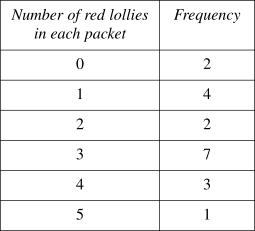
Each student in a class is given a packet of lollies. The teacher records the number of red lollies in each packet using a frequency table.
 

What is the relative frequency of a packet of lollies containing more than three red lollies?

  1.    `4/19`
  2.    `4/15`
  3.    `11/19`
  4.    `11/15`
Show Answers Only

`A`

Show Worked Solution

`text(# Packets with more than 3)`

`= 3 + 1 = 4`

`text(Total packets) = 19`

`:.\ text(Relative Frequency) = 4/19`

`=>  A`

Filed Under: Probability, Relative Frequency, Relative Frequency (Std 1), Relative Frequency (Std 2), Relative Frequency (Y11) Tagged With: Band 3, common-content, num-title-ct-core, num-title-qs-hsc, smc-1133-10-Surveys/Two-Way Tables, smc-4225-35-Relative frequency, smc-827-10-Surveys/Two-Way Tables, smc-990-10-Surveys/Two-Way Tables

Probability, STD2 S2 2011 HSC 24b

A die was rolled 72 times. The results for this experiment are shown in the table.
  

\begin{array} {|c|c|}
\hline
\rule{0pt}{2.5ex} \textit{Number obtained} \rule[-1ex]{0pt}{0pt} & \textit{Frequency} \\
\hline
\rule{0pt}{2.5ex} \ 1 \rule[-1ex]{0pt}{0pt} & 16 \\
\hline
\rule{0pt}{2.5ex} \ 2 \rule[-1ex]{0pt}{0pt} & 11 \\
\hline
\rule{0pt}{2.5ex} \ 3 \rule[-1ex]{0pt}{0pt} & \textbf{A} \\
\hline
\rule{0pt}{2.5ex} \ 4 \rule[-1ex]{0pt}{0pt} & 8 \\
\hline
\rule{0pt}{2.5ex} \ 5 \rule[-1ex]{0pt}{0pt} & 12 \\
\hline
\rule{0pt}{2.5ex} \ 6 \rule[-1ex]{0pt}{0pt} & 15 \\
\hline
\end{array}

  1. Find the value of  `A`.   (1 mark)

    --- 1 WORK AREA LINES (style=lined) ---
  2. What was the relative frequency of obtaining a 4.   (1 mark)

    --- 1 WORK AREA LINES (style=lined) ---
  3. If the die was unbiased, which number was obtained the expected number of times?   (1 mark)

    --- 1 WORK AREA LINES (style=lined) ---

Show Answers Only
  1. \(10\)
  2. \(\dfrac{1}{9}\)
  3. \(5\)
Show Worked Solution
i.     \(\text{Since die rolled 72 times}\)
\(\therefore\ A\) \(=72-(16+11+8+12+15)\)
  \(=72-62\)
  \(=10\)
♦ Mean mark 38%
IMPORTANT: Many students confused ‘relative frequency’ with ‘frequency’ and incorrectly answered 8.
ii.     \(\text{Relative frequency of 4}\) \(=\dfrac{8}{72}\)
  \(=\dfrac{1}{9}\)


iii.  \(\text{Expected frequency of any number}\)
\(=\dfrac{1}{6}\times 72\)
\(=12\)
 
\(\therefore\ \text{5 was obtained the expected number of times.}\)

Filed Under: Probability, Relative Frequency, Relative Frequency (Std 1), Relative Frequency (Std 2), Relative Frequency (Y11) Tagged With: Band 2, Band 4, Band 5, common-content, num-title-ct-core, num-title-qs-hsc, smc-1133-20-Games of Chance, smc-1133-30-Expected Frequency (np), smc-4225-35-Relative frequency, smc-827-20-Games of Chance, smc-827-40-Expected Frequency (np), smc-990-20-Games of Chance, smc-990-40-Expected Frequency (np)

Probability, STD2 S2 2009 HSC 9 MC

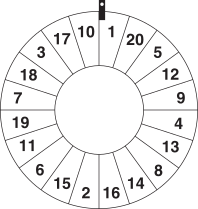
A wheel has the numbers 1 to 20 on it, as shown in the diagram. Each time the wheel is spun, it stops with the marker on one of the numbers.


 The wheel is spun 120 times.

 How many times would you expect a number less than 6 to be obtained?

  1.   `20` 
  2.   `24` 
  3.   `30` 
  4.   `36` 
Show Answers Only

`C`

Show Worked Solution

`P(text(number < 6) ) = 5/20 = 1/4`

`:.\ text(Expected times)` `= 1/4 xx text(times spun)`
  `= 1/4 xx 120`
  `= 30`

`=>  C`

Filed Under: Probability, Relative Frequency, Relative Frequency (Std 1), Relative Frequency (Std 2), Relative Frequency (Y11) Tagged With: Band 4, common-content, num-title-ct-core, num-title-qs-hsc, smc-1133-20-Games of Chance, smc-1133-30-Expected Frequency (np), smc-4225-35-Relative frequency, smc-827-20-Games of Chance, smc-827-40-Expected Frequency (np), smc-990-20-Games of Chance, smc-990-40-Expected Frequency (np)

Probability, STD2 S2 2012 HSC 26e

The dot plot shows the number of push-ups that 13 members of a fitness class can do in one minute.

2012 26e

  1.  What is the probability that a member selected at random from the class can do more than 38 push-ups in one minute?   (1 mark)

    --- 1 WORK AREA LINES (style=lined) ---
  2.  A new member who can do 32 push-ups in one minute joins the class.


    Does the addition of this new member to the class change the probability calculated in part (i)? Justify your answer.    (1 mark)

    --- 2 WORK AREA LINES (style=lined) ---
Show Answers Only
  1. `7/13`
  2. `text{Yes (See Worked Solutions)}`
Show Worked Solution
i.  `P` `= text(# Members > 38 push-ups)/text(Total members)`
  `= 7/13`

 
ii.
   `text(Yes.)`

`Ptext{(+ New member)}` `= text(Members > 38 push-ups)/text(Total members)`
  `= 7/14≠ 7/13`
MARKER’S COMMENT: The most successful candidates used the fraction `7/14` in their part (ii) answer rather than relying solely on words.

Filed Under: Probability, Relative Frequency, Relative Frequency (Std 1), Relative Frequency (Std 2), Relative Frequency (Y11) Tagged With: Band 3, Band 4, common-content, num-title-ct-core, num-title-qs-hsc, smc-1133-10-Surveys/Two-Way Tables, smc-4225-35-Relative frequency, smc-827-10-Surveys/Two-Way Tables, smc-990-10-Surveys/Two-Way Tables

Probability, STD2 S2 2012 HSC 17 MC

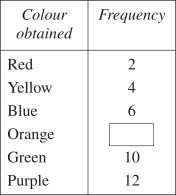
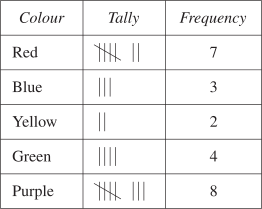
A spinner with different coloured sectors is spun 40 times. The results are recorded in the table.

 What is the relative frequency of obtaining the colour orange? 

  1.    `3/20`  
  2.    `1/5`  
  3.    `6`  
  4.    `8` 
Show Answers Only

`A`

Show Worked Solution
♦♦ Mean mark 34%
COMMENT: Note that relative frequency is the frequency of an event divided by the total frequencies (i.e. the probability).
`text(Total frequency)` `= 40\ text(spins)`
`text(Orange freq.)` `= 40\-(2 + 4 + 6 + 10 +12)`
  `=6`
`:.\ text(Relative freq.)` `= 6/40 = 3/20`

 
`=>  A`

Filed Under: Probability, Relative Frequency, Relative Frequency (Std 1), Relative Frequency (Std 2), Relative Frequency (Y11) Tagged With: Band 5, common-content, num-title-ct-core, num-title-qs-hsc, smc-1133-20-Games of Chance, smc-4225-35-Relative frequency, smc-827-20-Games of Chance, smc-990-20-Games of Chance

Probability, STD2 S2 2013 HSC 7 MC

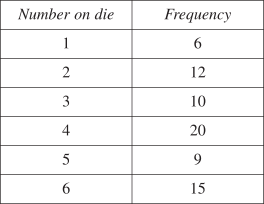
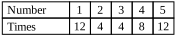
In an experiment, a standard six-sided die was rolled 72 times. The results are shown in the table.
 

Which number on the die was obtained the expected number of times?

  1.    1
  2.    2
  3.    3
  4.    6
Show Answers Only

`B`

Show Worked Solution

`text(Probability of rolling a specific number)=1/6`

`:.\ text(After 72 rolls, a specific number is expected)`

 `1/6xx72=12\ text(times.)`

`=>\ B`

Filed Under: Probability, Relative Frequency, Relative Frequency (Std 1), Relative Frequency (Std 2), Relative Frequency (Y11) Tagged With: Band 3, common-content, num-title-ct-core, num-title-qs-hsc, smc-1133-20-Games of Chance, smc-1133-30-Expected Frequency (np), smc-4225-35-Relative frequency, smc-827-20-Games of Chance, smc-827-40-Expected Frequency (np), smc-990-20-Games of Chance, smc-990-40-Expected Frequency (np)

Copyright © 2014–2025 SmarterEd.com.au · Log in