SmarterEd

Aussie Maths & Science Teachers: Save your time with SmarterEd

  • Login
  • Get Help
  • About

CHEMISTRY, M2 EQ-Bank 3

Balance the following chemical equations:

  1. \(\ce{HCl(aq) + Zn(s) -> ZnCl2(aq) + H2(g)}\)   (1 mark)
  2. \(\ce{CuSO4(aq) + AgNO3(aq) -> Ag2SO4(s) + Cu(NO3)2(aq)}\)   (1 mark)

Show Answers Only

a.    \(\ce{2HCl(aq) + Zn(s) -> ZnCl2(aq) + H2(g)}\)

b.    \(\ce{CuSO4(aq) + 2AgNO3(aq) -> Ag2SO4(s) + Cu(NO3)2(aq)}\)

Show Worked Solution

a.    \(\ce{2HCl(aq) + Zn(s) -> ZnCl2(aq) + H2(g)}\)

b.    \(\ce{CuSO4(aq) + 2AgNO3(aq) -> Ag2SO4(s) + Cu(NO3)2(aq)}\)

Filed Under: Chemical Reactions and Stoichiometry Tagged With: Band 3, Band 4, smc-4259-50-Balancing Chemical Equations

CHEMISTRY, M2 EQ-Bank 3 MC

The following equation represents the reaction of calcium disilicide \(\ce{(CaSi2)}\) with antimony trichloride \(\ce{(SbCl3)}\) to produce calcium chloride \(\ce{(CaCl2)}\), silicon \(\ce{(Si)}\), and antimony \(\ce{(Sb)}\):

\(\ce{a CaSi2 + b SbCl3 -> c Si + d Sb + e CaCl2}\)

What are the stoichiometric values for \( a, b, c, d\) and \( e\) in the balanced equation?

  1. \(2, 3, 6, 3, 2\)
  2. \(3, 2, 2, 6, 3\)
  3. \(3, 3, 6, 2, 3\)
  4. \(3, 2, 6, 2, 3\)
Show Answers Only

\(D\)

Show Worked Solution
  • Balancing the chlorine atoms:
  •    \(\ce{a CaSi2 + 2SbCl3 -> c Si + d Sb +  3CaCl2}\)
  • Since \(\ce{Si}\) and \(\ce{Sb}\) are by themselves on the right hand side, they can be easily balanced last.
  • Next, balance the \(\ce{Ca}\) atoms on the left hand side:
  •    \(\ce{3CaSi2 + 2SbCl3 -> c Si + d Sb +  3CaCl2}\)
  • The values for \(c\) and \(d\) can be added to balance the remaining atoms.
  •    \(\ce{3CaSi2 + 2SbCl3 -> 6 Si + 2 Sb +  3CaCl2}\)

\(\Rightarrow D\)

Filed Under: Chemical Reactions and Stoichiometry Tagged With: Band 4, smc-4259-50-Balancing Chemical Equations

CHEMISTRY, M2 EQ-Bank 2 MC

Which is the correct balanced formula equation for the reaction of potassium with water?

  1. \(\ce{K(s) + H2O(l) -> KOH(aq) + H2(g)}\)
  2. \(\ce{2K(s) + 2H2O(aq) -> 2KOH(aq) + H2(g)}\)
  3. \(\ce{2K(s) + 2H2O(l) -> 2KOH(aq) + H2(g)}\)
  4. \(\ce{K(s) + 2H2O(aq) -> KOH(aq) + 2H2(g)}\)
Show Answers Only

\(C\)

Show Worked Solution
  • The correct chemical equation is:
  •    \(\ce{2K(s) + 2H2O(l) -> 2KOH(aq) + H2(g)}\) 
  • The state of water is always liquid. An aqueous solution refers to a solution where a substance has been dissolved into water.

\(\Rightarrow C\)

Filed Under: Chemical Reactions and Stoichiometry Tagged With: Band 3, smc-4259-50-Balancing Chemical Equations

CHEMISTRY, M2 EQ-Bank 1 MC

What numbers are required to correctly balance this equation?

__\(\ce{Fe2O3 +}\) __\(\ce{CO ->}\) __\(\ce{Fe +}\) __\(\ce{CO2}\)

  1. \(1, 3, 2, 3\)
  2. \(2, 3, 1, 3\)
  3. \(1, 1, 2, 1\)
  4. \(2, 4, 2, 4\)
Show Answers Only

\(A\)

Show Worked Solution

Balancing the iron \(\ce{Fe}\) atoms:

  • There are 2 Fe atoms in \(\ce{Fe2O3}\), so we place a 2 in front of \(\ce{Fe}\) on the product side.
  •    \(\ce{Fe2O3 + CO -> 2Fe + CO2}\)  

Balancing the oxygen \(\ce{O}\) atoms:

  • \(\ce{Fe2O3}\) has 3 oxygen atoms. To balance equation, we need 3 \(\ce{CO}\) molecules on the reactant side to balance the 3 \(\ce{CO2}\) molecules on the product side.
  •    \(\ce{Fe2O3 + 3CO -> 2Fe + 3CO2}\)

\(\Rightarrow A\)

Filed Under: Chemical Reactions and Stoichiometry Tagged With: Band 3, smc-4259-50-Balancing Chemical Equations

CHEMISTRY, M2 EQ-Bank 1

Balance the following chemical equations:

  1. \(\ce{C2H6(l) + O2(g) -> H2O(l) + CO2(g)}\)   (1 mark)
  2. \(\ce{H3PO4(aq) + CuCO3(aq) -> Cu3(PO4)2(aq) + CO2(g) + H2O(l)}\)   (1 mark)
Show Answers Only

a.    \(\ce{2C2H6(l) + 7O2(g) -> 6H2O(l) + 4CO2(g)}\)

b.    \(\ce{2H3PO4(aq) + 3CuCO3(aq) -> Cu3(PO4)2(aq) + 3CO2(g) + 3H2O(l)}\)

Show Worked Solution

a.    \(\ce{2C2H6(l) + 7O2(g) -> 6H2O(l) + 4CO2(g)}\)

b.    \(\ce{2H3PO4(aq) + 3CuCO3(aq) -> Cu3(PO4)2(aq) + 3CO2(g) + 3H2O(l)}\)

Filed Under: Chemical Reactions and Stoichiometry Tagged With: Band 4, smc-4259-50-Balancing Chemical Equations

CHEMISTRY, M2 2013 VCE 8a

In an experiment, 5.85 g of ethanol was ignited with 14.2 g of oxygen.

  1. Write an equation for the complete combustion of ethanol.  (1 mark)

    --- 2 WORK AREA LINES (style=lined) ---

  2. Which reagent is in excess? Calculate the amount, in moles, of the reagent identified as being in excess.  (3 marks)

    --- 6 WORK AREA LINES (style=lined) ---

Show Answers Only

a.    \(\ce{C2H5OH(g) + 3O2(g) \rightarrow 2CO2(g) + 3H2O(g) }\)

b.   \(\ce{O2_{\text{(excess)}} = 0.062\ \text{mol}}\)

Show Worked Solution

a.    \(\ce{C2H5OH(g) + 3O2(g) \rightarrow 2CO2(g) + 3H2O(g) }\)

♦ Mean mark 43%.

 
b.
   \(\ce{MM(C2H5OH) = 2 \times 12.0 + 6 \times 1.0 + 16.0 = 46.0\ \text{g mol}^{-1}}\)

\(\ce{n(C2H5OH) = \dfrac{5.85}{46.0} = 0.1272\ \text{mol}} \)

\(\ce{n(O2) = \dfrac{14.2}{32.0} = 0.444\ \text{mol}}\)

\(\text{Reaction ratio}\ \ \ce{C2H5OH : O2 = 1:3}\)

\(\Rightarrow \ce{n(O2)_{\text{required}} = 3 \times 0.1272 = 0.382\ \text{mol}\ \ (\ce{O2}\ \text{excess}) }\)

\(\ce{O2_{\text{(excess)}} = 0.444-0.382 = 0.062\ \text{mol}}\)

Filed Under: Chemical Reactions and Stoichiometry Tagged With: Band 4, Band 5, smc-4259-20-Mass Changes, smc-4259-50-Balancing Chemical Equations

CHEMISTRY, M2 2014 VCE 11*

Consider the following unbalanced ionic equation.

\(\ce{Hg(l) + Cr2O7^2–(aq) + H+(aq)\rightarrow Hg^2+(aq) + Cr^3+(aq) + H2O(l)}\)

When this equation is completely balanced including the total charge on each side of the equation, find the coefficient of \(\ce{Hg(l)}\).   (3 marks)

--- 3 WORK AREA LINES (style=lined) ---

Show Answers Only

\(3\)

Show Worked Solution
  • By balancing the equations by the total number of atoms of each side
  •    \(\ce{Hg(l) + Cr2O7^2–(aq) + 14H+(aq)\rightarrow Hg^2+(aq) + 2Cr^3+(aq) + 7H2O(l)}\)
  • The charge on the left side is \(+12\) while the charge on the right side is \(+8\)
  • The charge on the right hand side needs to be increased by \(+4\)
  • This can be done by changing to \(\ce{3Hg^2+(aq)}\).
  • The total balanced equation while following law of conservation of charge is:
  •    \(\ce{3Hg(l) + Cr2O7^2–(aq) + 14H+(aq)\rightarrow 3Hg^2+(aq) + 2Cr^3+(aq) + 7H2O(l)}\)
  • Hence the coefficient of \(\ce{Hg(l)}\) is \(3\).

Filed Under: Chemical Reactions and Stoichiometry Tagged With: Band 6, smc-4259-50-Balancing Chemical Equations

CHEMISTRY, M2 2015 VCE 3 MC

In an experiment, 0.051 mol of sodium hydroxide, \(\ce{NaOH}\), reacted completely with 0.017 mol of citric acid, \(\ce{C6H8O7}\).

Which one of the following equations correctly represents the reaction between citric acid and the sodium hydroxide solution?

  1. \(\ce{NaOH(aq) + C6H8O7(aq)\rightarrow NaC6H7O7(aq) + H2O(l)}\)
  2. \(\ce{2NaOH(aq) + C6H8O7(aq)\rightarrow Na2C6H6O7(aq) + 2H2O(l)}\)
  3. \(\ce{3NaOH(aq) + C6H8O7(aq)\rightarrow Na3C6H5O7(aq) + 3H2O(l)}\)
  4. \(\ce{4NaOH(aq) + C6H8O7(aq)\rightarrow Na4C6H4O7(aq) + 4H2O(l)}\)
Show Answers Only

\(C\)

Show Worked Solution

\(\text{Ratio of moles reacting}\ = 0.051 : 0.017 = 3:1 \)

\(\ce{n(NaOH) : n(C6H8O7) = 3:1} \)

\(\ce{3NaOH(aq) + C6H8O7(aq)\rightarrow Na3C6H5O7(aq) + 3H2O(l)}\)

\(\Rightarrow C\)

Filed Under: Chemical Reactions and Stoichiometry Tagged With: Band 4, smc-4259-50-Balancing Chemical Equations

CHEMISTRY, M2 2022 VCE 3* MC

The correct equation for the incomplete combustion of ethanol is

  1. \(\ce{C2H5OH(l) + O2(g)\rightarrow CO(g) + H2O(l)}\)
  2. \(\ce{C2H5OH(l) + 2O2(g)\rightarrow 2CO(g) + 4H2O(l)}\)
  3. \(\ce{C2H5OH(l) + 2O2(g)\rightarrow 2CO(g) + 3H2O(l)}\)
  4. \(\ce{2C2H5OH(l) + 4O2(g)\rightarrow 4CO(g) + 5H2O(l)}\)
Show Answers Only

\(C\)

Show Worked Solution
  • The products of incomplete combustion are \(\ce{CO}\) and \(\ce{H2O}\) and correctly balanced as shown in \(C\).

\(\Rightarrow C\)

Filed Under: Chemical Reactions and Stoichiometry Tagged With: Band 3, smc-4259-50-Balancing Chemical Equations

CHEMISTRY, M2 2020 VCE 6a*

Methane gas, \(\ce{CH4}\), can be captured from the breakdown of waste in landfills. \(\ce{CH4}\) is also a primary component of natural gas. \(\ce{CH4}\) can be used to produce energy through combustion.

Write the balanced equation for the complete combustion of \(\ce{CH4}\) to produce carbon dioxide, \(\ce{CO2}\) given the unbalanced equation below.  (1 mark)

\(\ce{CH4(g) + O2 \rightarrow CO2(g) + H2O(l)}\)

--- 2 WORK AREA LINES (style=lined) ---

Show Answers Only

\(\ce{2CH4(g) + 3O2 \rightarrow 2CO2(g) + 4H2O(l)\ \ \text{or}}\)

\(\ce{CH4(g) + \dfrac{3}{2}O2 \rightarrow CO2(g) + 2H2O(l)}\)

Show Worked Solution

\(\ce{2CH4(g) + 3O2 \rightarrow 2CO2(g) + 4H2O(l)\ \ \text{or}}\)

\(\ce{CH4(g) + \dfrac{3}{2}O2 \rightarrow CO2(g) + 2H2O(l)}\)

Filed Under: Chemical Reactions and Stoichiometry Tagged With: Band 3, smc-4259-50-Balancing Chemical Equations

CHEMISTRY, M2 2016 VCE 9a

Standard solutions of sodium hydroxide, \(\ce{NaOH}\), must be kept in airtight containers. This is because \(\ce{NaOH}\) is a strong base and absorbs acidic oxides, such as carbon dioxide, \(\ce{CO2}\), from the air and reacts with them. As a result, the concentration of \(\ce{NaOH}\) is changed to an unknown extent.

\(\ce{CO2}\) in the air reacts with water to form carbonic acid, \(\ce{H2CO3}\). This can react with \(\ce{NaOH}\) to form sodium carbonate, \(\ce{Na2CO3}\).

  1. Write a balanced overall equation for the reaction between \(\ce{CO2}\) gas and water to form \(\ce{H2CO3}\).   (1 mark)

    --- 1 WORK AREA LINES (style=lined) ---

  2. Write a balanced equation for the complete reaction between \(\ce{H2CO3}\) and \(\ce{NaOH}\) to form \(\ce{Na2CO3}\).   (1 mark)

    --- 1 WORK AREA LINES (style=lined) ---

Show Answers Only

a.    \(\ce{CO2(g) + H2O(l) \rightarrow H2CO3(aq)} \)

b.   \(\ce{2NaOH(aq) + H2CO3(aq) \rightarrow Na2CO3(aq) + 2H2O(l)}\)

Show Worked Solution

a.    \(\ce{CO2(g) + H2O(l) \rightarrow H2CO3(aq)} \)

b.   \(\ce{2NaOH(aq) + H2CO3(aq) \rightarrow Na2CO3(aq) + 2H2O(l)}\)

Filed Under: Chemical Reactions and Stoichiometry Tagged With: Band 2, Band 4, smc-4259-50-Balancing Chemical Equations

CHEMISTRY, M2 2010 HSC 23a

  1. Write a balanced chemical equation for the complete combustion of 1-butanol.  (1 mark)
  2. A student measured the heat of combustion of three different fuels. The results are shown in the table.

\begin{array} {|c|c|}
\hline  & \textit{Heat of} \\ \ \ \ \textit{Fuel}\ \ \  & \textit{combustion}  \\ & (\text{kJ g}^{-1})  \\
\hline A  &  -48 \\ B & -38 \\ C & -28 \\
\hline \end{array}

  1. The published value for the heat of combustion of 1-butanol is 2676 kJ mol\(^{-1}\).
  2. Which fuel from the table is likely to be 1-butanol? Justify your answer.  (2 marks)

    --- 4 WORK AREA LINES (style=lined) ---

Show Answers Only

a.   \(\ce{C4H9OH + 6O2 \rightarrow 4CO2 + 5H2O}\)
 

b.   \(\text{Convert heat of combustion for each fuel to kJ mol}^{-1}:\)

\(\ce{MM(C4H9OH) = 12.01 \times 4 + 1.008 \times 9 + 16 + 1.008 = 74.12}\)

\(\ce{$A$: 48 \times 74 = 3552 kJ mol^{-1}}\)

\(\ce{$B$: 38 \times 74 = 2812 kJ mol^{-1}}\)

\(\ce{$C$: 28 \times 74 = 2072 kJ mol^{-1}}\)
 

  • \(\text{Energy will be lost due to heat and fuel impurities.}\)
  • \(A\ \text{and}\ B\ \text{have values higher than the published value.}\)

\(\therefore\ C\ \text{is most likely to be 1-butanol.}\)

Show Worked Solution

a.   \(\ce{C4H9OH + 6O2 \rightarrow 4CO2 + 5H2O}\)
 

b.   \(\text{Convert heat of combustion for each fuel to kJ mol}^{-1}:\)

\(\ce{MM(C4H9OH) = 12.01 \times 4 + 1.008 \times 9 + 16 + 1.008 = 74.12}\)

\(\ce{$A$: 48 \times 74 = 3552 kJ mol^{-1}}\)

\(\ce{$B$: 38 \times 74 = 2812 kJ mol^{-1}}\)

\(\ce{$C$: 28 \times 74 = 2072 kJ mol^{-1}}\)
 

  • \(\text{Energy will be lost due to heat and fuel impurities.}\)
  • \(A\ \text{and}\ B\ \text{have values higher than the published value.}\)

\(\therefore\ C\ \text{is most likely to be 1-butanol.}\)

Filed Under: Chemical Reactions and Stoichiometry Tagged With: Band 4, smc-4259-50-Balancing Chemical Equations

CHEMISTRY, M2 2012 HSC 5* MC

Which of the following is a balanced equation representing the fermentation of glucose?

  1. \(\ce{C6H12O6}(aq) \rightarrow \ce{C2H5OH}(aq) + \ce{CO2}(g)\)
  2. \(\ce{C6H12O6}(aq) \rightarrow \ce{2C2H5OH}(aq) + \ce{2CO2}(g)\)
  3. \(\ce{C6H12O6}(aq) \rightarrow \ce{C2H5OH}(aq) + \ce{2CO2}(g)\)
  4. \(\ce{2C6H12O6}(aq) \rightarrow \ce{4C2H5OH}(aq) + \ce{4CO2}(g)\)
Show Answers Only

\(B\)

Show Worked Solution
  • 1 glucose molecule undergoes fermentation to produce 2 ethanol molecules and 2 carbon dioxide molecules as seen in \(B\).

\(=>B\)

Filed Under: Chemical Reactions and Stoichiometry Tagged With: Band 3, smc-4259-50-Balancing Chemical Equations

CHEMISTRY, M2 2013 HSC 22b

A solution contains three cations, \( \ce{Ba}^{2+}, \ce{Cu}^{2+}\) and \(\ce{Pb}^{2+}\). The flow chart indicates the plan used to confirm the identity of these cations.
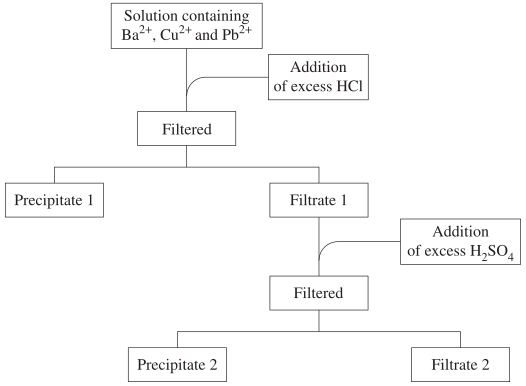


Write a balanced net ionic equation for the formation of Precipitate 1.  (2 marks)

--- 4 WORK AREA LINES (style=lined) ---

Show Answers Only

\(\ce{Pb^{2+}(aq) + 2Cl-(aq) \rightarrow PbCl2(s)}\)

Show Worked Solution

\(\ce{Pb^{2+}(aq) + 2Cl-(aq) \rightarrow PbCl2(s)}\)

  • In the above flow chart, the addition of excess HCl causes one of the cations to precipitate out of the solution.
  • The remaining two are then distinguished through precipitation with excess sulfuric acid \(\ce{(H2SO4)}\).
  • Of the possible salts, only \(\ce{PbCl2(s)}\) is insoluble. Therefore Precipitate 1 is Lead \(\text{(II)}\) Chloride.
  • Balanced net ionic equation:  \(\ce{Pb^{2+}(aq) + 2Cl-(aq) \rightarrow PbCl2(s)}\)
♦♦♦ Mean mark 27%.

Filed Under: Chemical Reactions and Stoichiometry Tagged With: Band 6, smc-4259-50-Balancing Chemical Equations

CHEMISTRY, M2 2016 HSC 19 MC

Excess barium nitrate solution is added to 200 mL of 0.200 mol L\(^{-1}\) sodium sulfate.

What is the mass of the solid formed?

  1. 4.65 g
  2. 8.69 g
  3. 9.33 g
  4. 31.5 g
Show Answers Only

`C`

Show Worked Solution

\( \ce{Ba(NO3)2 (aq) + Na2SO4 (aq) \rightarrow BaSO4 (s) + 2NaNO3 (aq)}\)

\(n(\ce{Na2SO4})=0.2 \times 0.2=0.04\ \text{mol}\)

\(n(\ce{BaSO4 (s)})=0.04\ \text{mol}\)

\(m(\ce{BaSO4 (s)})=0.04 \times 233.37=9.33\ \text{g}\)

\(\Rightarrow C\)

Filed Under: Chemical Reactions and Stoichiometry Tagged With: Band 4, smc-4259-20-Mass Changes, smc-4259-50-Balancing Chemical Equations, smc-4259-80-Conservation of Mass

Copyright © 2014–2025 SmarterEd.com.au · Log in