SmarterEd

Aussie Maths & Science Teachers: Save your time with SmarterEd

  • Login
  • Get Help
  • About

CHEMISTRY, M4 EQ-Bank 7

Bond energies can be used to estimate the enthalpy change of a reaction. The equation for the combustion of methane \(\ce{CH4}\) is shown below:

\(\ce{CH4(g) + 2O2(g) -> CO2(g) + 2H2O(l)}\)

Given the following bond energies:

  • \(\ce{C-H}\) bond: 412 kJ mol\(^{-1}\)
  • \(\ce{O=O}\) bond: 498 kJ mol\(^{-1}\)
  • \(\ce{C=O}\) bond: 805 kJ mol\(^{-1}\)
  • \(\ce{O-H}\) bond: 463 kJ mol\(^{-1}\)

Calculate the total bond energy of the products.   (2 marks)

--- 4 WORK AREA LINES (style=lined) ---
Show Answer Only

\(3462\ \text{kJ mol}^{-1}\)

Show Worked Solution
  • Total bond energy of 1 mole of \(\ce{CO2} = 2 \times 805 = 1610\ \text{kJ mol}^{-1}\)
  • Total bond energy of 2 mole of \(\ce{H2O} = 4 \times 463 = 1852\ \text{kJ mol}^{-1}\)
  • Thus the total bond energy of the products is \(3462\ \text{kJ mol}^{-1}\)

Filed Under: Enthalpy and Hess's Law Tagged With: Band 3, Band 4, smc-4267-20-Enthalpy and bonding

CHEMISTRY, M4 EQ-Bank 6

Explain why using bond energies is not an accurate method of calculating enthalpy changes.   (2 marks)

Show Answers Only
  • Enthalpy changes calculated using bond energies are not entirely accurate because bond energies represent averages of similar bond dissociations.
  • The actual energy of a specific bond can vary depending on the electrochemical environment around it, such as the presence of nearby electronegative atoms, adjacent double bonds, or the overall size of the molecule.
  • The energy of a specific bond depends also on the pressure, temperature, and state of the molecule. Bond energies assume standard laboratory conditions and all compounds already being in gas form and so are inaccurate. 
Show Worked Solution
  • Enthalpy changes calculated using bond energies are not entirely accurate because bond energies represent averages of similar bond dissociations.
  • The actual energy of a specific bond can vary depending on the electrochemical environment around it, such as the presence of nearby electronegative atoms, adjacent double bonds, or the overall size of the molecule.
  • The energy of a specific bond depends also on the pressure, temperature, and state of the molecule. Bond energies assume standard laboratory conditions and all compounds already being in gas form and so are inaccurate. 

Filed Under: Enthalpy and Hess's Law Tagged With: Band 6, smc-4267-20-Enthalpy and bonding

CHEMISTRY, M4 EQ-Bank 5

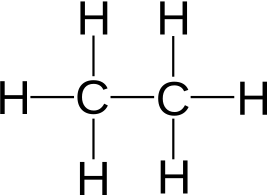
The chemical equation for the complete combustion of ethane  \(\ce{(C2H6)}\)  is given below:

\(\ce{2C2H6(g) + 7O2(g) -> 4CO2(g) + 6H2O(l)}\)

The structural formula for ethane and standard bond energies for provided for you.

\begin{array} {|c|c|}
\hline Bond & Enthalpy \text{ (kJ mol}^{-1})  \\     
\hline \ce{C-C} & 348 \\
\hline \ce{O-O} & 146 \\
\hline \ce{O=O} & 495 \\
\hline \ce{C-O} & 358 \\
\hline \ce{C=O} & 799 \\
\hline \ce{C-H} & 413 \\
\hline \ce{H-O} & 463 \\
\hline \end{array}

Using the bond energies provided, calculate the enthalpy for the complete combustion of one mole of ethane.   (3 marks)

Show Answers Only

\(-1415.5\ \text{kJ mol}^{-1}\)

Show Worked Solution
\(\Delta H\) \(=\Sigma\,{\text{bonds broken}}-\Sigma\,{\text{bonds formed}}\)  
  \(=((12 \times 413) + (2 \times 348) + (7 \times 495))-((8 \times 799) + (12 \times 463))\)  
  \(=9117-11948\)  
  \(=-2831\)  (for two moles of ethane, as per the equation)  
     
  • \(\Delta H\) for the combustion of one mole of ethane is \(-1415.5 \text{ kJ mol}^{-1}\)

Filed Under: Enthalpy and Hess's Law Tagged With: Band 5, Band 6, smc-4267-20-Enthalpy and bonding

CHEMISTRY, M4 EQ-Bank 3

The combustion of methane \(\ce{(CH4)}\) is represented by the following equation:

\(\ce{CH4(g) + 2O2(g) -> CO2(g) + 2H2O(l)}\qquad \Delta H = -890\ \text{kJ mol}^{-1}\)

Calculate the energy change when 3 moles of methane are combusted.   (2 marks)

--- 3 WORK AREA LINES (style=lined) ---

Show Answers Only

\(-2670\ \text{kJ mol}^{-1}\)

Show Worked Solution
  • The enthalpy change for 1 mole of methane is given as \(-890\ \text{kJ}\).
  • For 3 moles of methane, the energy change is:
  • \(\Delta H = 3 \times -890 = -2670\ \text{kJ}\)

Filed Under: Enthalpy and Hess's Law Tagged With: Band 3, smc-4267-20-Enthalpy and bonding

CHEMISTRY, M4 EQ-Bank 8 MC

The standard enthalpy of formation of water is – 286 kJ mol\(^{-1}\). What does this value represent?

  1. The enthalpy change when 1 mole of water decomposes
  2. The enthalpy change when 1 mole of water vaporizes
  3. The enthalpy change when 1 mole of water is formed from hydrogen and oxygen
  4. The enthalpy change when 1 mole of hydrogen is formed from water
Show Answers Only

\(C\)

Show Worked Solution
  • The standard enthalpy of formation for water \(\ce{(H2O)}\) is the enthalpy change when hydrogen gas \(\ce{(H2)}\) and oxygen gas \(\ce{(O2)}\) combine to form 1 mole of liquid water under standard conditions (298K and 100kPa):
  •    \(\ce{H2(g) + \frac{1}{2}O2(g) -> H2O(l)}\)         \(\Delta H =-286\ \text{kJ mol}^{-1}\)

\(\Rightarrow C\)

Filed Under: Enthalpy and Hess's Law Tagged With: Band 4, smc-4267-20-Enthalpy and bonding

CHEMISTRY, M4 EQ-Bank 7 MC

The chemical equation for the decomposition of calcium carbonate is shown below

\(\ce{CaCO3(s) -> CO2(g) + CaO(s)}\)

Which of the following best describes the type of reaction given that the bond energy of the reactant is greater than the bond energy of the products.

  1.  An exothermic reaction because energy is absorbed
  2. An exothermic reaction because energy is released
  3. An endothermic reaction because energy is absorbed
  4. An endothermic reaction because energy is released
Show Answers Only

\(C\)

Show Worked Solution
  • \(\Delta H= \Sigma\,\text{bond energies broken}-\Sigma\,\text{bond energies formed}\)
  • If the bond energy of the reactant is greater than the bond energy of the products, then more energy is required to break apart the reactant bonds then being produced in the formation of the product bonds.
  • Hence \(\Delta H\) will be positive as energy is being absorbed.

\(\Rightarrow C\)

Filed Under: Enthalpy and Hess's Law Tagged With: Band 5, smc-4267-20-Enthalpy and bonding

CHEMISTRY, M4 EQ-Bank 4 MC

Carbon dioxide decomposes into carbon monoxide and oxygen according to the equation:

   \(\ce{2CO2(g) → 2CO(g) + O2(g)} \quad \Delta H = +566 \, \text{kJ/mol}\)

Which of the following statements about this reaction is correct?

  1. The energy required to break the bonds in the reactants is less than the energy released when the products are formed.
  2. The energy required to break the bonds in the reactants is equal to the energy released when the products are formed.
  3. The energy required to break the bonds in the reactants is less than the energy required to form the reactants from the products.
  4. The energy required to break the bonds in the reactants is more than the energy released when the products are formed.
Show Answers Only

\(D\)

Show Worked Solution
  • This is an endothermic reaction (\(\Delta H > 0\))
  • More energy is absorbed to break the bonds in the reactants (CO₂) than is released during the formation of the products (\(\ce{CO}\) and \(\ce{O2}\)).
  • The positive enthalpy value indicates a net absorption of energy.

\(\Rightarrow D\)

Filed Under: Enthalpy and Hess's Law Tagged With: Band 4, smc-4267-20-Enthalpy and bonding

CHEMISTRY, M4 EQ-Bank 3 MC

Which of the following are the main products of respiration?

  1. Oxygen and glucose
  2. Water and carbon dioxide
  3. Lactic acid and oxygen
  4. Glucose and water
Show Answers Only

\(B\)

Show Worked Solution
  • The balanced equation for respiration is:
  •    \(\ce{C6H12O6 + 6O2 → 6CO2 + 6H2O + energy}\)     \(-\Delta H\)
  • Thus, the main products are carbon dioxide and water.

\(\Rightarrow B\)

Filed Under: Enthalpy and Hess's Law Tagged With: Band 4, smc-4267-20-Enthalpy and bonding

CHEMISTRY, M4 EQ-Bank 1 MC

The combustion of methane \((\ce{CH4(g) + 2 O2(g) → CO2(g) + 2 H2O(g)})\) occurs with the following bond energies:

    • \(\ce{C-H}:\ \text{412 kJ/mol}\)
    • \(\ce{O=O}:\ \text{498 kJ/mol}\)
    • \(\ce{C=O}:\ 799\ \text{kJ/mol}\)
    • \(\ce{O-H}:\ \text{463 kJ/mol}\)

Calculate the enthalpy change \((\Delta H)\) for this reaction:

  1. \(-802\ \text{kJ/mol}\)
  2. \(-482\ \text{kJ/mol}\)
  3. \(+482\ \text{kJ/mol}\)
  4. \(+802\ \text{kJ/mol}\)
Show Answers Only

\(A\)

Show Worked Solution

Energy required to break the reactant bonds:

Energy to break 4 \(\ce{(C-H)}\) bonds: \( 4 \times 412 = 1648 \, \text{kJ/mol}\)

Energy to break 2 \(\ce{(O=O)}\) bonds: \( 2 \times 498 = 996 \, \text{kJ/mol}\)

\(1648 + 996 = 2644 \, \text{kJ/mol} \)
 

Energy released in the formation of the product bonds:

Energy to form 2 \(\ce{(C=O)}\) bonds: \( 2 \times 799 = 1598 \, \text{kJ/mol}\)

Energy to form 4 \(\ce{(O-H)}\) bonds: \( 4 \times 463 = 1852 \, \text{kJ/mol}\)

\(1598 + 1852 = 3450 \, \text{kJ/mol}\)
 

\(\Delta H= \Sigma\,\text{bond energies broken}-\Sigma\,\text{bond energies formed}\)

\( \Delta H = 2644-3450 = -802 \, \text{kJ/mol} \)

\(\Rightarrow A\)

Filed Under: Enthalpy and Hess's Law Tagged With: Band 5, smc-4267-20-Enthalpy and bonding

CHEMISTRY, M4 2018 VCE 14*

An equation for the complete combustion of methanol is

\(\ce{2CH3OH(l) + 3O2(g)\rightarrow 2CO2(g) + 4H2O(g)}\ \ \ \ \ \ \ \Delta H=-726\ \text{kJ mol}^{-1}\)

  1. State whether this reaction exothermic or endothermic.   (1 mark)

    --- 1 WORK AREA LINES (style=lined) ---

  2. Calculate the total enthalpy change of the equation, in kilojoules.   (1 mark)

    --- 2 WORK AREA LINES (style=lined) ---

Show Answers Only

a.    Methanol combustion is an exothermic reaction.

\(\Delta H=-726\ \text{kJ mol}^{-1}\)  also indicates it is exothermic.
 

b.    \(\Delta H\ \ce{(CH3OH) = 726\ \text{kJ mol}^{-1}}\)

  • 2 moles of \(\ce{CH3OH}\) are involved.
  • \(\text{Total}\ \Delta H = 2 \times -726 = -1452\ \text{kJ}\)
Show Worked Solution

a.    Methanol combustion is an exothermic reaction.

\(\Delta H=-726\ \text{kJ mol}^{-1}\)  also indicates it is exothermic.
 

b.    \(\Delta H\ \ce{(CH3OH) = 726\ \text{kJ mol}^{-1}}\)

  • 2 moles of \(\ce{CH3OH}\) are involved.
  • \(\text{Total}\ \Delta H = 2 \times -726 = -1452\ \text{kJ}\)

Filed Under: Enthalpy and Hess's Law Tagged With: Band 3, smc-4267-20-Enthalpy and bonding

CHEMISTRY, M4 EQ-Bank 34

Consider the following average bond energies (\(\text{KJ mol}^{-1}\)):

\begin{array} {cc}
\ce{N\equiv N} & 945  \\
\ce{H-H} &  436 \\
\ce{N=N} & 470 \\
\ce{N-H} & 391 \\
\ce{N-N} & 158 \\
\ce{C=N} & 615 \\
\end{array}

Using the values above, calculate the enthalpy change for the Haber Process:

\(\ce{N2(g) + 3H2(g) \rightarrow 2NH3(g)}\)   (2 marks)

--- 4 WORK AREA LINES (style=lined) ---

Show Answers Only

\(\Delta H= -93\ \text{kJ}\)

Show Worked Solution
  • Bond energy refers to the energy required to break the bonds between two atoms.
  • Energy to break apart \(\ce{N2(g) = 945\ \text{kJ mol}^{-1} }\)
  • Energy to break apart \(\ce{H2(g) = 3 \times 436 = 1308\ \text{kJ mol}^{-1}} \)
  • The energy required to form the  \(\ce{2HCL(g)}= 6 \times -391 = -2346\ \text{kJ}^{-1}\) .
  • \(\Delta H = (945 + 1308)-2346 = -93\ \text{kJ}\).

Filed Under: Enthalpy and Hess's Law Tagged With: Band 4, smc-4267-20-Enthalpy and bonding

CHEMISTRY, M4 EQ-Bank 33

Consider the following average bond energies (\(\text{KJ mol}^{-1}\)):

\begin{array} {cc}
\ce{H-H} & 436  \\
\ce{Cl-Cl} &  242 \\
\ce{H-Cl} & 431 \\
\end{array}

Using the values above, calculate the enthalpy change for the following reaction:

\(\ce{H2(g) + Cl2(g) \rightarrow 2HCl(g)}\)   (2 marks)

--- 4 WORK AREA LINES (style=lined) ---

Show Answers Only

\(\Delta H= -184\ \text{kJ}\)

Show Worked Solution
  • Bond energy refers to the energy required to break the bonds between two atoms.
  • Energy to break apart \(\ce{H2(g) = 436\ \text{kJ mol}^{-1} }\)
  • Energy to break apart \(\ce{Cl2(g) = 242\ \text{kJ mol}^{-1}} \)
  • The energy required to form the  \(\ce{2HCL(g)}= 2 \times -431 = -862\ \text{kJ}^{-1}\) .
  • \(\Delta H = (436 + 242)-862 = -184\ \text{kJ}\).
COMMENT:
The units for the enthalpy change is kJ not kJ/mol due to 2 moles of HCl being produced in the reaction.

Filed Under: Enthalpy and Hess's Law Tagged With: Band 4, smc-4267-20-Enthalpy and bonding

CHEMISTRY, M4 2019 VCE 23 MC

Which one of the following statements about enthalpy change is correct?

  1. The sign of the enthalpy change for an endothermic reaction is negative.
  2. The sign of the enthalpy change for the condensation of a gas to a liquid is negative.
  3. The enthalpy change is the difference between the activation energy and the energy of the reactants.
  4. The enthalpy change is the difference between the activation energy and the energy of the products.
Show Answers Only

\(B\)

Show Worked Solution
  • \(\Delta H > 0\) for endothermic reaction. Enthalpy change is positive (eliminate \(A\)).
  • When gas condensation occurs, energy is released in an exothermic reaction. \(\Delta H < 0\) and enthalpy change is negative (\(B\) is correct).
  • When gas condensation occurs, stronger bonds are formed between molecules and as bond forming is exothermic, condensation is an exothermic process.
  • Enthalpy change does not involve activation energy levels (eliminate \(C\) and \(D\)).

\(\Rightarrow B\)

♦ Mean mark 47%.

Filed Under: Enthalpy and Hess's Law Tagged With: Band 5, smc-4267-20-Enthalpy and bonding

Copyright © 2014–2025 SmarterEd.com.au · Log in