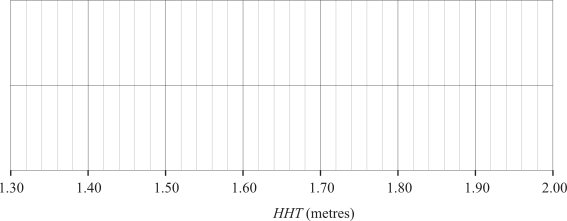
Data was collected to investigate the behaviour of tides in Sydney Harbour. There are usually two high tides and two low tides each day. The variables in this study were: Table 1 displays the data collected for a sample of 14 consecutive days in February 2021. Table 1 \begin{array}{|c|c|c|} --- 2 WORK AREA LINES (style=lined) --- --- 2 WORK AREA LINES (style=lined) --- --- 0 WORK AREA LINES (style=lined) --- \begin{array}{|c|c|c|c|c|} --- 4 WORK AREA LINES (style=lined) --- --- 0 WORK AREA LINES (style=lined) --- a.i. \(\text{Mean = 1.6}\) a.ii. \(\text{Std dev = 0.185}\) b. c. \(IQR (LLT) = 0.65-0.39=0.26\) \(\text{Lower fence}\ =Q_1-1.5 \times IQR = 0.39-1.5 \times o.26=0\) \(\text{Since 0.22 > 0, 0.22 is not an outlier.}\) d. \(HHT = 2.130 + (-1.054) \times LLT\) a.i. \(\text{Mean = 1.6}\) a.ii. \(\text{Std dev = 0.185}\) b. \(\text{Order \(HHT\) data:}\) \(1.42, 1.42, 1.42, [1.42], 1,44, 1.47, 1.55 | 1.55, 1.64, 1.65, [1.74],\) \(1.83, 1.90, 1.92\) \(\text{High = 1.92, Low = 1.42, \(Q_1=1.42, Q_3=1.74\), Median = 1.55}\) \(\text{Lower fence}\ =Q_1-1.5 \times IQR = 0.39-1.5 \times 0.26=0\) \(\text{Since 0.22 > 0, 0.22 is not an outlier.}\) d. \(HHT\ \text{is the response \((y)\) variable.}\) \(\text{By CAS:}\) \(HHT = 2.130 + (-1.054) \times LLT\)
\hline
\rule{0pt}{2.5ex}\ \ \ \textit{Day}\ \ \ \rule[-1ex]{0pt}{0pt}& \textit{LLT (m)} & \textit{HHT (m)}\\
\hline \rule{0pt}{2.5ex}1 \rule[-1ex]{0pt}{0pt}& 0.43 & 1.65 \\
\hline \rule{0pt}{2.5ex}2 \rule[-1ex]{0pt}{0pt}& 0.49 & 1.55 \\
\hline \rule{0pt}{2.5ex}3 \rule[-1ex]{0pt}{0pt}& 0.55 & 1.44 \\
\hline \rule{0pt}{2.5ex}4 \rule[-1ex]{0pt}{0pt}& 0.61 & 1.42 \\
\hline \rule{0pt}{2.5ex}5 \rule[-1ex]{0pt}{0pt}& 0.68 & 1.42 \\
\hline \rule{0pt}{2.5ex}6 \rule[-1ex]{0pt}{0pt}& 0.73 & 1.42 \\
\hline \rule{0pt}{2.5ex}7 \rule[-1ex]{0pt}{0pt}& 0.72 & 1.42 \\
\hline \rule{0pt}{2.5ex}8 \rule[-1ex]{0pt}{0pt}& 0.65 & 1.47 \\
\hline \rule{0pt}{2.5ex}9 \rule[-1ex]{0pt}{0pt}& 0.57 & 1.55 \\
\hline \rule{0pt}{2.5ex}10 \rule[-1ex]{0pt}{0pt}& 0.48 & 1.64 \\
\hline \rule{0pt}{2.5ex}11 \rule[-1ex]{0pt}{0pt}& 0.39 & 1.74 \\
\hline \rule{0pt}{2.5ex}12 \rule[-1ex]{0pt}{0pt}& 0.30 & 1.83 \\
\hline \rule{0pt}{2.5ex}13 \rule[-1ex]{0pt}{0pt}& 0.25 & 1.90 \\
\hline \rule{0pt}{2.5ex}14 \rule[-1ex]{0pt}{0pt}& 0.22 & 1.92 \\
\hline
\end{array}
\hline \rule{0pt}{2.5ex}\textbf{Minimum} \rule[-1ex]{0pt}{0pt}& \ \ \textbf{Q1} \ \ & \textbf{Median} & \ \ \textbf{Q3} \ \ & \textbf{Maximum} \\
\hline \rule{0pt}{2.5ex}0.22 \rule[-1ex]{0pt}{0pt}& 0.39 & 0.52 & 0.65 & 0.73 \\
\hline
\end{array}


c. \(IQR (LLT) = 0.65-0.39=0.26\)
Data Analysis, GEN1 2024 NHT 3 MC
The dot plot below displays the number of errors made in a test, for a sample of 15 students.

The mean and standard deviation for the number of errors are closest to
- mean \(=2.60 \quad\) standard deviation \(=7.47\)
- mean \(=2.70 \quad\) standard deviation \(=7.47\)
- mean \(=8.00 \quad\) standard deviation \(=3.00\)
- mean \(=7.47 \quad\) standard deviation \(=2.60\)
- mean \(=7.47 \quad\) standard deviation \(=2.70\)
Data Analysis, GEN1 2024 VCAA 13-14 MC
A school runs an orientation program for new staff each January.
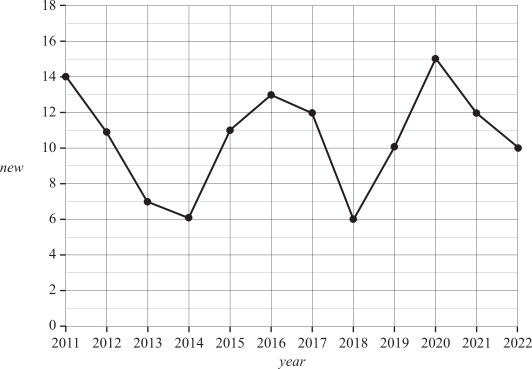
The time series plot below shows the number of new staff, new, for each year, year, from 2011 to 2022 (inclusive).
Part 1
The time series is smoothed using seven-median smoothing.
The smoothed value of new for the year 2016 is
- 10
- 11
- 12
- 13
Part 2
The number of new staff in 2023 is added to the total number of new staff from the previous 12 years.
For these 13 years, the mean number of new staff is 11 .
The number of new staff in 2023 is
- 11
- 16
- 17
- 19
Data Analysis, GEN1 2022 VCAA 4 MC
The age, in years, of a sample of 14 possums is displayed in the dot plot below.
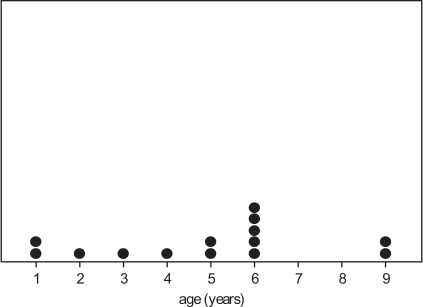
The mean and the standard deviation of age for this sample of possums are closest to
- mean = 4.25 standard deviation = 2.6
- mean = 4.8 standard deviation = 2.4
- mean = 4.8 standard deviation = 2.5
- mean = 4.9 standard deviation = 2.4
- mean = 4.9 standard deviation = 2.5
Data Analysis, GEN2 2023 VCAA 1
Data was collected to investigate the use of electronic images to automate the sizing of oysters for sale. The variables in this study were: The data collected for a sample of 15 oysters is displayed in the table. --- 1 WORK AREA LINES (style=lined) --- --- 1 WORK AREA LINES (style=lined) --- --- 1 WORK AREA LINES (style=lined) --- --- 1 WORK AREA LINES (style=lined) --- --- 0 WORK AREA LINES (style=lined) --- --- 4 WORK AREA LINES (style=lined) --- --- 4 WORK AREA LINES (style=lined) ---
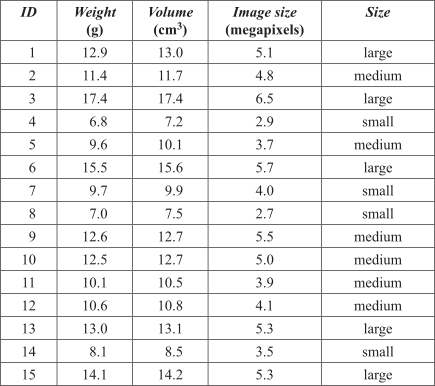
the median weight of the large oysters in this sample. (1 mark)
Complete the following sentence by filling in the blank space provided. (1 mark)
This equation predicts that, on average, each 10 g increase in the weight of an oyster is associated with a ________________ cm³ increase in its volume.
Data Analysis, GEN1 2023 VCAA 3 MC
Gemma’s favourite online word puzzle allows her 12 attempts to guess a mystery word. Her number of attempts for the last five days is displayed in the table below.
\begin{array} {|c|c|}
\hline
\rule{0pt}{2.5ex} \textbf{Day} \rule[-1ex]{0pt}{0pt} & \textbf{Number of attempts} \\
\hline
\rule{0pt}{2.5ex} 1 \rule[-1ex]{0pt}{0pt} & 8 \\
\hline
\rule{0pt}{2.5ex} 2 \rule[-1ex]{0pt}{0pt} & 11 \\
\hline
\rule{0pt}{2.5ex} 3 \rule[-1ex]{0pt}{0pt} & 5 \\
\hline
\rule{0pt}{2.5ex} 4 \rule[-1ex]{0pt}{0pt} & 6 \\
\hline
\rule{0pt}{2.5ex} 5 \rule[-1ex]{0pt}{0pt} & 9 \\
\hline
\end{array}
On day six, how many attempts can she make so that the mean number of attempts for these six days is exactly eight?
- 5
- 6
- 7
- 8
- 9
CORE, FUR2 2021 VCAA 1
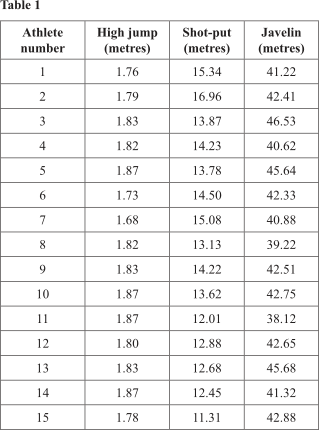
In the sport of heptathlon, athletes compete in seven events. These events are the 100 m hurdles, high jump, shot-put, javelin, 200 m run, 800 m run and long jump. Fifteen female athletes competed to qualify for the heptathlon at the Olympic Games. Their results for three of the heptathlon events – high jump, shot-put and javelin – are shown in Table 1 --- 2 WORK AREA LINES (style=lined) --- --- 0 WORK AREA LINES (style=lined) ---
--- 3 WORK AREA LINES (style=lined) --- --- 2 WORK AREA LINES (style=lined) --- --- 2 WORK AREA LINES (style=lined) --- --- 5 WORK AREA LINES (style=lined) ---
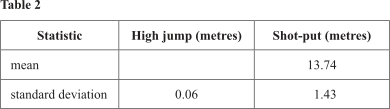
Use the 68–95–99.7% rule to calculate the percentage of athletes who would be expected to jump higher than Chara in the qualifying competition. (1 mark)
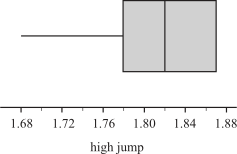
The boxplot below was constructed to show the distribution of high jump heights for all 15 athletes in the qualifying competition.
CORE, FUR1 2020 VCAA 1-3 MC
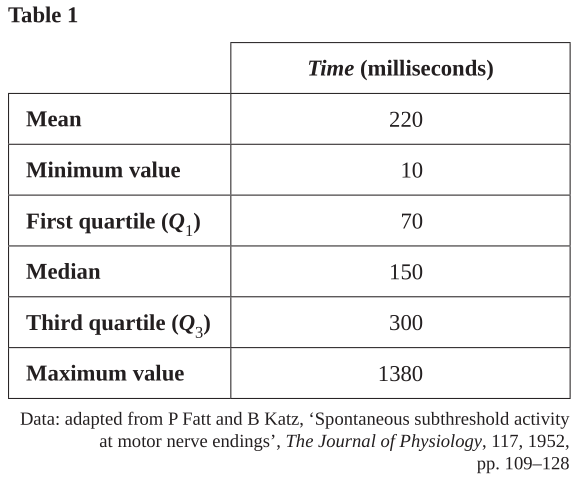
The times between successive nerve impulses (time), in milliseconds, were recorded.
Table 1 shows the mean and the five-number summary calculated using 800 recorded data values.
Part 1
The difference, in milliseconds, between the mean time and the median time is
- 10
- 70
- 150
- 220
- 230
Part 2
Of these 800 times, the number of times that are longer than 300 milliseconds is closest to
- 20
- 25
- 75
- 200
- 400
Part 3
The shape of the distribution of these 800 times is best described as
- approximately symmetric.
- positively skewed.
- positively skewed with one or more outliers.
- negatively skewed.
- negatively skewed with one or more outliers.
Data Analysis, GEN2 2019 NHT 1
The table below displays the average sleep time, in hours, for a sample of 19 types of mammals.
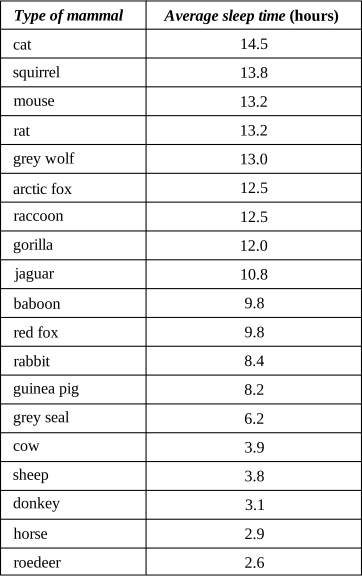
- Which of the two variables, type of mammal or average sleep time, is a nominal variable? (1 mark)
--- 1 WORK AREA LINES (style=lined) ---
- Determine the mean and standard deviation of the variable average sleep time for this sample of mammals.
- Round your answer to one decimal place. (1 mark)
--- 2 WORK AREA LINES (style=lined) ---
- The average sleep time for a human is eight hours.
- What percentage of this sample of mammals has an average sleep time that is less than the average sleep time for a human.
- Round your answer to one decimal place. (1 mark)
--- 2 WORK AREA LINES (style=lined) ---
- The sample is increase in size by adding in the average sleep time of the little brown bat.
- Its average sleep time is 19.9 hours.
- By how many many hours will the range for average sleep time increase when the average sleep time for the little brown bat is added to the sample? (1 mark)
--- 2 WORK AREA LINES (style=lined) ---
Data Analysis, GEN1 2019 NHT 3 MC
The total birth weight of a sample of 12 babies is 39.0 kg.
The mean birth weight of these babies, in kilograms, is
- 2.50
- 2.75
- 3.00
- 3.25
- 3.50
CORE, FUR1 2015 VCAA 3 MC
The dot plot below displays the difference between female and male life expectancy, in years, for a sample of 20 countries.

The mean (`barx`) and standard deviation (`s`) for this data are
| A. `text(mean)\ = 2.32` | `\ \ \ \ \ text(standard deviation)\ = 5.25` |
| B. `text(mean)\ = 2.38` | `\ \ \ \ \ text(standard deviation)\ = 5.25` |
| C. `text(mean)\ = 5.0` | `\ \ \ \ \ text(standard deviation)\ = 2.0` |
| D. `text(mean)\ = 5.25` | `\ \ \ \ \ text(standard deviation)\ = 2.32` |
| E. `text(mean)\ = 5.25` | `\ \ \ \ \ text(standard deviation)\ = 2.38` |
CORE, FUR1 2015 VCAA 2 MC
For an ordered set of data containing an odd number of values, the middle value is always
A. the mean.
B. the median.
C. the mode.
D. the mean and the median.
E. the mean, the median and the mode.
CORE, FUR1 2011 VCAA 6-8 MC
When blood pressure is measured, both the systolic (or maximum) pressure and the diastolic (or minimum) pressure are recorded.
Table 1 displays the blood pressure readings, in mmHg, that result from fifteen successive measurements of the same person's blood pressure.

Part 1
Correct to one decimal place, the mean and standard deviation of this person's systolic blood pressure measurements are respectively
A. `124.9 and 4.4`
B. `125.0 and 5.8`
C. `125.0 and 6.0`
D. `125.9 and 5.8`
E. `125.9 and 6.0`
Part 2
Using systolic blood pressure (systolic) as the response variable, and diastolic blood pressure (diastolic) as the explanatory variable, a least squares regression line is fitted to the data in Table 1.
The equation of the least squares regression line is closest to
A. `text(systolic) = 70.3 + 0.790 xx text(diastolic)`
B. `text(diastolic) = 70.3 + 0.790 xx text(systolic)`
C. `text(systolic) = 29.3 + 0.330 xx text(diastolic)`
D. `text(diastolic) = 0.330 + 29.3 xx text(systolic)`
E. `text(systolic) = 0.790 + 70.3 xx text(diastolic)`
Part 3
From the fifteen blood pressure measurements for this person, it can be concluded that the percentage of the variation in systolic blood pressure that is explained by the variation in diastolic blood pressure is closest to
A. `25.8text(%)`
B. `50.8text(%)`
C. `55.4text(%)`
D. `71.9text(%)`
E. `79.0text(%)`
CORE, FUR1 2008 VCAA 5 MC
A sample of 14 people were asked to indicate the time (in hours) they had spent watching television on the previous night. The results are displayed in the dot plot below.

Correct to one decimal place, the mean and standard deviation of these times are respectively
A. `bar x=2.0\ \ \ \ \ s=1.5`
B. `bar x=2.1\ \ \ \ \ s=1.5`
C. `bar x=2.1\ \ \ \ \ s=1.6`
D. `bar x=2.6\ \ \ \ \ s=1.2`
E. `bar x=2.6\ \ \ \ \ s=1.3`
CORE, FUR1 2014 VCAA 3-5 MC
The following table shows the data collected from a sample of seven drivers who entered a supermarket car park. The variables in the table are:
distance – the distance that each driver travelled to the supermarket from their home
-
- sex – the sex of the driver (female, male)
- number of children – the number of children in the car
- type of car – the type of car (sedan, wagon, other)
- postcode – the postcode of the driver’s home.

Part 1
The mean, `barx`, and the standard deviation, `s_x`, of the variable, distance, are closest to
A. `barx = 2.5\ \ \ \ \ \ \s_x = 3.3`
B. `barx = 2.8\ \ \ \ \ \ \s_x = 1.7`
C. `barx = 2.8\ \ \ \ \ \ \s_x = 1.8`
D. `barx = 2.9\ \ \ \ \ \ \s_x = 1.7`
E. `barx = 3.3\ \ \ \ \ \ \s_x = 2.5`
Part 2
The number of categorical variables in this data set is
A. `0`
B. `1`
C. `2`
D. `3`
E. `4`
Part 3
The number of female drivers with three children in the car is
A. `0`
B. `1`
C. `2`
D. `3`
E. `4`
CORE, FUR1 2012 VCAA 3 MC
The total weight of nine oranges is 1.53 kg.
Using this information, the mean weight of an orange would be calculated to be closest to
A. 115 g
B. 138 g
C. 153 g
D. 162 g
E. 170 g