SmarterEd

Aussie Maths & Science Teachers: Save your time with SmarterEd

  • Login
  • Get Help
  • About

Probability, SMB-014

Students studying vocational education courses were surveyed about their living arrangements.
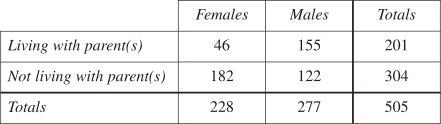
  

  1. One of these students is selected at random. What is the probability, correct to the nearest percentage, that this student is male and living with his parent(s)?   (2 marks)

    --- 4 WORK AREA LINES (style=lined) ---

  2. A female student is selected. What is the probability that she is not living with her parent(s)?   (2 marks)

    --- 4 WORK AREA LINES (style=lined) ---
Show Answers Only
  1.  `\text{31%}`
  2. `91/114`
Show Worked Solution

i.     `text{Number of males living with parents = 155}`

`text{Total students surveyed = 505}`

`P\text{(male and living with parents)}` `=155/505`  
  `=0.3069…`  
  `=31\text{%  (nearest %)}`  

 
ii. 
  `text{Number of females = 228}`

`text{Females not living with parents = 182}`

`P\text{(selected female not living with parents)} = 182/228 = 91/114`

Filed Under: Relative Frequency and Venn Diagrams Tagged With: num-title-ct-pathb, smc-4815-10-2-Way tables, smc-4815-50-Conditional probability

Probability, SMB-013

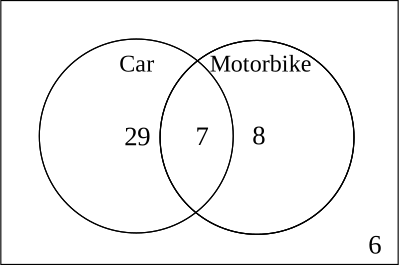
A group of coalminers were surveyed about what registered vehicles they own.

They were surveyed on whether they own a car, a motorbike, both or neither and the results were recorded in the Venn diagram below.
 

Record this information in the partially completed 2-way table below.    (2 marks)

\begin{array} {|l|c|c|}
\hline
\rule{0pt}{2.5ex} &\ \ \ \text{Car}\ \ \ \rule[-1ex]{0pt}{0pt} & \text{No Car}\\
\hline
\rule{0pt}{2.5ex}\text{Motorbike}\rule[-1ex]{0pt}{0pt} &  &  8 \\
\hline
\rule{0pt}{2.5ex}\text{No Motorbike}\rule[-1ex]{0pt}{0pt} &  &  \\
\hline
\end{array}

--- 0 WORK AREA LINES (style=lined) ---

Show Answers Only

\begin{array} {|l|c|c|}
\hline
\rule{0pt}{2.5ex} &\ \ \ \text{Car}\ \ \ \rule[-1ex]{0pt}{0pt} & \text{No Car}\\
\hline
\rule{0pt}{2.5ex}\text{Motorbike}\rule[-1ex]{0pt}{0pt} & 7 &  8 \\
\hline
\rule{0pt}{2.5ex}\text{No Motorbike}\rule[-1ex]{0pt}{0pt} & 29 & 6 \\
\hline
\end{array}

Show Worked Solution

\begin{array} {|l|c|c|}
\hline
\rule{0pt}{2.5ex} &\ \ \ \text{Car}\ \ \ \rule[-1ex]{0pt}{0pt} & \text{No Car}\\
\hline
\rule{0pt}{2.5ex}\text{Motorbike}\rule[-1ex]{0pt}{0pt} & 7 &  8 \\
\hline
\rule{0pt}{2.5ex}\text{No Motorbike}\rule[-1ex]{0pt}{0pt} & 29 & 6 \\
\hline
\end{array}

Filed Under: Relative Frequency and Venn Diagrams Tagged With: num-title-ct-pathb, smc-4815-10-2-Way tables, smc-4815-30-Venn diagrams

Probability, SMB-012

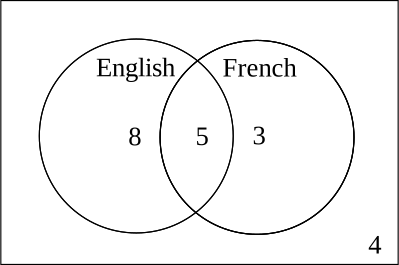
A group of 20 museum visitors were surveyed about what languages they could speak fluently.

They were surveyed on whether they could speak English or French and the results were recorded in the Venn diagram below.
 

Record this information in the partially completed 2-way table below.    (2 marks)

\begin{array} {|l|c|c|}
\hline
\rule{0pt}{2.5ex} & \text{English}\rule[-1ex]{0pt}{0pt} & \text{No English}\\
\hline
\rule{0pt}{2.5ex}\text{French}\rule[-1ex]{0pt}{0pt} &  &  \\
\hline
\rule{0pt}{2.5ex}\text{No French}\rule[-1ex]{0pt}{0pt} & 8 &  \\
\hline
\end{array}

--- 0 WORK AREA LINES (style=lined) ---

Show Answers Only

\begin{array} {|l|c|c|}
\hline
\rule{0pt}{2.5ex} & \text{English}\rule[-1ex]{0pt}{0pt} & \text{No English}\\
\hline
\rule{0pt}{2.5ex}\text{French}\rule[-1ex]{0pt}{0pt} & 5 & 3 \\
\hline
\rule{0pt}{2.5ex}\text{No French}\rule[-1ex]{0pt}{0pt} & 8 & 4 \\
\hline
\end{array}

Show Worked Solution

\begin{array} {|l|c|c|}
\hline
\rule{0pt}{2.5ex} & \text{English}\rule[-1ex]{0pt}{0pt} & \text{No English}\\
\hline
\rule{0pt}{2.5ex}\text{French}\rule[-1ex]{0pt}{0pt} & 5 & 3 \\
\hline
\rule{0pt}{2.5ex}\text{No French}\rule[-1ex]{0pt}{0pt} & 8 & 4 \\
\hline
\end{array}

Filed Under: Relative Frequency and Venn Diagrams Tagged With: num-title-ct-pathb, smc-4815-10-2-Way tables, smc-4815-30-Venn diagrams

Probability, SMB-011

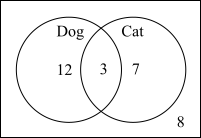
A class of 30 students were surveyed about their pets. They were asked whether they owned a dog, cat, both or neither and the results were recorded in the Venn diagram below.
 

Record this information in the partially completed 2-way table below.    (2 marks)

\begin{array} {|l|c|c|}
\hline
\rule{0pt}{2.5ex} &\ \ \ \text{Dog}\ \ \ \rule[-1ex]{0pt}{0pt} & \text{No Dog}\\
\hline
\rule{0pt}{2.5ex}\text{Cat}\rule[-1ex]{0pt}{0pt} &  &  \\
\hline
\rule{0pt}{2.5ex}\text{No Cat}\rule[-1ex]{0pt}{0pt} &  & 8\\
\hline
\end{array}

--- 0 WORK AREA LINES (style=lined) ---

Show Answers Only

\begin{array} {|l|c|c|}
\hline
\rule{0pt}{2.5ex} &\ \ \ \text{Dog}\ \ \ \rule[-1ex]{0pt}{0pt} & \text{No Dog}\\
\hline
\rule{0pt}{2.5ex}\text{Cat}\rule[-1ex]{0pt}{0pt} & 3 & 7 \\
\hline
\rule{0pt}{2.5ex}\text{No Cat}\rule[-1ex]{0pt}{0pt} & 12 & 8\\
\hline
\end{array}

Show Worked Solution

\begin{array} {|l|c|c|}
\hline
\rule{0pt}{2.5ex} &\ \ \ \text{Dog}\ \ \ \rule[-1ex]{0pt}{0pt} & \text{No Dog}\\
\hline
\rule{0pt}{2.5ex}\text{Cat}\rule[-1ex]{0pt}{0pt} & 3 & 7 \\
\hline
\rule{0pt}{2.5ex}\text{No Cat}\rule[-1ex]{0pt}{0pt} & 12 & 8\\
\hline
\end{array}

Filed Under: Relative Frequency and Venn Diagrams Tagged With: num-title-ct-pathb, smc-4815-10-2-Way tables, smc-4815-30-Venn diagrams

Probability, SMB-007

Some men and women were surveyed at a football game. They were asked which team they supported. The results are shown in the two-way table.

\begin{array} {|l|c|c|c|}
\hline
\rule{0pt}{2.5ex} &\ \textit{Team A }\ \rule[-1ex]{0pt}{0pt} &\ \textit{Team B}\ \ &\ \textit{Totals}\ \ \\
\hline
\rule{0pt}{2.5ex}\text{Men}\rule[-1ex]{0pt}{0pt} & 125 &  100 &  225 \\
\hline
\rule{0pt}{2.5ex}\text{Women}\rule[-1ex]{0pt}{0pt} & 75 & 90 & 165 \\
\hline
\rule{0pt}{2.5ex}\text{Totals}\rule[-1ex]{0pt}{0pt} & 200 & 190 & 390 \\
\hline
\end{array}

A man was chosen at random. What is the probability that he supports Team B, correct to the nearest percent?   (2 marks)

--- 4 WORK AREA LINES (style=lined) ---
Show Answers Only

`44%`

Show Worked Solution

`text{Total number of men}\ = 225`

`text{Number of men who support Team B}\ = 100`

`P(\text{chosen man supports Team B})`

`=100/225`

`=4/9`

`=44%\ \text{(nearest %)}`

Filed Under: Relative Frequency and Venn Diagrams Tagged With: num-title-ct-pathb, smc-4815-10-2-Way tables, smc-4815-50-Conditional probability

Probability, SMB-002 MC

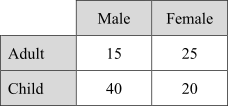
The table below shows all the people at Angus' birthday party.
 

What fraction of the children at the party are female?

  1. `20/60`
  2. `45/60`
  3. `20/100`
  4. `45/100`
Show Answers Only

`A`

Show Worked Solution

`text(Fraction of the children that are female)`

`= text(Female Children) / text(Total Children)`

`=20/60`
 

`=>A`

Filed Under: Relative Frequency and Venn Diagrams Tagged With: num-title-ct-pathb, smc-4815-10-2-Way tables

Probability, SMB-001

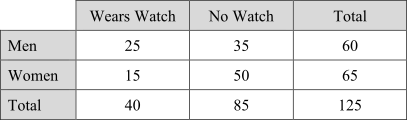
A group of 125 people were asked if they wear a watch or not.

This table shows the results.


A man was selected at random.

What is the exact probability that he wears a watch?   (2 marks)

--- 4 WORK AREA LINES (style=lined) ---
Show Answers Only

`5/12` 

Show Worked Solution

`P(text(man chosen wears watch))`

`= text(number of men wearing watch)/text(total men)`

`= 25/60`

`= 5/12`

Filed Under: Relative Frequency and Venn Diagrams Tagged With: num-title-ct-pathb, smc-4815-10-2-Way tables

Probability, STD2 S2 2016 HSC 23 MC

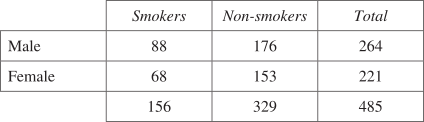
A group of 485 people was surveyed. The people were asked whether or not they smoke. The results are recorded in the table.
 

A person is selected at random from the group.

What is the approximate probability that the person selected is a smoker OR is male?

  1. 33%
  2. 18%
  3. 68%
  4. 87%
Show Answers Only

`=> C`

Show Worked Solution

`P(text(Smoker or a male))`

`= (text(Total males + female smokers))/(text(Total surveyed))`

`= (264 + 68)/485`

`= 0.684…`
 

`=> C`

♦♦ Mean mark 34%.

Filed Under: Relative Frequency, Relative Frequency (Std 1), Relative Frequency (Std 2), Relative Frequency (Y11), Relative Frequency and Venn Diagrams Tagged With: Band 6, common-content, num-title-ct-pathb, num-title-qs-hsc, smc-1133-10-Surveys/Two-Way Tables, smc-4815-10-2-Way tables, smc-4815-50-Conditional probability, smc-827-10-Surveys/Two-Way Tables, smc-990-10-Surveys/Two-Way Tables

Probability, STD2 S2 2006 HSC 26c

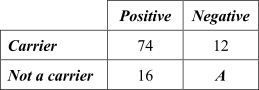
A new test has been developed for determining whether or not people are carriers of the Gaussian virus.

Two hundred people are tested. A two-way table is being used to record the results.
 

  1.  What is the value of  `A`?  (1 mark)

    --- 1 WORK AREA LINES (style=lined) ---

  2.  A person selected from the tested group is a carrier of the virus.


     What is the probability that the test results would show this?  (2 marks) 

    --- 4 WORK AREA LINES (style=lined) ---
  3.  For how many of the people tested were their test results inaccurate?  (1 mark)

    --- 2 WORK AREA LINES (style=lined) ---

Show Answers Only
  1. `98`
  2. `37/43`
  3. `28`
Show Worked Solution
i.  `A` `= 200-(74 + 12 + 16)`
  `= 98`


ii.  `P` `= text(# Positive carriers)/text(Total carriers)`
  `= 74/86`
  `= 37/43`


iii.  `text(# People with inaccurate results)`

`= 12 + 16`

`= 28`

Filed Under: Relative Frequency, Relative Frequency (Std 1), Relative Frequency (Std 2), Relative Frequency (Y11), Relative Frequency and Venn Diagrams Tagged With: Band 3, Band 4, common-content, num-title-ct-pathb, num-title-qs-hsc, smc-1133-10-Surveys/Two-Way Tables, smc-4815-10-2-Way tables, smc-827-10-Surveys/Two-Way Tables, smc-990-10-Surveys/Two-Way Tables

Probability, STD2 S2 2005 HSC 16 MC

On a television game show, viewers voted for their favourite contestant. The results were recorded in the two-way table.

\begin{array} {|l|c|c|}
\hline
\rule{0pt}{2.5ex} \rule[-1ex]{0pt}{0pt} & \textbf{Male viewers} & \textbf{Female viewers} \\
\hline
\rule{0pt}{2.5ex}\textbf{Contestant 1}\rule[-1ex]{0pt}{0pt} & 1372 & 3915\\
\hline
\rule{0pt}{2.5ex}\textbf{Contestant 2}\rule[-1ex]{0pt}{0pt} & 2054 & 3269\\
\hline
\end{array}

One male viewer was selected at random from all of the male viewers.

What is the probability that he voted for Contestant 1?

  1. `1372/(10\ 610)`
  2. `1372/5287`
  3. `1372/3426`
  4. `1372/2054`
Show Answers Only

`C`

Show Worked Solution

`text(Total male viewers)\ = 1372 + 2054= 3426`

  
`P\ text{(Male viewer chosen voted for C1)}`

`= text(Males who voted for C1)/text(Total male viewers)`

`= 1372/3426`
 

`=>  C`

Filed Under: Relative Frequency, Relative Frequency (Std 1), Relative Frequency (Std 2), Relative Frequency (Y11), Relative Frequency and Venn Diagrams Tagged With: Band 4, common-content, num-title-ct-pathb, num-title-qs-hsc, smc-1133-10-Surveys/Two-Way Tables, smc-4815-10-2-Way tables, smc-4815-50-Conditional probability, smc-827-10-Surveys/Two-Way Tables, smc-990-10-Surveys/Two-Way Tables

Probability, STD2 S2 2004 HSC 25c

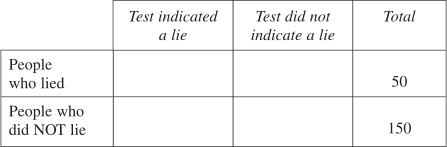
Lie detector tests are not always accurate. A lie detector test was administered to 200 people.

The results were:

• 50 people lied. Of these, the test indicated that 40 had lied;
• 150 people did NOT lie. Of these, the test indicated that 20 had lied.

  1. Complete the table using the information above   (2 marks)


    --- 0 WORK AREA LINES (style=lined) ---

  2. For how many of the people tested was the lie detector test accurate?   (1 mark)

    --- 2 WORK AREA LINES (style=lined) ---

  3. For what percentage of the people tested was the test accurate?   (1 mark)

    --- 2 WORK AREA LINES (style=lined) ---

  4. What is the probability that the test indicated a lie for a person who did NOT lie?   (1 mark)

    --- 2 WORK AREA LINES (style=lined) ---

Show Answers Only
  1. `text(See Worked Solutions)`
  2. `170`
  3. `text(85%)`
  4. `2/15`
Show Worked Solution

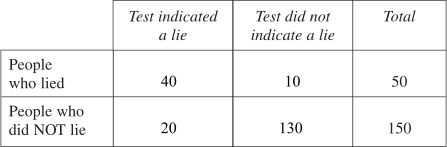
i.

ii.  `text(# Accurate readings)`

`= 40 + 130`

`= 170`
 

iii.  `text(Percentage of people with accurate readings)`

`= text(# Accurate readings)/text(Total readings) xx 100`

`= 170/200`

`= 85 text(%)`
 

iv.  `text{P(lie detected when NOT a lie)}`

`= 20/150`

`= 2/15`

Filed Under: Relative Frequency, Relative Frequency (Std 1), Relative Frequency (Std 2), Relative Frequency (Y11), Relative Frequency and Venn Diagrams Tagged With: Band 4, Band 5, common-content, num-title-ct-pathb, num-title-qs-hsc, smc-1133-10-Surveys/Two-Way Tables, smc-4815-10-2-Way tables, smc-827-10-Surveys/Two-Way Tables, smc-990-10-Surveys/Two-Way Tables

Probability, STD2 S2 2007 HSC 16 MC

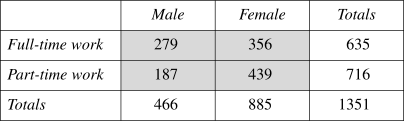
Leanne copied a two-way table into her book.


Leanne made an error in copying one of the values in the shaded section of the table.

Which value has been incorrectly copied?

  1. The number of males in full-time work
  2. The number of males in part-time work
  3. The number of females in full-time work
  4. The number of females in part-time work
Show Answers Only

`D`

Show Worked Solution

`text(By checking row and column total, the number)`

`text(of females part-time work is incorrect)`

`=>  D`

Filed Under: Relative Frequency (Std 1), Relative Frequency (Std 2), Relative Frequency (Y11), Relative Frequency and Venn Diagrams, Summary Statistics (no graph) Tagged With: Band 4, common-content, num-title-ct-pathb, num-title-qs-hsc, smc-1133-10-Surveys/Two-Way Tables, smc-4815-10-2-Way tables, smc-827-10-Surveys/Two-Way Tables, smc-990-10-Surveys/Two-Way Tables

Probability, STD2 S2 2008 HSC 26a

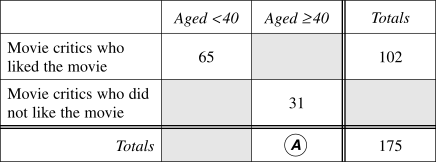
Cecil invited 175 movie critics to preview his new movie. After seeing the movie, he conducted a survey. Cecil has almost completed the two-way table.
 

  1. Determine the value of  `A`.   (1 mark)

    --- 1 WORK AREA LINES (style=lined) ---

  2. A movie critic is selected at random.


    What is the probability that the critic was less than 40 years old and did not like the movie?  (2 marks)

    --- 4 WORK AREA LINES (style=lined) ---
  3. Cecil believes that his movie will be a box office success if 65% of the critics who were surveyed liked the movie.


    Will this movie be considered a box office success? Justify your answer.  (1 mark)

    --- 2 WORK AREA LINES (style=lined) ---
Show Answers Only
  1. `58`
  2. `6/25`
  3. `text(Proof)\ \ text{(See Worked Solutions)}`
Show Worked Solution

i.  `text{Critics liked and}\ >= 40`

`= 102-65`

`= 37`

`:. A = 37+31=68`

 
ii.
  `text{Critics did not like and < 40}`

`= 175-65-37-31`

`= 42`
 

`:.\ P text{(not like and  < 40)}`

`= 42/175`

`= 6/25`
 

iii.   `text(Critics liked) = 102`

`text(% Critics liked)` `= 102/175 xx 100`
  `= 58.28…%`

 
`:.\ text{Movie NOT a box office success (< 65% critics liked)}`

Filed Under: Relative Frequency, Relative Frequency (Std 1), Relative Frequency (Std 2), Relative Frequency (Y11), Relative Frequency and Venn Diagrams Tagged With: Band 3, Band 4, common-content, num-title-ct-pathb, num-title-qs-hsc, smc-1133-10-Surveys/Two-Way Tables, smc-4815-10-2-Way tables, smc-827-10-Surveys/Two-Way Tables, smc-990-10-Surveys/Two-Way Tables

Probability, STD2 S2 2014 HSC 8 MC

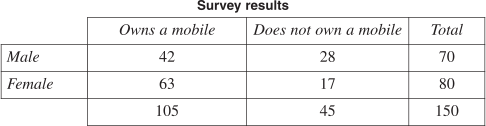
A group of 150 people was surveyed and the results recorded.
  

A person is selected at random from the surveyed group. 

What is the probability that the person selected is a male who does not own a mobile?

  1. `28/150`
  2. `45/150` 
  3. `28/70` 
  4. `45/70` 
Show Answers Only

`A`

Show Worked Solution
`P` `= text(number of males without mobile)/text(number in group)`
  `= 28/150`

 
`=>  A`

Filed Under: Relative Frequency, Relative Frequency (Std 1), Relative Frequency (Std 2), Relative Frequency and Venn Diagrams Tagged With: Band 3, common-content, num-title-ct-pathb, num-title-qs-hsc, smc-1133-10-Surveys/Two-Way Tables, smc-4815-10-2-Way tables, smc-827-10-Surveys/Two-Way Tables

Copyright © 2014–2025 SmarterEd.com.au · Log in