SmarterEd

Aussie Maths & Science Teachers: Save your time with SmarterEd

  • Login
  • Get Help
  • About

Calculus, 2ADV C4 2022 HSC 29

  1. The diagram shows the graph of  `y=2^{-x}`. Also shown on the diagram are the first 5 of an infinite number of rectangular strips of width 1 unit and height  `y=2^{-x}`  for non-negative integer values of `x`. For example, the second rectangle shown has width 1 and height `(1)/(2)`. 


  1. The sum of the areas of the rectangles forms a geometric series.
  2. Show that the limiting sum of this series is 2. (1 mark)

    --- 2 WORK AREA LINES (style=lined) ---

  3. Show that `int_(0)^(4)2^(-x)\ dx=(15)/(16 ln 2)`.  (2 marks)

    --- 5 WORK AREA LINES (style=lined) ---

  4. Use parts (a) and (b) to show that  `e^(15) < 2^(32)`.  (2 marks)

    --- 4 WORK AREA LINES (style=lined) ---

Show Answers Only
  1. `text{Proof (See Worked Solutions)}`
  2. `text{Proof (See Worked Solutions)}`
  3. `text{Proof (See Worked Solutions)}`
Show Worked Solution

a.   `text{Consider the rectangle heights:}`

`2^0=1, \ 2^(-1)=1/2, \ 2^(-2)= 1/4, \ 2^(-3)= 1/8, …`

`=>\ text{Rectangle Areas}\ = 1, \ 1/2, \  1/4, \ 1/8, …`

`a=1,\ \ r=1/2`

`S_oo=a/(1-r)=1/(1-1/2)=2\ \ text{… as required}`
 

b.   `text{Show}\ \ int_0^4 2^(-x)\ dx = 15/(16ln2)`

`int_0^4 2^(-x)\ dx ` `=(-1)/ln2[2^(-x)]_0^4`  
  `=(-1)/ln2(1/16-1)`  
  `=1/ln2-1/(16ln2)`  
  `=(16-1)/(16ln2)`  
  `=15/(16ln2)\ \ text{… as required}`  


Mean mark (b) 56%.

c.   `text{Show}\ \ e^15<2^32`

`text{Area under curve < Sum of rectangle areas}`

`15/(16ln2)` `<2`  
`15` `<32ln2`  
`15/32` `<ln2`  
`e^(15/32)` `<e^(ln2)`  
`root(32)(e^15)` `<2`  
`e^15` `<2^32\ \ text{… as required}`  

♦♦♦ Mean mark (c) 9%.

Filed Under: L&E Integration, Trapezium Rule and Newton, Trapezoidal Rule (Y12) Tagged With: Band 4, Band 6, smc-5145-04-Trapezium rule, smc-5145-30-Estimate comparison, smc-965-40-Definite Integrals, smc-976-30-Estimate Comparison

Calculus, 2ADV C4 2013* HSC 15a

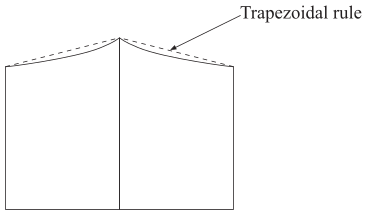
The diagram shows the front of a tent supported by three vertical poles. The poles are 1.2 m apart. The height of each outer pole is 1.5 m, and the height of the middle pole is 1.8 m. The roof hangs between the poles.

2013 15a

The front of the tent has area  `A\ text(m²)`. 

  1. Use the trapezoidal rule to estimate  `A`.    (1 mark)

    --- 2 WORK AREA LINES (style=lined) ---

  2. Does the Trapezoidal rule give a higher or lower estimate of the actual area? Justify your answer.  (1 mark)

    --- 2 WORK AREA LINES (style=lined) ---

Show Answers Only
  1. `3.96\ text(m²)`
  2. `text(See Worked Solutions)`
Show Worked Solution
i.    `A` `~~ h/2 [y_0 + 2y_1 + y_2]`
    `~~ 1.2/2 [1.5 + (2 xx 1.8) + 1.5]`
    `~~ 0.6 [6.6]`
    `~~ 3.96\ text(m²)`


ii.       

`text(S)text(ince the tent roof is concave up, the)`

`text(Trapezoidal rule uses straight lines and)`

`text(will estimate a higher area.)`

Filed Under: Trapezium Rule and Newton, Trapezoidal Rule (Y12) Tagged With: Band 3, Band 6, smc-5145-04-Trapezium rule, smc-5145-20-No table, smc-5145-30-Estimate comparison, smc-976-20-No Table, smc-976-30-Estimate Comparison

Calculus, 2ADV C4 2004* HSC 10a

  1. Use the Trapezoidal rule with 3 function values to find an approximation to the area under the curve  `y = 1/x`  between  `x = a ` and  `x = 3a`, where  `a`  is positive.  (2 marks)

    --- 4 WORK AREA LINES (style=lined) ---
  2. Using the result in part (i), show that  `ln 3 ≑ 7/6`.  (1 mark)

    --- 3 WORK AREA LINES (style=lined) ---

Show Answers Only
  1. `7/6`
  2. `text(Proof)\ \ text{(See Worked Solutions)}`
Show Worked Solution
i.   
`A` `~~ a/2[1/a + 2(1/(2a)) + 1/(3a)]`
  `~~ a/2(7/(3a))`
  `~~ 7/6`


ii.  `text{Area under the curve}\ \ y=1/x`

`= int_a^(3a) 1/x\ dx`

`= [ln x]_(\ a)^(3a)`

`= ln 3a − ln a`

`= ln\ (3a)/a`

`= ln 3`
 

`text{Trapezoidal rule in part (i) found the approximate}`

`text(value of the same area.)`

`:. ln 3 ≑ 7/6.`

Filed Under: Trapezium Rule and Newton, Trapezoidal Rule (Y12) Tagged With: Band 5, smc-5145-04-Trapezium rule, smc-5145-20-No table, smc-5145-30-Estimate comparison, smc-976-20-No Table, smc-976-30-Estimate Comparison

Calculus, 2ADV C4 2017* HSC 14b

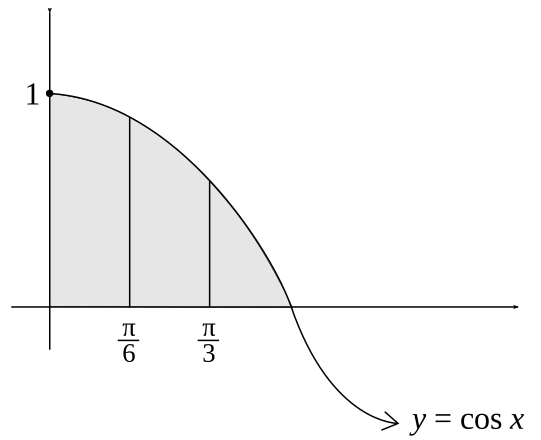
  1. Find the exact value of  `int_0^(pi/3) cos x\ dx`.  (1 mark)

    --- 2 WORK AREA LINES (style=lined) ---

  2. Using the Trapezoidal rule with three function values, find an approximation to the integral  `int_0^(pi/3) cos x\ dx,` leaving your answer in terms of `pi` and `sqrt 3`.  (2 marks)

    --- 4 WORK AREA LINES (style=lined) ---

  3. Using parts (i) and (ii), show that  `pi ~~ (12 sqrt 3)/(3 + 2 sqrt 3)`.  (1 mark)

    --- 2 WORK AREA LINES (style=lined) ---

Show Answers Only
  1. `sqrt 3/2`
  2. `((2sqrt3 + 3)pi)/24`
  3. `text{Proof (See Worked Solutions)}`
Show Worked Solution
i.   `int_0^(pi/3) cos x\ dx` `= [sin x]_0^(pi/3)`
    `= sin\ pi/3-0`
    `= sqrt 3/2`


ii.  

\begin{array} {|l|c|c|c|}\hline
x & \ \ \ 0\ \ \  & \ \ \ \dfrac{\pi}{6}\ \ \  & \ \ \ \dfrac{\pi}{3}\ \ \ \\ \hline
\text{height} & 1 & \dfrac{\sqrt{3}}{2} & \dfrac{1}{2} \\ \hline
\text{weight} & 1 & 2 & 1  \\ \hline \end{array}

`int_0^(pi/3) cos x\ dx` `~~ 1/2 xx pi/6[1 + 2(sqrt3/2) + 1/2]`
  `~~ pi/12((3 + 2sqrt3)/2)`
  `~~ ((3+2sqrt3)pi)/24`


♦ Mean mark part (iii) 49%.

(iii)    `((3+2sqrt3)pi)/24` `~~ sqrt3/2`
  `:. pi` `~~ (24sqrt3)/(2(3+2sqrt3))`
    `~~ (12sqrt3)/(3 + 2sqrt3)`

Filed Under: Trapezium Rule and Newton, Trapezoidal Rule (Y12) Tagged With: Band 3, Band 4, Band 5, smc-5145-04-Trapezium rule, smc-5145-20-No table, smc-5145-30-Estimate comparison, smc-976-20-No Table, smc-976-30-Estimate Comparison

Calculus, 2ADV C4 2016* HSC 14a

The diagram shows the cross-section of a tunnel and a proposed enlargement.

hsc-2016-14a

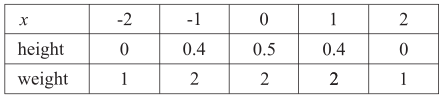
The heights, in metres, of the existing section at 1 metre intervals are shown in Table `A.`

hsc-2016-14ai

The heights, in metres, of the proposed enlargement are shown in Table `B.`

hsc-2016-14aii

Use the Trapezoidal rule with the measurements given to calculate the approximate increase in area.   (3 marks)

--- 6 WORK AREA LINES (style=lined) ---

Show Answers Only

`1.3\ text(m²)`

Show Worked Solution

`text(Consider the shaded area distances:)`

`A` `~~ 1/2[0 + 2(0.4 + 0.5 + 0.4) + 0]`
  `~~ 1/2(2.6)`
  `~~ 1.3\ text(m²)`

Filed Under: Trapezium Rule and Newton, Trapezoidal Rule (Y12) Tagged With: Band 3, smc-5145-04-Trapezium rule, smc-5145-10-Table provided, smc-5145-30-Estimate comparison, smc-976-10-Table provided, smc-976-30-Estimate Comparison

Calculus, 2ADV C4 2010 HSC 3b

  1. Sketch the curve  `y=lnx`.   (1 mark)

    --- 6 WORK AREA LINES (style=lined) ---
  2. Use the trapezoidal rule with 3 function values to find an approximation to `int_1^3 lnx\ dx`   (2 marks) 

    --- 5 WORK AREA LINES (style=lined) ---

  3. State whether the approximation found in part (ii) is greater than or less than the exact value of  `int_1^3 lnx\ dx`. Justify your answer.   (1 mark)

    --- 2 WORK AREA LINES (style=lined) ---

Show Answer Only
  1. `text(See Worked Solutions for sketch.)`
  2. `1.24\ \ text(u²)`
  3. `text(See Worked Solutions)`
Show Worked Solutions
i. 2010 3b image - Simpsons
MARKER’S COMMENT: Many students failed to illustrate important features in their graph such as the concavity, `x`-axis intercept and `y`-axis asymptote (this can be explicitly stated or made graphically clear).


ii.    `text(Area)` `~~h/2[f(1)+2xxf(2)+f(3)]`
  `~~1/2[0+2ln2+ln3]`
  `~~1/2[ln(2^2 xx3)]`
  `~~1/2ln12`
  `~~1.24\ \ text(u²)`    `text{(to 2 d.p.)}`


iii. 2010 13b image 2 - Simpsons


♦♦♦ Mean mark 12%.
MARKER’S COMMENT: Best responses commented on concavity and that the trapezia lay beneath the curve. Diagrams featured in the best responses.

`text(The approximation is less because the sides)`

`text{of the trapezia lie below the concave down}`

`text{curve (see diagram).}`


Filed Under: Applied Calculus (L&E), Trapezium Rule and Newton, Trapezoidal and Simpson's Rule, Trapezoidal Rule (Y12) Tagged With: Band 4, Band 6, page-break-before-solution, smc-5145-04-Trapezium rule, smc-5145-20-No table, smc-5145-30-Estimate comparison, smc-976-20-No Table, smc-976-30-Estimate Comparison

Copyright © 2014–2025 SmarterEd.com.au · Log in