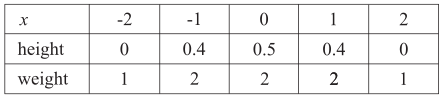
The trapezium rule is used, with two trapeziums, to estimate the area bounded by the graph of \(y=f(x)\), the \(x\)-axis and the lines \(x=0\) and \(x=1\).
For which function will the trapezium rule estimate be larger than the exact area?
- \(f(x)=3-e^x\)
- \(f(x)=x^3+1\)
- \(f(x)=3 \sin (x)+1\)
- \(f(x)=\log _e(x+3)\)
Show Worked Solution
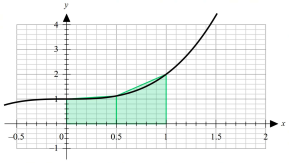
\(\text{Consider option B:}\)
♦ Mean mark 50%.
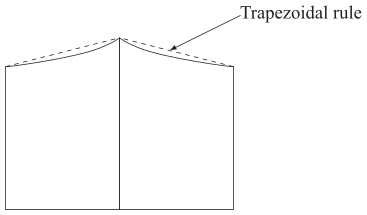
\(\text{By drawing trapeziums (see graph), the estimated area}\)
\(\text{is greater than the actual area.}\)
\(\Rightarrow B\)