Consider the function \(f:\left[0, \dfrac{5 \pi}{2}\right] \rightarrow R, f(x)=\sin (x)+1\).
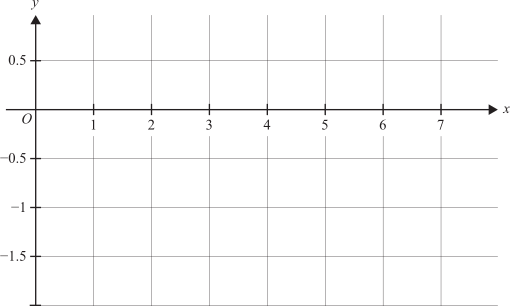
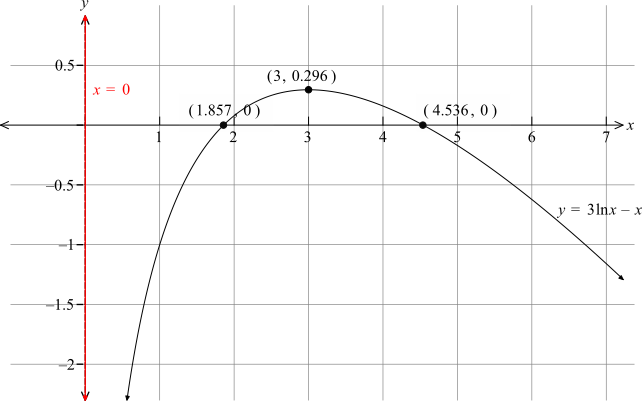
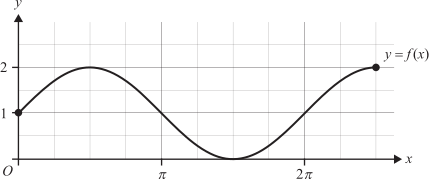
The graph of \(y=f(x)\) is shown below.
- Evaluate \(f\left(\dfrac{2 \pi}{3}\right)\). (1 mark)
--- 2 WORK AREA LINES (style=lined) ---
- Find the exact values of \(x\) for which \(f(x)=\dfrac{3}{2}\). (1 mark)
--- 3 WORK AREA LINES (style=lined) ---
- There exist real numbers \(a\) and \(k\) in the interval \(\left(0, \dfrac{5 \pi}{2}\right)\), such that \(f(x+k)=f(x)\) for all \(x \in[0, a]\).
- Find the value of \(k\) and the largest possible value of \(a\). (2 marks)
--- 3 WORK AREA LINES (style=lined) ---
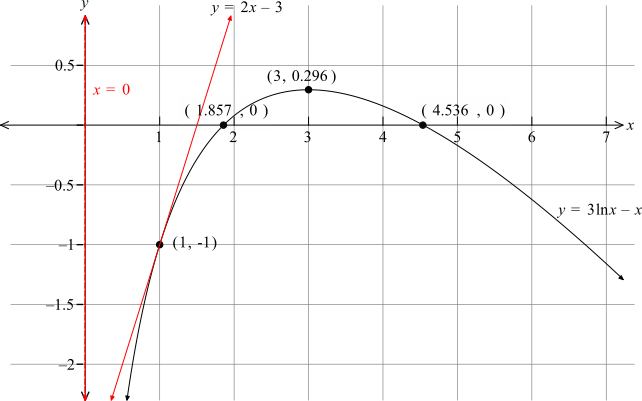
- Consider the tangent to the graph of \(y=f(x)\) at the point \(A\) where \(x=\dfrac{2 \pi}{3}\), as shown on the axes below.
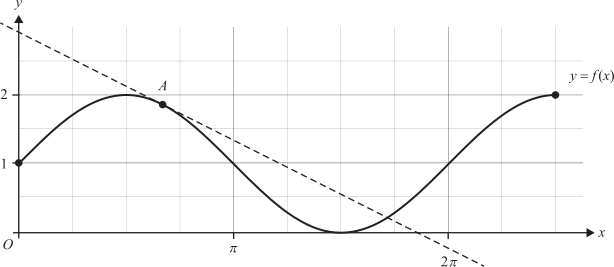
- Find the equation of the tangent to the graph of \(y=f(x)\) at the point where \(x=\dfrac{2 \pi}{3}\). (1 mark)
--- 2 WORK AREA LINES (style=lined) ---
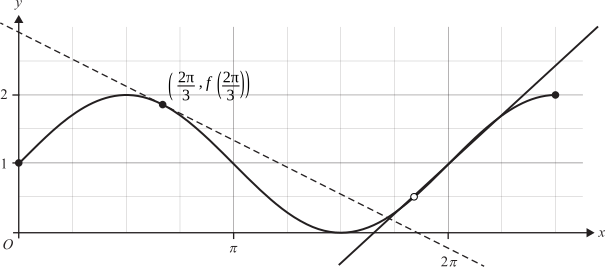
- Apply two iterations of Newton's method to \(f\) with \(x_0=\dfrac{2 \pi}{3}\).
- Write down \(x_2\), correct to one decimal place. (1 mark)
--- 1 WORK AREA LINES (style=lined) ---
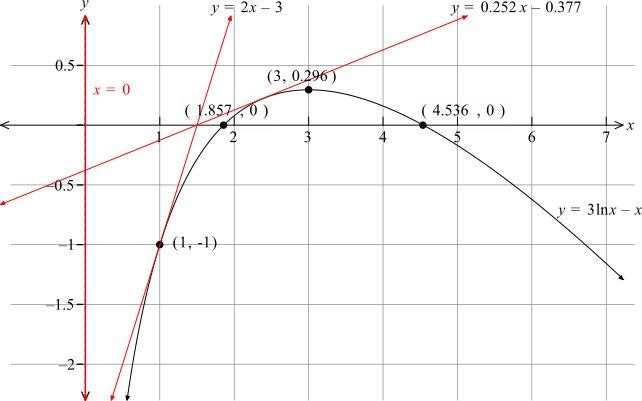
- On the axes in part d, draw the tangent to the graph of \(y=f(x)\) at the point where \(x=x_1\).
- Answer on the graph in part d. (1 mark)
--- 0 WORK AREA LINES (style=lined) ---
- Write down \(x_2\), correct to one decimal place. (1 mark)
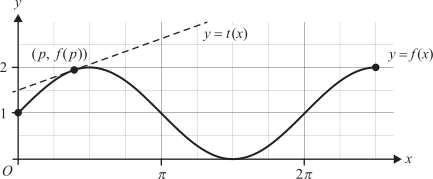
- Now consider the line \(y=t(x)\), which is the tangent to the graph of \(y=f(x)\) at the point \((p, f(p))\), where \(p \in\left(0, \dfrac{5 \pi}{2}\right)\).
-
-
- Show that \(t(x)=\cos (p)(x-p)+\sin (p)+1\). (2 marks)
--- 6 WORK AREA LINES (style=lined) ---
- Determine the minimum and maximum possible values for the \(y\)-intercept of \(y=t(x)\), for \(p \in\left(0, \dfrac{5 \pi}{2}\right)\). (2 marks)
--- 3 WORK AREA LINES (style=lined) ---
- Determine the values of \(p\) for which \(y=t(x)\) has a unique \(x\)-intercept that is equal to the \(x\)-intercept of \(y=f(x)\).
- Give your answers correct to two decimal places. (2 marks)
--- 2 WORK AREA LINES (style=lined) ---
- Show that \(t(x)=\cos (p)(x-p)+\sin (p)+1\). (2 marks)
-
- Let \(g:\left[0, \dfrac{5 \pi}{2}\right] \rightarrow R, g(x)=a x^3+b x^2+c x+d\) be a polynomial function, where \(a, b, c, d \in R\).
- Suppose \(g(0)=f(0)\) and \(g^{\prime}(0)=f^{\prime}(0)\).
- Show that \(c=1\) and \(d=1\). (2 marks)
--- 5 WORK AREA LINES (style=lined) ---
- If \(g(2 \pi)=f(2 \pi)\) and \(g^{\prime}(2 \pi)=f^{\prime}(2 \pi)\), determine the area bounded by the graphs of \(y=f(x)\) and \(y=g(x)\), for \(x \in[0,2 \pi]\).
- Give your answer correct to two decimal places. (2 marks)
--- 7 WORK AREA LINES (style=lined) ---
- Let \(a=0, c=1, d=1\).
- Find \(b\) and \(r\), such that \(g(r)=f(r)\) and \(g^{\prime}(r)=f^{\prime}(r)\), where \(b \in R\) and \(r \in\left(0, \dfrac{5 \pi}{2}\right)\). (2 marks)
--- 5 WORK AREA LINES (style=lined) ---
- Show that \(c=1\) and \(d=1\). (2 marks)
a. \(f\left(\dfrac{2 \pi}{3}\right)=\dfrac{2+\sqrt{3}}{2}\)
b. \(x=\dfrac{\pi}{6}, \dfrac{5 \pi}{6}, \dfrac{13 \pi}{6}\)
c. \(k=2 \pi, \ \ a=\dfrac{\pi}{2}\)
d. \(y=-\dfrac{x}{2}+\dfrac{\pi}{3}+\dfrac{\sqrt{3}}{2}+1\)
e.i. \(x_2=5.2\)
e.ii.
f.i. \(f^{\prime}(p)=\cos (p)\)
\(\text{Equation of tangent at}\ (p, \sin (p)+1):\)
| \(y-(\sin (p)+1)\) | \(=\cos (p)(x-p)\) |
| \(t(x)\) | \(=\cos (p)(x-p)+\sin (p)+1\) |
f.ii. \(y \text{-int (min)}=1-2 \pi \ \text { (at } p=2 \pi)\)
\(y \text{-int (max)}=1+\pi \ \text { (at } p= \pi)\)
f.iii. \(p=2.38 \ \text{or} \ 7.04\)
g.i. \(g(x)=a x^3+b x^2+c x+d, \ f(x)=\sin (x)+1\)
\(\text{Given} \ \ f(0)=g(0):\)
\(d=\sin (0)+1=1\)
\(g^{\prime}(x)=3 a x^2+2 b x+c, \ f^{\prime}(x)=\cos (x)\)
\(\text{Given} \ \ f^{\prime}(0)=g^{\prime}(0):\)
\(c=1\)
g.ii. \(\text {Area}=1.53\)
g.iii. \(r=\pi, \ b=-\dfrac{1}{\pi}\)
a. \(f(x)=\sin (x)+1\)
\(f\left(\dfrac{2 \pi}{3}\right)=\sin \left(\dfrac{2 \pi}{3}\right)+1=\dfrac{2+\sqrt{3}}{2}\)
b. \(\text{Solve \(\ f(x)=\dfrac{3}{2} \ \) for \(x\) (by CAS):}\)
\(\sin (x)+1=\dfrac{3}{2} \ \Rightarrow \ \sin (x)=\dfrac{1}{2}\)
\(\text{Solve} \ \ \sin (x)=\dfrac{1}{2} \ \text { for } \ x \in\left[0, \dfrac{5 \pi}{2}\right]:\)
\(x=\dfrac{\pi}{6}, \dfrac{5 \pi}{6}, \dfrac{13 \pi}{6}\)
c. \(f(x+k)=f(x) \ \ \text{for} \ \ x \in[0, a]\)
\(\text{By inspection of graph:}\)
\(k=2 \pi, \ \ a=\dfrac{\pi}{2}\)
d. \(f(x)=\sin (x)+1 \ \Rightarrow \ f^{\prime}(x)=\cos (x)\)
\(f^{\prime}\left(\dfrac{2 \pi}{3}\right)=-\dfrac{1}{2}\)
\(\text{Find equation of line} \ \ m_2=-\dfrac{1}{2} \ \ \text{through}\ \ \left(\dfrac{2 \pi}{3}, \dfrac{2+\sqrt{3}}{2}\right):\)
\(y=-\dfrac{x}{2}+\dfrac{\pi}{3}+\dfrac{\sqrt{3}}{2}+1\)
e.i. \(x_0=\dfrac{2 \pi}{3}\)
\(x_1=\dfrac{2 \pi}{3}-\dfrac{f\left(\dfrac{2 \pi}{3}\right)}{f^{\prime}\left(\dfrac{2 \pi}{3}\right)}=5.8264 \ldots\)
\(x_2=5.8264 \ldots-\dfrac{f(5.8264)}{f^{\prime}(5.8264)}=5.2 \ \text{(1 d.p.)}\)
e.ii.
f.i. \(f^{\prime}(p)=\cos (p)\)
\(\text{Equation of tangent at}\ (p, \sin (p)+1):\)
| \(y-(\sin (p)+1)\) | \(=\cos (p)(x-p)\) |
| \(t(x)\) | \(=\cos (p)(x-p)+\sin (p)+1\) |
f.ii. \(t(x)=\cos (p) x+\sin (p)+1-p \times \cos (p)\)
\(y\text{-intercept}=\sin (p)+1-p \times \cos (p)\)
\(\text{Find max/min of} \ y\text{-int for} \ p \in\left[0, \dfrac{5 \pi}{2}\right] \ \ \text{(by CAS):}\)
\(y \text{-int (min)}=1-2 \pi \ \text { (at } p=2 \pi)\)
\(y \text{-int (max)}=1+\pi \ \text { (at } p= \pi)\)
♦♦♦ Mean mark (f.iii) 23%.
f.iii. \(x \text{-intercept of} \ f(x) \ \text{occurs at} \ \ x=\dfrac{3 \pi}{2}\)
\(\text{Solve} \ \ t\left(\dfrac{3 \pi}{2}\right)=0 \ \ \text {for}\ p:\)
\(p=2.38 \ \text{or} \ 7.04\)
g.i. \(g(x)=a x^3+b x^2+c x+d, \ f(x)=\sin (x)+1\)
\(\text{Given} \ \ f(0)=g(0):\)
\(d=\sin (0)+1=1\)
\(g^{\prime}(x)=3 a x^2+2 b x+c, \ f^{\prime}(x)=\cos (x)\)
\(\text{Given} \ \ f^{\prime}(0)=g^{\prime}(0):\)
\(c=1\)
g.ii. \(g(x)=a x^3+b x^2+x+1 \ \Rightarrow \ g^{\prime}(x)=3 a x^2+2 b x+1\)
\(\text{Given \(\ g(2 \pi)=f(2 \pi)=1\ \) and \(\ \ g^{\prime}(2 \pi)=f^{\prime}(2 \pi)=1\)}\)
\(\text{Solve \(\ g(2 \pi)=1 \ \) and \(\ g^{\prime}(2 \pi)=1\) simultaneously for \(a, b\):}\)
\(a=\dfrac{1}{2 \pi^2}, \ b=-\dfrac{3}{2 \pi}\)
♦♦♦ Mean mark (g.iii) 24%.
\(\text{Find intersection of}\ f(x)\ \text{and}\ g(x)\ \text{(by CAS)}:\)
\(f(x)=g(x)\ \ \Rightarrow\ \ x=\pi\)
\(\text {Area}=\displaystyle \int_0^\pi f(x)-g(x)\, d x+\int_\pi^{2 \pi} g(x)-f(x)\, d x=1.53\)
g.iii. \(a=0, c=1, d=1\)
\(g(x)=b x^2+x+1, \ f(x)=\sin (x)+1\)
\(g^{\prime}(x)=2 b x+1, \ f^{\prime}(x)=\cos (x)\)
\(\text{Solve simultaneous equations for \(b\) and \(r\):}\)
\(br^2+r=\sin (r)\ \ldots\ (1)\)
\(2 b r+1=\cos (r)\ \ldots\ (2)\)
\(r=\pi, \ b=-\dfrac{1}{\pi}\)