SmarterEd

Aussie Maths & Science Teachers: Save your time with SmarterEd

  • Login
  • Get Help
  • About

v1 Algebra, STD2 A2 2009 HSC 13 MC

The volume of water in a tank changes over six months, as shown in the graph.
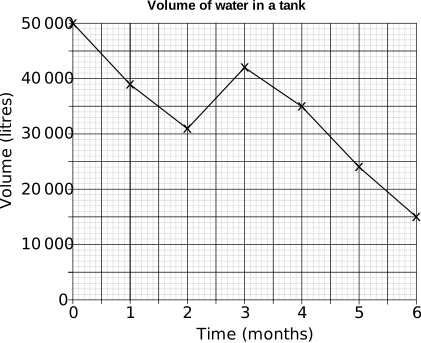
 

Consider the overall decrease in the volume of water.

What is the average percentage decrease in the volume of water per month over this time, to the nearest percent?

  1. 6%
  2. 12%
  3. 35%
  4. 64%
Show Answers Only

\(B\)

Show Worked Solution
\(\text{Initial Volume}\) \(=50\ 000\ \text{L}\)
\(\text{Final volume}\) \(=15\ 000\ \text{L}\)
\(\text{Decrease}\) \(=50\ 000-15\ 000\)
  \(=35\ 000\ \text{L   (over 6 months)}\)


\(\text{Loss per month}\) \(=\dfrac{35\ 000}{6}\)
  \(=5833.33\dots\ \text{L per month}\)
\(\text{% loss per month}\) \(=\dfrac{5833.33\dots}{50\ 000}\times 100\%\)
  \(=11.666\dots \%\)

 
\(\Rightarrow B\)


♦ Mean mark 48%.
COMMENT: Remember that % decrease requires the decrease in volume to be divided by the original volume (50,000L)

Filed Under: Applications: Currency, Fuel and Other Problems (Std 2-X) Tagged With: Band 5, smc-5236-30-Other linear applications

v1 Algebra, STD2 A2 2009 HSC 24d

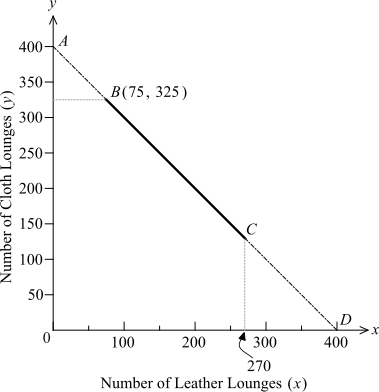
A factory makes both cloth and leather lounges. In any week

• the total number of cloth lounges and leather lounges that are made is 400
• the maximum number of leather lounges made is 270
• the maximum number of cloth lounges made is 325.

The factory manager has drawn a graph to show the numbers of leather lounges (\(x\)) and cloth lounges (\(y\)) that can be made.


  1. Find the equation of the line \(AD\).   (1 mark)

    --- 2 WORK AREA LINES (style=lined) ---

  2. Explain why this line is only relevant between \(B\) and \(C\) for this factory.     (1 mark)

    --- 3 WORK AREA LINES (style=lined) ---

  3. The profit per week, \($P\), can be found by using the equation  \(P = 2520x + 1570y\).


    Compare the profits at \(B\) and \(C\).     (2 marks)

    --- 6 WORK AREA LINES (style=lined) ---

Show Answers Only
  1. \(x+y=400\)
  2. \(\text{Since the max amount of leather lounges}=270\)


    \(\rightarrow\ x\ \text{cannot be}\ >270\)


    \(\text{Since the max amount of cloth lounges}=325\)


    \(\rightarrow\ y\ \text{cannot be}\ >325\)


    \(\therefore\ \text{The line}\ AD\ \text{is only possible between}\ B\ \text{and}\ C.\)

  3. \(\text{The profits at}\ C\ \text{are }$185\ 250\ \text{more than at}\ B.\)
Show Worked Solution

i.   \(\text{We are told the number of leather lounges}\ (x),\)

\(\text{and cloth lounges}\  (y),\ \text{made in any week} = 400\)

\(\rightarrow\ \text{Equation of}\ AD\ \text{is}\ x+y=400\)


♦♦♦ Mean mark part (i) 14%.
Using \(y=mx+c\) is a less efficient but equally valid method, using  \(m=–1\)  and  \(b=400\) (\(y\)-intercept).

ii.   \(\text{Since the max amount of leather lounges}=270\)

\(\rightarrow\ x\ \text{cannot}\ >270\)

\(\text{Since the max amount of cloth lounges}=325\)

\(\rightarrow\ y\ \text{cannot}\ >325\)

\(\therefore\ \text{The line}\ AD\ \text{is only possible between}\ B\ \text{and}\ C.\)


♦ Mean mark part (ii) 49%.

iii.  \(\text{At}\ B,\ x=75,\ y=325\)

\(\rightarrow\ $P  (\text{at}\ B)\) \(=2520\times 75+1570\times 325\)
  \(=189\ 000+510\ 250\)
  \(=$699\ 250\)

  
\(\text{At}\ C,\ x=270,\ y=130\)

\(\rightarrow\ $P  (\text{at}\ C)\) \(=2520\times 270+1570\times 130\)
  \(=680\ 400+204\ 100\)
  \(=$884\ 500\)

  
\(\text{Difference in profits}=$884\ 500-$699\ 250=$185\ 250\)

\(\text{The profits at}\ C\ \text{are } $185\ 250\ \text{more than at}\ B.\)


♦ Mean mark (iii)40%.

Filed Under: Applications: Currency, Fuel and Other Problems (Std 2-X) Tagged With: Band 5, Band 6, smc-5236-30-Other linear applications

v1 Algebra, STD2 A2 2010 HSC 27c

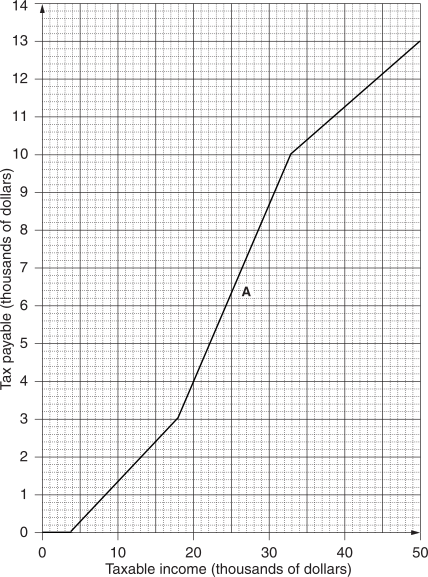
The graph shows tax payable against taxable income, in thousands of dollars.
  

  1. Use the graph to find the tax payable on a taxable income of \($18\ 000\).  (1 mark)

    --- 1 WORK AREA LINES (style=lined) ---

  2. Use suitable points from the graph to show that the gradient of the section of the graph marked  \(A\)  is  \(\dfrac{7}{15}\).    (1 mark)

    --- 3 WORK AREA LINES (style=lined) ---

  3. How much of each dollar earned between  \($18\ 000\)  and  \($33\ 000\) is payable in tax? Give your answer correct to the nearest whole number.   (1 mark)

    --- 2 WORK AREA LINES (style=lined) ---

  4. Write an equation that could be used to calculate the tax payable, \(T\), in terms of the taxable income, \(I\), for taxable incomes between  \($18\ 000\)  and  \($33\ 000\).   (2 marks)

    --- 4 WORK AREA LINES (style=lined) ---

Show Answers Only
  1. \($3000\ \ \text{(from graph)}\)
  2. \(\text{See worked solution}\)
  3. \(46\frac{2}{3}\approx  47\ \text{cents per dollar earned}\)
  4. \(\text{Tax payable →}\ T=\dfrac{7}{15}I-5400\)
Show Worked Solution
i.   

\(\text{Income on}\ $18\ 000=$3000\ \ \text{(from graph)}\)


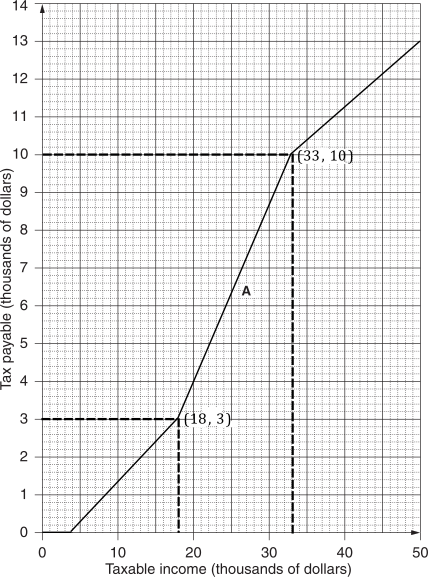
ii.  \(\text{Using the points}\ (18, 3)\ \text{and}\ (33, 10)\)

\(\text{Gradient at}\ A\) \(=\dfrac{y_2-y_1}{x_2-x_1}\)
  \(=\dfrac{10\ 000-3000}{33\ 000-18\ 000}\)
  \(=\dfrac{7000}{15\ 000}\)
  \(=\dfrac{7}{15}\ \ \ \ \text{… as required}\)

♦♦ Mean mark (ii) 25%.

iii.  \(\text{The gradient represents the tax applicable on each dollar}\)

\(\text{Tax}\) \(=\dfrac{7}{15}\ \text{of each dollar earned}\)
  \(=46\frac{2}{3}\approx 47\ \text{cents per dollar earned (nearest whole number)}\)

♦♦♦ Mean mark (iii) 12%!
MARKER’S COMMENT: Interpreting gradients is an examiner favourite, so make sure you are confident in this area.

iv.  \(\text{Tax payable up to }$18\ 000 = $3000\)

\(\text{Tax payable on income between }$18\ 000\ \text{and }$33\ 000\)

\(=\dfrac{7}{15}(I-18\ 000)\)

\(\therefore\ \text{Tax payable →}\ \ T\) \(=3000+\dfrac{7}{15}(I-18\ 000)\)
  \(=3000+\dfrac{7}{15} I-8400\)
  \(=\dfrac{7}{15}I-5400\)

♦♦♦ Mean mark (iv) 15%.
STRATEGY: The earlier parts of this question direct students to the most efficient way to solve this question. Make sure earlier parts of a question are front and centre of your mind when devising strategy.

Filed Under: Applications: Currency, Fuel and Other Problems (Std 2-X) Tagged With: Band 3, Band 5, Band 6, page-break-before-solution, smc-5236-30-Other linear applications

v1 Algebra, STD2 A2 2007 HSC 27b

A cafe uses eight long-life light globes for 7 hours every day of the year. The purchase price of each light globe is $11.00 and they each cost  \($f\)  per hour to run.

  1. Write an equation for the total cost (\($c\)) of purchasing and running these eight light globes for one year in terms of  \(f\).    (2 marks)

    --- 4 WORK AREA LINES (style=lined) ---

  2. Find the value of  \(f\)  (correct to three decimal places) if the total cost of running these eight light globes for one year is $850.   (1 mark)

    --- 2 WORK AREA LINES (style=lined) ---

  3. If the use of the light globes increases to ten and a half hours per night every night of the year, does the total cost increase by one-and-a-half times? Justify your answer with appropriate calculations.   (1 mark)

    --- 2 WORK AREA LINES (style=lined) ---

Show Answers Only
  1. \($c=88+20\ 440f\)
  2. \(0.037\ $/\text{hr}\ \text{(3 d.p.)}\)
  3. \(\text{Proof:  (See Worked Solutions)}\)
Show Worked Solution

i.  \(\text{Purchase price}=8\times 11=$88\)

\(\text{Running cost}\) \(=\text{No. of  hours}\times \text{Cost per hour}\)
  \(=8\times 7\times 365\times f\)
  \(=20\ 440f\)

  
\(\therefore\ $c=88+20\ 440f\)
  

ii.  \(\text{Given}\ \ $c=$850\)

\(850\) \(=88+20\ 440f\)
\(20\ 440f\) \(=850-88\)
\(f\) \(=\dfrac{762}{20440}\)
  \(= 0.03727\dots\)
  \(=0.037\ $/\text{hr}\ \text{(3 d.p.)}\)


iii.  \(\text{If}\ f\ \text{is multiplied by  }1.5 =\dfrac{10.5}{7}\)

\(f=1.5\times0.037=0.0555\ \ $/\text{hr}\)

\(\therefore\ $c\) \(=88+20\ 440\times 0.0555\)
  \(=$1222.42\)

  
\(\text{Since }$1222.42\ \text{is less than}\ 1.5\times $850 = $1275,\)

\(\text{the total cost increases to less than 1.5 times the}\)

\(\text{the original cost.}\)

Filed Under: Applications: Currency, Fuel and Other Problems (Std 2-X) Tagged With: Band 4, Band 5, smc-5236-30-Other linear applications

v1 Algebra, STD2 A2 2016 HSC 29e

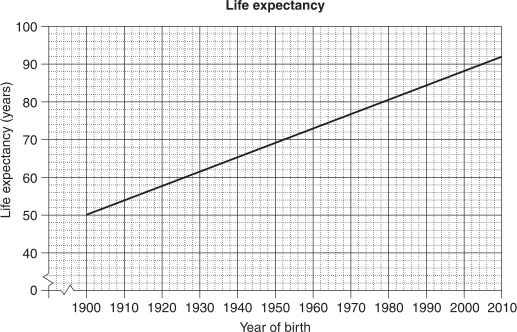
The graph shows the life expectancy of people born between 1900 and 2010.


  1. According to the graph, what is the life expectancy of a person born in 1968?  (1 mark)

    --- 1 WORK AREA LINES (style=lined) ---

  2. With reference to the value of the gradient, explain the meaning of the gradient in this context.  (2 marks)

    --- 4 WORK AREA LINES (style=lined) ---

Show Answers Only
  1. \(\text{76 years}\)
  2. \(\text{After 1900, life expectancy increases by 0.38 years for}\)
    \(\text{each year later that someone is born.}\)
Show Worked Solution

i.    \(\text{76 years}\)

ii.    \(\text{Using (2000, 88) and (1900, 50):}\)

\(\text{Gradient}\) \(= \dfrac{y_2-y_1}{x_2-x_1}\)
  \(= \dfrac{88-50}{2000-1900}\)
  \(= 0.38\)

 
\(\text{After 1900, life expectancy increases by 0.38 years for}\)

\(\text{each year later that someone is born.}\)

♦♦ Mean mark (ii) 33%.

Filed Under: Applications: Currency, Fuel and Other Problems (Std 2-X) Tagged With: Band 3, Band 5, smc-5236-30-Other linear applications

v1 Algebra, STD2 A2 SM-Bank 2

The cost of apples per kilogram, \(C\), varies directly with the weight of apples purchased, \(w\).

If 12 kilograms costs $56.64, calculate the cost of 4.5 kilograms of apples.  (2 marks)

--- 4 WORK AREA LINES (style=lined) ---

Show Answers Only

\($21.24\)

Show Worked Solution

\(C\ \propto \ w\)

\(C=kw\)

\(\text{When}\ C=$56.64\ \text{kg},\ w=12\ \text{kg}\)

\(56.64\) \(=k\times 12\)
\(k\) \(=\dfrac{56.64}{12}\)
  \(=$4.72\)


\(\text{When}\ \ w=4.5\ \text{kg,}\)

\(C\) \(=4.72\times 4.5\)
  \(=$21.24\)

Filed Under: Applications: Currency, Fuel and Other Problems (Std 2-X) Tagged With: Band 5, smc-5236-30-Other linear applications, smc-5236-50-Proportion

v1 Algebra, STD2 A2 2017 HSC 3 MC

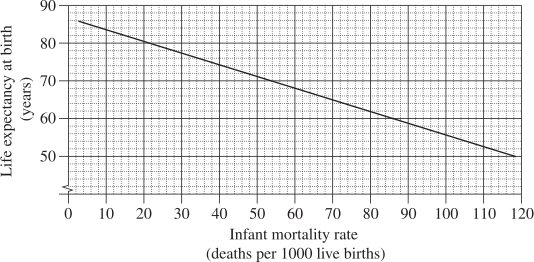
The graph shows the relationship between infant mortality rate (deaths per 1000 live births) and life expectancy at birth (in years) for different countries.
 

What is the life expectancy at birth in a country which has an infant mortality rate of 80?

  1. 20 years
  2. 21 years
  3. 61 years
  4. 62 years
Show Answers Only

\(D\)

Show Worked Solution

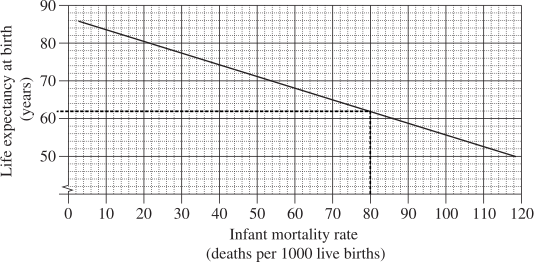
\(\text{When infant mortality rate is 80, life expectancy}\)

\(\text{at birth is 62 years (see below).}\)
 

\(\Rightarrow D\)

Filed Under: Applications: Currency, Fuel and Other Problems (Std 2-X) Tagged With: Band 3, smc-5236-30-Other linear applications

v1 Algebra, STD2 A2 SM-Bank 3

The average height, \(L\), in centimetres, of a boy between the ages of 7 years and 10 years can be represented by a line with equation

\(L=7A+85\)

where \(A\) is the age in years. For this line, the gradient is 7.

  1. What does this indicate about the heights of boys aged 7 to 10?   (1 mark)

    --- 2 WORK AREA LINES (style=lined) ---

  2. Give ONE reason why this equation is not suitable for predicting heights of boys older than 10.   (1 mark)

    --- 2 WORK AREA LINES (style=lined) ---

Show Answers Only
  1. \(\text{It indicates that 7-10 year old boys, on average, grow 7 cm per year.}\)
  2. \(\text{Boys eventually stop growing, and the equation doesn’t factor this in.}\)
Show Worked Solution

i.    \(\text{It indicates that 7-10 year old boys, on average, grow}\)

\(\text{7 cm per year.}\)
 

ii.   \(\text{Boys eventually stop growing, and the equation doesn’t}\)

\(\text{factor this in.}\)

Filed Under: Applications: Currency, Fuel and Other Problems (Std 2-X) Tagged With: Band 4, Band 5, smc-5236-30-Other linear applications, smc-5236-40-Limitations

v1 Algebra, STD2 A4 EQ-Bank 8 MC

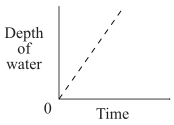
Water was poured into a container at a constant rate. The graph shows the depth of water in the container as it was being filled.


Which of the following containers could have been used to produce this result?

A. B.
C. D.
Show Answers Only

\(C\)

Show Worked Solution

\(\text{Since the graph is a straight line, the container must have}\)
\(\text{vertical sides so the container will fill up at a constant rate.}\)
  

\(\Rightarrow C\)

Filed Under: Applications: Currency, Fuel and Other Problems (Std 2-X) Tagged With: Band 3, smc-5236-30-Other linear applications

v1 Algebra, STD2 A2 2019 HSC 14 MC

Last Friday, Jake had 98 marbles and Jack had 79 Marbles. On average, Jake wins 5 marbles per day and Jack loses 4 marbles per day.

If  \(x\)  represents the number of days since last Friday and  \(y\)  represents the number of marbles, which pair of equations model this situation?

  A.     \(\text{Jake:}\ \ y=98x+5\)


    \(\text{Jack:}\ \ y=79x-4\)

  B.     \(\text{Jake:}\ \ y=5+98x\)


    \(\text{Jack:}\ \ y=4-79x\)

  C.     \(\text{Jake:}\ \ y=5x+98\)


    \(\text{Jack:}\ \ y=4x-79\)

  D.     \(\text{Jake:}\ \ y=98+5x\)


    \(\text{Jack:}\ \ y=79-4x\)

Show Answers Only

\(D\)

Show Worked Solution

\(\text{Jake starts with 98 and adds 5 per day:}\)

\(y=98+5x\)

\(\text{Jack starts with 79 and loses 4 per day:}\)

\(y=79-4x\)

\(\Rightarrow D\)

Filed Under: Applications: Currency, Fuel and Other Problems (Std 2-X) Tagged With: Band 4, smc-5236-30-Other linear applications

v1 Algebra, STD1 A3 2021 HSC 25

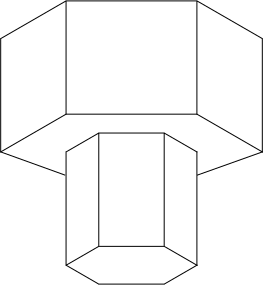
The diagram shows a container which consists of a large hexagonal prism on top of a smaller hexagonal prism.
 

The container is filled with water at a constant rate into the top of the larger hexagonal prism.

The smaller prism is totally filled before the larger prism begins to fill.

It takes 5 minutes to fill the smaller cylinder.

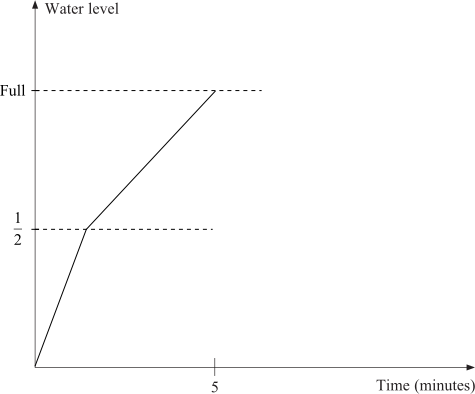
Draw a possible graph of the water level in the container against time.  (2 marks)
 

--- 0 WORK AREA LINES (style=lined) ---

Show Answers Only

Show Worked Solution


♦♦ Mean mark 38%.

Filed Under: Applications: Currency, Fuel and Other Problems (Std 2-X) Tagged With: Band 5, smc-5236-30-Other linear applications

v1 Algebra, STD2 A2 2020 HSC 10 MC

An electrician charges a call-out fee of $75 as well as $1.50 per minute while working.

Suppose the electrician works for \(t\) hours.

Which equation expresses the amount the plumber charges ($\(C\)) as a function of time (\(t\) hours)?

  1. \(C=75+1.50t\)
  2. \(C=150+75t\)
  3. \(C=75+90t\)
  4. \(C=90+75t\)
Show Answers Only

\(C\)

Show Worked Solution

\(\text{Hourly rate}=60\times 1.50=$90\)

\(\therefore\ C=75+90t\)
  

\(\Rightarrow C\)


♦ Mean mark 42%.

Filed Under: Applications: Currency, Fuel and Other Problems (Std 2-X) Tagged With: Band 5, smc-5236-30-Other linear applications

v1 Algebra, STD2 A2 2022 HSC 16

Rhonda is 38 years old, and likes to keep fit by doing cross-fit classes.

  1. Use this formula to find her maximum heart rate (bpm).   (1 mark)
      
       Maximum heart rate = 220 – age in years

    --- 2 WORK AREA LINES (style=lined) ---

  2. Rhonda will get the most benefit from this exercise if her heart rate is between 65% and 85% of her maximum heart rate.
  3. Between what two heart rates should Rhonda be aiming for to get the most benefit from her exercise?  (2 marks)

    --- 4 WORK AREA LINES (style=lined) ---

Show Answers Only

a.   \(182\ \text{bpm}\)

b.   \(118-155\ \text{bpm}\)

Show Worked Solution
a.     \(\text{Max heart rate}\) \(=220-38\)
    \(=182\ \text{bpm}\)


b.    \(\text{65% max heart rate}\ = 0.65\times 182 = 118.3\ \text{bpm}\)

\(\text{85% max heart rate}\ = 0.85\times 182 = 154.7\ \text{bpm}\)

\(\therefore\ \text{Rhonda should aim for between 118 and 155 bpm during exercise.}\)

Filed Under: Applications: Currency, Fuel and Other Problems (Std 2-X) Tagged With: Band 2, Band 3, smc-5236-30-Other linear applications

v1 Algebra, STD2 A4 2022 HSC 22

The formula  \(C=80n+b\)  is used to calculate the cost of producing desktop computers, where \(C\) is the cost in dollars, \(n\) is the number of desktop computers produced and \(b\) is the fixed cost in dollars.

  1. Find the cost \(C\) when 2458 desktop computers are produced and the fixed cost is \($18\ 230\).  (1 mark)

    --- 2 WORK AREA LINES (style=lined) ---

  2. Some desktop computers have extra features added. The formula to calculate the production cost for these desktop computers is
  3.     \(C=80n+an+18\ 230\)
  4. where \(a\) is the additional cost in dollars per desktop computer produced.
  5. Find the number of desktop computers produced if the additional cost is $35 per desktop computer and the total production cost is \($103\ 330\).  (2 marks)

    --- 4 WORK AREA LINES (style=lined) ---

Show Answers Only
  1. \($214\ 870\)
  2. \(740\ \text{desktop computers}\)
Show Worked Solution

a.   \(\text{Find}\ C,\ \text{given}\ n=2458\ \text{and}\ b=18\ 230\)

\(C\) \(=80\times 2458+18\ 230\)  
  \(=$214\ 870\)  


b.   \(\text{Find}\ n,\ \text{given}\ C=103\ 330\ \text{and}\ a=35\)

\(C\) \(=80n+an+18\ 230\)
\(103\ 330\) \(=80n+35n+18\ 230\)
\(115n\) \(=85\ 100\)
\(n\) \(=\dfrac{85\ 100}{115}\)
  \(=740\ \text{desktop computers}\)

Filed Under: Applications: Currency, Fuel and Other Problems (Std 2-X) Tagged With: Band 2, Band 4, smc-5236-30-Other linear applications

Copyright © 2014–2025 SmarterEd.com.au · Log in