SmarterEd

Aussie Maths & Science Teachers: Save your time with SmarterEd

  • Login
  • Get Help
  • About

HMS, TIP NSE-Bank 25

Analyse how the principles of progressive overload and training thresholds could be applied to a cyclist’s aerobic training program to improve performance. Provide examples to support your answer.   (8 marks)

--- 22 WORK AREA LINES (style=lined) ---

Show Answers Only

Overview Statement

Progressive overload and training thresholds each connect to a cyclist’s aerobic performance through physiological adaptations that improve the delivery and use of oxygen.

Component Relationship 1

Progressive overload can be effectively used to improve a cyclist’s aerobic performance by gradually increasing the frequency, duration and/or intensity of training.

Once the cyclist has adapted to their training program, this can be achieved by increasing the duration of sessions from one hour to 75 minutes.

This increased training stress on the cardiovascular and respiratory systems results in physiological adaptations, including increased haemoglobin and stroke volume levels.

These adaptations mean the cyclist can delay fatigue and maintain performance for longer, resulting in a faster time.

Component Relationship 2

Training thresholds connect to aerobic performance by ensuring that training occurs at an intensity above the aerobic threshold and below the anaerobic threshold, within the aerobic training zone.

To improve the performance of a cyclist, this would involve the athlete cycling continuously at 70–80% MHR within their training program.

Training at this intensity results in physiological adaptations including increased oxygen uptake and stroke volume.

These adaptations enable the cyclist to train and compete at a higher intensity for a longer duration because their heart is more efficient in delivering oxygen to the working muscles.

Implications and Synthesis

The relationships demonstrate that progressive overload and training thresholds work together to produce physiological adaptations that improve aerobic performance.

Overall, applying both principles enables the cyclist to delay fatigue, maintain a higher intensity for longer and achieve a faster performance time.
Show Worked Solution

Overview Statement

Progressive overload and training thresholds each connect to a cyclist’s aerobic performance through physiological adaptations that improve the delivery and use of oxygen.

Component Relationship 1

Progressive overload can be effectively used to improve a cyclist’s aerobic performance by gradually increasing the frequency, duration and/or intensity of training.

Once the cyclist has adapted to their training program, this can be achieved by increasing the duration of sessions from one hour to 75 minutes.

This increased training stress on the cardiovascular and respiratory systems results in physiological adaptations, including increased haemoglobin and stroke volume levels.

These adaptations mean the cyclist can delay fatigue and maintain performance for longer, resulting in a faster time.

Component Relationship 2

Training thresholds connect to aerobic performance by ensuring that training occurs at an intensity above the aerobic threshold and below the anaerobic threshold, within the aerobic training zone.

To improve the performance of a cyclist, this would involve the athlete cycling continuously at 70–80% MHR within their training program.

Training at this intensity results in physiological adaptations including increased oxygen uptake and stroke volume.

These adaptations enable the cyclist to train and compete at a higher intensity for a longer duration because their heart is more efficient in delivering oxygen to the working muscles.

Implications and Synthesis

The relationships demonstrate that progressive overload and training thresholds work together to produce physiological adaptations that improve aerobic performance.

Overall, applying both principles enables the cyclist to delay fatigue, maintain a higher intensity for longer and achieve a faster performance time.

Filed Under: Principles of training Tagged With: Band 4, Band 5, Band 6, smc-5460-10-Progressive overload, smc-5460-20-Thresholds

HMS, TIP 2025 HSC 18 MC

An elite athlete is training to enhance their muscular strength.

Which of the following approaches best demonstrates progressive overload for increased strength? (RM = repetition maximum)

  1. Adding exercises while performing four sets of eight repetitions at 60% of one RM
  2. Alternating between 80% and 90% of one RM weekly for three sets of 12 repetitions
  3. Starting with weights at 50% of one RM and gradually increasing the total repetitions each week repetitions each week 
  4. Adjusting the resistance from 80% to 90% of one RM, performing three to five sets of four to six repetitions
Show Answers Only

\(D\)

Show Worked Solution
  • D is correct: Progressive resistance increase (80% to 90% 1RM) with low reps (4-6) targets absolute strength development

Other Options:

  • A is incorrect: 60% 1RM with 8 reps develops muscular endurance, not maximal strength; adding exercises doesn’t increase load
  • B is incorrect: Alternating loads weekly lacks progressive overload; 12 reps targets endurance rather than strength
  • C is incorrect: Starting at 50% 1RM and increasing repetitions develops endurance, not strength; requires higher loads

♦♦ Mean mark 43%.

Filed Under: Principles of training Tagged With: Band 5, smc-5460-10-Progressive overload, smc-5460-20-Thresholds

HMS, TIP 2012 HSC 27

How can THREE principles of training be applied to improve strength? Provide examples.   (6 marks)

--- 18 WORK AREA LINES (style=lined) ---

Show Answers Only
  • Progressive overload requires gradually increasing training demands to stimulate strength adaptations. This occurs when athletes systematically increase weight, repetitions or sets over time. For example, a weightlifter progressing from 60kg to 80kg bench press over eight weeks demonstrates progressive overload application. Without continuous progression, strength plateaus because muscles adapt to consistent loads.
  • Specificity ensures training matches the demands of the target activity or muscle group. This means exercises must replicate movement patterns and energy systems used in performance. For instance, a shot-putter performing explosive medicine ball throws creates specific adaptations for their competitive throwing technique. This principle results in targeted muscle fibre recruitment patterns.
  • Training thresholds establish minimum intensity levels required to stimulate strength improvements. This typically involves working at 70-85% of one repetition maximum for optimal strength gains. For example, a rugby player performing squats at 75% of maximum weight triggers the physiological adaptations necessary for increased muscular strength and power development. Below this threshold, minimal strength gains occur.
Show Worked Solution
  • Progressive overload requires gradually increasing training demands to stimulate strength adaptations. This occurs when athletes systematically increase weight, repetitions or sets over time. For example, a weightlifter progressing from 60kg to 80kg bench press over eight weeks demonstrates progressive overload application. Without continuous progression, strength plateaus because muscles adapt to consistent loads.
  • Specificity ensures training matches the demands of the target activity or muscle group. This means exercises must replicate movement patterns and energy systems used in performance. For instance, a shot-putter performing explosive medicine ball throws creates specific adaptations for their competitive throwing technique. This principle results in targeted muscle fibre recruitment patterns.
  • Training thresholds establish minimum intensity levels required to stimulate strength improvements. This typically involves working at 70-85% of one repetition maximum for optimal strength gains. For example, a rugby player performing squats at 75% of maximum weight triggers the physiological adaptations necessary for increased muscular strength and power development. Below this threshold, minimal strength gains occur.

Filed Under: Principles of training Tagged With: Band 4, smc-5460-10-Progressive overload, smc-5460-20-Thresholds, smc-5460-40-Specificity

HMS, TIP 2015 HSC 12 MC

How could a coach use a circuit training program to develop the aerobic capacity and strength of her athletes?

  1. By increasing the time allowed for the circuit to be completed
  2. By increasing the resistance and the time at each of the stations
  3. By decreasing the time allowed for the circuit to be completed
  4. By decreasing the resistance and the time at each of the stations
Show Answers Only

\(B\)

Show Worked Solution
  • B is correct: Higher resistance builds strength while longer time develops aerobic capacity.

Other Options:

  • A is incorrect: More time doesn’t increase training intensity effectively.
  • C is incorrect: Less time reduces aerobic development opportunities.
  • D is incorrect: Lower resistance and time reduces both strength and aerobic benefits.

Filed Under: Principles of training Tagged With: Band 4, smc-5460-10-Progressive overload

HMS, TIP 2021 HSC 24

Describe how specificity and progressive overload can be applied to a strength training program in order to improve an athlete’s performance. Provide examples to support your answer.   (5 marks)

--- 15 WORK AREA LINES (style=lined) ---

Show Answers Only
  • Specificity involves targeting muscle groups and movement patterns directly related to the athlete’s sport requirements. A rugby player would focus on compound exercises like squats and deadlifts to develop leg and core strength needed for scrummaging and tackling. Training movements should mirror the biomechanical demands of competition. For instance, a basketball player would incorporate explosive jump squats to replicate jumping motions required for rebounding and shot blocking. This principle ensures training adaptations transfer effectively to sport-specific performance demands.
  • Progressive overload requires systematically increasing training stimulus to promote continued strength gains. Athletes can increase resistance, repetitions, sets, or training frequency over time. For example, a weightlifter might progress from bench pressing 80kg for 8 repetitions to 85kg for the same repetitions the following week. Alternatively, they could maintain 80kg but increase from 3 sets to 4 sets. This gradual increase challenges muscles beyond their current capacity, stimulating hypertrophy and strength development essential for improved athletic performance across all sporting contexts.
Show Worked Solution
  • Specificity involves targeting muscle groups and movement patterns directly related to the athlete’s sport requirements. A rugby player would focus on compound exercises like squats and deadlifts to develop leg and core strength needed for scrummaging and tackling. Training movements should mirror the biomechanical demands of competition. For instance, a basketball player would incorporate explosive jump squats to replicate jumping motions required for rebounding and shot blocking. This principle ensures training adaptations transfer effectively to sport-specific performance demands.
  • Progressive overload requires systematically increasing training stimulus to promote continued strength gains. Athletes can increase resistance, repetitions, sets, or training frequency over time. For example, a weightlifter might progress from bench pressing 80kg for 8 repetitions to 85kg for the same repetitions the following week. Alternatively, they could maintain 80kg but increase from 3 sets to 4 sets. This gradual increase challenges muscles beyond their current capacity, stimulating hypertrophy and strength development essential for improved athletic performance across all sporting contexts.

Filed Under: Principles of training Tagged With: Band 4, smc-5460-10-Progressive overload, smc-5460-40-Specificity

HMS, TIP 2022 HSC 15 MC

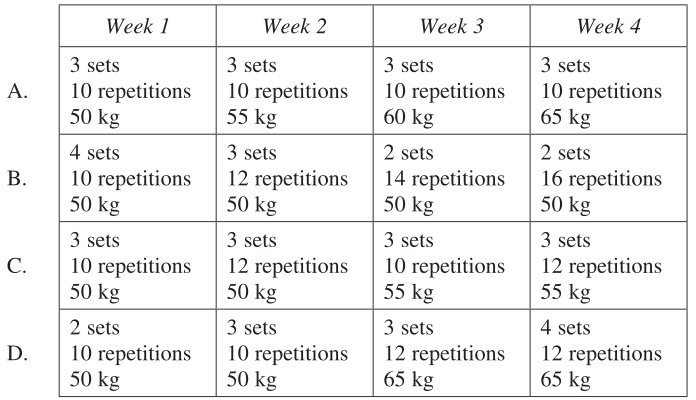
An athlete is aiming to maximise their muscular strength when performing a bench press.

Which row in the table represents the most effective four week application of progressive overload?

Show Answers Only

\( A \)

Show Worked Solution
  • A is correct: Systematic weight increases with consistent volume optimises strength development.

Other Options:

  • B is incorrect: No weight progression; increasing reps reduces strength focus.
  • C is incorrect: Inconsistent progression pattern doesn’t optimise strength gains.
  • D is incorrect: Erratic volume changes and sudden weight jumps.

♦♦ Mean mark 52%.

Filed Under: Principles of training Tagged With: Band 5, smc-5460-10-Progressive overload

Copyright © 2014–2026 SmarterEd.com.au · Log in