SmarterEd

Aussie Maths & Science Teachers: Save your time with SmarterEd

  • Login
  • Get Help
  • About

HMS, TIP NSE-Bank 25

Analyse how the principles of progressive overload and training thresholds could be applied to a cyclist’s aerobic training program to improve performance. Provide examples to support your answer.   (8 marks)

--- 22 WORK AREA LINES (style=lined) ---

Show Answers Only

Overview Statement

Progressive overload and training thresholds each connect to a cyclist’s aerobic performance through physiological adaptations that improve the delivery and use of oxygen.

Component Relationship 1

Progressive overload can be effectively used to improve a cyclist’s aerobic performance by gradually increasing the frequency, duration and/or intensity of training.

Once the cyclist has adapted to their training program, this can be achieved by increasing the duration of sessions from one hour to 75 minutes.

This increased training stress on the cardiovascular and respiratory systems results in physiological adaptations, including increased haemoglobin and stroke volume levels.

These adaptations mean the cyclist can delay fatigue and maintain performance for longer, resulting in a faster time.

Component Relationship 2

Training thresholds connect to aerobic performance by ensuring that training occurs at an intensity above the aerobic threshold and below the anaerobic threshold, within the aerobic training zone.

To improve the performance of a cyclist, this would involve the athlete cycling continuously at 70–80% MHR within their training program.

Training at this intensity results in physiological adaptations including increased oxygen uptake and stroke volume.

These adaptations enable the cyclist to train and compete at a higher intensity for a longer duration because their heart is more efficient in delivering oxygen to the working muscles.

Implications and Synthesis

The relationships demonstrate that progressive overload and training thresholds work together to produce physiological adaptations that improve aerobic performance.

Overall, applying both principles enables the cyclist to delay fatigue, maintain a higher intensity for longer and achieve a faster performance time.
Show Worked Solution

Overview Statement

Progressive overload and training thresholds each connect to a cyclist’s aerobic performance through physiological adaptations that improve the delivery and use of oxygen.

Component Relationship 1

Progressive overload can be effectively used to improve a cyclist’s aerobic performance by gradually increasing the frequency, duration and/or intensity of training.

Once the cyclist has adapted to their training program, this can be achieved by increasing the duration of sessions from one hour to 75 minutes.

This increased training stress on the cardiovascular and respiratory systems results in physiological adaptations, including increased haemoglobin and stroke volume levels.

These adaptations mean the cyclist can delay fatigue and maintain performance for longer, resulting in a faster time.

Component Relationship 2

Training thresholds connect to aerobic performance by ensuring that training occurs at an intensity above the aerobic threshold and below the anaerobic threshold, within the aerobic training zone.

To improve the performance of a cyclist, this would involve the athlete cycling continuously at 70–80% MHR within their training program.

Training at this intensity results in physiological adaptations including increased oxygen uptake and stroke volume.

These adaptations enable the cyclist to train and compete at a higher intensity for a longer duration because their heart is more efficient in delivering oxygen to the working muscles.

Implications and Synthesis

The relationships demonstrate that progressive overload and training thresholds work together to produce physiological adaptations that improve aerobic performance.

Overall, applying both principles enables the cyclist to delay fatigue, maintain a higher intensity for longer and achieve a faster performance time.

Filed Under: Principles of training Tagged With: Band 4, Band 5, Band 6, smc-5460-10-Progressive overload, smc-5460-20-Thresholds

HMS, TIP 2025 HSC 18 MC

An elite athlete is training to enhance their muscular strength.

Which of the following approaches best demonstrates progressive overload for increased strength? (RM = repetition maximum)

  1. Adding exercises while performing four sets of eight repetitions at 60% of one RM
  2. Alternating between 80% and 90% of one RM weekly for three sets of 12 repetitions
  3. Starting with weights at 50% of one RM and gradually increasing the total repetitions each week repetitions each week 
  4. Adjusting the resistance from 80% to 90% of one RM, performing three to five sets of four to six repetitions
Show Answers Only

\(D\)

Show Worked Solution
  • D is correct: Progressive resistance increase (80% to 90% 1RM) with low reps (4-6) targets absolute strength development

Other Options:

  • A is incorrect: 60% 1RM with 8 reps develops muscular endurance, not maximal strength; adding exercises doesn’t increase load
  • B is incorrect: Alternating loads weekly lacks progressive overload; 12 reps targets endurance rather than strength
  • C is incorrect: Starting at 50% 1RM and increasing repetitions develops endurance, not strength; requires higher loads

♦♦ Mean mark 43%.

Filed Under: Principles of training Tagged With: Band 5, smc-5460-10-Progressive overload, smc-5460-20-Thresholds

HMS, TIP EQ-Bank 242

A powerlifter focuses on absolute strength development using 1-6 repetitions at maximum resistance, while a cyclist trains for strength endurance using 15-20 repetitions at moderate resistance. Both athletes are applying different strength training thresholds.

Compare the effectiveness of these different training thresholds for developing the specific strength qualities required by each athlete.   (4 marks)

--- 12 WORK AREA LINES (style=lined) ---

Show Answers Only

Similarities

  • Both training thresholds require progressive overload principles to achieve strength adaptations over time.
  • Each method stimulates muscle protein synthesis and strength development through resistance-based training stimulus.
  • Both approaches demand proper technique and recovery periods to prevent injury and optimise adaptation responses.

Differences

  • The powerlifter’s 1-6 repetition threshold develops maximal strength by recruiting maximum motor units for explosive power.
  • In contrast, the cyclist’s 15-20 repetition threshold targets muscular endurance through sustained muscle contractions and aerobic metabolism.
  • Powerlifting thresholds create neural adaptations for maximum force production, while cycling thresholds enhance capillary density for endurance performance.
  • Therefore threshold selection determines whether athletes develop explosive strength or sustained muscular endurance capacities.
Show Worked Solution

Similarities

  • Both training thresholds require progressive overload principles to achieve strength adaptations over time.
  • Each method stimulates muscle protein synthesis and strength development through resistance-based training stimulus.
  • Both approaches demand proper technique and recovery periods to prevent injury and optimise adaptation responses.

Differences

  • The powerlifter’s 1-6 repetition threshold develops maximal strength by recruiting maximum motor units for explosive power.
  • In contrast, the cyclist’s 15-20 repetition threshold targets muscular endurance through sustained muscle contractions and aerobic metabolism.
  • Powerlifting thresholds create neural adaptations for maximum force production, while cycling thresholds enhance capillary density for endurance performance.
  • Therefore threshold selection determines whether athletes develop explosive strength or sustained muscular endurance capacities.

Filed Under: Principles of training Tagged With: Band 4, smc-5460-20-Thresholds

HMS, TIP EQ-Bank 241

A 20-year-old athlete wants to train within their aerobic training zone to improve cardiovascular fitness. They calculate their maximum heart rate as 200 beats per minute and know that the aerobic threshold is approximately 70% of maximum heart rate.

Describe the characteristics of training at the aerobic threshold and what happens when the athlete exercises above this intensity level.   (3 marks)

--- 9 WORK AREA LINES (style=lined) ---

Show Answers Only
  • Training at aerobic threshold involves exercising at approximately 140 beats per minute for sustained periods.
  • Aerobic threshold represents the minimum intensity required to achieve cardiovascular training adaptations and improvements.
  • Athletes can maintain steady-state exercise at this level using primarily aerobic energy systems for fuel.
  • Exercising above aerobic threshold but below anaerobic threshold places athletes in the aerobic training zone.
  • Training above anaerobic threshold results in rapid lactate accumulation and inability to sustain exercise intensity.
Show Worked Solution
  • Training at aerobic threshold involves exercising at approximately 140 beats per minute for sustained periods.
  • Aerobic threshold represents the minimum intensity required to achieve cardiovascular training adaptations and improvements.
  • Athletes can maintain steady-state exercise at this level using primarily aerobic energy systems for fuel.
  • Exercising above aerobic threshold but below anaerobic threshold places athletes in the aerobic training zone.
  • Training above anaerobic threshold results in rapid lactate accumulation and inability to sustain exercise intensity.

Filed Under: Principles of training Tagged With: Band 2, smc-5460-20-Thresholds

HMS, TIP 2012 HSC 27

How can THREE principles of training be applied to improve strength? Provide examples.   (6 marks)

--- 18 WORK AREA LINES (style=lined) ---

Show Answers Only
  • Progressive overload requires gradually increasing training demands to stimulate strength adaptations. This occurs when athletes systematically increase weight, repetitions or sets over time. For example, a weightlifter progressing from 60kg to 80kg bench press over eight weeks demonstrates progressive overload application. Without continuous progression, strength plateaus because muscles adapt to consistent loads.
  • Specificity ensures training matches the demands of the target activity or muscle group. This means exercises must replicate movement patterns and energy systems used in performance. For instance, a shot-putter performing explosive medicine ball throws creates specific adaptations for their competitive throwing technique. This principle results in targeted muscle fibre recruitment patterns.
  • Training thresholds establish minimum intensity levels required to stimulate strength improvements. This typically involves working at 70-85% of one repetition maximum for optimal strength gains. For example, a rugby player performing squats at 75% of maximum weight triggers the physiological adaptations necessary for increased muscular strength and power development. Below this threshold, minimal strength gains occur.
Show Worked Solution
  • Progressive overload requires gradually increasing training demands to stimulate strength adaptations. This occurs when athletes systematically increase weight, repetitions or sets over time. For example, a weightlifter progressing from 60kg to 80kg bench press over eight weeks demonstrates progressive overload application. Without continuous progression, strength plateaus because muscles adapt to consistent loads.
  • Specificity ensures training matches the demands of the target activity or muscle group. This means exercises must replicate movement patterns and energy systems used in performance. For instance, a shot-putter performing explosive medicine ball throws creates specific adaptations for their competitive throwing technique. This principle results in targeted muscle fibre recruitment patterns.
  • Training thresholds establish minimum intensity levels required to stimulate strength improvements. This typically involves working at 70-85% of one repetition maximum for optimal strength gains. For example, a rugby player performing squats at 75% of maximum weight triggers the physiological adaptations necessary for increased muscular strength and power development. Below this threshold, minimal strength gains occur.

Filed Under: Principles of training Tagged With: Band 4, smc-5460-10-Progressive overload, smc-5460-20-Thresholds, smc-5460-40-Specificity

HMS, TIP 2014 HSC 20 MC

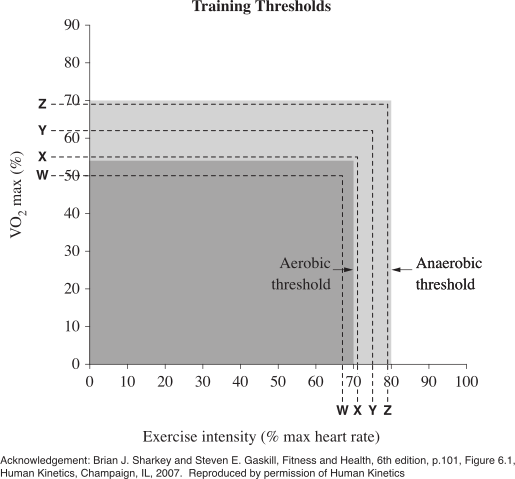
The graph shows training thresholds for aerobic and anaerobic conditioning.
 

Which exercise intensity indicates the greatest potential for gain in aerobic conditioning?

  1. W
  2. X
  3. Y
  4. Z
Show Answers Only

\(D\)

Show Worked Solution
  • D is correct: Zone Z is just below anaerobic threshold providing maximum aerobic benefit.

Other Options:

  • A is incorrect: Zone W is below aerobic threshold with minimal conditioning benefit.
  • B is incorrect: Zone X is at aerobic threshold but not optimal intensity.
  • C is incorrect: Zone Y provides some benefit but not maximum aerobic gain.

♦♦♦ Mean mark 13%.

Filed Under: Principles of training Tagged With: Band 6, smc-5460-20-Thresholds

HMS, TIP 2015 HSC 14 MC

Which of the following would be a suitable weight training plan for enhancing the performance of an endurance athlete?

  1. Low repetition numbers with long recovery periods between sets
  2. Low repetition numbers with short recovery periods between sets
  3. High repetition numbers with slow speed and long recovery periods between sets
  4. High repetition numbers with fast speed and short recovery periods between sets
Show Answers Only

\(D\)

Show Worked Solution
  • D is correct: High reps with fast speed and short recovery mimics endurance demands.

Other Options:

  • A is incorrect: Low reps and long recovery develops power not endurance.
  • B is incorrect: Low reps develops strength not muscular endurance.
  • C is incorrect: Slow speed and long recovery doesn’t match endurance specificity.

♦♦ Mean mark 47%.

Filed Under: Principles of training Tagged With: Band 5, smc-5460-20-Thresholds, smc-5460-40-Specificity

HMS, TIP 2023 HSC 17 MC

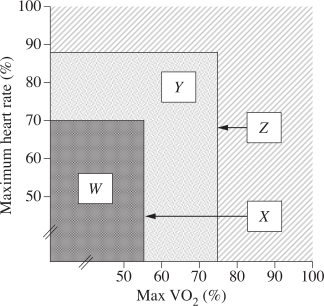
The following graph represents aerobic and anaerobic threshold training zones.

Which letter on the graph represents the minimum intensity for an athlete to train to produce a physiological improvement in performance?

  1. W
  2. X
  3. Y
  4. Z
Show Answers Only

\(B\)

Show Worked Solution
  • B is correct: Position X represents the aerobic threshold, the minimum intensity required for physiological adaptations.

Other Options:

  • A is incorrect: Position W is below the aerobic threshold and won’t produce significant adaptations.
  • C is incorrect: Position Y is higher intensity than needed for minimum improvement.
  • D is incorrect: Position Z represents anaerobic threshold, beyond minimum requirement.

♦♦♦ Mean mark 36%.

Filed Under: Principles of training Tagged With: Band 5, smc-5460-20-Thresholds

HMS, TIP 2024 HSC 2 MC

A coach develops a resistance training program where the weight load to be lifted is at 15−20 repetition maximum (15−20 RM).

By following the program's repetition maximum, what is the primary focus the coach is aiming to improve?

  1. Endurance
  2. Hypertrophy
  3. Power
  4. Strength
Show Answers Only

\(A\)

Show Worked Solution
  • A is correct: Primarily targets muscular endurance. Rep range too high for maximum strength or power development.

Other Options:

  • B is incorrect: Hypertrophy training typically uses 8-12 RM.
  • C is incorrect: Power training typically uses 1-5 RM with explosive movements.
  • D is incorrect: Strength training typically uses 1-6 RM.

♦ Mean mark 55%.

Filed Under: Principles of training Tagged With: Band 5, smc-5460-20-Thresholds

Copyright © 2014–2026 SmarterEd.com.au · Log in