SmarterEd

Aussie Maths & Science Teachers: Save your time with SmarterEd

  • Login
  • Get Help
  • About

HMS, HAG EQ-Bank 12 MC

Australia's Health 2024 data shows that First Nations people have a lower life expectancy compared to non-Indigenous Australians. Which factor is identified as a key contributor to reducing this health gap?

  1. Improving employment rates and educational attainment for First Nations people
  2. Focusing solely on genetic factors that influence health outcomes
  3. Reducing healthcare services in urban areas to fund remote programs
  4. Implementing identical health programs for all population groups regardless of cultural needs
Show Answers Only

\(A\)

Show Worked Solution
  • A is correct: Social determinants like employment and education contribute significantly to health gap.

Other Options:

  • B is incorrect: Social and environmental factors more significant than genetics.
  • C is incorrect: Reducing urban services doesn’t effectively address inequities.
  • D is incorrect: Cultural responsiveness needed, not identical programs.

Filed Under: Groups Experiencing Inequities Tagged With: Band 3, smc-5475-10-First Nations, smc-5475-50-Actions and Interventions

HMS, HAG EQ-Bank 11 MC

According to Australia's Health 2024, people living in rural and remote areas experience higher death rates and poorer health outcomes compared to those in major cities. Which is the most effective approach to address these geographic health inequities?

  1. Reduce healthcare funding to major cities to redistribute resources
  2. Focus only on emergency medical services in remote areas
  3. Implement identical healthcare delivery models across all geographic locations
  4. Increase telehealth services and mobile healthcare units for remote communities
Show Answers Only

\(D\)

Show Worked Solution
  • D is correct: Telehealth and mobile units address geographic barriers to healthcare access.

Other Options:

  • A is incorrect: Reducing city services doesn’t improve rural access effectively.
  • B is incorrect: Emergency-only approach ignores preventive and routine care needs.
  • C is incorrect: One-size-fits-all models don’t address unique rural challenges.

Filed Under: Groups Experiencing Inequities Tagged With: Band 4, smc-5475-20-Other Inequity Groups, smc-5475-50-Actions and Interventions

HMS, HAG 2012 HSC 24

Explain the roles of individuals, communities and governments in addressing the health inequities experienced by ONE group other than Aboriginal and Torres Strait Islander peoples.   (8 marks)

--- 24 WORK AREA LINES (style=lined) ---

Show Answers Only

Socioeconomically disadvantaged people experience significant health inequities requiring coordinated responses.

  • Individual roles involve pursuing education and employment opportunities, which leads to improved income and health outcomes. Disadvantaged individuals can access community health services, resulting in better preventive care. This occurs when people develop health literacy skills and seek appropriate medical attention early.
  • Community organisations provide essential support services that bridge healthcare gaps. For example, community health centres offer bulk-billing services in low-income areas, ensuring affordable healthcare access. Food banks and community kitchens address nutritional needs, while employment training programs create pathways to economic stability.
  • Government interventions target systemic inequities through policy and funding. Medicare provides universal healthcare coverage, removing financial barriers to medical treatment. Centrelink payments ensure basic income support, enabling disadvantaged families to meet essential needs. Public housing programs address accommodation security, which directly impacts health outcomes.
  • Collaborative approaches prove most effective when all three levels work together. This integration results in comprehensive support addressing multiple determinants of health simultaneously.
Show Worked Solution

Socioeconomically disadvantaged people experience significant health inequities requiring coordinated responses.

  • Individual roles involve pursuing education and employment opportunities, which leads to improved income and health outcomes. Disadvantaged individuals can access community health services, resulting in better preventive care. This occurs when people develop health literacy skills and seek appropriate medical attention early.
  • Community organisations provide essential support services that bridge healthcare gaps. For example, community health centres offer bulk-billing services in low-income areas, ensuring affordable healthcare access. Food banks and community kitchens address nutritional needs, while employment training programs create pathways to economic stability.
  • Government interventions target systemic inequities through policy and funding. Medicare provides universal healthcare coverage, removing financial barriers to medical treatment. Centrelink payments ensure basic income support, enabling disadvantaged families to meet essential needs. Public housing programs address accommodation security, which directly impacts health outcomes.
  • Collaborative approaches prove most effective when all three levels work together. This integration results in comprehensive support addressing multiple determinants of health simultaneously.

♦♦ Mean mark 46%.

Filed Under: Groups Experiencing Inequities Tagged With: Band 4, Band 5, smc-5475-20-Other Inequity Groups, smc-5475-50-Actions and Interventions

HMS, HAG 2015 HSC 33a

How can generalisations about Australians who experience health inequalities be challenged?   (8 marks)

--- 24 WORK AREA LINES (style=lined) ---

Show Answers Only
  • Generalisations about Australians experiencing health inequities can be challenged by using reliable health information and questioning what people assume about disadvantaged groups. The reason for this is that harmful stereotypes often oversimplify complex health determinants affecting disadvantaged groups.
  • This occurs when people question broad statements by examining reliable health data from sources like Australia’s Health reports. For instance, challenging assumptions about Aboriginal and Torres Strait Islander health requires understanding how colonisation impacts contribute to current health disparities rather than blaming individual lifestyle choices.
  • Consequently, promoting health literacy enables individuals to critically analyse media representations about disadvantaged groups. This leads to better understanding of how social determinants like education, employment and housing influence health outcomes more than personal behaviours.
  • The underlying reason is that involving affected communities in defining their own health challenges prevents others from making assumptions about them. Therefore, direct contact with affected populations helps break down misconceptions because personal experiences contradict stereotypical assumptions.
  • As a result, research methods that include disadvantaged groups in the process ensure they participate in health research rather than being passive subjects.
  • This demonstrates how combining evidence-based information with community involvement creates more accurate understandings of health inequity causes.
Show Worked Solution
  • Generalisations about Australians experiencing health inequities can be challenged by using reliable health information and questioning what people assume about disadvantaged groups. The reason for this is that harmful stereotypes often oversimplify complex health determinants affecting disadvantaged groups.
  • This occurs when people question broad statements by examining reliable health data from sources like Australia’s Health reports. For instance, challenging assumptions about Aboriginal and Torres Strait Islander health requires understanding how colonisation impacts contribute to current health disparities rather than blaming individual lifestyle choices.
  • Consequently, promoting health literacy enables individuals to critically analyse media representations about disadvantaged groups. This leads to better understanding of how social determinants like education, employment and housing influence health outcomes more than personal behaviours.
  • The underlying reason is that involving affected communities in defining their own health challenges prevents others from making assumptions about them. Therefore, direct contact with affected populations helps break down misconceptions because personal experiences contradict stereotypical assumptions.
  • As a result, research methods that include disadvantaged groups in the process ensure they participate in health research rather than being passive subjects.
  • This demonstrates how combining evidence-based information with community involvement creates more accurate understandings of health inequity causes.

♦♦♦♦ Mean mark 36%.

Filed Under: Groups Experiencing Inequities Tagged With: Band 4, Band 5, smc-5475-50-Actions and Interventions

HMS, HAG 2016 HSC 31a

In relation to a group affected by health inequities, explain the role of the media in influencing social attitudes and public policy.   (8 marks)

--- 24 WORK AREA LINES (style=lined) ---

Show Answers Only

Rural and Remote Australians

  • Media representation directly shapes public perceptions about rural communities through stereotypical portrayals that influence funding priorities.
  • This occurs because mainstream media often depicts rural areas as backward or resistant to change rather than highlighting systemic disadvantages.
  • When negative stereotypes dominate coverage of rural health issues, urban audiences develop unsympathetic attitudes toward resource allocation needs.
  • For instance, when television programs portray rural people as self-reliant and independent, public support decreases for government health service funding in remote areas.
      
  • Limited media access creates barriers to health promotion message delivery that compounds existing rural health disadvantages.
  • This happens because rural communities often experience poor internet connectivity and reduced television reception affecting health campaign exposure.
  • Geographic isolation leads to missed opportunities for accessing digital health promotion initiatives and online health resources.
  • Evidence of this includes rural youth missing social media mental health campaigns due to poor digital infrastructure, resulting in delayed help-seeking behaviours during crisis periods.
      
  • Positive media advocacy generates significant policy improvements when rural health stories receive compassionate and accurate representation.
  • This works by humanising rural health challenges and creating emotional connections with urban audiences and politicians.
  • Community-driven media initiatives trigger increased government attention and funding announcements for rural health infrastructure development.
  • A clear example is rural communities using local newspapers and radio stations to document healthcare worker shortages, prompting state government recruitment incentive programs and improved medical training placements.

Show Worked Solution

Rural and Remote Australians

  • Media representation directly shapes public perceptions about rural communities through stereotypical portrayals that influence funding priorities.
  • This occurs because mainstream media often depicts rural areas as backward or resistant to change rather than highlighting systemic disadvantages.
  • When negative stereotypes dominate coverage of rural health issues, urban audiences develop unsympathetic attitudes toward resource allocation needs.
  • For instance, when television programs portray rural people as self-reliant and independent, public support decreases for government health service funding in remote areas.
      
  • Limited media access creates barriers to health promotion message delivery that compounds existing rural health disadvantages.
  • This happens because rural communities often experience poor internet connectivity and reduced television reception affecting health campaign exposure.
  • Geographic isolation leads to missed opportunities for accessing digital health promotion initiatives and online health resources.
  • Evidence of this includes rural youth missing social media mental health campaigns due to poor digital infrastructure, resulting in delayed help-seeking behaviours during crisis periods.
      
  • Positive media advocacy generates significant policy improvements when rural health stories receive compassionate and accurate representation.
  • This works by humanising rural health challenges and creating emotional connections with urban audiences and politicians.
  • Community-driven media initiatives trigger increased government attention and funding announcements for rural health infrastructure development.
  • A clear example is rural communities using local newspapers and radio stations to document healthcare worker shortages, prompting state government recruitment incentive programs and improved medical training placements.

♦♦ Mean mark 50%.

Filed Under: Groups Experiencing Inequities Tagged With: Band 4, Band 5, smc-5475-50-Actions and Interventions

HMS, HAG 2018 HSC 32b

Population groups experiencing health inequities can often be exposed to multiple risk factors.

Analyse the implications of multiple risk factors in managing health inequities faced by population groups.   (12 marks)

--- 28 WORK AREA LINES (style=lined) ---

Show Answers Only

Overview Statement

  • Multiple risk factors create complex interactions that exacerbate health inequities for vulnerable populations.
  • These interconnected determinants require comprehensive management approaches that address root causes rather than individual symptoms, as single-factor interventions prove inadequate for sustainable change.

Component Relationship 1

  • Socioeconomic and environmental factors interact to reinforce each other to worsen health outcomes for disadvantaged groups through cascading effects.
  • Low income connects to poor housing conditions, which influences exposure to environmental hazards, overcrowding and chronic stress.
    For example, homeless populations experience combined effects of financial insecurity, inadequate shelter, limited healthcare access, and social isolation.
  • This relationship demonstrates how poverty leads to substandard living conditions that can enable infectious disease transmission, respiratory problems and mental health deterioration.
  • Poor nutrition results in part from limited income, which affects immune function and chronic disease development.
  • The significance is that addressing only housing or income provides limited improvement because other interconnected risks continue to undermine overall health status and create ongoing vulnerability.

Component Relationship 2

  • Social and cultural determinants interact with healthcare access barriers to create compounding disadvantages that perpetuate health inequities.
  • Indigenous Australians face multiple interacting challenges including geographic isolation, cultural barriers, historical trauma and systemic discrimination.
  • This pattern shows how racism in healthcare settings connects to reduced help-seeking behaviour, which results in delayed diagnosis, inadequate treatment and preventable complications.
  • Language barriers combine with cultural misunderstanding to create communication breakdowns between patients and providers. The trend indicates that cultural incompetence among healthcare providers affects trust levels, which depends on community experiences of discrimination and historical injustices.
  • Consequently, these interconnected factors create cycles where poor health outcomes reinforce social disadvantage and community mistrust of health services.

Implications and Synthesis

  • Management strategies must address multiple determinants simultaneously because isolated interventions fail to break complex disadvantage cycles that maintain health inequities.
  • The broader implications show that effective programs require coordinated approaches across housing, employment, education and healthcare sectors with sustained funding and community partnership.
  • This means that successful interventions involve community-led solutions that tackle structural inequalities while building cultural competence in service delivery systems and creating supportive policy frameworks.

Show Worked Solution

Overview Statement

  • Multiple risk factors create complex interactions that exacerbate health inequities for vulnerable populations.
  • These interconnected determinants require comprehensive management approaches that address root causes rather than individual symptoms, as single-factor interventions prove inadequate for sustainable change.

Component Relationship 1

  • Socioeconomic and environmental factors interact to reinforce each other to worsen health outcomes for disadvantaged groups through cascading effects.
  • Low income connects to poor housing conditions, which influences exposure to environmental hazards, overcrowding and chronic stress.
  • For example, homeless populations experience combined effects of financial insecurity, inadequate shelter, limited healthcare access, and social isolation.
  • This relationship demonstrates how poverty leads to substandard living conditions that can enable infectious disease transmission, respiratory problems and mental health deterioration.
  • Poor nutrition results in part from limited income, which affects immune function and chronic disease development.
  • The significance is that addressing only housing or income provides limited improvement because other interconnected risks continue to undermine overall health status and create ongoing vulnerability.

Component Relationship 2

  • Social and cultural determinants interact with healthcare access barriers to create compounding disadvantages that perpetuate health inequities.
  • Indigenous Australians face multiple interacting challenges including geographic isolation, cultural barriers, historical trauma and systemic discrimination.
  • This pattern shows how racism in healthcare settings connects to reduced help-seeking behaviour, which results in delayed diagnosis, inadequate treatment and preventable complications.
  • Language barriers combine with cultural misunderstanding to create communication breakdowns between patients and providers. The trend indicates that cultural incompetence among healthcare providers affects trust levels, which depends on community experiences of discrimination and historical injustices.
  • Consequently, these interconnected factors create cycles where poor health outcomes reinforce social disadvantage and community mistrust of health services.

Implications and Synthesis

  • Management strategies must address multiple determinants simultaneously because isolated interventions fail to break complex disadvantage cycles that maintain health inequities.
  • The broader implications show that effective programs require coordinated approaches across housing, employment, education and healthcare sectors with sustained funding and community partnership.
  • This means that successful interventions involve community-led solutions that tackle structural inequalities while building cultural competence in service delivery systems and creating supportive policy frameworks.

♦♦♦♦ Mean mark 40%.

Filed Under: Groups Experiencing Inequities Tagged With: Band 5, smc-5475-40-Causes of Inequity, smc-5475-50-Actions and Interventions

HMS, HAG 2018 HSC 32a

Explain how implementing economic and cultural change supports a population experiencing health inequity.   (8 marks)

--- 24 WORK AREA LINES (style=lined) ---

Show Answers Only

  • Economic changes support populations experiencing health inequity because improved financial resources enable better access to healthcare and healthy lifestyle choices. This occurs because economic disadvantage creates barriers to accessing medical services, nutritious food and safe housing.
    For example, increasing minimum wages and providing employment opportunities enables low-income families to afford preventive healthcare and quality food. This leads to reduced financial stress and improved capacity to make healthy choices.
    Additionally, government investment in affordable housing programs creates stable living environments that support better health outcomes. The reason for this is secure housing reduces exposure to environmental health risks and provides a foundation for accessing education and employment.
  • Cultural changes address health inequities because they challenge discriminatory attitudes and practices that prevent equal access to healthcare. This happens when healthcare providers receive cultural competency training to better understand diverse populations’ needs.
    For instance, implementing culturally appropriate health services for Aboriginal and Torres Strait Islander peoples results in increased trust and participation in health programs.
    Consequently, this produces higher rates of preventive care utilisation and better health outcomes.
    Furthermore, community education campaigns that reduce stigma around mental health facilitate greater help-seeking behaviour among affected populations.
  • Therefore, combined economic and cultural interventions create comprehensive support systems that address both structural barriers and social attitudes. This process ensures sustainable improvements in health equity across different population groups.

Show Worked Solution

  • Economic changes support populations experiencing health inequity because improved financial resources enable better access to healthcare and healthy lifestyle choices. This occurs because economic disadvantage creates barriers to accessing medical services, nutritious food and safe housing.
    For example, increasing minimum wages and providing employment opportunities enables low-income families to afford preventive healthcare and quality food. This leads to reduced financial stress and improved capacity to make healthy choices.
    Additionally, government investment in affordable housing programs creates stable living environments that support better health outcomes. The reason for this is secure housing reduces exposure to environmental health risks and provides a foundation for accessing education and employment.
  • Cultural changes address health inequities because they challenge discriminatory attitudes and practices that prevent equal access to healthcare. This happens when healthcare providers receive cultural competency training to better understand diverse populations’ needs.
    For instance, implementing culturally appropriate health services for Aboriginal and Torres Strait Islander peoples results in increased trust and participation in health programs.
    Consequently, this produces higher rates of preventive care utilisation and better health outcomes.
    Furthermore, community education campaigns that reduce stigma around mental health facilitate greater help-seeking behaviour among affected populations.
  • Therefore, combined economic and cultural interventions create comprehensive support systems that address both structural barriers and social attitudes. This process ensures sustainable improvements in health equity across different population groups.

♦♦ Mean mark 50%.

Filed Under: Groups Experiencing Inequities Tagged With: Band 4, Band 5, smc-5475-50-Actions and Interventions

HMS, HAG 2018 HSC 24

Explain the roles of individuals, communities and governments in addressing health inequities experienced by Aboriginal and Torres Strait Islander peoples. Use examples to support your answer.   (8 marks)

--- 24 WORK AREA LINES (style=lined) ---

Show Answers Only

Governments

  • Governments play crucial roles in addressing Aboriginal and Torres Strait Islander health inequities. This occurs because governments control funding allocation and policy development. For example, the Close the Gap strategy provides targeted funding for Indigenous health programs and services. This leads to improved access to culturally appropriate healthcare in remote communities. The reason for this is governments have the legislative power to create systemic change. Consequently, initiatives like Aboriginal Community Controlled Health Services receive ongoing support.

Communities

  • Communities are essential in implementing culturally safe health programs. This happens when local Aboriginal communities take ownership of health initiatives. For instance, community elders provide health education using traditional knowledge and storytelling methods. This creates trust between health services and community members. This relationship results in higher participation rates in screening programs and health checks. As a result, communities can address specific local health needs more effectively.

Individuals

  • Individuals contribute by adopting healthier behaviours and advocating for change. This works by personal responsibility combining with community support. For example, Aboriginal health workers serve as role models, encouraging smoking cessation and regular health checks. This demonstrates how individuals can influence family and peer networks. Therefore, personal actions create ripple effects throughout communities, improving overall health outcomes.

Show Worked Solution

Governments

  • Governments play crucial roles in addressing Aboriginal and Torres Strait Islander health inequities. This occurs because governments control funding allocation and policy development. For example, the Close the Gap strategy provides targeted funding for Indigenous health programs and services. This leads to improved access to culturally appropriate healthcare in remote communities. The reason for this is governments have the legislative power to create systemic change. Consequently, initiatives like Aboriginal Community Controlled Health Services receive ongoing support.

Communities

  • Communities are essential in implementing culturally safe health programs. This happens when local Aboriginal communities take ownership of health initiatives. For instance, community elders provide health education using traditional knowledge and storytelling methods. This creates trust between health services and community members. This relationship results in higher participation rates in screening programs and health checks. As a result, communities can address specific local health needs more effectively.

Individuals

  • Individuals contribute by adopting healthier behaviours and advocating for change. This works by personal responsibility combining with community support. For example, Aboriginal health workers serve as role models, encouraging smoking cessation and regular health checks. This demonstrates how individuals can influence family and peer networks. Therefore, personal actions create ripple effects throughout communities, improving overall health outcomes.

Filed Under: Groups Experiencing Inequities Tagged With: Band 4, smc-5475-10-First Nations, smc-5475-50-Actions and Interventions

HMS, HAG 2019 HSC 32b

To what extent has the inequity gap changed for TWO population groups as a result of government interventions?   (12 marks)

--- 28 WORK AREA LINES (style=lined) ---

Show Answers Only

Judgment Statement

  • Government interventions have achieved moderate success in reducing health inequities for rural Australians and older people. Evidence shows significant improvements in access and some health outcomes, though substantial gaps remain.

Rural and Remote Australians

  • Government interventions have moderately reduced health inequities for rural Australians through improved access initiatives. The Royal Flying Doctor Service connects remote communities with emergency and primary healthcare services. Medicare telehealth consultations enable rural patients to access specialists without travelling long distances. The Rural Health Strategy provides additional funding for medical equipment and practitioners in regional areas.
  • These interventions demonstrate measurable improvements in healthcare access rates. Emergency response times have decreased in many remote regions. Specialist consultation rates have increased through digital health platforms. However, significant challenges remain as rural Australians still experience higher mortality rates than metropolitan populations. Chronic disease management continues to lag behind urban standards, indicating partial effectiveness of current interventions.

Older Australians

  • Government interventions show substantial progress in supporting healthy ageing and reducing inequities for older Australians. My Aged Care coordinates support services and helps older people access appropriate care. The National Immunisation Program provides free vaccinations specifically targeting older adults’ health needs. Medicare subsidises preventive health checks for people aged 65 and over.
  • Evidence supports significant positive outcomes from these targeted interventions. Aged care service utilisation rates have increased substantially over recent years. Preventable hospitalisation rates for older people have decreased due to better community support. Life expectancy for older Australians continues to improve, suggesting successful health promotion strategies. These interventions effectively address social isolation and healthcare access barriers that previously created major inequities.

Reaffirmation

  • Government interventions have achieved moderate success in reducing health inequities for both population groups. Rural health initiatives show promise but require sustained investment to achieve equity with urban areas. Older Australian programs demonstrate stronger outcomes, reflecting more comprehensive policy approaches and adequate resource allocation for this growing demographic.

Show Worked Solution

Judgment Statement

  • Government interventions have achieved moderate success in reducing health inequities for rural Australians and older people. Evidence shows significant improvements in access and some health outcomes, though substantial gaps remain.

Rural and Remote Australians

  • Government interventions have moderately reduced health inequities for rural Australians through improved access initiatives. The Royal Flying Doctor Service connects remote communities with emergency and primary healthcare services. Medicare telehealth consultations enable rural patients to access specialists without travelling long distances. The Rural Health Strategy provides additional funding for medical equipment and practitioners in regional areas.
  • These interventions demonstrate measurable improvements in healthcare access rates. Emergency response times have decreased in many remote regions. Specialist consultation rates have increased through digital health platforms. However, significant challenges remain as rural Australians still experience higher mortality rates than metropolitan populations. Chronic disease management continues to lag behind urban standards, indicating partial effectiveness of current interventions.

Older Australians

  • Government interventions show substantial progress in supporting healthy ageing and reducing inequities for older Australians. My Aged Care coordinates support services and helps older people access appropriate care. The National Immunisation Program provides free vaccinations specifically targeting older adults’ health needs. Medicare subsidises preventive health checks for people aged 65 and over.
  • Evidence supports significant positive outcomes from these targeted interventions. Aged care service utilisation rates have increased substantially over recent years. Preventable hospitalisation rates for older people have decreased due to better community support. Life expectancy for older Australians continues to improve, suggesting successful health promotion strategies. These interventions effectively address social isolation and healthcare access barriers that previously created major inequities.

Reaffirmation

  • Government interventions have achieved moderate success in reducing health inequities for both population groups. Rural health initiatives show promise but require sustained investment to achieve equity with urban areas. Older Australian programs demonstrate stronger outcomes, reflecting more comprehensive policy approaches and adequate resource allocation for this growing demographic.

♦♦ Mean mark 45%.

Filed Under: Groups Experiencing Inequities Tagged With: Band 5, smc-5475-30-Extent of Inequities, smc-5475-50-Actions and Interventions

HMS, HAG 2022 HSC 18 MC

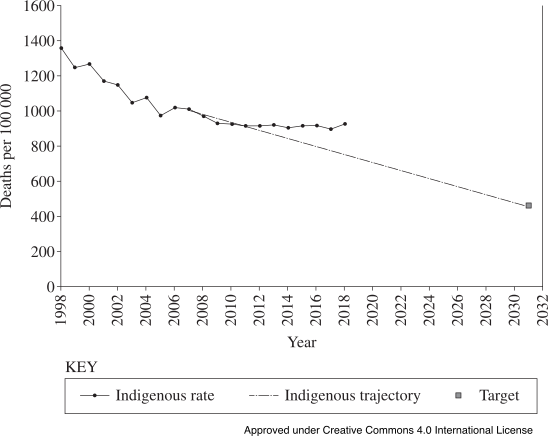
The graph shows the mortality rate and projected trajectory to the year 2031 for Indigenous Australians.
 

Which of the following was the most significant factor that contributed to the trend in the mortality rate for Indigenous Australians from 1998-2005?

  1. More Indigenous Australian students completed Year 12
  2. The Australian Government's implementation of the Closing the Gap framework
  3. Increased childhood immunisation rates among Indigenous populations in Australia
  4. Improvement in the early detection and management of chronic disease for Indigenous Australians
Show Answers Only

\( D \)

Show Worked Solution
  • D is correct: Early detection and chronic disease management directly reduces mortality rates.

Other Options:

  • A is incorrect: Education improvements have longer-term rather than immediate mortality impact.
  • B is incorrect: Closing the Gap was implemented after 2008, not 1998-2005.
  • C is incorrect: Immunisation affects childhood mortality, not overall population trends.

♦♦ Mean mark 40%.

Filed Under: Groups Experiencing Inequities Tagged With: Band 5, smc-5475-10-First Nations, smc-5475-30-Extent of Inequities, smc-5475-50-Actions and Interventions

HMS, HAG 2021 HSC 32a

  1. In relation to ONE population group experiencing health inequities, outline the media's role in influencing public policy.   (3 marks)

    --- 6 WORK AREA LINES (style=lined) ---

  2. Explain the effects of a government intervention for ONE population group that experiences health inequities.   (5 marks)

    --- 15 WORK AREA LINES (style=lined) ---

Show Answers Only

i.    Aboriginal and Torres Strait Islander Peoples

  • Media coverage of Aboriginal and Torres Strait Islander health inequities raises public awareness about persistent disparities in life expectancy and chronic disease rates.
  • Investigative journalism highlighting inadequate healthcare access in remote communities creates pressure for government policy responses.
  • Media campaigns featuring Indigenous health advocates amplify community voices and demands for culturally appropriate services.
  • Television documentaries and news reports generate public support for increased health funding and policy reforms addressing systemic barriers to healthcare access.

ii.    Aboriginal and Torres Strait Islander Peoples

  • The Closing the Gap strategy aims to reduce health disparities between Aboriginal and Torres Strait Islander Peoples and non-Indigenous Australians. This intervention works by establishing measurable targets for life expectancy, infant mortality, and chronic disease management.
  • The strategy has resulted in improved access to culturally appropriate healthcare through increased funding for Aboriginal Community Controlled Health Organisations. These services consequently provide more effective primary healthcare because they incorporate traditional healing with Western medicine and employ Indigenous health workers.
  • Educational initiatives have led to enhanced health literacy among Indigenous communities. Programs teaching diabetes management and nutrition have enabled better chronic condition self-management. This approach produces measurable improvements in blood glucose control and medication adherence.
  • However, progress remains limited in remote areas where geographical barriers continue to restrict specialist access. Additionally, social determinants like housing and employment still influence health outcomes despite targeted interventions. Overall effects demonstrate modest improvements in specific indicators while highlighting the need for broader social policy integration to address underlying inequality causes.
Show Worked Solution

i.    Aboriginal and Torres Strait Islander Peoples

  • Media coverage of Aboriginal and Torres Strait Islander health inequities raises public awareness about persistent disparities in life expectancy and chronic disease rates.
  • Investigative journalism highlighting inadequate healthcare access in remote communities creates pressure for government policy responses.
  • Media campaigns featuring Indigenous health advocates amplify community voices and demands for culturally appropriate services.
  • Television documentaries and news reports generate public support for increased health funding and policy reforms addressing systemic barriers to healthcare access.

ii.    Aboriginal and Torres Strait Islander Peoples

  • The Closing the Gap strategy aims to reduce health disparities between Aboriginal and Torres Strait Islander Peoples and non-Indigenous Australians. This intervention works by establishing measurable targets for life expectancy, infant mortality, and chronic disease management.
  • The strategy has resulted in improved access to culturally appropriate healthcare through increased funding for Aboriginal Community Controlled Health Organisations. These services consequently provide more effective primary healthcare because they incorporate traditional healing with Western medicine and employ Indigenous health workers.
  • Educational initiatives have led to enhanced health literacy among Indigenous communities. Programs teaching diabetes management and nutrition have enabled better chronic condition self-management. This approach produces measurable improvements in blood glucose control and medication adherence.
  • However, progress remains limited in remote areas where geographical barriers continue to restrict specialist access. Additionally, social determinants like housing and employment still influence health outcomes despite targeted interventions. Overall effects demonstrate modest improvements in specific indicators while highlighting the need for broader social policy integration to address underlying inequality causes.

♦ Mean mark 50%.

Filed Under: Groups Experiencing Inequities Tagged With: Band 3, Band 5, smc-5475-10-First Nations, smc-5475-50-Actions and Interventions

HMS, HAG 2022 HSC 31b

Analyse how enabling, mediating and advocating processes can lead to sustainable health improvements for disadvantaged groups.   (12 marks)

--- 30 WORK AREA LINES (style=lined) ---

Show Answers Only

Overview Statement

  • Enabling, mediating and advocating processes interact to create comprehensive support systems that address root causes of health disadvantage.
  • Key relationships include skill development empowerment, stakeholder collaboration, and systemic change advocacy.

Enabling and Mediating Relationship

  • Enabling processes directly empower disadvantaged groups by building health literacy and self-management skills for chronic conditions.
  • This aligns with mediating processes which facilitate collaboration between health services, community organisations and disadvantaged populations.
  • For example, diabetes education programs for Aboriginal communities enable individuals to manage blood glucose, while mediating processes bring together traditional healers and medical practitioners.
  • This relationship results in culturally appropriate care that respects traditional knowledge while incorporating medical expertise.
  • The interaction means sustainable improvements occur because communities develop internal capacity while maintaining external professional support.
  • Mediating processes ensure different stakeholders work toward common health goals rather than competing approaches.

Advocating and System Change Relationship

  • Advocating processes influence policy makers and healthcare systems to remove structural barriers that perpetuate health inequities.
  • Advocacy complements enabling processes by creating environments where newly developed skills can be effectively utilised.
  • For instance, advocacy for bulk-billing clinics in disadvantaged areas enables low-income families to use health literacy skills without financial barriers.
  • The significance is that individual empowerment becomes meaningless without systemic change to support improved health behaviours.
  • Advocacy leads to legislative changes like improved disability access requirements that complement individual skill development programs.
  • Thus demonstrating how structural change amplifies the impact of personal empowerment initiatives.

Implications and Synthesis

  • These interconnected processes create sustainable change because they address both individual capacity and environmental barriers simultaneously.
  • The pattern shows that isolated approaches fail while integrated enabling, mediating and advocating strategies produce lasting health improvements.
  • Therefore, sustainable health improvements for disadvantaged groups depend on coordinated processes that empower individuals, facilitate collaboration, and transform systems.
Show Worked Solution

Overview Statement

  • Enabling, mediating and advocating processes interact to create comprehensive support systems that address root causes of health disadvantage.
  • Key relationships include skill development empowerment, stakeholder collaboration, and systemic change advocacy.

Enabling and Mediating Relationship

  • Enabling processes directly empower disadvantaged groups by building health literacy and self-management skills for chronic conditions.
  • This aligns with mediating processes which facilitate collaboration between health services, community organisations and disadvantaged populations.
  • For example, diabetes education programs for Aboriginal communities enable individuals to manage blood glucose, while mediating processes bring together traditional healers and medical practitioners.
  • This relationship results in culturally appropriate care that respects traditional knowledge while incorporating medical expertise.
  • The interaction means sustainable improvements occur because communities develop internal capacity while maintaining external professional support.
  • Mediating processes ensure different stakeholders work toward common health goals rather than competing approaches.

Advocating and System Change Relationship

  • Advocating processes influence policy makers and healthcare systems to remove structural barriers that perpetuate health inequities.
  • Advocacy complements enabling processes by creating environments where newly developed skills can be effectively utilised.
  • For instance, advocacy for bulk-billing clinics in disadvantaged areas enables low-income families to use health literacy skills without financial barriers.
  • The significance is that individual empowerment becomes meaningless without systemic change to support improved health behaviours.
  • Advocacy leads to legislative changes like improved disability access requirements that complement individual skill development programs.
  • Thus demonstrating how structural change amplifies the impact of personal empowerment initiatives.

Implications and Synthesis

  • These interconnected processes create sustainable change because they address both individual capacity and environmental barriers simultaneously.
  • The pattern shows that isolated approaches fail while integrated enabling, mediating and advocating strategies produce lasting health improvements.
  • Therefore, sustainable health improvements for disadvantaged groups depend on coordinated processes that empower individuals, facilitate collaboration, and transform systems.

♦♦ Mean mark 41%.

Filed Under: Groups Experiencing Inequities Tagged With: Band 5, smc-5475-50-Actions and Interventions

HMS, HAG 2022 HSC 31aii

Explain how improving access to services and transport can reduce health inequities for a population group.   (5 marks)

--- 15 WORK AREA LINES (style=lined) ---

Show Answers Only

Rural and Remote Populations

  • Improved transport access directly enables rural and remote populations to reach healthcare facilities for preventive screening and treatment.
  • Such access removes the primary barrier, geographic isolation, preventing rural residents from accessing specialist medical services.
  • For example, shuttle bus services allow elderly rural residents to attend regular GP appointments without relying on family transport.
  • Mobile health services bring essential healthcare directly to remote communities, eliminating the need for long-distance travel.
  • This is facilitated by sending specialist teams and screening equipment to rural towns on scheduled visits.
  • Consequently, rural women can receive mammograms without travelling hundreds of kilometres to major cities.
  • Enhanced telehealth services enable rural patients to consult specialists via video conferencing from local medical centres.
  • Thus creating immediate access to expert medical advice that would otherwise require expensive overnight trips.
  • As a result, chronic conditions like diabetes can be monitored regularly, preventing serious complications.
  • Therefore, systematic access improvements directly address the geographic disadvantage that causes health inequities in rural and remote areas.
Show Worked Solution

Rural and Remote Populations

  • Improved transport access directly enables rural and remote populations to reach healthcare facilities for preventive screening and treatment.
  • Such access removes the primary barrier, geographic isolation, preventing rural residents from accessing specialist medical services.
  • For example, shuttle bus services allow elderly rural residents to attend regular GP appointments without relying on family transport.
  • Mobile health services bring essential healthcare directly to remote communities, eliminating the need for long-distance travel.
  • This is facilitated by sending specialist teams and screening equipment to rural towns on scheduled visits.
  • Consequently, rural women can receive mammograms without travelling hundreds of kilometres to major cities.
  • Enhanced telehealth services enable rural patients to consult specialists via video conferencing from local medical centres.
  • Thus creating immediate access to expert medical advice that would otherwise require expensive overnight trips.
  • As a result, chronic conditions like diabetes can be monitored regularly, preventing serious complications.
  • Therefore, systematic access improvements directly address the geographic disadvantage that causes health inequities in rural and remote areas.

♦ Mean mark 52%.

Filed Under: Groups Experiencing Inequities Tagged With: Band 5, smc-5475-50-Actions and Interventions

HMS, HAG 2023 HSC 32aii

Explain how ensuring cultural relevance improves the potential for the success of ONE health promotion strategy.   (5 marks)

--- 15 WORK AREA LINES (style=lined) ---

Show Answers Only

Sample answer

  • Cultural relevance in the Aboriginal and Torres Strait Islander health promotion campaign “Bring the Mob Home Safely” significantly improves success potential through multiple mechanisms.
  • This occurs because acknowledging and respecting cultural values and beliefs ensures that health messages align with cultural worldviews. As a result, community members are more likely to accept and act on safety messages rather than rejecting externally imposed solutions.
  • Using appropriate language, terminology and communication styles leads to better message resonance with target audiences. This creates stronger connections when visual representations reflect community members rather than generic imagery. Therefore, culturally appropriate messaging enables deeper engagement with road safety content.
  • Community involvement in planning and implementation produces genuine ownership of the campaign. This mechanism allows communities to identify locally relevant barriers to safe road practices. Consequently, solutions become more practical and sustainable because they address specific contextual factors affecting each community.
  • The underlying reason is that cultural relevance builds trust with communities historically subjected to inappropriate interventions. This relationship results in improved participation rates and generates lasting behaviour change towards safer road practices.

Show Worked Solution

  • Cultural relevance in the Aboriginal and Torres Strait Islander health promotion campaign “Bring the Mob Home Safely” significantly improves success potential through multiple mechanisms.
  • This occurs because acknowledging and respecting cultural values and beliefs ensures that health messages align with cultural worldviews. As a result, community members are more likely to accept and act on safety messages rather than rejecting externally imposed solutions.
  • Using appropriate language, terminology and communication styles leads to better message resonance with target audiences. This creates stronger connections when visual representations reflect community members rather than generic imagery. Therefore, culturally appropriate messaging enables deeper engagement with road safety content.
  • Community involvement in planning and implementation produces genuine ownership of the campaign. This mechanism allows communities to identify locally relevant barriers to safe road practices. Consequently, solutions become more practical and sustainable because they address specific contextual factors affecting each community.
  • The underlying reason is that cultural relevance builds trust with communities historically subjected to inappropriate interventions. This relationship results in improved participation rates and generates lasting behaviour change towards safer road practices.

♦♦ Mean mark 41%.

Filed Under: Groups Experiencing Inequities Tagged With: Band 5, smc-5475-10-First Nations, smc-5475-50-Actions and Interventions

HMS, HAG 2023 HSC 12 MC

In 2022, the Australian Institute of Health and Welfare reported that the average life expectancy for Aboriginal and Torres Strait Islander peoples was eight years less than that of non-Indigenous people in Australia.

Which of the following determinants is likely to have the most significant influence on narrowing this gap in the next five years?

  1. Improved access to housing
  2. Better access to culturally responsive health services
  3. Increased participation in outdoor recreational activities
  4. The further development of cultural maintenance programs
Show Answers Only

\(B\)

Show Worked Solution

Consider Option B 

  • B is correct: Culturally responsive health services reduce healthcare barriers affecting Aboriginal and Torres Strait Islander life expectancy.

Other Options:

  • A is incorrect: Housing access is important but has longer-term impact timeframes.
  • C is incorrect: Outdoor activities alone won’t address systemic healthcare barriers.
  • D is incorrect: Cultural maintenance programs are valuable but have indirect health impacts.

Filed Under: Groups Experiencing Inequities Tagged With: Band 3, smc-5475-10-First Nations, smc-5475-50-Actions and Interventions

HMS HAG 2023 HSC 8 MC

What strategy would be most effective in improving equity of access to health services for Aboriginal and Torres Strait Islander peoples?

  1. Increasing awareness of online health resources
  2. Increasing the funding for child immunisation programs
  3. Providing a telephone or video consultation with a specialist
  4. Implementing training for community members to become health care providers
Show Answers Only

\(D\)

Show Worked Solution
  • D is correct: Training community members addresses cultural barriers and sustainability by building capacity within Aboriginal and Torres Strait Islander communities.

Other Options:

  • A is incorrect: Online resources may not address cultural barriers or internet access issues.
  • B is incorrect: Child immunisation doesn’t address broader healthcare access barriers.
  • C is incorrect: Telehealth helps but doesn’t address cultural barriers comprehensively.

♦♦ Mean mark 39%.

Filed Under: Groups Experiencing Inequities Tagged With: Band 5, smc-5475-10-First Nations, smc-5475-50-Actions and Interventions

Copyright © 2014–2026 SmarterEd.com.au · Log in