SmarterEd

Aussie Maths & Science Teachers: Save your time with SmarterEd

  • Login
  • Get Help
  • About

HMS, HAG 2013 HSC 3 MC

What would a comparison of the health status of Indigenous and non­Indigenous Australians show?

  1. Non­-Indigenous Australians have higher infant mortality rates.
  2. Non­-Indigenous Australians have a lower prevalence of acute diseases.
  3. Indigenous Australians have lower hospital admission rates.
  4. Indigenous Australians have a higher prevalence of chronic diseases
Show Answers Only

\(D\)

Show Worked Solution
  • D is correct: Indigenous Australians experience significantly higher chronic disease rates.

Other Options:

  • A is incorrect: Indigenous Australians have higher infant mortality rates.
  • B is incorrect: Non-Indigenous Australians have lower chronic disease prevalence.
  • C is incorrect: Indigenous Australians have higher hospitalisation rates overall.

Filed Under: Groups Experiencing Inequities Tagged With: Band 3, smc-5475-10-First Nations, smc-5475-30-Extent of Inequities

HMS, HAG 2014 HSC 23

Explain the nature and extent of health inequities within Australia for one group OTHER than Aboriginal and Torres Strait Islanders.   (5 marks)

--- 15 WORK AREA LINES (style=lined) ---

Show Answers Only
  • People in rural and remote areas experience significant health inequities because limited healthcare access and higher risk behaviours create poorer health outcomes compared to city residents.
  • Geographic isolation directly affects health service availability and emergency response times. This leads to higher mortality rates for preventable chronic diseases including cardiovascular disease. As a result, life expectancy is lower with increased suicide rates.
  • Limited specialist services occur because fewer medical professionals choose rural practice locations. This creates longer travel distances and delays in receiving appropriate treatment. Consequently, emergency medical situations have poorer outcomes than urban areas.
  • Higher risk behaviours develop due to social isolation and limited recreational opportunities. This results in increased smoking rates and alcohol consumption exceeding guidelines. The combination produces elevated rates of preventable chronic diseases.
  • Socioeconomic disadvantage contributes through lower average incomes and reduced educational opportunities. This interaction with geographic isolation generates compounded effects on mental health and wellbeing.
Show Worked Solution
  • People in rural and remote areas experience significant health inequities because limited healthcare access and higher risk behaviours create poorer health outcomes compared to city residents.
  • Geographic isolation directly affects health service availability and emergency response times. This leads to higher mortality rates for preventable chronic diseases including cardiovascular disease. As a result, life expectancy is lower with increased suicide rates.
  • Limited specialist services occur because fewer medical professionals choose rural practice locations. This creates longer travel distances and delays in receiving appropriate treatment. Consequently, emergency medical situations have poorer outcomes than urban areas.
  • Higher risk behaviours develop due to social isolation and limited recreational opportunities. This results in increased smoking rates and alcohol consumption exceeding guidelines. The combination produces elevated rates of preventable chronic diseases.
  • Socioeconomic disadvantage contributes through lower average incomes and reduced educational opportunities. This interaction with geographic isolation generates compounded effects on mental health and wellbeing.

Filed Under: Groups Experiencing Inequities Tagged With: Band 4, smc-5475-20-Other Inequity Groups, smc-5475-30-Extent of Inequities

HMS, HAG 2019 HSC 32b

To what extent has the inequity gap changed for TWO population groups as a result of government interventions?   (12 marks)

--- 28 WORK AREA LINES (style=lined) ---

Show Answers Only

Judgment Statement

  • Government interventions have achieved moderate success in reducing health inequities for rural Australians and older people. Evidence shows significant improvements in access and some health outcomes, though substantial gaps remain.

Rural and Remote Australians

  • Government interventions have moderately reduced health inequities for rural Australians through improved access initiatives. The Royal Flying Doctor Service connects remote communities with emergency and primary healthcare services. Medicare telehealth consultations enable rural patients to access specialists without travelling long distances. The Rural Health Strategy provides additional funding for medical equipment and practitioners in regional areas.
  • These interventions demonstrate measurable improvements in healthcare access rates. Emergency response times have decreased in many remote regions. Specialist consultation rates have increased through digital health platforms. However, significant challenges remain as rural Australians still experience higher mortality rates than metropolitan populations. Chronic disease management continues to lag behind urban standards, indicating partial effectiveness of current interventions.

Older Australians

  • Government interventions show substantial progress in supporting healthy ageing and reducing inequities for older Australians. My Aged Care coordinates support services and helps older people access appropriate care. The National Immunisation Program provides free vaccinations specifically targeting older adults’ health needs. Medicare subsidises preventive health checks for people aged 65 and over.
  • Evidence supports significant positive outcomes from these targeted interventions. Aged care service utilisation rates have increased substantially over recent years. Preventable hospitalisation rates for older people have decreased due to better community support. Life expectancy for older Australians continues to improve, suggesting successful health promotion strategies. These interventions effectively address social isolation and healthcare access barriers that previously created major inequities.

Reaffirmation

  • Government interventions have achieved moderate success in reducing health inequities for both population groups. Rural health initiatives show promise but require sustained investment to achieve equity with urban areas. Older Australian programs demonstrate stronger outcomes, reflecting more comprehensive policy approaches and adequate resource allocation for this growing demographic.

Show Worked Solution

Judgment Statement

  • Government interventions have achieved moderate success in reducing health inequities for rural Australians and older people. Evidence shows significant improvements in access and some health outcomes, though substantial gaps remain.

Rural and Remote Australians

  • Government interventions have moderately reduced health inequities for rural Australians through improved access initiatives. The Royal Flying Doctor Service connects remote communities with emergency and primary healthcare services. Medicare telehealth consultations enable rural patients to access specialists without travelling long distances. The Rural Health Strategy provides additional funding for medical equipment and practitioners in regional areas.
  • These interventions demonstrate measurable improvements in healthcare access rates. Emergency response times have decreased in many remote regions. Specialist consultation rates have increased through digital health platforms. However, significant challenges remain as rural Australians still experience higher mortality rates than metropolitan populations. Chronic disease management continues to lag behind urban standards, indicating partial effectiveness of current interventions.

Older Australians

  • Government interventions show substantial progress in supporting healthy ageing and reducing inequities for older Australians. My Aged Care coordinates support services and helps older people access appropriate care. The National Immunisation Program provides free vaccinations specifically targeting older adults’ health needs. Medicare subsidises preventive health checks for people aged 65 and over.
  • Evidence supports significant positive outcomes from these targeted interventions. Aged care service utilisation rates have increased substantially over recent years. Preventable hospitalisation rates for older people have decreased due to better community support. Life expectancy for older Australians continues to improve, suggesting successful health promotion strategies. These interventions effectively address social isolation and healthcare access barriers that previously created major inequities.

Reaffirmation

  • Government interventions have achieved moderate success in reducing health inequities for both population groups. Rural health initiatives show promise but require sustained investment to achieve equity with urban areas. Older Australian programs demonstrate stronger outcomes, reflecting more comprehensive policy approaches and adequate resource allocation for this growing demographic.

♦♦ Mean mark 45%.

Filed Under: Groups Experiencing Inequities Tagged With: Band 5, smc-5475-30-Extent of Inequities, smc-5475-50-Actions and Interventions

HMS, HAG 2020 HSC 16 MC

Which of the following identifies the health inequities experienced by Aboriginal and Torres Strait Islander peoples when compared to non-Indigenous Australians?

  1. Lower life expectancy, higher mortality rate from diabetes, higher incidence of lung cancer
  2. Lower life expectancy, lower morbidity rate from diabetes, higher incidence of breast cancer
  3. Higher infant mortality rate, lower mortality rate from diabetes, higher incidence of lung cancer
  4. Higher infant mortality rate, higher morbidity rate from diabetes, lower rate of hospitalisation due to injury
Show Answers Only

\(A\)

Show Worked Solution
  • A is correct: Aboriginal peoples have lower life expectancy, higher diabetes mortality, higher lung cancer.

Other Options:

  • B is incorrect: Aboriginal peoples have higher not lower diabetes morbidity.
  • C is incorrect: Aboriginal peoples have higher not lower diabetes mortality.
  • D is incorrect: Aboriginal peoples have higher not lower injury hospitalisation rates.

Filed Under: Groups Experiencing Inequities Tagged With: Band 3, smc-5475-10-First Nations, smc-5475-30-Extent of Inequities

HMS, HAG 2022 HSC 18 MC

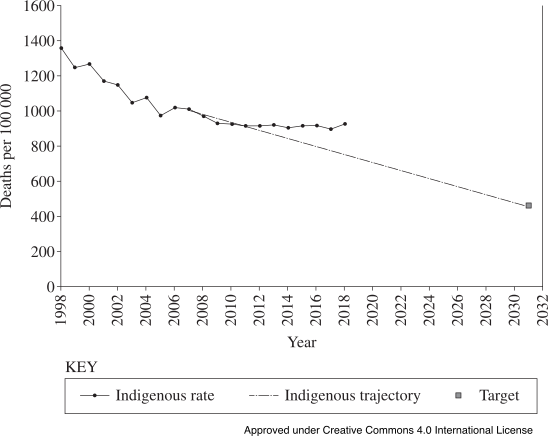
The graph shows the mortality rate and projected trajectory to the year 2031 for Indigenous Australians.
 

Which of the following was the most significant factor that contributed to the trend in the mortality rate for Indigenous Australians from 1998-2005?

  1. More Indigenous Australian students completed Year 12
  2. The Australian Government's implementation of the Closing the Gap framework
  3. Increased childhood immunisation rates among Indigenous populations in Australia
  4. Improvement in the early detection and management of chronic disease for Indigenous Australians
Show Answers Only

\( D \)

Show Worked Solution
  • D is correct: Early detection and chronic disease management directly reduces mortality rates.

Other Options:

  • A is incorrect: Education improvements have longer-term rather than immediate mortality impact.
  • B is incorrect: Closing the Gap was implemented after 2008, not 1998-2005.
  • C is incorrect: Immunisation affects childhood mortality, not overall population trends.

♦♦ Mean mark 40%.

Filed Under: Groups Experiencing Inequities Tagged With: Band 5, smc-5475-10-First Nations, smc-5475-30-Extent of Inequities, smc-5475-50-Actions and Interventions

HMS, HAG 2021 HSC 15 MC

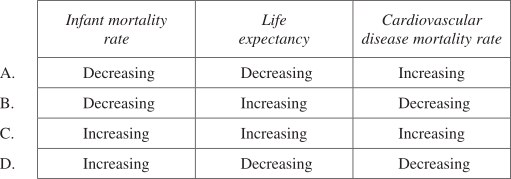
Which row in the table shows the trend over the past 10 years for Aboriginal and Torres Strait Islander peoples in relation to the identified health measures?

Show Answers Only

\(B\)

Show Worked Solution
  • B is correct: All three measures show positive improvements over decade.

Other Options:

  • A is incorrect: Life expectancy has been increasing not decreasing.
  • C is incorrect: Infant mortality and cardiovascular mortality have decreased.
  • D is incorrect: Infant mortality has decreased and life expectancy increased.

Filed Under: Groups Experiencing Inequities Tagged With: Band 4, smc-5475-10-First Nations, smc-5475-30-Extent of Inequities

HMS, HAG 2024 HSC 19 MC

Improvements in the health of Aboriginal and Torres Strait Islander peoples in relation to which THREE chronic health conditions has resulted in a reduction in mortality rates?

  1. Cancer, diabetes, kidney disease
  2. Cancer, cardiovascular disease, diabetes
  3. Cancer, cardiovascular disease, kidney disease
  4. Cardiovascular disease, diabetes, kidney disease
Show Answers Only

\(D\)

Show Worked Solution
  • D is correct: These three chronic conditions have shown reduced mortality rates in Aboriginal and Torres Strait Islander populations due to targeted interventions.

Other Options:

  • A,B and C are incorrect: Combinations of chronic conditions don’t match the mortality rate improvement patterns.

♦♦♦♦ Mean mark 17%.

Filed Under: Groups Experiencing Inequities Tagged With: Band 6, smc-5475-10-First Nations, smc-5475-30-Extent of Inequities

Copyright © 2014–2026 SmarterEd.com.au · Log in