SmarterEd

Aussie Maths & Science Teachers: Save your time with SmarterEd

  • Login
  • Get Help
  • About

HMS, HAG EQ-Bank 140

Research shows that five-year survival rates for major cancers have improved significantly, with prostate cancer increasing from 89% to 96% and breast cancer from 79% to 92%. However, certain population groups continue to experience poorer cancer outcomes.

Analyse how improvements in cancer detection and treatment interact with health inequities to create different cancer outcomes across Australian populations.   (12 marks)

--- 30 WORK AREA LINES (style=lined) ---

Show Answers Only

Overview Statement

  • Cancer detection and treatment improvements show complex relationships with health inequities across Australian populations.
  • They reveal important connections between healthcare access, early intervention and survival outcomes.

Component Relationship 1

  • Advanced cancer detection methods create substantial survival improvements for populations with good healthcare access, demonstrated through dramatically improved five-year survival rates across major cancer types.
  • Routine screening programs, enhanced imaging techniques and early intervention strategies enable cancers to be detected at treatable stages when outcomes are most favourable.
  • This relationship shows that technological advances and systematic screening approaches directly contribute to better survival rates by identifying cancers before they progress to advanced stages.
  • The significance of this pattern reveals that early detection remains the most critical factor in determining positive cancer outcomes across different cancer types and patient populations.

Component Relationship 2

  • However, health inequities create barriers that prevent certain population groups from accessing these improved detection and treatment services equally.
  • Aboriginal and Torres Strait Islander peoples, socioeconomically disadvantaged communities and those in remote areas experience lower participation in cancer screening programs and face difficulties accessing specialist cancer treatment services.
  • This connection illustrates how healthcare improvements can actually widen health gaps when access remains unequal across different population groups.
  • The implications show that while overall cancer outcomes improve, persistent inequities mean that vulnerable populations continue to experience higher mortality rates and lower survival rates compared to advantaged groups with better healthcare access.

Component Relationship 3

  • Geographic location compounds these inequities by limiting access to both screening services and specialised cancer treatment facilities.
  • People in remote areas have the lowest cancer survival rates despite needing the same detection and treatment services as urban populations.
  • This relationship demonstrates how distance from healthcare centres creates multiple disadvantages including delayed diagnosis, limited treatment options and reduced access to follow-up care.
  • The significance reveals that healthcare improvements must be systematically delivered across all geographic areas to ensure equitable cancer outcomes for Australian populations regardless of location.

Implications and Synthesis

  • These interconnected improvement and inequity patterns demonstrate that cancer outcome improvements require both advanced medical technology and equitable access strategies.
  • Effective cancer policy must address systematic barriers to ensure all Australians benefit from detection and treatment advances.
Show Worked Solution

Overview Statement

  • Cancer detection and treatment improvements show complex relationships with health inequities across Australian populations.
  • They reveal important connections between healthcare access, early intervention and survival outcomes.

Component Relationship 1

  • Advanced cancer detection methods create substantial survival improvements for populations with good healthcare access, demonstrated through dramatically improved five-year survival rates across major cancer types.
  • Routine screening programs, enhanced imaging techniques and early intervention strategies enable cancers to be detected at treatable stages when outcomes are most favourable.
  • This relationship shows that technological advances and systematic screening approaches directly contribute to better survival rates by identifying cancers before they progress to advanced stages.
  • The significance of this pattern reveals that early detection remains the most critical factor in determining positive cancer outcomes across different cancer types and patient populations.

Component Relationship 2

  • However, health inequities create barriers that prevent certain population groups from accessing these improved detection and treatment services equally.
  • Aboriginal and Torres Strait Islander peoples, socioeconomically disadvantaged communities and those in remote areas experience lower participation in cancer screening programs and face difficulties accessing specialist cancer treatment services.
  • This connection illustrates how healthcare improvements can actually widen health gaps when access remains unequal across different population groups.
  • The implications show that while overall cancer outcomes improve, persistent inequities mean that vulnerable populations continue to experience higher mortality rates and lower survival rates compared to advantaged groups with better healthcare access.

Component Relationship 3

  • Geographic location compounds these inequities by limiting access to both screening services and specialised cancer treatment facilities.
  • People in remote areas have the lowest cancer survival rates despite needing the same detection and treatment services as urban populations.
  • This relationship demonstrates how distance from healthcare centres creates multiple disadvantages including delayed diagnosis, limited treatment options and reduced access to follow-up care.
  • The significance reveals that healthcare improvements must be systematically delivered across all geographic areas to ensure equitable cancer outcomes for Australian populations regardless of location.

Implications and Synthesis

  • These interconnected improvement and inequity patterns demonstrate that cancer outcome improvements require both advanced medical technology and equitable access strategies.
  • Effective cancer policy must address systematic barriers to ensure all Australians benefit from detection and treatment advances.

Filed Under: Chronic Conditions, Diseases and Injury Tagged With: Band 6, smc-5477-10-Cancer trends

HMS, HAG EQ-Bank 139

Explain the apparent paradox between increasing cancer incidence rates and decreasing cancer mortality rates in Australia.   (5 marks)

--- 15 WORK AREA LINES (style=lined) ---

Show Answers Only
  • Cancer incidence rates are increasing because Australia has an ageing population, and cancer risk rises significantly with age, resulting in more people reaching ages where cancer commonly develops.
  • This occurs alongside improved detection methods such as routine screening programs, enhanced imaging techniques and better diagnostic technology that identify cancers earlier and more frequently than in previous decades.
  • However, this creates decreasing mortality rates because advances in cancer treatment, surgical techniques and early intervention strategies have dramatically improved survival rates for many cancer types.
  • The relationship demonstrates that while more cancers are being detected, patients are living longer after diagnosis due to better medical care and treatment options compared to previous generations.
  • Therefore, the paradox reflects successful healthcare improvements where enhanced detection capabilities combine with better treatment outcomes to reduce deaths despite increasing the number of diagnosed cases across Australian populations.
Show Worked Solution
  • Cancer incidence rates are increasing because Australia has an ageing population, and cancer risk rises significantly with age, resulting in more people reaching ages where cancer commonly develops.
  • This occurs alongside improved detection methods such as routine screening programs, enhanced imaging techniques and better diagnostic technology that identify cancers earlier and more frequently than in previous decades.
  • However, this creates decreasing mortality rates because advances in cancer treatment, surgical techniques and early intervention strategies have dramatically improved survival rates for many cancer types.
  • The relationship demonstrates that while more cancers are being detected, patients are living longer after diagnosis due to better medical care and treatment options compared to previous generations.
  • Therefore, the paradox reflects successful healthcare improvements where enhanced detection capabilities combine with better treatment outcomes to reduce deaths despite increasing the number of diagnosed cases across Australian populations.

Filed Under: Chronic Conditions, Diseases and Injury Tagged With: Band 4, smc-5477-10-Cancer trends

HMS, HAG EQ-Bank 94 MC

The difference between benign and malignant tumours is significant because:

  1. Benign tumours grow faster than malignant tumours requiring immediate treatment
  2. Malignant tumours can spread to other parts of the body and invade healthy tissues
  3. Benign tumours are more likely to cause death than malignant tumours
  4. Malignant tumours only affect older adults while benign tumours affect all ages
Show Answers Only

\(B\)

Show Worked Solution
  • B is correct: Malignant tumours can spread to other body parts and invade healthy tissues causing sickness and death.

Other Options:

  • A is incorrect: Benign tumours generally grow slowly while malignant tumours grow uncontrollably.
  • C is incorrect: Malignant tumours are more likely to cause death not benign tumours.
  • D is incorrect: Both tumour types can affect people of various ages not specific age groups.

Filed Under: Chronic Conditions, Diseases and Injury Tagged With: Band 5, smc-5477-10-Cancer trends

HMS, HAG 2013 HSC 8 MC

Which of the following best explains why breast cancer death rates are decreasing while incidence rates are increasing in Australia?

  1. Enhanced early detection and treatment
  2. Increased use and acceptance of alternative medicines
  3. Improved access to and delivery of immunisation programs
  4. Advances in understanding the role of family history in surviving breast cancer after diagnosis
Show Answers Only

\(A\)

Show Worked Solution
  • A is correct: Early detection and treatment improve survival despite higher incidence.

Other Options:

  • B is incorrect: Alternative medicines not primary factor in survival improvement.
  • C is incorrect: No immunisation exists for breast cancer prevention.
  • D is incorrect: Family history understanding doesn’t explain incidence/mortality trends.

Filed Under: Chronic Conditions, Diseases and Injury Tagged With: Band 2, smc-5477-10-Cancer trends

HMS, HAG 2014 HSC 2 MC

Which type of skin cancer is most closely linked to increased mortality?

  1. Solar keratosis
  2. Basal cell carcinoma
  3. Malignant melanoma
  4. Squamous cell carcinoma
Show Answers Only

\(C\)

Show Worked Solution
  • C is correct: Malignant melanoma has the highest mortality rate of skin cancers.

Other Options:

  • A is incorrect: Solar keratosis is pre-cancerous with low mortality risk.
  • B is incorrect: Basal cell carcinoma rarely metastasises or causes death.
  • D is incorrect: Squamous cell carcinoma has lower mortality than melanoma.

Filed Under: Chronic Conditions, Diseases and Injury Tagged With: Band 3, smc-5477-10-Cancer trends

HMS, HAG 2015 HSC 4 MC

Which of the following best defines the process of metastasis?

  1. Scanning to locate a tumour
  2. Cells dividing and multiplying
  3. Malignant cells invading body tissue or organs
  4. Differentiating between different types of cancers
Show Answers Only

\(C\)

Show Worked Solution
  • C is correct: Metastasis is malignant cells spreading to other body parts.

Other Options:

  • A is incorrect: This describes diagnostic imaging procedures, not metastasis.
  • B is incorrect: This describes general cell division, not cancer spread.
  • D is incorrect: This describes cancer classification, not the spreading process.

♦♦ Mean mark 51%.

Filed Under: Chronic Conditions, Diseases and Injury Tagged With: Band 5, smc-5477-10-Cancer trends

HMS, HAG 2016 HSC 13 MC

Which of the following lists the most common risk factors associated with both cardiovascular disease (CVD) and breast cancer?

  1. Ethnicity, gender, lack of physical activity
  2. Family history, smoking, low sugar intake
  3. Family history, obesity, lack of physical activity
  4. Ethnicity, high fat diet, early onset of menstruation
Show Answers Only

\(C\)

Show Worked Solution
  • C is correct: All three factors are established risk factors for both conditions.

Other Options:

  • A is incorrect: Gender is not a modifiable risk factor for both.
  • B is incorrect: Low sugar intake is protective, not a risk factor.
  • D is incorrect: Early menstruation affects breast cancer but not CVD specifically.

Filed Under: Chronic Conditions, Diseases and Injury Tagged With: Band 3, smc-5477-05-Cardiovascular disease, smc-5477-10-Cancer trends

HMS, HAG 2017 HSC 20 MC

Which group is most at risk of developing breast cancer?

  1. Women who take the contraceptive pill and exercise regularly
  2. Women over the age of 50 with high levels of circulating oestrogen
  3. Women who have given birth to multiple children and breastfed them
  4. Women with early onset menopause and using hormone replacement therapies
Show Answers Only

\(B\)

Show Worked Solution

  • B is correct: Age over 50 and high oestrogen levels are major breast cancer risk factors.

Other Options:

  • A is incorrect: Regular exercise is protective against breast cancer, reducing risk.
  • C is incorrect: Multiple births and breastfeeding are protective factors against breast cancer.
  • D is incorrect: Early menopause reduces lifetime oestrogen exposure, lowering breast cancer risk.

Filed Under: Chronic Conditions, Diseases and Injury Tagged With: Band 4, smc-5477-10-Cancer trends

HMS, HAG 2019 HSC 19 MC

Which row of the table shows the risk factors and protective factors for the second-highest leading cause of cancer deaths for females in Australia in 2016?

  Risk factors Protective factors
A.   Constipation, high-fat diet Not smoking, consume foods high in
fibre
B. Alcohol consumption, family history Regular physical activity, avoid
weight gain
C. Excessive exposure to sunlight, fair
skin
Apply sunscreen, wear SPF clothing
D. Smoking, exposure to occupational
radiation
Not smoking, wear personal
protective equipment
Show Answers Only

\(B\)

Show Worked Solution

  • B is correct: Breast cancer is second-highest female cancer death; alcohol and family history are key risks.

Other Options:

  • A is incorrect: These factors relate to colorectal cancer, not second-highest cause.
  • C is incorrect: Skin cancer factors don’t match second-highest female cancer mortality.
  • D is incorrect: Lung cancer factors match highest, not second-highest female cancer deaths.

♦♦ Mean mark 29%.

Filed Under: Chronic Conditions, Diseases and Injury Tagged With: Band 6, smc-5477-10-Cancer trends

HMS, HAG 2019 HSC 1 MC

Which of the following is a non-modifiable risk factor for breast cancer?

  1. Age
  2. Obesity
  3. High-fat diet
  4. Physical inactivity
Show Answers Only

\(A\)

Show Worked Solution

  • A is correct: Age cannot be changed and increases breast cancer risk.

Other Options:

  • B is incorrect: Obesity is modifiable through diet and exercise.
  • C is incorrect: High-fat diet can be changed through nutrition choices.
  • D is incorrect: Physical inactivity is modifiable through lifestyle changes.

Filed Under: Chronic Conditions, Diseases and Injury Tagged With: Band 2, smc-5477-10-Cancer trends

HMS, HAG 2019 HSC 25

Explain why cancer continues to be identified as a priority health issue in Australia. Use examples to support your answer.   (7 marks)

--- 21 WORK AREA LINES (style=lined) ---

Show Answers Only

  • Cancer remains a priority because it causes the highest burden of disease in Australia. This occurs because cancer affects multiple body systems and requires extensive treatment over long periods. Hundreds of thousands of new cases are diagnosed annually, demonstrating its widespread impact.
  • High mortality rates demonstrate cancer’s priority status. Lung cancer represents the leading cause of cancer deaths, while breast and colorectal cancers contribute significantly to overall mortality. This results in substantial years of life lost and profound family impact across communities nationwide.
  • Rising incidence rates necessitate continued priority focus. Skin cancer diagnoses continue increasing due to Australia’s sun exposure patterns and cultural outdoor lifestyle. Consequently, prevention programs require ongoing investment and sustained public health attention.
  • The cost to the economy justifies priority classification. Cancer treatment accounts for a significant proportion of healthcare expenditure through chemotherapy, radiotherapy, surgery and ongoing supportive care. This creates substantial financial pressure on individuals, families and the healthcare system, requiring government intervention.
  • Prevention potential supports priority status. A substantial proportion of cancers are preventable through lifestyle modifications including smoking cessation, sun protection and dietary changes. Therefore, investment in prevention strategies can reduce future incidence rates significantly, providing long-term health and economic benefits for Australia.

Show Worked Solution

  • Cancer remains a priority because it causes the highest burden of disease in Australia. This occurs because cancer affects multiple body systems and requires extensive treatment over long periods. Hundreds of thousands of new cases are diagnosed annually, demonstrating its widespread impact.
  • High mortality rates demonstrate cancer’s priority status. Lung cancer represents the leading cause of cancer deaths, while breast and colorectal cancers contribute significantly to overall mortality. This results in substantial years of life lost and profound family impact across communities nationwide.
  • Rising incidence rates necessitate continued priority focus. Skin cancer diagnoses continue increasing due to Australia’s sun exposure patterns and cultural outdoor lifestyle. Consequently, prevention programs require ongoing investment and sustained public health attention.
  • The cost to the economy justifies priority classification. Cancer treatment accounts for a significant proportion of healthcare expenditure through chemotherapy, radiotherapy, surgery and ongoing supportive care. This creates substantial financial pressure on individuals, families and the healthcare system, requiring government intervention.
  • Prevention potential supports priority status. A substantial proportion of cancers are preventable through lifestyle modifications including smoking cessation, sun protection and dietary changes. Therefore, investment in prevention strategies can reduce future incidence rates significantly, providing long-term health and economic benefits for Australia.

♦♦ Mean mark 52%.

Filed Under: Chronic Conditions, Diseases and Injury Tagged With: Band 5, smc-5477-10-Cancer trends

HMS, HAG 2020 HSC 9 MC

Which risk factor contributes to the leading cause of cancer death in males in Australia?

  1. High-fat diet
  2. Tobacco smoking
  3. Physical inactivity
  4. High blood pressure
Show Answers Only

\(B\)

Show Worked Solution
  • B is correct: Tobacco smoking is the major risk factor for lung cancer.

Other Options:

  • A is incorrect: High-fat diet linked to bowel cancer not lung cancer.
  • C is incorrect: Physical inactivity increases various cancers but not leading cause.
  • D is incorrect: High blood pressure linked to cardiovascular disease not cancer.

Filed Under: Chronic Conditions, Diseases and Injury Tagged With: Band 4, smc-5477-10-Cancer trends

HMS, HAG 2020 HSC 1 MC

Which type of cancer are people who work outdoors most at risk of developing?

  1. Bowel
  2. Breast
  3. Cervical
  4. Skin
Show Answers Only

\(D\)

Show Worked Solution
  • D is correct: UV exposure from sun increases skin cancer risk significantly.

Other Options:

  • A is incorrect: Bowel cancer linked to diet and lifestyle factors.
  • B is incorrect: Breast cancer affects females, not outdoor work-related.
  • C is incorrect: Cervical cancer caused by HPV, not sun exposure.

Filed Under: Chronic Conditions, Diseases and Injury Tagged With: Band 2, smc-5477-10-Cancer trends

HMS, HAG 2021 HSC 19 MC

The graph shows the trends in the incidence of a type of cancer for males and females in Australia from 2004 to 2019.

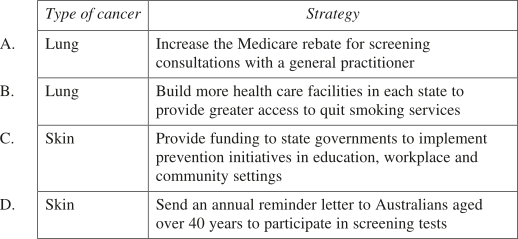
Which row of the table identifies the type of cancer represented in the graph and the most effective strategy for the federal government to implement in order to reduce its overall expenditure on this type of cancer by 2040?

Show Answers Only

\(C\)

Show Worked Solution
  • C is correct: Graph pattern matches skin cancer trends; prevention most cost-effective.

Other Options:

  • A is incorrect: Screening less effective than prevention for skin cancer.
  • B is incorrect: Pattern doesn’t match lung cancer epidemiology trends.
  • D is incorrect: Letters less effective than comprehensive prevention programs.

♦ Mean mark 55%.

Filed Under: Chronic Conditions, Diseases and Injury Tagged With: Band 5, smc-5477-10-Cancer trends, smc-5477-20-Protective factors

HMS, HAG 2021 HSC 13 MC

The chance of being alive for five years after being diagnosed with a condition, compared with the general population, is called the 5-year relative survival rate.

The table shows data for breast cancer and lung cancer in Australia, 2011-2015.

\begin{array} {|l|c|}
\hline
\rule{0pt}{2.5ex}\ \ \textit{Cancer}\ \ \rule[-1ex]{0pt}{0pt} & \textit{5-year relative survival rate}\\
\hline
\rule{0pt}{2.5ex}\text{Breast}\rule[-1ex]{0pt}{0pt} & \text{90.8%}\\
\hline
\rule{0pt}{2.5ex}\text{Lung}\rule[-1ex]{0pt}{0pt} & \text{17.4%}\\
\hline
\end{array}

Which of the following provides the most likely reason for the difference in these 5-year relative survival rates?

  1. Health promotion strategies in schools have been more effective in reducing risk factors for lung cancer compared to breast cancer.
  2. There was a higher hospitalisation rate and greater demand for emerging treatments for lung cancer compared to breast cancer.
  3. There was a higher demand for palliative care services when individuals were diagnosed with breast cancer compared to lung cancer.
  4. Technology advancements have increased early detection and provided more successful treatment options for breast cancer compared to lung cancer.
Show Answers Only

\(D\)

Show Worked Solution
  • D is correct: Early detection technology improves breast cancer survival rates.

Other Options:

  • A is incorrect: School strategies less effective for lung cancer.
  • B is incorrect: Higher demand doesn’t improve survival outcomes.
  • C is incorrect: Breast cancer has better prognosis requiring less palliative care.

Filed Under: Chronic Conditions, Diseases and Injury Tagged With: Band 2, smc-5477-10-Cancer trends

HMS, HAG 2021 HSC 2 MC

What type of cancer currently has the highest mortality rate in Australia?

  1. Breast
  2. Lung
  3. Prostate
  4. Skin
Show Answers Only

\(B\)

Show Worked Solution
  • B is correct: Lung cancer leads mortality rates across both sexes.

Other Options:

  • A is incorrect: High incidence but better survival rates.
  • C is incorrect: High incidence but lower mortality rates.
  • D is incorrect: Lower mortality despite high incidence rates.

Filed Under: Chronic Conditions, Diseases and Injury Tagged With: Band 4, smc-5477-10-Cancer trends

HMS, HAG 2022 HSC 20 MC

The table shows the incidence rate and mortality rate for two types of cancer \((X, Y)\) with the highest mortality rate for females in Australia in 2017.

\begin{array} {|c|c|c|}
\hline
\rule{0pt}{2.5ex}\textit{Type of cancer}\rule[-1ex]{0pt}{0pt} & \textit{Incidence rate} & \textit{Mortality rate} \\ & \textit{per 100 000} & \textit{per 100 000}\\
\hline
\rule{0pt}{2.5ex} X \rule[-1ex]{0pt}{0pt} & 36.2 & 21.8 \\
\hline
\rule{0pt}{2.5ex} Y \rule[-1ex]{0pt}{0pt} & 124.8 & 19.2 \\
\hline
\end{array}

Which statement best explains why cancer Y has a lower mortality rate than cancer X ?

  1. Government funding has increased for research into treatment options for cancer Y.
  2. Health services have been reoriented so that cancer Y is detected and treated earlier.
  3. Individuals have enhanced their personal skills to effectively address the modifiable risk factors for cancer Y.
  4. An increased number of out-patient health services for cancer Y has improved access for the priority population group.
Show Answers Only

\( B \)

Show Worked Solution

  • B is correct: Earlier detection and treatment improves survival rates despite higher incidence.

Other Options:

  • A is incorrect: Research funding doesn’t directly explain current mortality differences.
  • C is incorrect: Personal skills affect incidence, not mortality-to-incidence ratio.
  • D is incorrect: Outpatient services don’t explain lower mortality with higher incidence.

Filed Under: Chronic Conditions, Diseases and Injury Tagged With: Band 4, smc-5477-10-Cancer trends

HMS, HAG 2023 HSC 16 MC

Which row of the table correctly matches the type of cancer?

  Carcinoma Leukaemia
A.   Forms only on the skin Originates in bones and
connective tissues
B. Forms from cells that release
hormones into the blood
Develops in the body’s
infection-fighting organs
C. Forms in epithelial tissue Originates in the blood-forming
tissue of the bone marrow
D. Usually found in the
gastrointestinal system
Originates in plasma cells
Show Answers Only

\(C\)

Show Worked Solution
  • C is correct: Carcinomas develop in epithelial tissue and leukemia originates in blood-forming tissue of bone marrow.

Other Options:

  • A is incorrect: Carcinomas can form in many tissues, not just skin; leukemia doesn’t originate in bones/connective tissues.
  • B is incorrect: Hormone-releasing cells would be neuroendocrine tumors; infection-fighting organs relates to lymphoma.
  • D is incorrect: Gastrointestinal limitation is incorrect; plasma cells relate to multiple myeloma, not leukemia.

♦ Mean mark 54%.

Filed Under: Chronic Conditions, Diseases and Injury Tagged With: Band 5, smc-5477-10-Cancer trends

HMS, HAG 2024 HSC 14 MC

The graph shows the number of deaths of Australian females over time for TWO cancers, X and Y, that resulted in more deaths than for any other forms of cancer.

Which cancer is represented by cancer Y?

  1. Breast
  2. Cervical
  3. Lung
  4. Skin
Show Answers Only

\(C\)

Show Worked Solution
  • C is correct: Cancer Y represents lung cancer, a leading cause of cancer deaths in Australian females, with numbers declining since 2000.

Other Options:

  • A is incorrect: Breast cancer would likely show as the higher line (X).
  • B is incorrect: Cervical cancer has much lower mortality numbers.
  • D is incorrect: Skin cancer mortality is significantly lower than lung cancer.

♦♦♦ Mean mark 34%.

Filed Under: Chronic Conditions, Diseases and Injury Tagged With: Band 5, smc-5477-10-Cancer trends

HMS, HAG 2020 HSC 22

Complete the table for THREE current leading causes of mortality for males and females in Australia.   (4 marks)

--- 0 WORK AREA LINES (style=blank) ---

\begin{array}{|c|c|c|}
\hline
\rule{0pt}{2.5ex}\textit{Current leading} & \textit{Trend in mortality rate for} & \textit{Trend in mortality rate for}\\
\rule[-1ex]{0pt}{0pt}\quad \textit{cause of mortality} \quad & \textit{males over the last 10 years} & \textit{females over the last 10 years}\\
\hline
\quad & \quad &\quad\\
\hline
\quad & \quad &\quad\\
\hline
\quad & \quad &\quad\\
\hline
\end{array}

 
Show Answers Only

\(\text{Any THREE of the following}\)

\begin{array}{|l|c|c|}
\hline
\rule{0pt}{2.5ex}\quad \quad \textit{Current leading} & \textit{Trend in mortality} & \textit{Trend in mortality }\\
\quad \ \  \textit{cause of mortality} \quad & \textit{rates for males over} & \textit{rate for females }\\
\rule[-1ex]{0pt}{0pt}\quad \quad & \textit{the last 10 years} & \textit{over the last 10 years}\\
\hline
\rule{0pt}{2.5ex}\text{Coronary heart disease} \rule[-1ex]{0pt}{0pt}& \text{Decreased} & \text{Decreased} \\
\hline
\rule{0pt}{2.5ex}\text{Dementia and Alzheimer’s } & \text{Increased} & \text{Increased} \\
\rule[-1ex]{0pt}{0pt}\text{disease} & \text{} & \text{} \\
\hline
\rule{0pt}{2.5ex}\text{Cerebrovascular disease} \rule[-1ex]{0pt}{0pt}& \text{Decreased} & \text{Decreased} \\
\hline
\rule{0pt}{2.5ex}\text{Lung cancer} \rule[-1ex]{0pt}{0pt}& \text{Decreased} & \text{Decreased} \\
\hline
\rule{0pt}{2.5ex}\text{Chronic obstructive} & \text{Decreased} & \text{Decreased} \\
\rule[-1ex]{0pt}{0pt}\text{pulmonary disease} & \text{} & \text{} \\
\hline
\rule{0pt}{2.5ex}\text{Diabetes} \rule[-1ex]{0pt}{0pt}& \text{Increased} & \text{Increased} \\
\hline
\rule{0pt}{2.5ex}\text{Cardiovascular disease} \rule[-1ex]{0pt}{0pt}& \text{Decreased} & \text{Decreased} \\
\hline
\rule{0pt}{2.5ex}\text{Mental health (suicide)} \rule[-1ex]{0pt}{0pt}& \text{Increased} & \text{Increased} \\
\hline
\end{array}

Show Worked Solution

\(\text{Any THREE of the following}\)

\begin{array}{|l|c|c|}
\hline
\rule{0pt}{2.5ex}\quad \quad \textit{Current leading} & \textit{Trend in mortality} & \textit{Trend in mortality }\\
\quad \ \  \textit{cause of mortality} \quad & \textit{rates for males over} & \textit{rate for females }\\
\rule[-1ex]{0pt}{0pt}\quad \quad & \textit{the last 10 years} & \textit{over the last 10 years}\\
\hline
\rule{0pt}{2.5ex}\text{Coronary heart disease} \rule[-1ex]{0pt}{0pt}& \text{Decreased} & \text{Decreased} \\
\hline
\rule{0pt}{2.5ex}\text{Dementia and Alzheimer’s } & \text{Increased} & \text{Increased} \\
\rule[-1ex]{0pt}{0pt}\text{disease} & \text{} & \text{} \\
\hline
\rule{0pt}{2.5ex}\text{Cerebrovascular disease} \rule[-1ex]{0pt}{0pt}& \text{Decreased} & \text{Decreased} \\
\hline
\rule{0pt}{2.5ex}\text{Lung cancer} \rule[-1ex]{0pt}{0pt}& \text{Decreased} & \text{Decreased} \\
\hline
\rule{0pt}{2.5ex}\text{Chronic obstructive} & \text{Decreased} & \text{Decreased} \\
\rule[-1ex]{0pt}{0pt}\text{pulmonary disease} & \text{} & \text{} \\
\hline
\rule{0pt}{2.5ex}\text{Diabetes} \rule[-1ex]{0pt}{0pt}& \text{Increased} & \text{Increased} \\
\hline
\rule{0pt}{2.5ex}\text{Cardiovascular disease} \rule[-1ex]{0pt}{0pt}& \text{Decreased} & \text{Decreased} \\
\hline
\rule{0pt}{2.5ex}\text{Mental health (suicide)} \rule[-1ex]{0pt}{0pt}& \text{Increased} & \text{Increased} \\
\hline
\end{array}


♦♦ Mean mark 47%.

Filed Under: Chronic Conditions, Diseases and Injury, Current Health Status Tagged With: Band 5, smc-5474-05-Major causes, smc-5477-05-Cardiovascular disease, smc-5477-10-Cancer trends, smc-5477-15-Other conditions

Copyright © 2014–2025 SmarterEd.com.au · Log in