SmarterEd

Aussie Maths & Science Teachers: Save your time with SmarterEd

  • Login
  • Get Help
  • About

HMS, HAG NSE-Bank 19 MC

Consider the following statements.

Statement 1:     The federal, state and territory governments share responsibility for the
regulation of the health workforce and the regulation of pharmacies and
pharmaceuticals.
Statement 2: Medicare covers part of the Medicare Benefits Schedule (MBS) fee for
services and procedures for private patients in a public or private hospital.

  
Which of the following is correct?

  1. Both statements are true.
  2. Both statements are false.
  3. Statement 1 is false and statement 2 is true.
  4. Statement 1 is true and statement 2 is false.
Show Answers Only

A

Show Worked Solution
  • A is correct: Both statements accurately describe shared government responsibilities in Australia’s health system and Medicare coverage for private patients.
  • Statement 1 is true because federal, state and territory governments share responsibility for regulating the health workforce, pharmacies and pharmaceuticals.
  • Statement 2 is true because Medicare covers part of the MBS fee for eligible services provided to private patients in hospital.

Filed Under: Govt and Non-Govt responsibilities, Healthcare expenditure Tagged With: Band 5, smc-5480-05-Levels of Government, smc-5480-10-Government Relations, smc-5482-20-Medicare

HMS, HAG NSE-Bank 17 MC

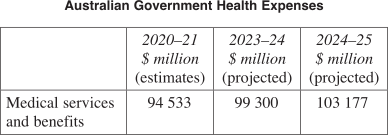
The table shows the Australian Government’s health expenses for 2020–21 and projected health expenses for 2023–25.
 

What could account for the projections shown?

  1. Decreased spending on Medicare, increased private health insurance uptake
  2. Decreased spending on Medicare, decreased private health insurance uptake
  3. Decreased spending on health promotion, increased private health insurance uptake
  4. Decreased spending on health promotion, decreased private health insurance uptake
Show Answers Only

D

Show Worked Solution
  • D is correct: Decreased spending on health promotion and decreased private health insurance uptake would both increase reliance on government-funded healthcare and therefore increase projected expenditure.

Other options:

  • A and C are incorrect: Increased private health insurance uptake would reduce reliance on government-funded healthcare.
  • B is incorrect: Decreased spending on Medicare would not account for an increase in projected government health expenditure.

Filed Under: Healthcare expenditure Tagged With: Band 4, smc-5482-20-Medicare, smc-5482-25-Private insurance

HMS, HAG 2025 HSC 5 MC

Which row of the table correctly identifies advantages of Medicare and private health
insurance?

\begin{align*}
\begin{array}{l}
\rule{0pt}{2.5ex} \ \rule[-1ex]{0pt}{0pt}& \\
\rule{0pt}{2.5ex} \rule[-1ex]{0pt}{0pt}\\
\rule{0pt}{2.5ex}\textbf{A.}\rule[-1ex]{0pt}{0pt}\\
 \rule[-1ex]{0pt}{0pt}\\
\rule{0pt}{2.5ex}\textbf{B.}\rule[-1ex]{0pt}{0pt}\\
\rule[-1ex]{0pt}{0pt}\\
\rule{0pt}{2.5ex}\textbf{C.}\rule[-1ex]{0pt}{0pt}\\
 \rule[-1ex]{0pt}{0pt}\\
\rule{0pt}{2.5ex}\textbf{D.}\rule[-1ex]{0pt}{0pt}\\
\rule[-1ex]{0pt}{0pt}\\
\end{array}
\begin{array}{|l|l|}
\hline
\rule{0pt}{2.5ex}Medicare\rule[-1ex]{0pt}{0pt}& Private \ health \ insurance \\
\hline
\rule{0pt}{2.5ex}\text{Covers all surgeries in hospitals}&\text{Shorter waiting times for}\\
\text{}\rule[-1ex]{0pt}{0pt}&\text{surgery }\\
\hline
\rule{0pt}{2.5ex}\text{Provides free access to all }\rule[-1ex]{0pt}{0pt}& \text{Ensures no out-of-pocket costs}\\
\text{healthcare services }& \text{for elective surgeries}\\
\hline
\rule{0pt}{2.5ex}\text{Bulk billing may be available in} & \text{Choice of surgeon } \\
\text{in medical practices} \\
\hline
\rule{0pt}{2.5ex}\text{Choice of doctor } & \text{Eliminates the need to access Medicare } \\
\text{}\rule[-1ex]{0pt}{0pt}& \text{Medicare } \\
\hline
\end{array}
\end{align*}

Show Answers Only

\(C\)

Show Worked Solution
  • C is correct: Bulk billing removes upfront costs at some practices; private insurance offers surgeon selection.

Other Options:

  • A is incorrect: Medicare covers public hospital treatment as public patient, not all surgeries universally.
  • B is incorrect: Medicare doesn’t provide free access to all services; private insurance has gap payments.
  • D is incorrect: Private insurance complements Medicare, doesn’t eliminate need for Medicare coverage.

Filed Under: Healthcare expenditure Tagged With: Band 4, smc-5482-20-Medicare, smc-5482-25-Private insurance

HMS, HAG EQ-Bank 187

Explain how Medicare contributes to equity in Australia's healthcare system.   (5 marks)

--- 15 WORK AREA LINES (style=lined) ---

Show Answers Only
  • Medicare provides universal access to healthcare regardless of income level because it operates as a taxpayer-funded system available to all Australians.
  • This occurs through the Medicare levy system where contributions are based on taxable income, ensuring higher earners contribute more while everyone receives the same basic healthcare coverage.
  • Medicare promotes equity because bulk billing allows patients to receive medical services without out-of-pocket costs, removing financial barriers that might prevent low-income Australians from accessing healthcare.
  • This system enables free public hospital treatment for all patients regardless of their financial circumstances, ensuring equal access to emergency and essential medical services.
  • As a result, Medicare creates a safety net that prevents healthcare becoming available only to those who can afford private treatment, maintaining social equity across different socioeconomic groups.
  • Therefore, the universal nature of Medicare ensures that healthcare access is not determined by wealth, contributing to fairer health outcomes for all Australians.
Show Worked Solution
  • Medicare provides universal access to healthcare regardless of income level because it operates as a taxpayer-funded system available to all Australians.
  • This occurs through the Medicare levy system where contributions are based on taxable income, ensuring higher earners contribute more while everyone receives the same basic healthcare coverage.
  • Medicare promotes equity because bulk billing allows patients to receive medical services without out-of-pocket costs, removing financial barriers that might prevent low-income Australians from accessing healthcare.
  • This system enables free public hospital treatment for all patients regardless of their financial circumstances, ensuring equal access to emergency and essential medical services.
  • As a result, Medicare creates a safety net that prevents healthcare becoming available only to those who can afford private treatment, maintaining social equity across different socioeconomic groups.
  • Therefore, the universal nature of Medicare ensures that healthcare access is not determined by wealth, contributing to fairer health outcomes for all Australians.

Filed Under: Healthcare expenditure Tagged With: Band 5, smc-5482-20-Medicare

HMS, HAG 2012 HSC 21

Describe the advantages of Medicare for Australian citizens.   (3 marks)

--- 9 WORK AREA LINES (style=lined) ---

Show Answers Only
  • Medicare is Australia’s universal healthcare system, ensuring equality of access for all Australian citizens regardless of income or circumstances.
  • It provides free or partially funded medical, optometrical and hospital care. Bulk billing removes out-of-pocket costs for GP visits, and treatment as a public patient in a public hospital is free.
  • Citizens keep the option of choosing private health care for other services, such as their own doctor or a private hospital, and Medicare still subsidises part of the fee.
Show Worked Solution
  • Medicare is Australia’s universal healthcare system, ensuring equality of access for all Australian citizens regardless of income or circumstances.
  • It provides free or partially funded medical, optometrical and hospital care. Bulk billing removes out-of-pocket costs for GP visits, and treatment as a public patient in a public hospital is free.
  • Citizens keep the option of choosing private health care for other services, such as their own doctor or a private hospital, and Medicare still subsidises part of the fee.

Filed Under: Healthcare expenditure Tagged With: Band 4, smc-5482-20-Medicare

HMS, HAG 2014 HSC 6 MC

How do Medicare and the Pharmaceutical Benefits Scheme support the principles of social justice?

  1. They are funded by the Australian government to supply health care services.
  2. They provide resources only to those most in need of health services and treatment.
  3. They allocate resources according to the needs of the population in order to promote equality of health outcomes.
  4. They empower individuals and communities to be involved in planning and decision making to achieve good health.
Show Answers Only

\(C\)

Show Worked Solution
  • C is correct: Medicare provides universal access for all while PBS concessions allocate additional support according to need, together promoting equality of health outcomes.

Other Options:

  • A is incorrect: Government funding alone doesn’t explain social justice principles.
  • B is incorrect: These schemes serve all Australians not just those most in need.
  • D is incorrect: Medicare/PBS don’t directly involve community planning participation.

Filed Under: Healthcare expenditure, Healthcare System effectiveness Tagged With: Band 4, smc-5479-10-Equity of Access, smc-5482-20-Medicare, smc-5482-30-Commonwealth programs

HMS, HAG 2015 HSC 21

What are the advantages to Australians of having a public health care system?   (3 marks)

--- 7 WORK AREA LINES (style=lined) ---

Show Answers Only
  • Australia’s public healthcare system provides universal access to essential medical services regardless of individual financial capacity. Medicare ensures all citizens receive subsidised general practitioner consultations, with many services available through bulk billing arrangements that eliminate patient costs entirely.
  • The Pharmaceutical Benefits Scheme reduces medication expenses significantly, making prescription drugs affordable for chronic condition management. Public hospitals deliver emergency care and essential surgical procedures without direct patient charges, ensuring life-saving treatments remain accessible.
  • This system promotes health equity by removing financial barriers that might prevent timely medical intervention, supporting better population health outcomes across all socioeconomic groups.
Show Worked Solution
  • Australia’s public healthcare system provides universal access to essential medical services regardless of individual financial capacity. Medicare ensures all citizens receive subsidised general practitioner consultations, with many services available through bulk billing arrangements that eliminate patient costs entirely.
  • The Pharmaceutical Benefits Scheme reduces medication expenses significantly, making prescription drugs affordable for chronic condition management. Public hospitals deliver emergency care and essential surgical procedures without direct patient charges, ensuring life-saving treatments remain accessible.
  • This system promotes health equity by removing financial barriers that might prevent timely medical intervention, supporting better population health outcomes across all socioeconomic groups.

Filed Under: Healthcare expenditure Tagged With: Band 3, smc-5482-20-Medicare

HMS, HAG 2017 HSC 31b

Assess the effectiveness of government funding aimed at improving the health status of Australians.   (12 marks)

--- 28 WORK AREA LINES (style=lined) ---

Show Answers Only

Assessment Statement

  • Government funding demonstrates highly effective outcomes in improving Australian health status through universal healthcare access, targeted support for disadvantaged groups, and evidence-based resource allocation.
  • Effectiveness varies across different health areas and population groups.

Healthcare Infrastructure and Universal Access

  • Medicare funding achieves excellent results in providing equitable healthcare access for all Australians regardless of socioeconomic status. The universal healthcare system ensures emergency treatment, specialist referrals, and prescription medications remain affordable for the entire population.
  • Evidence supporting effectiveness includes Australia’s high life expectancy rankings internationally and reduced mortality rates from treatable conditions.
  • However, significant gaps exist in mental health and dental care funding, creating ongoing health inequities despite substantial investment.

Targeted Funding for Disadvantaged Groups

  • Indigenous health funding demonstrates substantial progress through programs like Close the Gap, which specifically address health inequities experienced by Aboriginal and Torres Strait Islander peoples. Dedicated funding for Aboriginal Community Controlled Health Services provides culturally appropriate care and shows measurable improvements in immunisation rates and chronic disease management.
  • Aged care funding through programs like My Aged Care enables elderly Australians to remain in their homes longer, reducing hospital admission rates and improving quality of life.
  • Disability support funding via the NDIS produces significant outcomes by providing individualised support packages that address both health and social determinants.
  • This targeted approach demonstrates how funding allocation based on specific population needs creates sustainable health improvements rather than generic solutions.

Prevention and Health Promotion Principles

  • Preventative funding aligns with effective health promotion principles by addressing multiple determinants of health simultaneously. Immunisation programs exemplify the Ottawa Charter principle of developing personal skills while creating supportive environments through school-based delivery.
  • Cancer screening funding demonstrates the principle of reorienting health services from treatment to prevention, resulting in earlier detection and improved survival rates.
  • Tobacco control funding successfully applies multiple health promotion strategies including policy development through taxation, community action through quit campaigns, and creating supportive environments in workplaces.
  • This comprehensive approach produces measurable population health improvements with smoking rates declining from 24% to 11% over two decades.

Overall Assessment

  • Assessment reveals highly effective outcomes when funding addresses specific population needs and applies evidence-based health promotion principles.
  • The greatest success occurs where funding combines universal access with targeted support for disadvantaged groups, demonstrating optimal resource allocation strategies.
Show Worked Solution

Assessment Statement

  • Government funding demonstrates highly effective outcomes in improving Australian health status through universal healthcare access, targeted support for disadvantaged groups, and evidence-based resource allocation.
  • Effectiveness varies across different health areas and population groups.

Healthcare Infrastructure and Universal Access

  • Medicare funding achieves excellent results in providing equitable healthcare access for all Australians regardless of socioeconomic status. The universal healthcare system ensures emergency treatment, specialist referrals, and prescription medications remain affordable for the entire population.
  • Evidence supporting effectiveness includes Australia’s high life expectancy rankings internationally and reduced mortality rates from treatable conditions.
  • However, significant gaps exist in mental health and dental care funding, creating ongoing health inequities despite substantial investment.

Targeted Funding for Disadvantaged Groups

  • Indigenous health funding demonstrates substantial progress through programs like Close the Gap, which specifically address health inequities experienced by Aboriginal and Torres Strait Islander peoples. Dedicated funding for Aboriginal Community Controlled Health Services provides culturally appropriate care and shows measurable improvements in immunisation rates and chronic disease management.
  • Aged care funding through programs like My Aged Care enables elderly Australians to remain in their homes longer, reducing hospital admission rates and improving quality of life.
  • Disability support funding via the NDIS produces significant outcomes by providing individualised support packages that address both health and social determinants.
  • This targeted approach demonstrates how funding allocation based on specific population needs creates sustainable health improvements rather than generic solutions.

Prevention and Health Promotion Principles

  • Preventative funding aligns with effective health promotion principles by addressing multiple determinants of health simultaneously. Immunisation programs exemplify the Ottawa Charter principle of developing personal skills while creating supportive environments through school-based delivery.
  • Cancer screening funding demonstrates the principle of reorienting health services from treatment to prevention, resulting in earlier detection and improved survival rates.
  • Tobacco control funding successfully applies multiple health promotion strategies including policy development through taxation, community action through quit campaigns, and creating supportive environments in workplaces.
  • This comprehensive approach produces measurable population health improvements with smoking rates declining from 24% to 11% over two decades.

Overall Assessment

  • Assessment reveals highly effective outcomes when funding addresses specific population needs and applies evidence-based health promotion principles.
  • The greatest success occurs where funding combines universal access with targeted support for disadvantaged groups, demonstrating optimal resource allocation strategies.

♦♦♦ Mean mark 44%.

Filed Under: Healthcare expenditure Tagged With: Band 5, smc-5482-10-Healthcare vs Prevention, smc-5482-20-Medicare, smc-5482-30-Commonwealth programs

HMS, HAG 2017 HSC 14 MC

How does Medicare reflect the principles of social justice?

  1. It provides resources only to those most in need of health services and treatment.
  2. It is funded by the Australian government to supply equality in health care services to all Australians.
  3. It allocates resources according to the needs of the population in order to promote equity of health outcomes.
  4. It empowers individuals and communities to be involved in planning and decision making to achieve good health.
Show Answers Only

\(B\)

Show Worked Solution

  • B is correct: Medicare is government-funded to provide equal healthcare access to all Australians.

Other Options:

  • A is incorrect: Medicare provides universal access, not just for those most in need.
  • C is incorrect: Medicare provides equal access rather than resource allocation based on need.
  • D is incorrect: Medicare is a funding system, not a community empowerment program.

Filed Under: Healthcare expenditure Tagged With: Band 4, smc-5482-20-Medicare

HMS, HAG 2018 HSC 10 MC

Which of the following best describes Medicare?

  1. It is funded by taxpayers and covers the cost of ambulance services.
  2. It is funded by private contributions and covers the cost of physiotherapy.
  3. It is funded by insurance premiums and covers the cost of private hospitals.
  4. It is funded by a levy and subsidises the cost of visits to general practitioners.
Show Answers Only

\(D\)

Show Worked Solution

  • D is correct: Medicare is funded by a levy and subsidises GP visits through bulk billing.

Other Options:

  • A is incorrect: Ambulance services are typically state-funded, not covered by Medicare.
  • B is incorrect: Medicare is government-funded through levy, not private contributions.
  • C is incorrect: Private health insurance covers private hospitals, not Medicare.

Filed Under: Healthcare expenditure Tagged With: Band 2, smc-5482-20-Medicare

HMS, HAG 2023 HSC 10 MC

Which of the following incentives was introduced by the Australian Government to encourage individuals to take out private health insurance?

  1. Entitlement to a mental health treatment plan
  2. Guaranteed 50% rebate on all ancillary services
  3. Free admission for treatment in private hospitals
  4. Exemption from paying the Medicare levy surcharge
Show Answers Only

\(D\)

Show Worked Solution
  • D is correct: Medicare levy surcharge exemption introduced as a financial incentive to encourage private health insurance uptake.

Other Options:

  • A is incorrect: Mental health treatment plans are available through Medicare, not linked to private insurance.
  • B is incorrect: No guarantee of 50% rebate on all ancillary services exists.
  • C is incorrect: Private hospitals still charge for admission despite insurance.

♦♦ Mean mark 45%.

Filed Under: Healthcare expenditure Tagged With: Band 5, smc-5482-20-Medicare, smc-5482-25-Private insurance

HMS, HAG EQ-Bank 1 MC

A low-income family had multiple medical appointments with specialists over a three-month period, resulting in high out-of-pocket expenses. After reaching a certain threshold, their out-of-pocket medical costs were significantly reduced for the remainder of the calendar year.

Which of the following enabled this reduction in medical costs?

  1. Medicare Safety Net
  2. Private health insurance
  3. Health care concession card
  4. Bulk billing incentive
Show Answers Only

\(A\)

Show Worked Solution
  • A is correct: Medicare Safety Net reduces costs after reaching annual threshold.

Other Options:

  • B is incorrect: Private insurance doesn’t use annual threshold system.
  • C is incorrect: Concession cards provide discounts not threshold-based reductions.
  • D is incorrect: Bulk billing eliminates gaps not threshold-based cost reduction.

Filed Under: Healthcare expenditure Tagged With: Band 4, smc-5482-20-Medicare

Copyright © 2014–2026 SmarterEd.com.au · Log in