SmarterEd

Aussie Maths & Science Teachers: Save your time with SmarterEd

  • Login
  • Get Help
  • About

HMS, HAG 2025 HSC 11 MC

A doctor prescribes chemotherapy for a patient diagnosed with cancer.

Which of the following is an example of a complementary health care approach that the doctor could suggest as part of the treatment plan for this patient?

  1. Use surgery instead of chemotherapy
  2. Use surgery alongside chemotherapy
  3. Use acupuncture instead of chemotherapy
  4. Use acupuncture alongside chemotherapy
Show Answers Only

\(D\)

Show Worked Solution
  • D is correct: Complementary approaches work alongside conventional treatments; acupuncture supplements chemotherapy for symptom management

Other Options:

  • A is incorrect: “Instead of” indicates alternative therapy replacement, not complementary approach alongside treatment
  • B is incorrect: Surgery is conventional medical treatment, not complementary healthcare approach
  • C is incorrect: Using acupuncture “instead of” replaces conventional treatment rather than complementing it

Filed Under: Complementary Healthcare Tagged With: Band 4, smc-5489-30-Treating Health Issues, smc-5489-40-Alternative Treatments

HMS, HAG EQ-Bank 202

Assess the effectiveness of complementary healthcare approaches when used as supplements to conventional medical treatments.   (8 marks)

--- 25 WORK AREA LINES (style=lined) ---

Show Answers Only

Judgment Statement

  • Complementary healthcare approaches demonstrate highly effective outcomes when used as supplements to conventional medical treatments, particularly for chronic conditions and patient wellbeing.

Patient Outcomes and Recovery

  • Assessment reveals significant improvements in patient outcomes when complementary approaches supplement conventional treatments.
  • Research demonstrates that patients using acupuncture alongside pain medications experience greater pain relief and reduced medication dependence.
  • Cancer patients receiving naturopathy support during chemotherapy show improved immune function and faster recovery times.
  • Mind-body practices like meditation and yoga effectively reduce anxiety and depression in patients with chronic illnesses when combined with pharmaceutical treatments.
  • Evidence shows that massage therapy enhances physiotherapy effectiveness by improving circulation and reducing muscle tension.
  • This demonstrates strong effectiveness because supplementary approaches address multiple aspects of healing that conventional medicine alone cannot achieve.

Cost-Effectiveness and System Integration

  • Complementary approaches show excellent value when supplementing conventional care through reduced healthcare costs and improved treatment efficiency.
  • Studies indicate that patients using integrated treatment plans require fewer hospital admissions and demonstrate better long-term health outcomes.
  • Healthcare systems benefit from reduced pharmaceutical costs when complementary approaches effectively manage symptoms and side effects.
  • However, some limitations exist regarding standardisation and training requirements for practitioners across different complementary disciplines.

Overall Assessment

  • The evidence indicates that complementary approaches are highly effective supplements to conventional treatments.
  • They produce measurable improvements in patient outcomes while supporting sustainable healthcare delivery.
Show Worked Solution

Judgment Statement

  • Complementary healthcare approaches demonstrate highly effective outcomes when used as supplements to conventional medical treatments, particularly for chronic conditions and patient wellbeing.

Patient Outcomes and Recovery

  • Assessment reveals significant improvements in patient outcomes when complementary approaches supplement conventional treatments.
  • Research demonstrates that patients using acupuncture alongside pain medications experience greater pain relief and reduced medication dependence.
  • Cancer patients receiving naturopathy support during chemotherapy show improved immune function and faster recovery times.
  • Mind-body practices like meditation and yoga effectively reduce anxiety and depression in patients with chronic illnesses when combined with pharmaceutical treatments.
  • Evidence shows that massage therapy enhances physiotherapy effectiveness by improving circulation and reducing muscle tension.
  • This demonstrates strong effectiveness because supplementary approaches address multiple aspects of healing that conventional medicine alone cannot achieve.

Cost-Effectiveness and System Integration

  • Complementary approaches show excellent value when supplementing conventional care through reduced healthcare costs and improved treatment efficiency.
  • Studies indicate that patients using integrated treatment plans require fewer hospital admissions and demonstrate better long-term health outcomes.
  • Healthcare systems benefit from reduced pharmaceutical costs when complementary approaches effectively manage symptoms and side effects.
  • However, some limitations exist regarding standardisation and training requirements for practitioners across different complementary disciplines.

Overall Assessment

  • The evidence indicates that complementary approaches are highly effective supplements to conventional treatments.
  • They produce measurable improvements in patient outcomes while supporting sustainable healthcare delivery.

Filed Under: Complementary Healthcare Tagged With: Band 6, smc-5489-30-Treating Health Issues

HMS, HAG EQ-Bank 201

Describe how complementary healthcare approaches work as supplements to conventional treatments for chronic conditions.   (4 marks)

--- 12 WORK AREA LINES (style=lined) ---

Show Answers Only
  • Complementary approaches supplement chronic condition management by addressing symptoms and underlying causes that conventional medicine may not fully treat.
  • Naturopathy works alongside pharmaceutical treatments by focusing on lifestyle changes, nutrition and herbal medicines to support overall health.
  • Acupuncture complements pain management medications by providing additional relief for chronic pain without increasing pharmaceutical dependence.
  • Mind-body practices like meditation and yoga supplement mental health treatments by reducing stress and improving emotional wellbeing.
  • Massage therapy supports conventional physiotherapy by enhancing circulation, reducing muscle tension and promoting relaxation during recovery.
  • These approaches create holistic treatment plans that enhance conventional care effectiveness while addressing patient needs traditional medicine cannot meet.
Show Worked Solution
  • Complementary approaches supplement chronic condition management by addressing symptoms and underlying causes that conventional medicine may not fully treat.
  • Naturopathy works alongside pharmaceutical treatments by focusing on lifestyle changes, nutrition and herbal medicines to support overall health.
  • Acupuncture complements pain management medications by providing additional relief for chronic pain without increasing pharmaceutical dependence.
  • Mind-body practices like meditation and yoga supplement mental health treatments by reducing stress and improving emotional wellbeing.
  • Massage therapy supports conventional physiotherapy by enhancing circulation, reducing muscle tension and promoting relaxation during recovery.
  • These approaches create holistic treatment plans that enhance conventional care effectiveness while addressing patient needs traditional medicine cannot meet.

Filed Under: Complementary Healthcare Tagged With: Band 4, smc-5489-30-Treating Health Issues

HMS, HAG EQ-Bank 200

Outline how complementary healthcare approaches can be used as supplements to conventional medical treatments.   (3 marks)

--- 9 WORK AREA LINES (style=lined) ---

Show Answers Only
  • Complementary approaches support conventional treatments by managing side effects from medications and medical procedures without interfering with primary care.
  • Acupuncture and massage therapy supplement cancer treatments by reducing nausea, pain and anxiety during chemotherapy and radiation therapy.
  • Naturopathy and herbal medicines complement pharmaceutical treatments by supporting immune system function and promoting faster recovery times.
  • Mind-body therapies like meditation and yoga supplement mental health treatments by reducing stress and improving emotional wellbeing.
  • Nutritional therapy complements conventional care by optimising dietary intake to support healing and enhance treatment effectiveness.
Show Worked Solution
  • Complementary approaches support conventional treatments by managing side effects from medications and medical procedures without interfering with primary care.
  • Acupuncture and massage therapy supplement cancer treatments by reducing nausea, pain and anxiety during chemotherapy and radiation therapy.
  • Naturopathy and herbal medicines complement pharmaceutical treatments by supporting immune system function and promoting faster recovery times.
  • Mind-body therapies like meditation and yoga supplement mental health treatments by reducing stress and improving emotional wellbeing.
  • Nutritional therapy complements conventional care by optimising dietary intake to support healing and enhance treatment effectiveness.

Filed Under: Complementary Healthcare Tagged With: Band 3, smc-5489-30-Treating Health Issues

HMS, HAG EQ-Bank 197

Justify the use of integrative health approaches in Australia's healthcare system.   (6 marks)

--- 18 WORK AREA LINES (style=lined) ---

Show Answers Only

Position Statement

  • Integrative health approaches should be adopted in Australia’s healthcare system because they provide comprehensive patient care and improve outcomes.

Patient-Centred Care

  • Evidence demonstrates that integrative approaches address the whole person rather than just treating symptoms.
  • Patients receiving combined conventional and complementary treatments report higher satisfaction and better quality of life.
  • Research shows integrative care reduces anxiety, manages chronic pain effectively and supports faster recovery.
  • This supports the position because patient wellbeing improves when multiple therapeutic approaches address physical, mental and emotional health needs.

Cost-Effectiveness and System Benefits

  • Integrative approaches reduce long-term healthcare costs by preventing complications and reducing hospital readmissions.
  • Complementary therapies like acupuncture decrease reliance on expensive medications and invasive procedures.
  • Many integrative treatments focus on prevention and lifestyle modification, reducing chronic disease burden.
  • This justifies adoption because integrative approaches offer sustainable solutions benefiting patients and the healthcare system through improved efficiency.

Reinforcement

  • While critics question evidence for certain therapies, research supports integrative approaches when properly regulated.
  • The position remains valid because integrative health represents personalised, holistic healthcare addressing Australia’s need for sustainable treatment.
Show Worked Solution

Position Statement

  • Integrative health approaches should be adopted in Australia’s healthcare system because they provide comprehensive patient care and improve outcomes.

Patient-Centred Care

  • Evidence demonstrates that integrative approaches address the whole person rather than just treating symptoms.
  • Patients receiving combined conventional and complementary treatments report higher satisfaction and better quality of life.
  • Research shows integrative care reduces anxiety, manages chronic pain effectively and supports faster recovery.
  • This supports the position because patient wellbeing improves when multiple therapeutic approaches address physical, mental and emotional health needs.

Cost-Effectiveness and System Benefits

  • Integrative approaches reduce long-term healthcare costs by preventing complications and reducing hospital readmissions.
  • Complementary therapies like acupuncture decrease reliance on expensive medications and invasive procedures.
  • Many integrative treatments focus on prevention and lifestyle modification, reducing chronic disease burden.
  • This justifies adoption because integrative approaches offer sustainable solutions benefiting patients and the healthcare system through improved efficiency.

Reinforcement

  • While critics question evidence for certain therapies, research supports integrative approaches when properly regulated.
  • The position remains valid because integrative health represents personalised, holistic healthcare addressing Australia’s need for sustainable treatment.

Filed Under: Complementary Healthcare Tagged With: Band 5, smc-5489-30-Treating Health Issues

HMS, HAG EQ-Bank 196

How can integrative health approaches be combined with conventional medicine to improve patient outcomes?   (4 marks)

--- 12 WORK AREA LINES (style=lined) ---

Show Answers Only
  • Integrative health combines conventional treatments with complementary therapies to address both physical symptoms and overall patient wellbeing.
  • This works by doctors prescribing standard medications while incorporating acupuncture or naturopathy to manage side effects and enhance healing.
  • The process occurs through healthcare teams including medical practitioners and complementary therapists working together on comprehensive treatment plans.
  • This functions by using conventional medicine for primary treatment while complementary therapies support recovery and improve quality of life.
  • The mechanism involves patients receiving evidence-based care combined with holistic approaches that address mental and emotional health aspects.
  • This enables personalised healthcare because patients respond better when various approaches are used together rather than separately.
Show Worked Solution
  • Integrative health combines conventional treatments with complementary therapies to address both physical symptoms and overall patient wellbeing.
  • This works by doctors prescribing standard medications while incorporating acupuncture or naturopathy to manage side effects and enhance healing.
  • The process occurs through healthcare teams including medical practitioners and complementary therapists working together on comprehensive treatment plans.
  • This functions by using conventional medicine for primary treatment while complementary therapies support recovery and improve quality of life.
  • The mechanism involves patients receiving evidence-based care combined with holistic approaches that address mental and emotional health aspects.
  • This enables personalised healthcare because patients respond better when various approaches are used together rather than separately.

Filed Under: Complementary Healthcare Tagged With: Band 4, smc-5489-30-Treating Health Issues

HMS, HAG EQ-Bank 65 MC

A cancer patient undergoes conventional chemotherapy treatment whilst also consulting a naturopath to develop a holistic treatment plan combining pharmaceutical and herbal medicines. This scenario demonstrates complementary healthcare functioning as:

  1. A complete replacement for conventional medical oncology treatment
  2. An emergency intervention when conventional treatments fail completely
  3. A supplementary approach enhancing overall patient recovery alongside conventional treatment
  4. A primary treatment method taking precedence over pharmaceutical interventions
Show Answers Only

\(C\)

Show Worked Solution
  • C is correct: Naturopathy supplements conventional chemotherapy to enhance overall patient recovery.

Other Options:

  • A is incorrect: Scenario shows complementary use alongside, not replacement of conventional treatment.
  • B is incorrect: Supplementary use occurs during treatment, not as emergency backup option.
  • D is incorrect: Complementary approach supports rather than takes precedence over conventional treatment.

Filed Under: Complementary Healthcare Tagged With: Band 4, smc-5489-30-Treating Health Issues

HMS, HAG EQ-Bank 64 MC

Traditional Aboriginal healing methods have been successfully integrated into some mainstream healthcare settings, resulting in improved Indigenous client engagement. Which principle BEST explains why this integrative approach can be effective?

  1. Traditional methods completely replace conventional medical treatments for Indigenous patients
  2. Cultural familiarity increases patient comfort and willingness to engage with healthcare services
  3. Indigenous healing practices are scientifically superior to conventional medical treatments
  4. Integration reduces healthcare costs by eliminating the need for qualified medical practitioners
Show Answers Only

\(B\)

Show Worked Solution
  • B is correct: Cultural familiarity increases patient comfort and willingness to engage with healthcare services.

Other Options:

  • A is incorrect: Integration combines approaches rather than replacing conventional treatments entirely.
  • C is incorrect: Integration focuses on cultural acceptance rather than claims of superiority.
  • D is incorrect: Integration adds services rather than removing qualified medical practitioners.

Filed Under: Complementary Healthcare Tagged With: Band 3, smc-5489-30-Treating Health Issues

HMS, HAG EQ-Bank 63 MC

The World Health Organisation supports countries in developing national policies on complementary medicine to study their potential usefulness. What does this international recognition indicate about integrative healthcare approaches?

  1. All complementary medicines have been scientifically proven effective for treating diseases
  2. Complementary approaches require systematic evaluation within established healthcare frameworks
  3. Traditional medicine should completely replace conventional medical treatments globally
  4. Alternative healing methods need no regulation or professional standards
Show Answers Only

\(B\)

Show Worked Solution
  • B is correct: WHO support indicates need for systematic evaluation within established healthcare frameworks.

Other Options:

  • A is incorrect: WHO support for study indicates ongoing evaluation needed, not proven effectiveness.
  • C is incorrect: Integration involves combining approaches, not replacing conventional medicine entirely.
  • D is incorrect: WHO policy development suggests regulation and standards are important.

Filed Under: Complementary Healthcare Tagged With: Band 5, smc-5489-30-Treating Health Issues

HMS, HAG EQ-Bank 62 MC

Traditional western medicine practitioners are increasingly recognising the value of complementary healthcare approaches. Which statement describes this integrative trend?

  1. Conventional doctors are completely replacing traditional medicine with alternative treatments
  2. Medical practitioners are incorporating selected complementary approaches alongside conventional treatments
  3. Alternative medicine practitioners are abandoning their traditional methods for western approaches
  4. Healthcare systems are eliminating all conventional treatments in favour of complementary medicine
Show Answers Only

\(B\)

Show Worked Solution
  • B is correct: Medical practitioners incorporating complementary approaches demonstrates integrative healthcare development.

Other Options:

  • A is incorrect: Integration involves combining approaches, not complete replacement of conventional medicine.
  • C is incorrect: Alternative practitioners maintain their methods while working within integrated systems.
  • D is incorrect: Integration combines both approaches rather than eliminating conventional treatments.

Filed Under: Complementary Healthcare Tagged With: Band 4, smc-5489-30-Treating Health Issues

HMS, HAG 2015 HSC 7 MC

Meditation techniques are used by some patients while undergoing chemotherapy for cancer.

What type of approach to treatment is this?

  1. Diversionary
  2. Pain management
  3. Alternative health care
  4. Complementary health care
Show Answers Only

\(D\)

Show Worked Solution
  • D is correct: Meditation alongside chemotherapy represents complementary healthcare approach.

Other Options:

  • A is incorrect: Diversionary is not a recognised healthcare treatment category.
  • B is incorrect: Too narrow, meditation has broader benefits than pain.
  • C is incorrect: Alternative replaces conventional treatment, this supplements it.

♦♦♦♦ Mean mark 34%.

Filed Under: Complementary Healthcare Tagged With: Band 5, smc-5489-30-Treating Health Issues, smc-5489-40-Alternative Treatments

HMS, HAG 2016 HSC 21

Using examples, describe the difference between alternative health therapies and complementary health therapies.   (5 marks)

--- 15 WORK AREA LINES (style=lined) ---

Show Answers Only

Complementary health therapies

  • Such approaches are used alongside conventional medical treatments to enhance overall patient care. They work together with mainstream medicine to support healing and wellbeing.
  • Complementary therapies supplement standard medical care rather than replacing it entirely.
  • For example, a cancer patient might receive chemotherapy from their oncologist whilst also using acupuncture to manage treatment side effects. Massage therapy can complement physiotherapy treatment for muscle injuries. Meditation might be used alongside antidepressant medication for mental health conditions.

Alternative health therapies

  • These therapies are used instead of conventional medical treatments as the primary healthcare approach. They replace mainstream medical interventions completely rather than supporting them.
  • Patients choose alternative approaches as their sole treatment method for health conditions.
  • For example, someone might choose herbal remedies instead of prescribed antibiotics for infections. A person might select homeopathic treatments rather than conventional surgery for medical conditions. Naturopathic approaches might replace pharmaceutical medications entirely.

Key difference

  • The key difference is in how these therapies interact with conventional medicine.
  • Complementary approaches enhance traditional treatment whilst alternative approaches replace conventional care completely.

Show Worked Solution

Complementary health therapies

  • Such approaches are used alongside conventional medical treatments to enhance overall patient care. They work together with mainstream medicine to support healing and wellbeing.
  • Complementary therapies supplement standard medical care rather than replacing it entirely.
  • For example, a cancer patient might receive chemotherapy from their oncologist whilst also using acupuncture to manage treatment side effects. Massage therapy can complement physiotherapy treatment for muscle injuries. Meditation might be used alongside antidepressant medication for mental health conditions.

Alternative health therapies

  • These therapies are used instead of conventional medical treatments as the primary healthcare approach. They replace mainstream medical interventions completely rather than supporting them.
  • Patients choose alternative approaches as their sole treatment method for health conditions.
  • For example, someone might choose herbal remedies instead of prescribed antibiotics for infections. A person might select homeopathic treatments rather than conventional surgery for medical conditions. Naturopathic approaches might replace pharmaceutical medications entirely.

Key difference

  • The key difference is in how these therapies interact with conventional medicine.
  • Complementary approaches enhance traditional treatment whilst alternative approaches replace conventional care completely.

♦♦ Mean mark 48%.

Filed Under: Complementary Healthcare Tagged With: Band 5, smc-5489-30-Treating Health Issues, smc-5489-40-Alternative Treatments

HMS, HAG 2022 HSC 19 MC

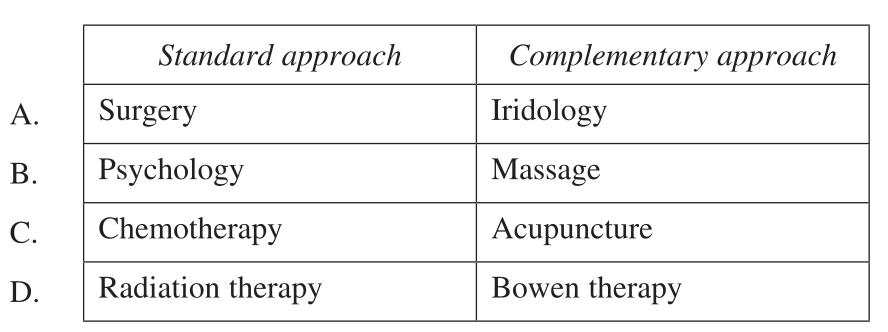
Which row in the table shows the most effective combination of health care approaches for men being treated for the current leading cause of cancer deaths in Australia?

Show Answers Only

\( C \)

Show Worked Solution
  • C is correct: Chemotherapy is standard treatment for lung cancer; acupuncture helps manage side effects.

Other Options:

  • A is incorrect: Surgery not always primary treatment; iridology lacks evidence base.
  • B is incorrect: Psychology not primary treatment for cancer itself.
  • D is incorrect: Radiation therapy less common as primary treatment for lung cancer.

♦♦ Mean mark 46%.

Filed Under: Complementary Healthcare Tagged With: Band 5, smc-5489-30-Treating Health Issues

Copyright © 2014–2026 SmarterEd.com.au · Log in